What to expect
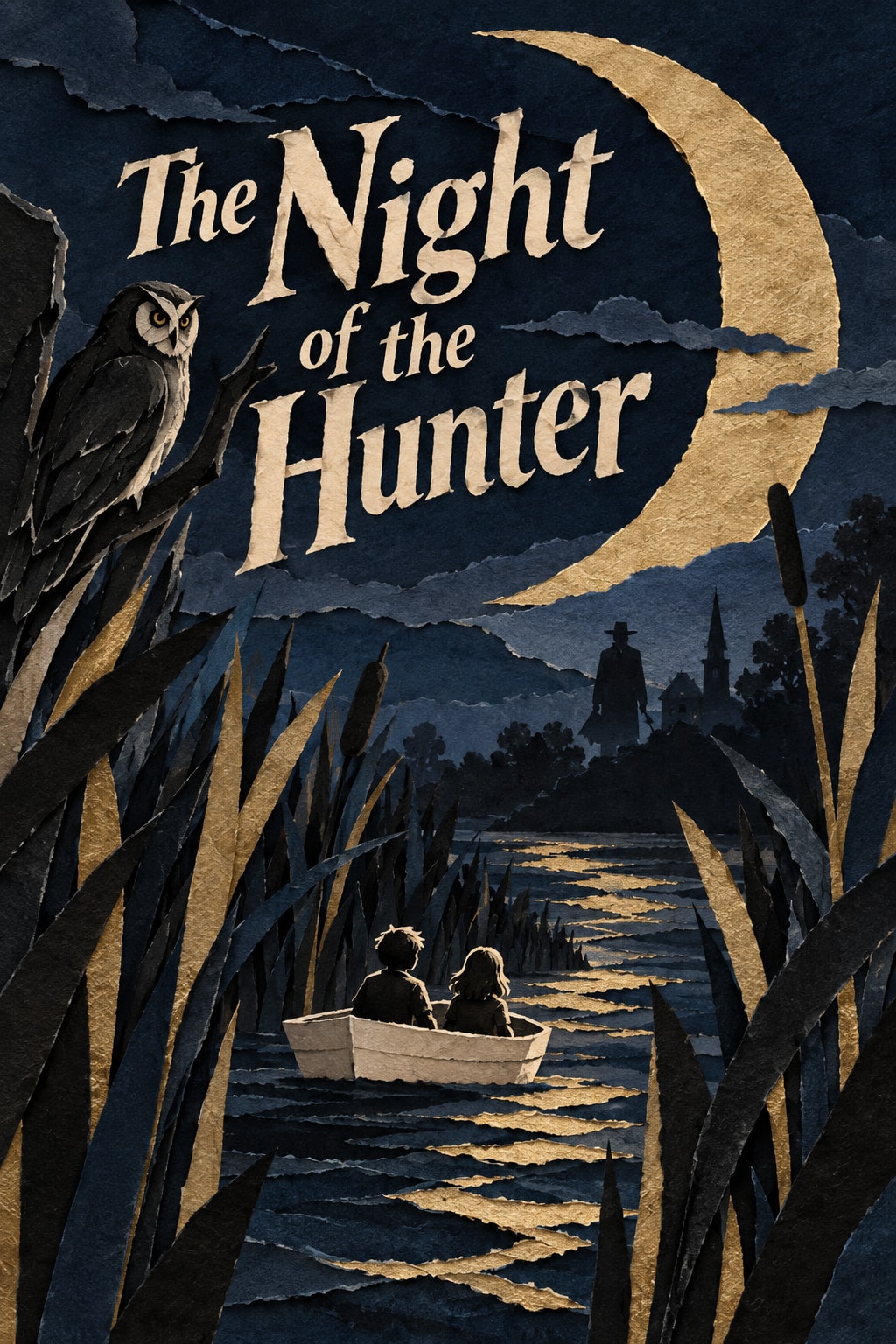
The Night of the Hunter is singular American Gothic: part crime story, fairy tale, religious nightmare, and child’s-eye odyssey. Robert Mitchum’s false preacher Harry Powell turns hymns and scripture into instruments of pursuit, while Charles Laughton and cinematographer Stanley Cortez shape houses, riverbanks, and night skies into stark symbolic spaces. The children’s flight shifts the film away from adult realism toward an eerie protective dream. Initially unsuccessful, it became enormously influential because its stylization makes evil both theatrically obvious and socially persuasive.
How to ease in
Accept the abrupt changes in tone: menace, humour, expressionist design, and storybook calm all belong to the children’s unstable world. The film is less interested in realistic police procedure than in how danger appears to a child. Listen for the repeated hymn, which can signal threat or resistance depending on who carries it.
Heads-up
A repeated song changes force when another voice takes it up.
Open the note ↓ Close the note ↑
Powell uses a hymn to announce himself, but the film eventually lets another voice answer. That matters to me. The children cannot defeat his performance by arguing with it; they survive by reaching a different kind of authority, one grounded in shelter, patience, and watchfulness.
— Momo
- Peter Rainer describes Rachel joining Powell’s song while guarding the children with a rifle; AFI records her sheltering and defending them. AFI Catalog — The Night of the Hunter (1955); Peter Rainer — The Night of the Hunter (Library of Congress)

Credits & versions
- Cast
- Robert Mitchum · Shelley Winters — Willa · Lillian Gish
- Screenplay
- James Agee
- Production
- Paul Gregory
- Cinematography
- Stanley Cortez
Version map
Ways to watch and read
| Action | Search destination |
|---|---|
| Watch | Check availability on JustWatch |
| Rent | Search rentals on Apple TV |
| Read | Search books on Bookshop.org |
U.S. search destinations · Links checked 2026-07-27 · Stock, editions, prices, and availability can change · Disclosure
Where to go next
Want a gentler, shorter, or stranger next film? Ask Momo for something like this →
Momo is on shift. Visit Momo Cinema →