What to watch next
10 Classic Historical and Costume Dramas to Watch
Choose a historical or costume drama: compare ten classics by setting, mood and length, from Joan of Arc and Seven Samurai to The Leopard and Amadeus.
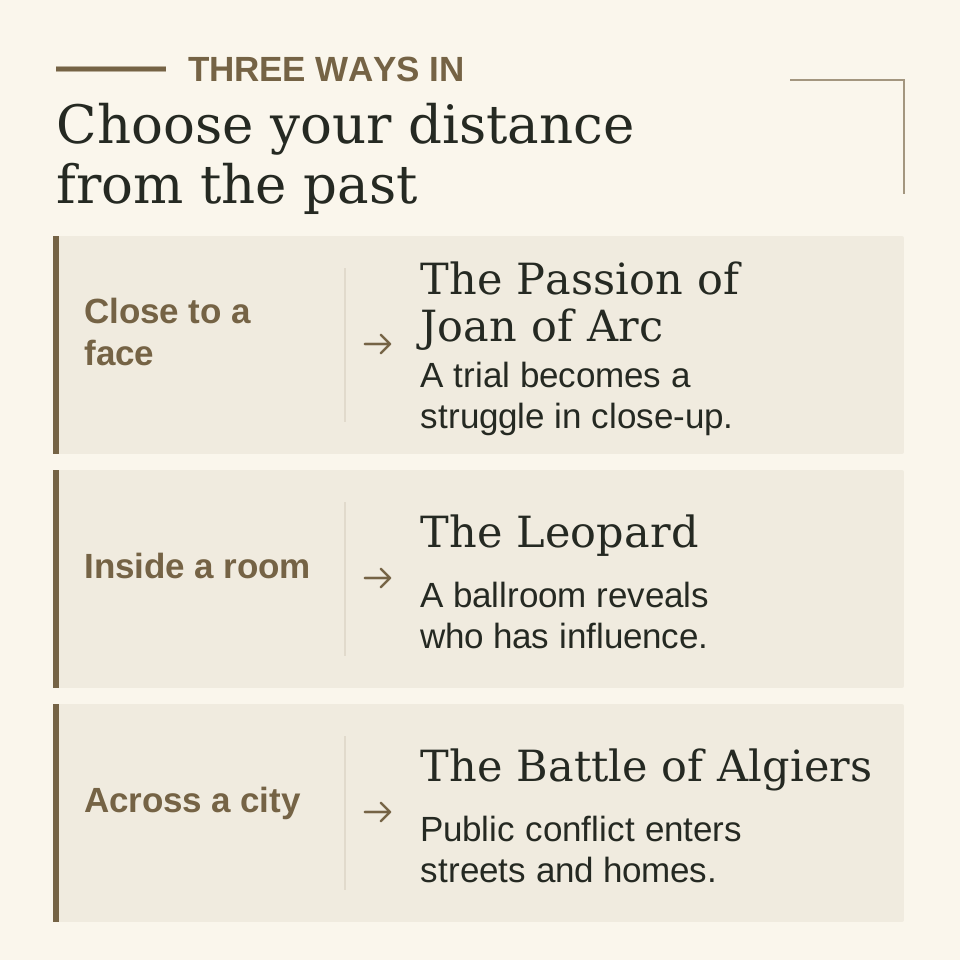
Choose La Grande Illusion for people finding connections across wartime divisions, The Leopard for a whole social order revealed at a ball, or The Battle of Algiers for the pressure of a city fighting over its future. The past becomes interesting on screen when it changes what people can do: whom they may marry, whose orders they must obey, whether their work or their lives matter to those in power.
These ten classics, released between 1928 and 1989, bring together historical dramas and costume dramas. Some stage documented people and events; others invent lives within an earlier society. Barry Lyndon follows a fictional social climber; Glory dramatises a real regiment while inventing its principal Black soldiers.
Compare the historical and costume dramas
| Film | Setting and approach | Time to allow | Before choosing |
|---|---|---|---|
| The Passion of Joan of Arc (1928) | A concentrated dramatisation of the 1431 trial | 81 min at 24 fps | Silent; interrogation and execution |
| La Grande Illusion (1937) | Fictional prisoners during the First World War | 114 min, Criterion edition | Multiple languages; captivity and loss |
| Seven Samurai (1954) | A fictional village in sixteenth-century Japan | 207 min | Sustained combat and deaths |
| Lawrence of Arabia (1962) | A dramatised T. E. Lawrence in the Arab Revolt | 222 min, BFI catalogue | War violence and imperial politics |
| The Leopard (1963) | A fictional aristocratic family during Italian unification | 185 min, Italian version | Deliberate pace and a long ballroom sequence |
| The Battle of Algiers (1966) | A staged reconstruction of anti-colonial struggle | 121 min | Bombings, torture and civilian deaths |
| Andrei Rublev (1966) | Imagined episodes around a medieval painter | 183 min, director-preferred cut | Graphic violence and distressing animal scenes |
| Barry Lyndon (1975) | Fictional ambition in eighteenth-century Europe | 185 min | Emotional cruelty, duels and bereavement |
| Amadeus (1984) | A fictional rivalry built around Mozart and Salieri | About 160 min, theatrical cut | Sexual humour, illness and death |
| Glory (1989) | The 54th Massachusetts Infantry, through dramatised lives | 122 min | Racist abuse, flogging and bloody combat |
Edition details matter particularly for Joan of Arc, The Leopard, Andrei Rublev and Amadeus. The timings above follow the records linked below. Allow extra time for a break during the longer films.
The Passion of Joan of Arc (1928): history at the distance of a face
Dreyer does not begin with a battlefield and work towards the trial. He brings us close to a young woman being questioned by men who control the room, the procedure and the terms of an acceptable answer. Renée Falconetti’s face, the judges’ expressions and the disorienting spaces between them make authority something you can feel in the image.
The film draws on the trial record but compresses its events, as BFI’s account of Dreyer explains. Choose it for intensity rather than a broad biography of Joan. Criterion provides an 81-minute presentation at 24 frames per second and an alternative at 20; check the speed and accompanying score when choosing a copy. Our film page provides a further starting point.
Next: Andrei Rublev for faith and art within a much wider landscape.
La Grande Illusion (1937): the border is not always where you expect
A French officer and a German commandant may recognise the same social codes more readily than the French officer and a fellow prisoner. Food, language, manners and entertainment continually redraw the lines between people. Renoir lets the effort of living together compete with the institutions that have made them enemies.
These fictional prisoners give Renoir room for a humane ensemble drama with suspense inside it. Small courtesies matter, but they do not abolish class differences or the consequences of captivity. Its antiwar feeling grows through attention to particular people. Criterion. Our La Grande Illusion page extends the introduction.
Next: The Leopard for another society whose inherited codes are losing their power.
Seven Samurai (1954): defending a place requires learning it
Before the fighting, there is hiring, persuasion, observation and planning. We learn where the village’s approaches lie, how its people behave, and why the warriors and farmers do not automatically trust one another. That patient groundwork makes action readable: a threat arrives somewhere whose importance we already understand.
Kurosawa’s fictional sixteenth-century community gives the film more to consider than professional heroism. A meal, a harvest and a family’s fear can matter as much as a sword. Choose it for a long, involving group story with formidable action and a clear sense of its human cost. Criterion. The Seven Samurai film page is a useful companion once the characters begin to multiply.
Next: La Grande Illusion for collective survival in a more confined space.
Lawrence of Arabia (1962): spectacle built around an unstable hero
A distant figure takes time to emerge from the desert. The wait makes the landscape more than a backdrop: distance controls knowledge, arrival and danger. David Lean repeatedly sets an intensely charismatic individual against spaces and political forces that exceed him.
This is a dramatised interpretation of T. E. Lawrence and the Arab Revolt during the First World War, shaped around his contradictions. Choose it for epic scale and a central performance that becomes harder to read as the story develops. Its concentration on Lawrence also shapes which participants receive the fullest interior lives. Give it an evening and the largest practical screen: people can become very small within the image. BFI.
Next: The Battle of Algiers for a colonial conflict organised around a city and its population.
The Leopard (1963): a ballroom contains a political change
The Prince of Salina can read a room: who is newly confident, whose money matters, which marriage would be useful, and which familiar gestures have become ceremonial. Luchino Visconti gives those observations time. The famous ball is not a decorative pause in the history; it is one of the places where the transfer of influence becomes visible.
The prince and his family come from Lampedusa’s novel, set amid Sicily’s involvement in Italian unification. Choose this for social detail, atmosphere and the melancholy of recognising that one’s world will continue without one’s authority. Burt Lancaster makes exhaustion as expressive as command. Begin with the 185-minute Italian version documented by Criterion; the same edition also includes the shorter 161-minute American version with Lancaster’s own English voice.
Next: Barry Lyndon for the view of aristocracy from somebody trying to enter it.
The Battle of Algiers (1966): a city under pressure
The streets, crowds and faces can make Pontecorvo’s film resemble news footage. They are part of a staged historical reconstruction. The distinction makes its achievement more interesting: editing, casting and location work create the immediacy of events being witnessed while carefully directing our attention.
Choose it for political drama in which actions pass through a whole urban system. A checkpoint changes a journey; a bombing makes ordinary customers visible as potential victims; repression turns private spaces into places of fear. Its reconstruction of the Algerian struggle against French colonial rule is unsparing about violence against civilians and torture. Criterion. The film page offers another route into its people and setting.
Next: Glory for a different historical drama about people fighting while being denied equal standing.
Andrei Rublev (1966): making something in a brutal world
Mud, rain, unfinished buildings and the labour of casting a bell make the past feel resistant to human wishes. Tarkovsky follows a painter through episodes in medieval Russia, but the artist is often watching other people struggle. The question of making an image grows inseparable from what it means to witness suffering.
Rublev was real; the film’s episodic life story is largely imagined, as Criterion’s historical essay makes clear. Choose it for a demanding, tactile meditation on art and belief, with passages of severe violence. Criterion distinguishes the director-preferred 183-minute cut from the earlier 205-minute The Passion According to Andrei. The shorter version is the starting point here, not an accidentally incomplete copy.
Next: The Passion of Joan of Arc for conviction tested in a concentrated encounter with authority.
Barry Lyndon (1975): how to enter a painting and remain an outsider
Kubrick’s rooms and landscapes can look composed beyond improvement. Inside them, Barry misreads situations, seizes opportunities and tries to convert possession into belonging. The distance between the splendour of a room and the pettiness of its occupants gives the film much of its bitter humour.
Barry is a fictional protagonist adapted from Thackeray, travelling through eighteenth-century war and high society. Choose the film if you enjoy watching ambition unfold through rituals: introductions, card games, courtship, meals and duels. A measured pace does not mean that little is happening; a small breach of etiquette can rearrange a life. The emotional damage eventually reaches beyond the social satire. Criterion.
Next: The Leopard to see inherited status from the other side of the threshold.
Amadeus (1984): genius heard by the person who resents it
Salieri can recognise what makes Mozart’s music extraordinary. That is the source of his suffering and our route into the score. A phrase can acquire dramatic force because the listener understands it immediately, while also wishing that somebody else had written it.
Choose Miloš Forman’s film for a lively, darkly comic costume drama about artistic jealousy. Its Mozart–Salieri plot is Peter Shaffer’s dramatic invention, not evidence that Salieri murdered Mozart; the Mozarteum Foundation discusses the legend’s history. For a first viewing, the restored theatrical cut makes an effective starting point: BFI’s 2025 presentation lists 161 minutes. Check the edition rather than assuming every listing refers to the same cut.
Next: Andrei Rublev for an artist’s predicament approached through silence, work and belief.
Glory (1989): the uniform does not make its wearers equal
The 54th Massachusetts Infantry has to confront racism within the army it serves as well as danger from the enemy. Training, pay, equipment and relationships among the men give military participation its everyday political meaning. The dramatic force comes from people insisting on their standing while institutions repeatedly diminish it.
Edward Zwick builds that story around both historical and invented figures. Robert Gould Shaw and the regiment were real; the principal Black soldiers played by Denzel Washington, Morgan Freeman, André Braugher and Jihmi Kennedy are fictional, a consequential choice examined by the National Park Service. Pick the film for its performances and questions of recognition, while leaving room to learn the actual soldiers’ names afterwards. Combat, flogging and racist abuse are forceful parts of the viewing experience.
Next: La Grande Illusion for another examination of divisions that uniforms cannot fully explain.
Choose the scale of the story
One person under pressure: Joan of Arc is the shortest and most concentrated choice. Amadeus provides a more expansive, verbally lively approach to a person’s sense of importance. Neither requires prior specialist knowledge to follow its central conflict.
A society in a room: try La Grande Illusion, The Leopard or Barry Lyndon. Watch who may speak casually, who must ask, and who is expected to serve. The past becomes legible through behaviour rather than a stream of dates.
A community and its survival: Seven Samurai, The Battle of Algiers and Glory make collective life central, though they take very different approaches to history. Their action matters because of the people who must live with its consequences.
For uncertain listings, our restoration and remastering guide explains why an improved transfer and a different cut are separate questions.
Momo’s Note: A grand house can tell you who owned the land. Watch the person waiting by its door, and you may learn who was allowed to enter.
On screen
Films discussed
- The Passion of Joan of Arc (1928) · Carl Theodor Dreyer
- La Grande Illusion (1937) · Jean Renoir
- Seven Samurai (1954) · Akira Kurosawa
- Lawrence of Arabia (1962) · David Lean
- The Leopard (1963) · Luchino Visconti
- The Battle of Algiers (1966) · Gillo Pontecorvo
- Andrei Rublev (1966) · Andrei Tarkovsky
- Barry Lyndon (1975) · Stanley Kubrick
- Amadeus (1984) · Miloš Forman
- Glory (1989) · Edward Zwick
Continue exploring on Monocurator
Further reading
Read next in the Journal
Want a recommendation shaped around your evening? Ask Momo what to watch next →