Bring a film into the classroom

Free film worksheets
& lesson plans.

A gesture to read. A machine to question. An argument to take apart.

Choose what you want students to explore. Each lesson includes printable student sheets, teacher notes with sample reasoning, and an editable Word file.

English-language materials · Free to print and adapt · No sign-up

Each plan contains 45 minutes of activity. Allow time for watching and replaying scenes separately; 12 Angry Men is designed for a class that has already seen the film.

01Visual storytelling

The Kid 1921

Suggested ages 8–12 Two selected scenes

What could you tell in four shots?

Follow the plan behind a broken-window joke, then notice how the Tramp cares for a baby. Students connect visible actions before making a story of their own.

Have ready
Have the window routine and baby-care scene ready. The lesson page links to both clips on Chaplin’s official site. A whole-film screening is optional.
Students make
A four-shot storyboard: a problem, a choice, an action and a change. A partner reads it back; the creator revises one shot.
Get The Kid: worksheet & notes

2 student pages · 2 teacher pages · 4-page Word file
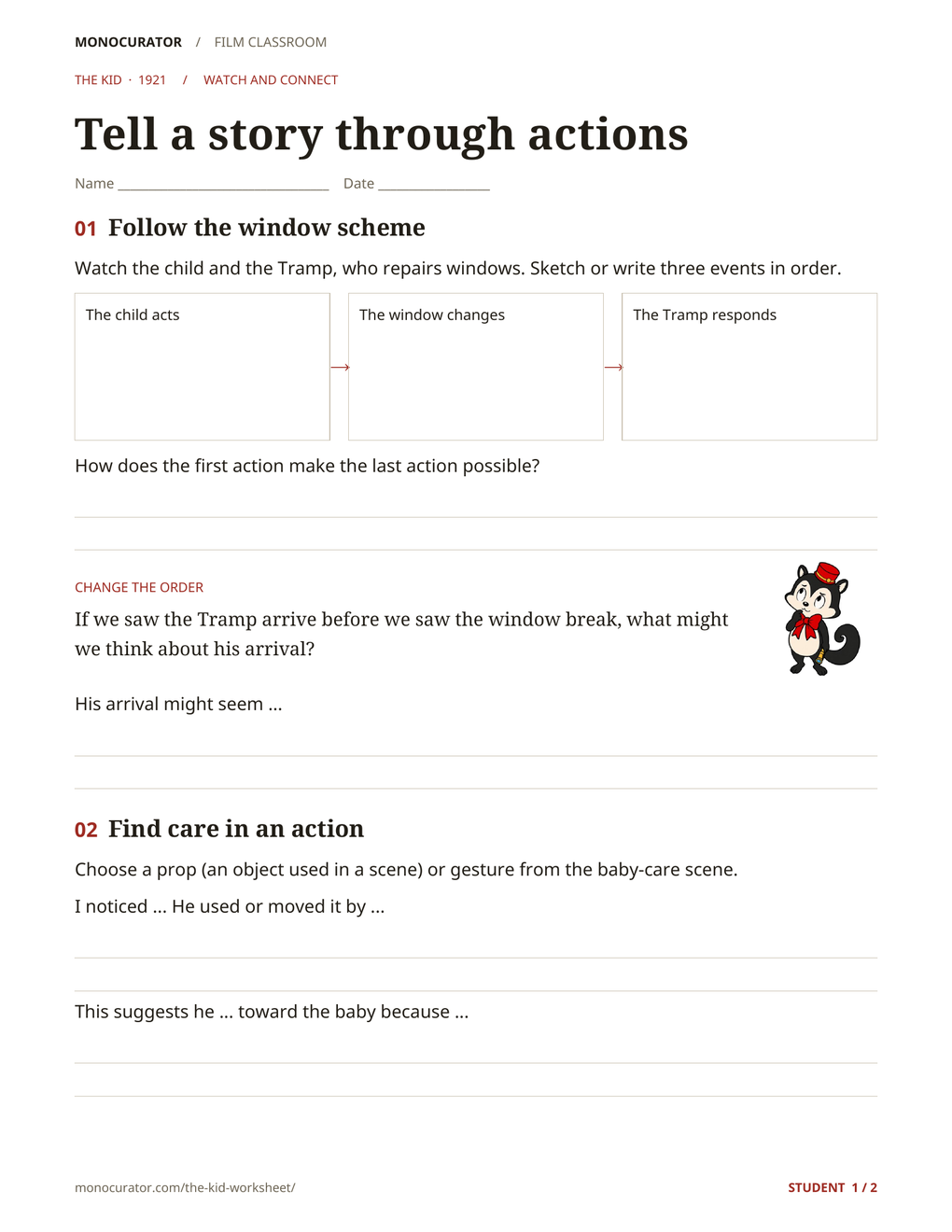
The Kid student worksheet: sequence an action, explain a connection and observe a relationship, with Momo beside a question
Inside the pack Student page 1

02Work, bodies & comic movement

Modern Times 1936

Suggested ages 12–16 Two selected sequences

Faster for whom?

A conveyor sets the pace. A machine promises to shorten lunch. Students follow the movement, compare a promise with its consequences, and consider the person caught in the design.

Have ready
Cue the assembly-line routine and the feeding-machine demonstration in your classroom copy. The core activity works with these sequences; the full film is optional.
Students make
Scene observations and a sketched or written redesign, supported by a detail from the film and an explanation of what the change would cost or leave unresolved.
Get Modern Times: worksheet & notes

2 student pages · 2 teacher pages · 4-page Word file
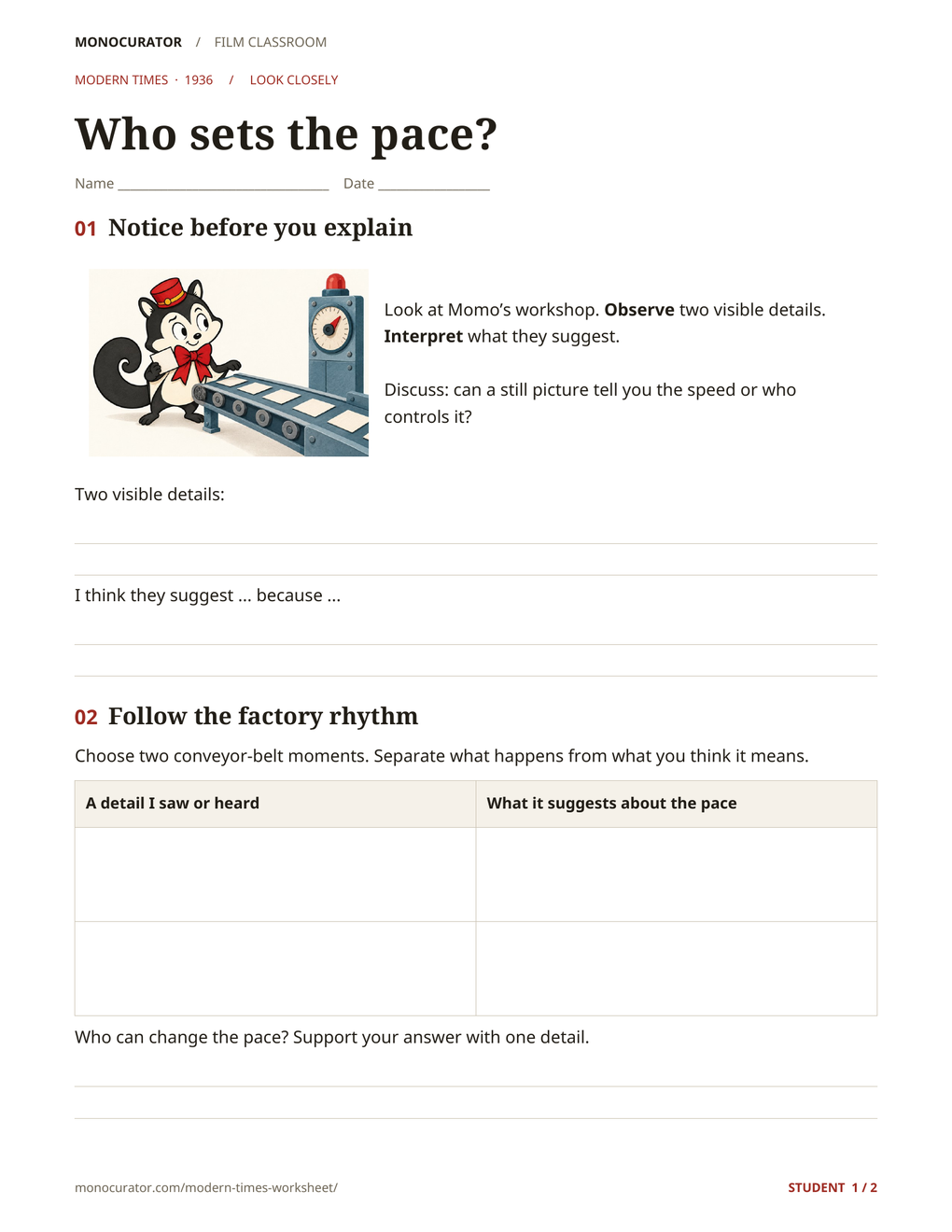
Modern Times student worksheet with Momo’s workshop illustration, an observation task and spaces to follow the assembly line
Inside the pack Student page 1

03Evidence, inference & discussion

12 Angry Men 1957

Discussion after viewing Prior film viewing

What does the evidence actually show?

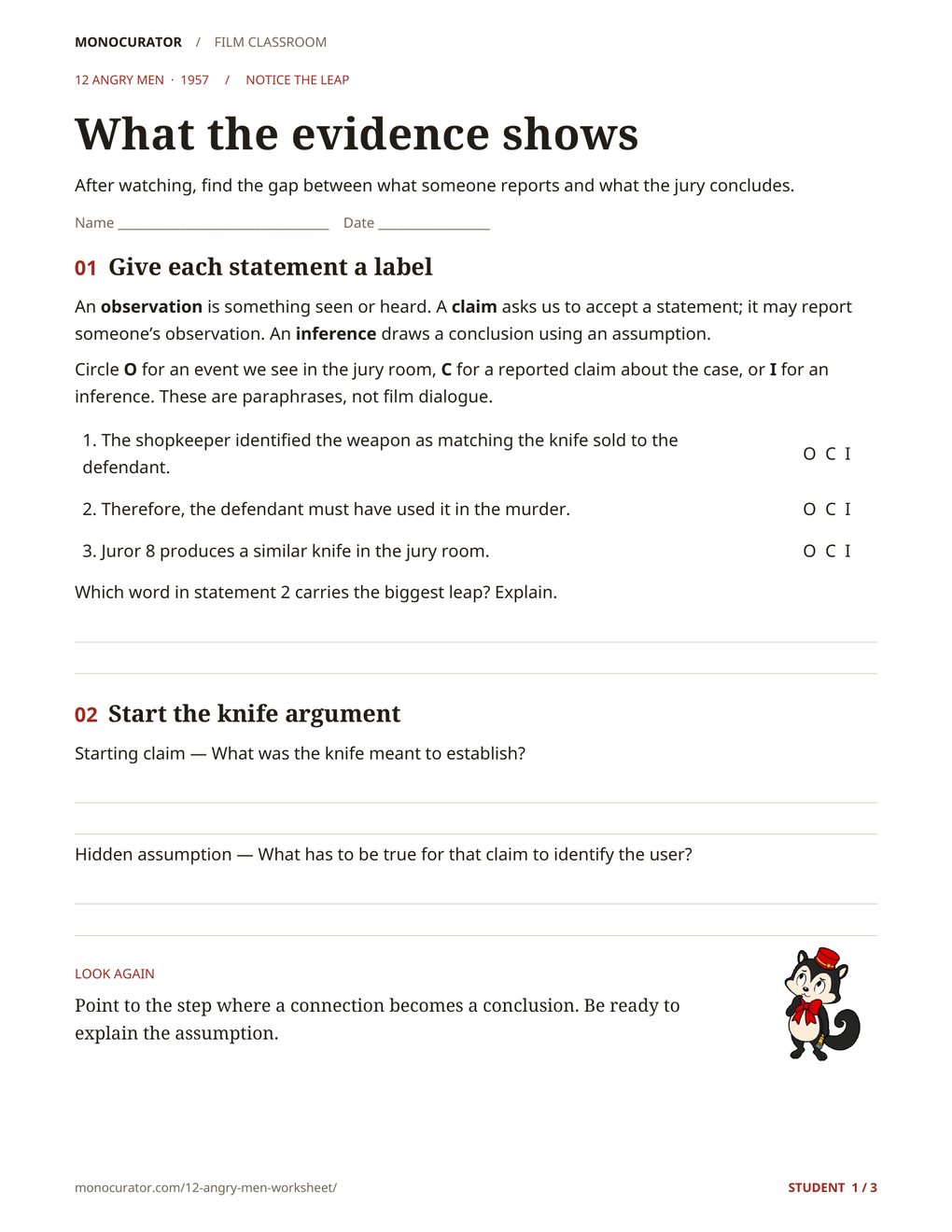
Separate what someone reports, what the jurors observe and what they infer. Students reconstruct the knife and eyesight arguments, then test the assumptions that hold them together.

Have ready
Use after watching the film. Have viewing notes ready, and cue the knife and glasses discussions if you want to revisit them. The worksheets include the verdict.
Students make
An evidence trail, a tested alternative explanation and a short response distinguishing a reason for doubt from proof of innocence.
Get 12 Angry Men: worksheet & notes

3 student pages · 2 teacher pages · 5-page Word file

12 Angry Men student worksheet with statement sorting, an evidence and inference exercise and a Momo prompt
Inside the pack Student page 1

One more thing to make

Give the same picture
a different story.

Sketch someone waiting beside a closed door. Write two title cards: “At last, she had found the right room.” and “She hoped nobody was home.”

Show the picture with each card. Ask a partner what they expect to happen next, then change one phrase to shift that expectation again.

Make a silent-film title card

Free browser tool · Save your words as a PNG

She hoped
nobody was home.

Before the class

Ready to use.
Easy to make your own.

Start with the teacher notes. They provide the lesson sequence, scene cues and examples of reasoning. The individual lesson pages explain what to watch and link to the sources behind the scene notes.

Print or edit. The student PDFs have writing and drawing space, with Momo alongside the activities. Use “Fit to page” for A4 or US Letter, or adapt the questions and space in Word. Keep the source references with adapted copies.

Choose the viewing material. The downloads contain our teaching materials; arrange the film or clips separately. Preview the selected scenes for your class and use their actions as cues, since timings can differ between editions.

Ready to try editing? Use our free archive footage and shot-order exercise. Students arrange four extracts in two ways and compare their readings, with a one-page worksheet to record their choices.