See Films Differently Momo Notices
Bertillon’s Mugshots: Why the Filing System Mattered
How Bertillon combined measurements, photographs and classified records, and what identification can establish, with a detour to The Wrong Man.
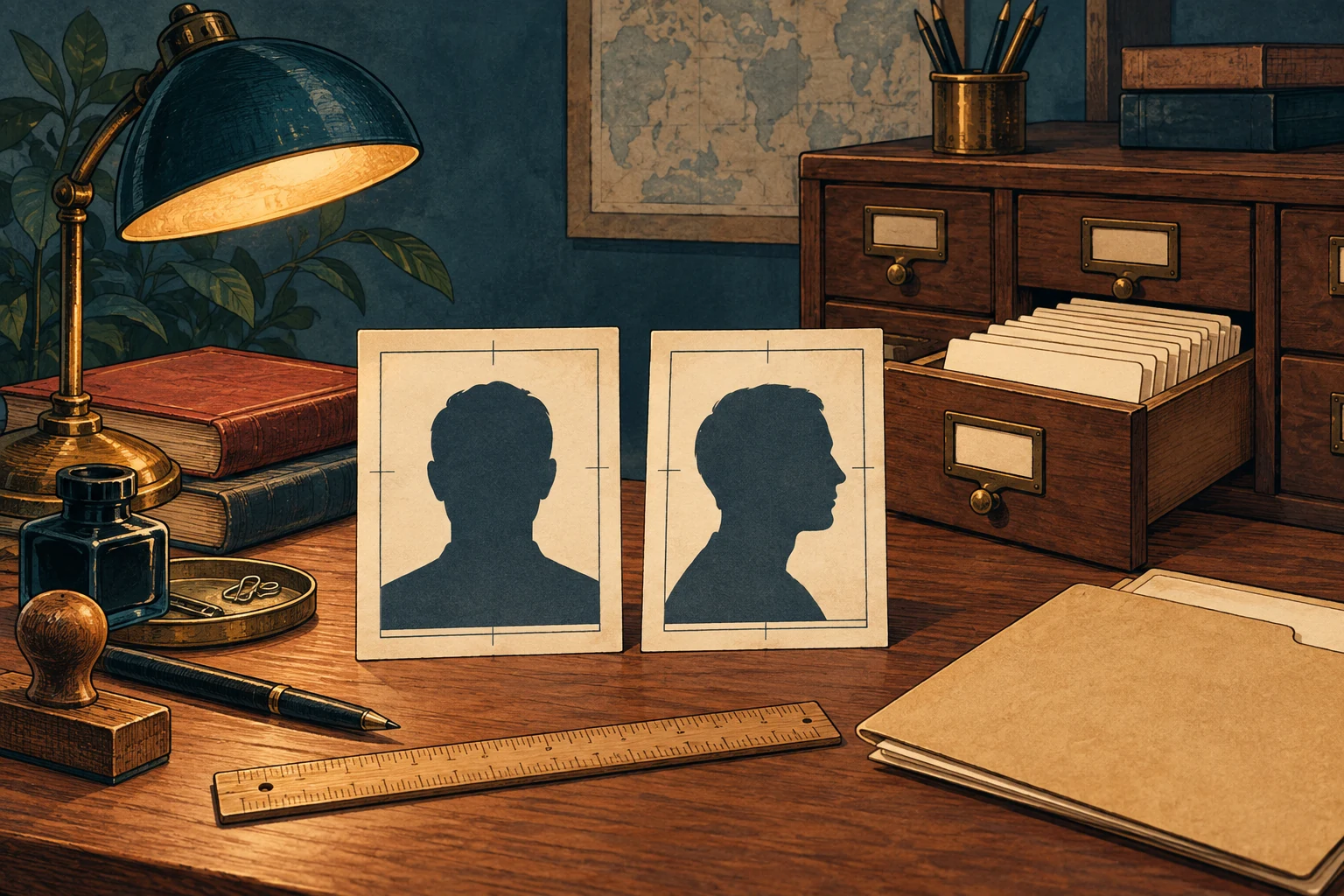
Two views of a face, a set of measurements and the difficult business of deciding what a record establishes.
Suppose the police arrest somebody who gives a name they haven’t recorded before. There may be an older record under another name. A photograph could help confirm it—once somebody has found the right photograph.
That last bit is the awkward one. A roomful of portraits is a collection; it still needs a way of being searched.
Alphonse Bertillon, who joined the Paris police as a clerk in 1879, developed a system combining body measurements, descriptions and standardised photographs. [1] The familiar full-face and profile portraits belonged to a larger machinery of identification. I’d keep an eye on the filing cabinet as well as the camera.
Make one record comparable with another
Bertillon’s system is usually called bertillonage. Anthropometry means measuring the body: his procedures included head dimensions, fingers, feet and forearms. A surviving teaching photograph at the Metropolitan Museum of Art shows him demonstrating the measurement of the left middle finger. The museum describes specially designed instruments and precisely prescribed positions for both the person measured and the operator. [2]
Those instructions mattered because another officer might later measure the same person. A number obtained by a different method could send the search towards the wrong records.
Photography required similar discipline. In the 1896 English edition of his Signaletic Instructions, Bertillon prescribes full-face and profile views, uniform pose and a fixed reduction in scale. He also insists on photographing the person bareheaded. [3]
You’re trying to make two records comparable, perhaps taken years apart. A flattering angle would be a rather unhelpful contribution.
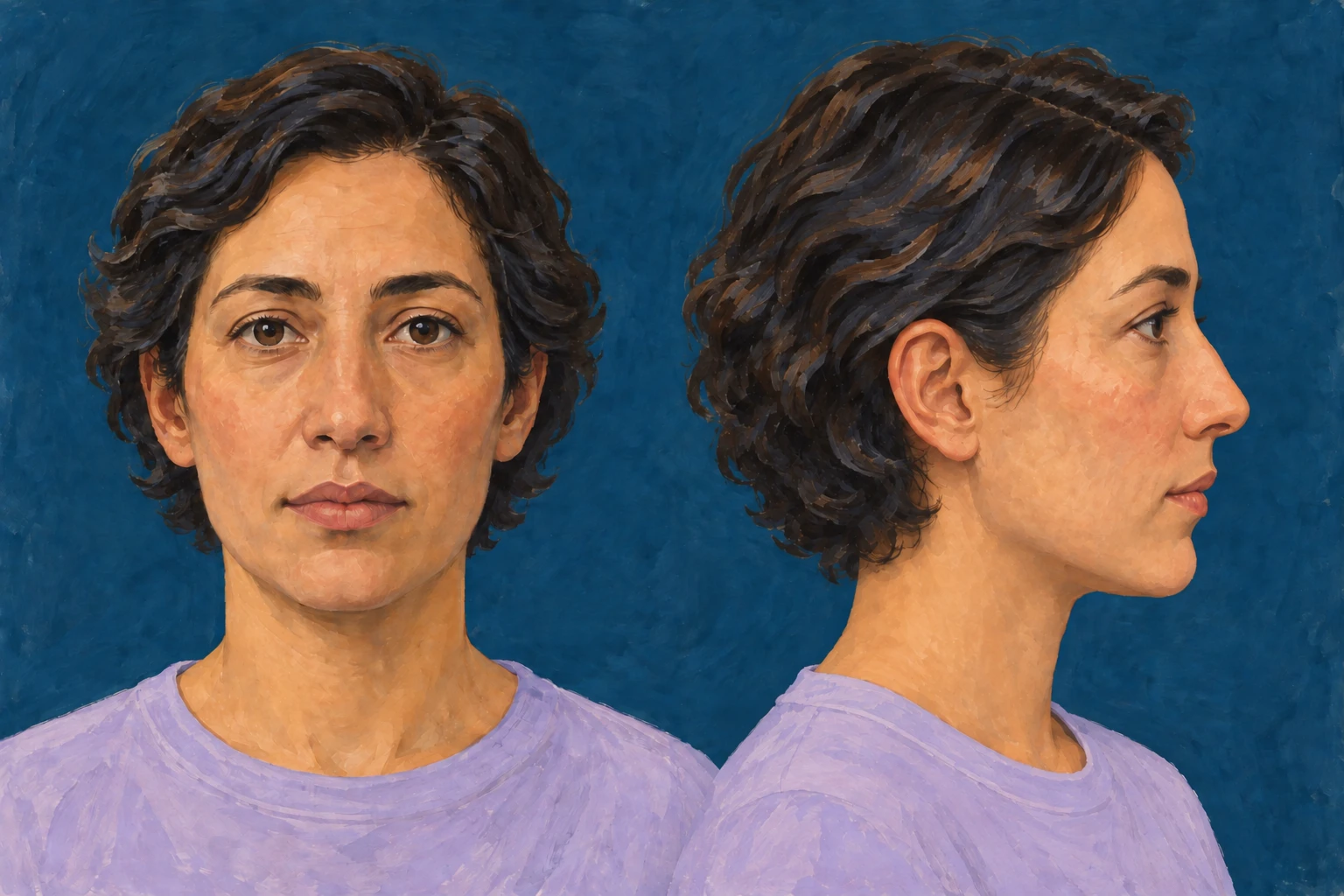
Which box should the clerk open?
The manual makes the search surprisingly concrete.
In its account of the Paris collection, adult men’s records are first divided by head length: short, medium or long. Each division is subdivided by head width, then by middle-finger length, foot length and forearm length. Further divisions narrow the packets again. Women and younger males have separate arrangements. [3]
The clerk can follow that sequence using the newly taken measurements, instead of recognising every face in the collection. The categories guide them towards a smaller set of records to examine.
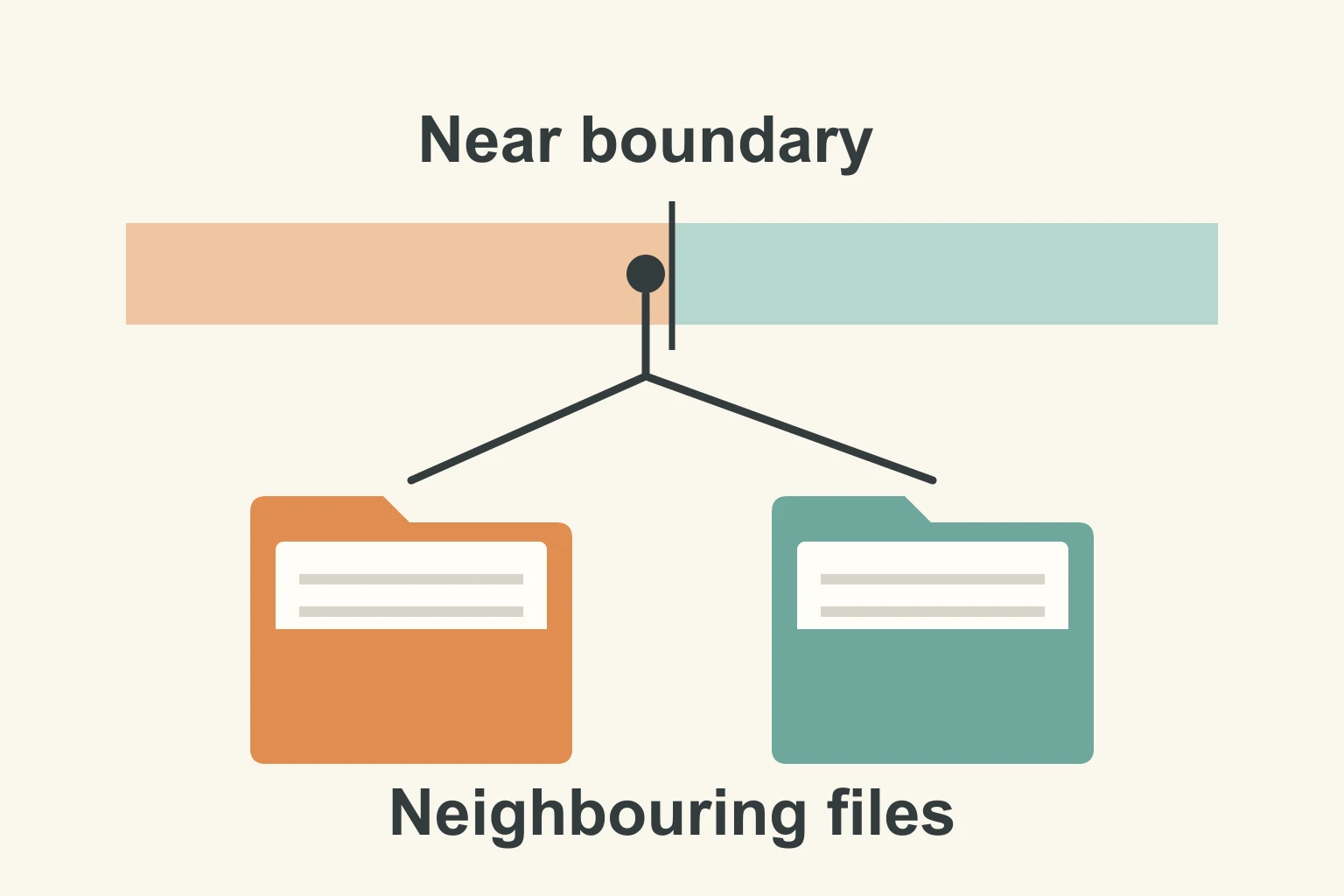
There’s a useful complication. If a measurement falls near a category boundary, Bertillon instructs the searcher to check adjoining compartments too. [3] Human measurement doesn’t become exact merely because a filing cabinet would prefer it to be.
I find that more revealing than a triumphant claim about identifying everybody. The system needs consistent measuring, correct filing and somebody willing to search beyond the first plausible box. The National Library of Medicine’s historical account notes that even trained officers could obtain different measurements of the same person. [4]
Identifying someone doesn’t explain their character
This search concerns whether a person corresponds to an existing record. Head length supplies a route through the collection. It doesn’t establish a disposition to steal, or prove an allegation against the person now being measured.
Nor should we treat being in the collection as self-explanatory. Who was recorded, under what authority, and for what purpose?
The Landes departmental archives document the extension of Bertillon-style recording beyond identifying repeat offenders. Their exhibition includes anthropometric identity booklets for people officially classified as “nomads”, and records associated with the French law of 16 July 1912. It also identifies an individual notice made in 1915 for Thomas Uhart, aged thirteen, when his anthropometric identity booklet was issued. [5]
That is a different use of the machinery from searching for someone’s previous conviction. The administrative classification supplied a reason to record and monitor a population. I’d resist letting the precision of the measurements lend that discriminatory surveillance an air of inevitability. A technical procedure can be carefully standardised while the decision to impose it remains open to challenge.
A detour to The Wrong Man
Alfred Hitchcock’s black-and-white The Wrong Man (1956) gives me another reason to separate the questions. Henry Fonda plays Manny Balestrero, a musician who visits an insurance office to seek a loan. The clerks think he resembles the man who robbed them. The police take him into custody and seek identifications from other victims. [6], [7]
I’m comparing problems here, rather than tracing Bertillon’s system into the film. Its New York investigation belongs to another place and period.
The difficulty is sharper than asking whether Manny has been described accurately. You can accurately describe the person standing before you and still be wrong about whether they committed the robbery. Resemblance becomes consequential when somebody treats it as a reliable identification.
That’s what makes the premise troubling to me: the error has somewhere to go. People question him, take him away and build a case. A mistaken judgement starts organising somebody else’s life.
The opening situation is enough for this comparison; I’ll leave the film’s resolution for you to discover.

What does the photograph let you conclude?
Bertillon’s mugshot makes more sense when you look beyond its two views. Measuring and classification helped make the photograph retrievable; standardisation helped make comparisons possible.
Then comes the harder question of what the comparison establishes. Is this the person already recorded? Is the allegation supported? Why was this person required to enter the system in the first place?
I’d ask those separately. The front view and profile may be admirably consistent. The conclusions attached to them still need examining.
References & Further Reading
The sources establish the historical procedures, particular archived records and film premise. The comparisons and evaluations are Monocurator’s own framing.
- Metropolitan Museum of Art, ‘Mugshots of Suspected Anarchists from French Police Files’, Alphonse Bertillon, 1891–95, object 2005.100.375.1–.434. Collection introduction and catalogue record.
- Metropolitan Museum of Art, ‘Measurement of Left Middle Finger’, Alphonse Bertillon, c. 1893, object 2016.7. Collection introduction and catalogue record.
- Alphonse Bertillon (1896), Signaletic Instructions, Including the Theory and Practice of Anthropometrical Identification, translated from the French and edited under the supervision of R. W. McClaughry, The Werner Company. Introduction, pp. 19–22, 54; digitised full text. The historical manual describes and advocates its system; it is not an independent assessment of its reliability.
- National Library of Medicine, ‘Alphonse Bertillon (1853–1914)’, Visible Proofs: Forensic Views of the Body.
- Archives départementales des Landes, ‘Aux origines de la police scientifique, de Paris jusqu’aux Landes’, online exhibition. Particularly ‘La preuve par l’image’ and ‘Populations sous surveillance’; Thomas Uhart notice, AD 40, 4 M 58; identity booklets, AD 40, 4 M 59 and 4 M 62.
- American Film Institute, The Wrong Man, AFI Catalog. Credits, physical properties and opening synopsis. The linked synopsis includes the ending. AFI gives a New York opening on 22 December 1956 and general release in January 1957.
- British Film Institute, The Wrong Man (1956). Film year and credits.
For the next unexpected question, follow the Journal in your RSS reader.
On screen
Films discussed
- The Wrong Man (1956) · Alfred Hitchcock
Further reading
Read next in the Journal
Want a recommendation shaped around your evening? Ask Momo what to watch next →