See Films Differently Film analysis
How Does The Crowd Find One Man in a Sea of Desks?
Follow King Vidor's office-camera movement in The Crowd, from a city facade to one desk, and see how scale makes a worker visible.
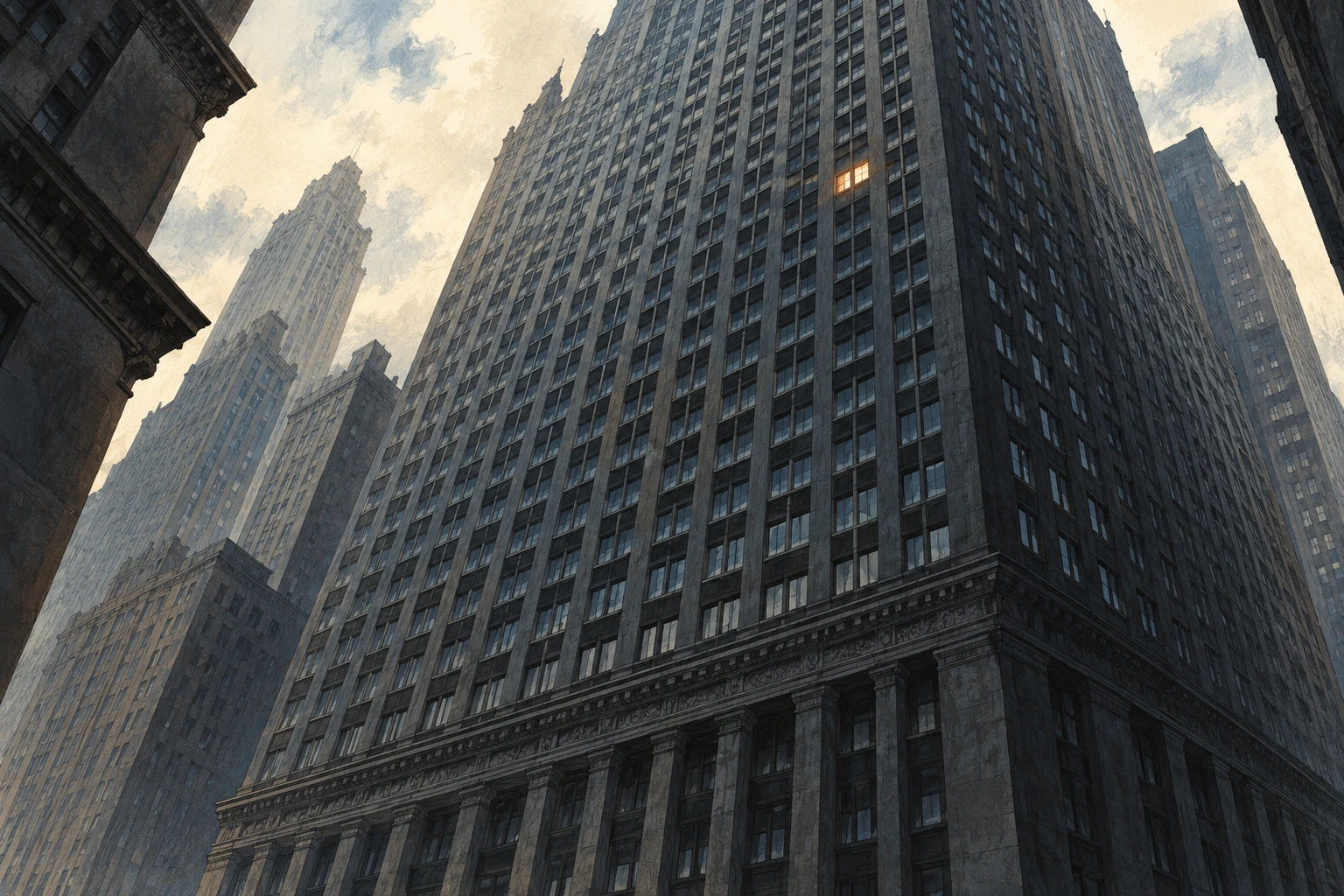
King Vidor’s The Crowd (1928) has an unusual way of introducing an office worker. As Lucy Sante describes it, the camera travels up a skyscraper, enters a window and passes rows of desks before reaching John Sims’s position. The movement is famous enough that Sante mentions it while writing about another New York film, and the British Film Institute traces its later influence on The Apartment. Yet the shot is worth watching as more than a technical flourish. It asks a simple question: what does it take to locate one person inside a system built to make every desk look alike?
Start with the building, not the worker
The shot does not give us John first and then reveal his surroundings. It starts outside the building. Sante’s account follows the camera up its side, through a window and across a seemingly endless field of desks before it stops at his location. That order changes the information we receive. The building has a shape before we learn where John works. The office has a pattern before the film selects one position within it.
At first, the movement can feel like a promise of mastery. A camera can go where a person on the street cannot; it can climb a facade and pass into an office without using the doors. But that mobility does not make the workers more powerful. The closer the camera gets, the more clearly the repeated desks organize the room. When it finally reaches John’s location, the grid has already defined his place within it.
This is an editorial reading of a documented camera movement, not a claim that Vidor intended a single fixed symbol for every desk. The composition gives viewers a practical way into the film’s problem. We can keep both scales in mind: a person with a name and a workplace that could, at a glance, absorb that person into a pattern.

What “ordinary” costs
Ian Christie, writing for the BFI, describes The Crowd as Vidor’s attempt to make a drama of a truly ordinary life. He notes that the film follows John Sims from birth toward the contemporary city, and that John believes he can stand out from the crowd even as the story places him within it. Matthew Thrift’s BFI account adds a useful caution: John encounters a series of indignities, and moments of success do not simply settle the difficulty.
Put beside the office shot, these descriptions keep “ordinary” from sounding small. John does not need to represent every worker for the film to matter. The camera’s journey makes a sharper distinction. It can find a particular worker among many; being found by the camera does not guarantee that the city will reward his ambitions. Attention is something cinema can give him. Security is another question.
The camera’s choice also creates an expectation. A story that follows one person might seem to promise that he will become exceptional. The BFI’s account of John’s setbacks makes the office’s scale a useful warning against that promise. The film can attend closely to someone without changing the conditions under which he works.
A studio film with a city in it
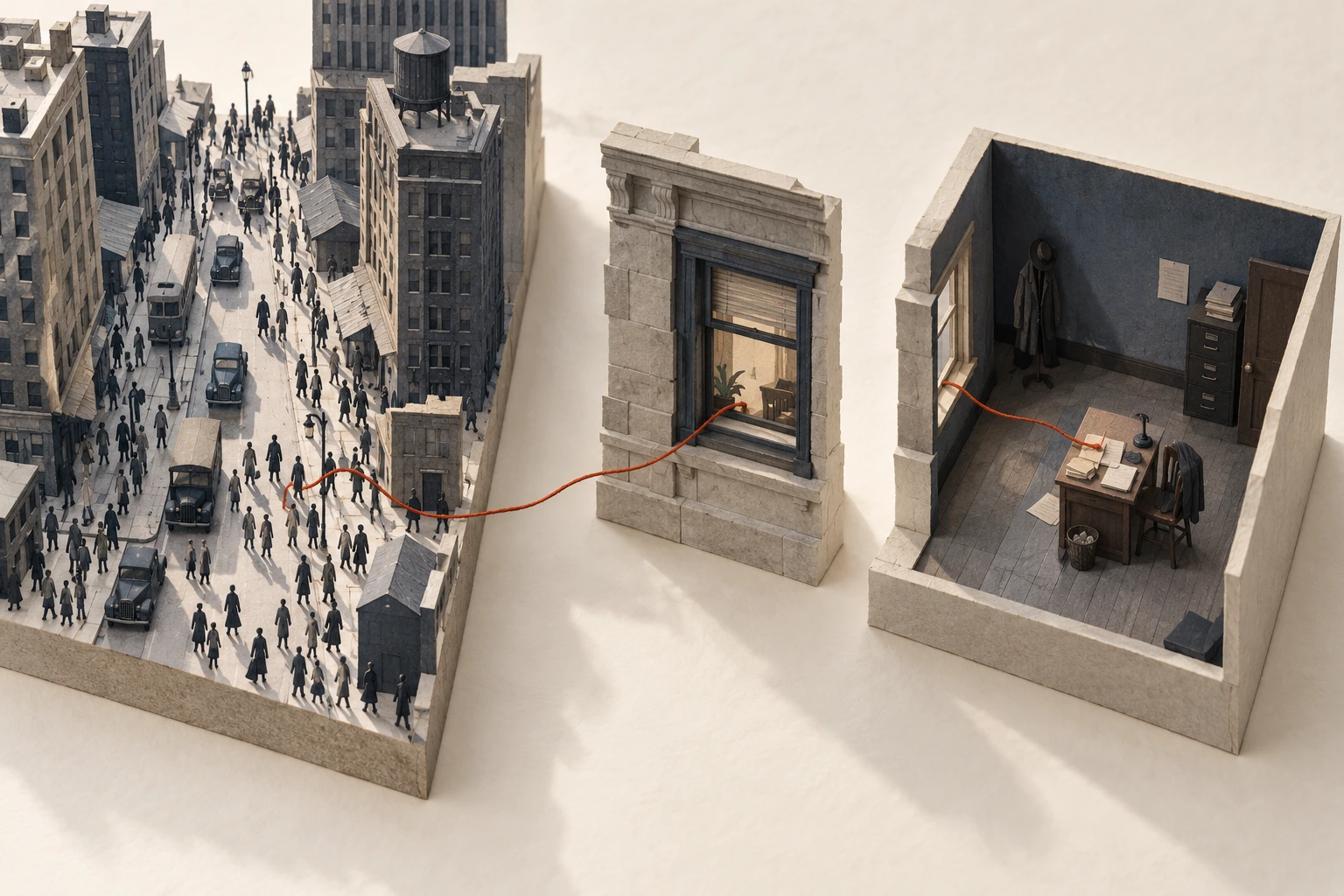
Christie reports that Vidor used unknown lead performers and shot clandestinely on New York streets. He also describes the film’s mixture of striking sequences and a restrained approach to ordinary American life. Street filming and the office movement do different work. On a street, other people and traffic share space with the performers; the location can bring activity that a single character does not control. In the office movement, the camera chooses an unusually exact route from exterior to interior and from many desks toward one location. Neither method makes the film a documentary. Together they let it move between an unpredictable city and a strongly organized view of one workplace.
This contrast helps explain why the office shot remains memorable. Its design is conspicuous, yet its destination is an unglamorous place to work. The camera performs an extraordinary movement toward an ordinary position. How much visual effort must a film spend to locate a person in a crowd?
The BFI points to a later echo in Billy Wilder’s The Apartment (1960). That connection is useful as a viewing path, not proof that the two films make identical arguments. Look at how each film uses the geometry of office space, then ask what happens after an individual has been singled out. An expansive room can make a character look isolated while reminding us of lives beyond the frame’s chosen point.
Watch the scale change
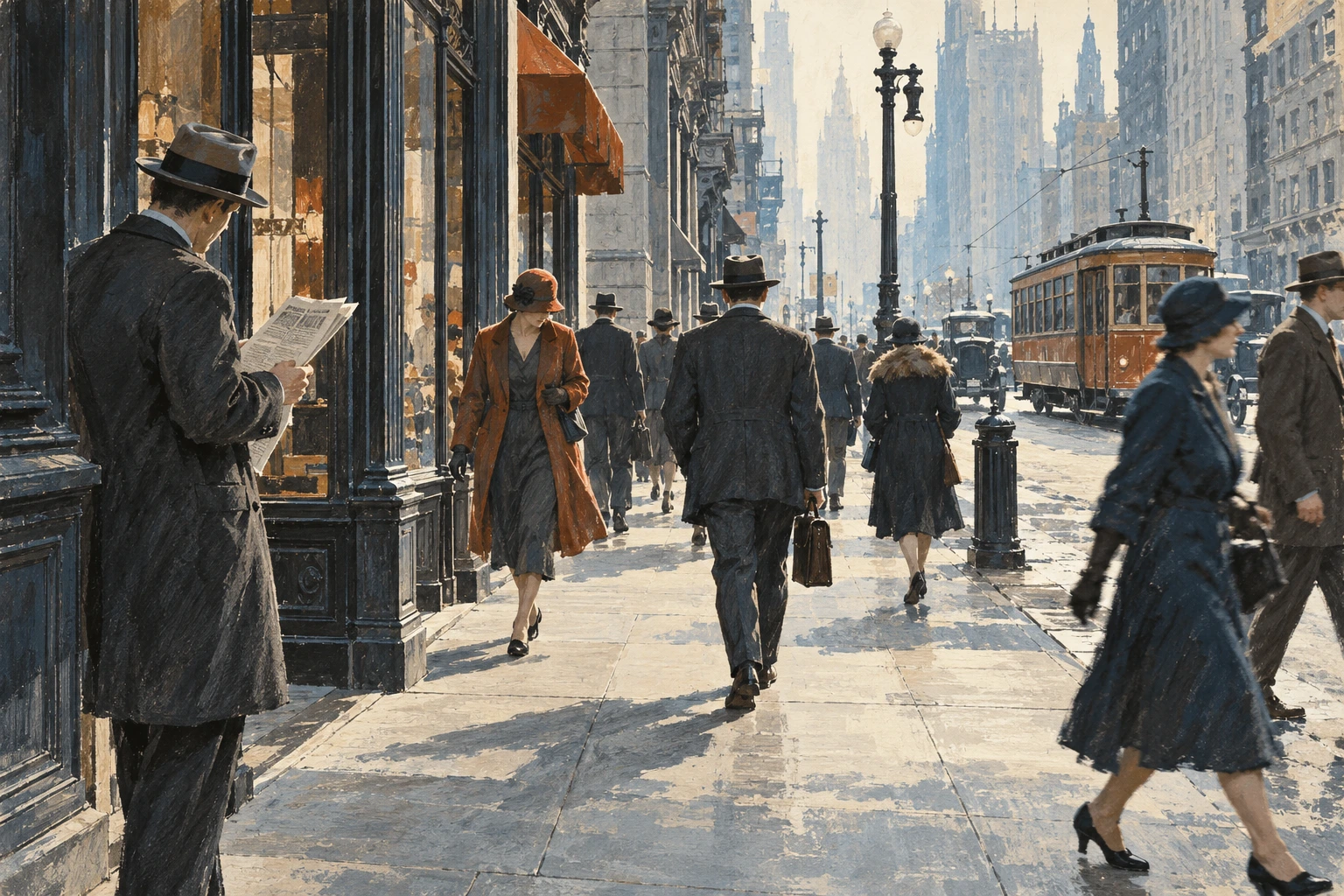
When watching The Crowd, follow the beginning of that office movement as carefully as its destination. At what point does a building become a room? At what point do the rows become individual desks? When the camera reaches John’s location, how much of the earlier pattern remains in your mind? The movement has already taught us to look at him in relation to the room.
There is no need to turn that relation into a slogan about cities or work. A camera can select John without pretending that the other desks have vanished. The movement toward one location makes the room the condition under which that location is seen.
Sources and reading notes
- BFI film record, The Crowd — film identity, year, director, principal cast.
- Ian Christie, BFI, “The peak of silent cinema” — ordinary-life framing, office shot, New York filming, lead casting, restrained style. See the The Crowd subsection.
- Matthew Thrift, BFI, “King Vidor: 10 essential films” — John’s repeated reversals and the office shot’s later influence on The Apartment. See the The Crowd subsection.
- Lucy Sante, Criterion, “The Naked City: New York Plays Itself” — concrete camera route up the skyscraper, through a window and across desks to John.
- David Hudson, Criterion, “King Vidor, the Versatile Messenger” — contextual check for Vidor’s career and the film’s principal characters; not used to infer scenes beyond the sources above.
This article is an editorial reading of the cited descriptions. It does not claim direct viewing of a complete edition or reproduce a film frame. The three inline images and hero are original conceptual illustrations.
For the next unexpected question, follow the Journal in your RSS reader.
On screen
Films discussed
- The Crowd (1928) · King Vidor
Continue exploring on Monocurator
Further reading
Read next in the Journal


Want a recommendation shaped around your evening? Ask Momo what to watch next →