See Films Differently Momo Notices
Songs That Lift You Without Getting Bigger and Bigger
Why a song can feel buoyant without constantly building: repetition, expectation and a way to hear the small returns that matter.

A listening essay on repetition, expectation and the small returns that make a song worth staying with.
Imagine a chorus coming round for the second time. The tune is familiar, the pulse keeps going, and the arrangement need not become more crowded. You could be waiting for one particular turn in the phrase. Its arrival would be enough.
That is the possibility I want to make room for when asking why a song can lift you without continually building. A large climax gives you an obvious destination. A pattern you want to hear again gives you another reason to stay.
Three candidates for that question are Fairlane, Syence & Kwesi’s ‘Replay’, Arcando & Silent Child’s ‘Savior’ and Fluencee’s ‘Nervous’, whose video credit features Tyreeq DeMarious. Their recordings have not been analysed here. They offer a starting question, rather than a verdict: what are we enjoying while the music is already under way?
Sixteen seconds, going round
One unusually concrete place to start is a drum loop.
In a study by Maria Witek and colleagues, listeners heard programmed drum patterns: two bars repeated four times, making sixteen seconds at 120 beats per minute. They rated how much pleasure they experienced and how much the patterns made them want to move. Patterns with a medium degree of syncopation received the highest ratings. Syncopation shifts rhythmic emphasis away from expected positions; here, its amount mattered. 1
There was enough in a short repeated pattern to produce different ratings. The study did not compare whole songs with and without a climax. Still, it gives us a reason to examine what happens inside an ongoing rhythm, instead of judging a song solely by the size of its next arrival.
It also gives ‘lift’ a more precise possible meaning: wanting to move while listening. That differs from enjoying a sound, liking a song enough to play it again, or feeling happier afterwards. These can coincide. We should keep track of which one we mean.
Repetition has a shape
‘It repeats’ leaves a lot unsaid.
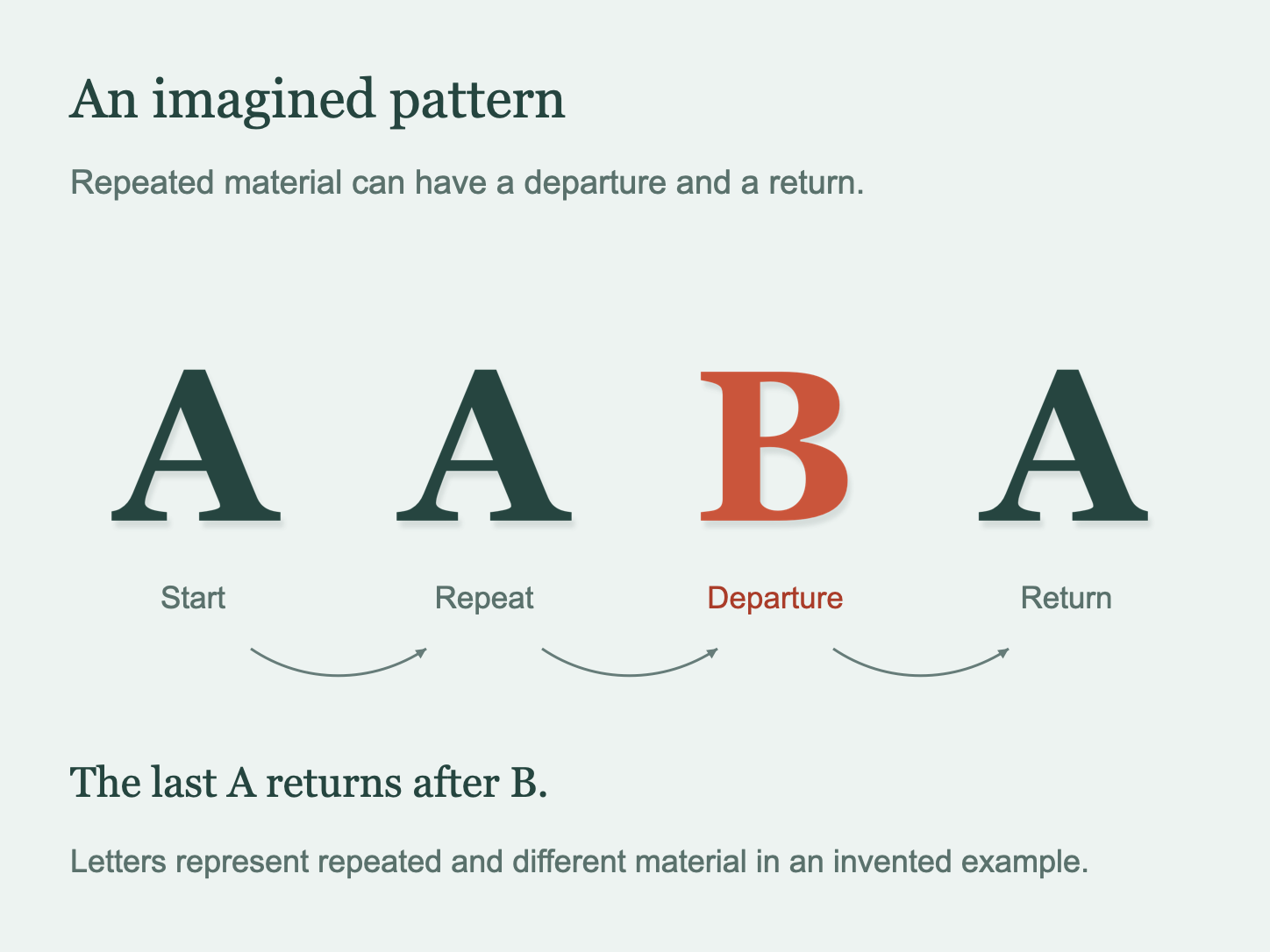
Think of an invented four-part pattern, A–A–B–A. A appears three times, but one of its appearances follows B. Even without adding a fifth part, there is a departure and a return to notice. The letters stand for repeated and different material in this imagined example.
Kat Agres and colleagues studied harmonic repetition using generated excerpts of uplifting trance. Twenty listeners with experience of the genre rated the enjoyment of short passages whose chord repetition structures varied. The results depended on harmonic context: some highly repetitive structures were enjoyed, and greater complexity was not a straightforward route to greater enjoyment. The study concerned short excerpts, rather than the larger repeating sections of a complete track. 2
That qualification matters. ‘Repetition works’ would be much too large a verdict. The interesting question is which repetition, in which surroundings.
For listening, the return in A–A–B–A offers a small distinction worth keeping. Ask whether you welcome A because it is familiar, because B has made its return noticeable, or because you enjoy some detail within A itself. Those are different descriptions of the same moment. None requires you to decide that the song has reached its biggest point.
A surprise needs something to surprise
There is a temptation to give variation all the credit. More changes, more interest. Music would become a very busy committee meeting.
Vincent Cheung and colleagues reported a more specific relationship between expectation and pleasure in Western tonal harmony. High pleasure ratings occurred both when a chord was surprising in a relatively predictable context and when it met expectations in an uncertain context. The combination mattered; surprise alone was insufficient to describe the result. 3
This suggests a better listening question than ‘What changes next?’: ‘What am I expecting to return?’ A familiar turn can provide something to anticipate. A small change can make that expectation noticeable. How either feels will depend on the musical context and the listener; the research does not establish the effect of a particular chorus on you.
I find ‘renewal’ a useful name for the possibility that a return gives you another moment to welcome. It is a listening description, not a scientific category. A chorus can renew your interest at the same scale as before. Whether it does is something your account of the song should explain.
Keep two accounts of the same passage
Try describing a passage twice.
First, describe its size. Does it get louder? Do more sounds enter? Does the singing move into a higher register? Does the music actually continue growing, or has it reached a level it maintains?
Then describe what you wait for within it. Perhaps it is the return of a phrase, the placement of an accent, or the instant a brief gap ends.
The second account can be specific without declaring a new climax every time something pleasing happens. ‘I look forward to that phrase returning’ already tells us more than ‘it has good energy’. Add the audible detail that makes the return matter, and you have a description someone else can compare with their own hearing.
A useful counterexample is a passage that becomes larger but less enjoyable to you. Your two accounts can disagree. The increase in size is one observation; your response is another. Equally, a steady passage might leave you bored. A loop has no exemption from being dull merely because a paper found pleasure in other loops.
A song may contain a substantial climax and still give you much of its pleasure between those major arrivals. ‘It does not keep building’ leaves room for a peak. It asks what carries the rest of the listening.
Momo’s connection has wheels
All this attention to continuing motion has given me an excuse to roll into Charlie Chaplin’s Modern Times (1936), a black-and-white film with a roller-skating sequence available through the official Chaplin site. 4 5
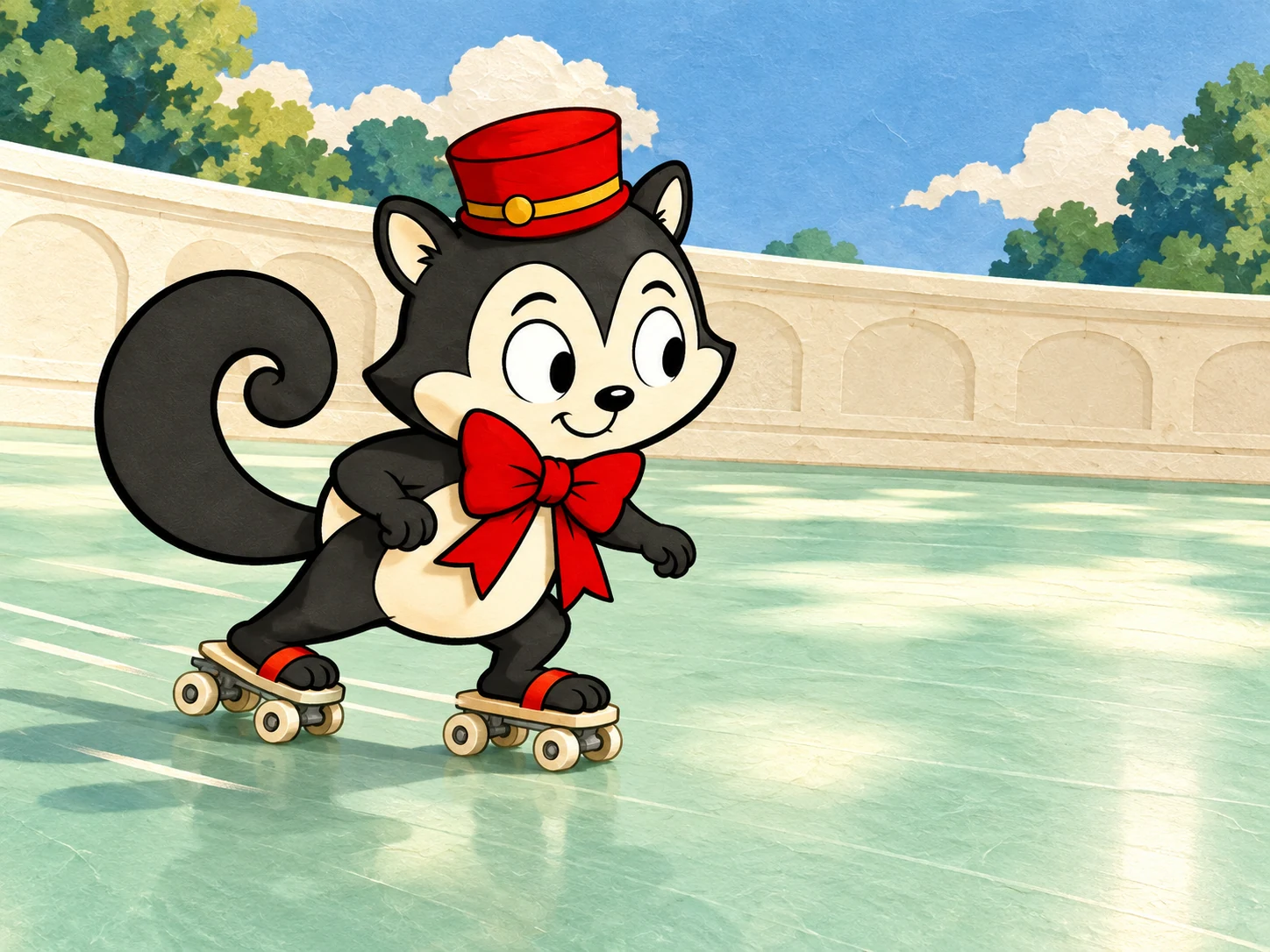
I am borrowing the idea of skating: movement that can keep going across a surface. It makes a pleasantly literal companion to the question of music that feels buoyant without an endless climb. My connection has wheels. I shall let it coast.
Back with the music, the detail worth naming is the one you want to come round again. It might be a whole chorus. It might be two beats. Give those two beats their due before asking the song to build another floor.

References & Further Reading
- Witek, M. A. G., Clarke, E. F., Wallentin, M., Kringelbach, M. L., & Vuust, P. (2014). ‘Syncopation, body-movement and pleasure in groove music’. PLOS ONE, 9(4), e94446. https://doi.org/10.1371/journal.pone.0094446. Publisher full text consulted, including Methods and Results. The authors’ 2015 correction, PLOS ONE, 10(9), e0139409, corrects stimulus indexing and notation; it states that the findings and their interpretation are unaffected.
2. Agres, K., Herremans, D., Bigo, L., & Conklin, D. (2017). ‘Harmonic structure predicts the enjoyment of uplifting trance music’. Frontiers in Psychology, 7, 1999. https://doi.org/10.3389/fpsyg.2016.01999. Published 10 January 2017 in the 2016 volume. Publisher full text consulted, particularly the stimulus design and limits of the repetition investigated.
3. Cheung, V. K. M., Harrison, P. M. C., Meyer, L., Pearce, M. T., Haynes, J.-D., & Koelsch, S. (2019). ‘Uncertainty and surprise jointly predict musical pleasure and amygdala, hippocampus, and auditory cortex activity’. Current Biology, 29(23), 4084–4092.e4. https://doi.org/10.1016/j.cub.2019.09.067. Version consulted: the authors’ abstract on PubMed; the article uses its reported behavioural result, without claims drawn from inaccessible methodological detail.
4. Roy Export S.A.S. (n.d.). ‘Charlie Chaplin — Modern Times — Roller Skating Scene’. Official Chaplin website. The textual page identifies the film and sequence. The clip was not played for this article; no sequence-level analysis is claimed.
5. American Film Institute. (n.d.). Modern Times (1936). AFI Catalog of Feature Films. Director, date and ‘Black and White’ physical properties consulted. Institutional film metadata, distinct from the primary research above. Film association: Momo’s editorial comparison, rather than a claim of artistic influence.
For the next unexpected question, follow the Journal in your RSS reader.
On screen
Films discussed
- Modern Times (1936) · Charlie Chaplin
Further reading
Read next in the Journal


Want a recommendation shaped around your evening? Ask Momo what to watch next →