See Films Differently Adaptation
What Is Rashomon Based On? The Two Stories Behind Kurosawa’s Film
Rashomon draws on two Akutagawa stories. Compare In a Grove with the gate story, and see how Kurosawa changes both — including the film’s ending.
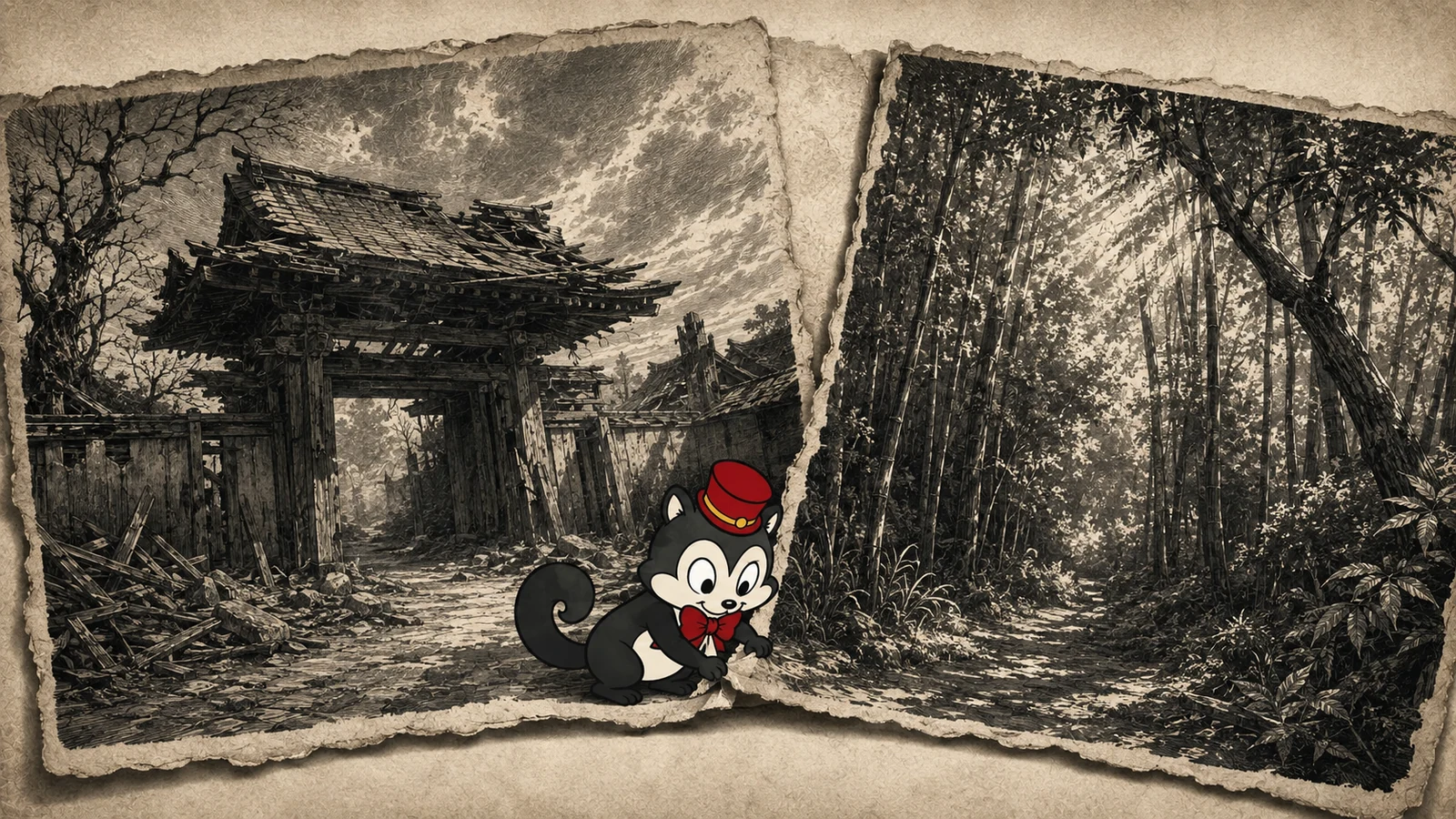
Akira Kurosawa’s Rashomon (1950) draws on two short stories by Ryunosuke Akutagawa: “In a Grove” supplies the crime and its conflicting accounts; “Rashomon” supplies the ruined gate and material about wrongdoing justified by survival. The screenplay, credited to Kurosawa and Shinobu Hashimoto, combines and changes them. Reading the story called “Rashomon” alone will not give you the film’s murder mystery. Criterion’s film page identifies both source stories.
The adaptation is worth approaching through both its events and its arrangement. Asking where a scene comes from is useful; asking what changes when it sits beside another scene takes the comparison further. A borrowed setting can alter the meaning of a borrowed plot.
| Source story and first publication | Its main contribution |
|---|---|
| “Rashomon” (November 1915) | A decaying gate, rain, destitution and the reasoning used to excuse theft |
| “In a Grove” (January 1922) | A death in the woods, witnesses and incompatible accounts of how it happened |
The publication dates come from the edition records accompanying Akutagawa’s Japanese texts in Aozora Bunko, linked below. Neither story is a novel, and the film is not a straightforward transfer of either one.
How two stories became one film
Hashimoto first adapted “In a Grove”. The National Film Archive of Japan’s programme note describes the addition of material from “Rashomon” during the screenplay’s development.
Exactly who proposed the combination is less secure than the basic sequence. In his account of Hashimoto’s career, Stephen Prince notes that Hashimoto and Kurosawa each credited himself with the suggestion. They agreed to incorporate the second story; their later accounts disagree about whose idea it was.
There is no need to settle that dispute to recognise the collaboration. The useful question is what the combination makes possible. A setting borrowed from one story becomes a place where people can hear, challenge and respond to the events adapted from the other.
Spoilers from here: the following sections discuss sexual violence, the plots of both stories and major changes in the film. The final section also reveals the film’s ending.
“In a Grove”: incompatible accounts of a death
Akutagawa’s “In a Grove” has seven sections. The first four speakers are a woodcutter, a priest, a captor and the wife’s mother. Their statements are followed by the accounts of Tajomaru, the wife and the dead husband, who speaks through a medium.
The bandit claims to have killed the husband in a duel. The wife says she stabbed him after the assault. The husband describes killing himself. These are contradictions about actions, not merely different feelings about an agreed event.
The husband’s account ends with an unidentified person removing the dagger from his chest. There is no final solution or further eyewitness narrative from the woodcutter.
“Rashomon”: finding permission to steal
In Akutagawa’s “Rashomon”, a dismissed servant shelters beneath the gate, hesitating over theft. Among discarded corpses upstairs, he finds an old woman taking a dead woman’s hair for wigs.
Disgust gives way to calculation. She argues that survival excuses her, as it excused the dead woman’s own deceit. He steals her clothes using the same defence.
The cruelty lies partly in how quickly a justification changes hands. He does not need to prove the old woman innocent before using her defence. Hearing someone explain away an injury gives him a way to explain away his own.
The borrowed gate carries this disturbing exchange of excuses with it.
What changes when testimony becomes an image?
The film’s achievement also depends on the people who turned the screenplay into sights and sounds. The National Film Archive of Japan’s anniversary exhibition foregrounds the work of cinematographer Kazuo Miyagawa, the art department led by So Matsuyama and composer Fumio Hayasaka alongside the writing and direction.
That matters to an adaptation built around doubtful reports. A sentence can announce that somebody claims an event happened. Cinema can supply that claim with bodies, space, movement and duration. It can become easy to remember an image without remembering whose account produced it.
A useful way to watch the retellings is to keep the speaker attached to the scene. Ask who is being presented as brave, powerless, desirable or contemptible. A persuasive performance can make a version compelling without establishing its accuracy. Those judgements are part of the comparison, rather than a verdict supplied by the camera.
The woodcutter becomes more than an opening witness
In the film, the woodcutter offers another account of the killing at the gate. This is a substantial extension of his role in “In a Grove”. His new account can seem like a route beyond the competing stories of the people most directly involved.
Yet being outside the central conflict does not automatically make him reliable. Alexander Sesonske’s Criterion essay points out that the woodcutter has already changed what he says: his later version gives him knowledge his earlier testimony withheld.
That change puts pressure on the comfortable distinction between interested participants and an impartial observer. The person who introduces a story may also have something to conceal. A narrator can sound plain and undramatic while still controlling what reaches us. The film’s additional account therefore brings another person into the problem of trust, rather than simply appointing someone to solve it.
Ending spoilers: what the baby changes
The abandoned baby and its adoption are additions to the film, absent from both source stories. At the gate, the commoner takes the child’s clothing and defends his selfishness. He also confronts the woodcutter about the missing valuable dagger. The woodcutter’s offer to take the baby home follows that damaging exchange; it is not the reward given to an observer established as blameless. These actions are documented in Orit Kamir’s close analysis of the film, particularly its synopsis.
The theft echoes the gate story’s borrowed excuse. The adoption offers a different response to deprivation.
Stephen Prince’s “The Rashomon Effect” treats the ending as a turn towards compassionate action, while leaving its persuasiveness open to the viewer. It need not erase the earlier doubts to matter. Caring for the child cannot retrospectively verify a testimony or reconstruct the killing.
The two-source comparison makes that distinction particularly useful. A story about uncertainty has been joined to a story about how people act under pressure. The film can leave its central event unresolved while allowing an action in the present to count for something.
For a reading companion to Rashomon, begin with “In a Grove” if you want to follow the changes to the crime narrative. Read “Rashomon” alongside the scenes at the gate. Neither serves as a hidden answer sheet. Their value is in making the film’s choices visible: which witness gains a new role, which excuse travels into another situation, and where the adaptation allows somebody to do more than explain himself.
For another route into the director’s work, see where to start with Akira Kurosawa.
Sources
- Ryunosuke Akutagawa, “Rashomon” — Japanese text and edition record, Aozora Bunko.
- Ryunosuke Akutagawa, “In a Grove” — Japanese text and edition record, Aozora Bunko.
- National Film Archive of Japan, “Rashomon” programme note and 70th-anniversary exhibition.
- The Criterion Collection, film credits; Stephen Prince, “Mightier Than the Sword: Shinobu Hashimoto at 100” and “The Rashomon Effect”; Alexander Sesonske, “Rashomon”.
- Orit Kamir, “Judgment by Film: Socio-Legal Functions of Rashomon”, Yale Journal of Law & the Humanities 12 (2000), pp. 39–88. Used for the documented sequence of film actions, not as the article’s definitive interpretation.
On screen
Films discussed
- Rashomon (1950) · Akira Kurosawa
Continue exploring on Monocurator
Want a recommendation shaped around your evening? Ask Momo what to watch next →