ページの操作項目を翻訳しています。作品名は目録の表記のままです。解説本文と出典の説明は英語です。

← 作品一覧に戻る

Drama

The Trial

上映時間
未確定

A man is arrested without being detained and drawn through a legal system that never states the charge against him.

購入用の版を探す ↓ 観る前に ↓

Amazon.comで検索 · 広告リンク。購入前に版と対応地域をご確認ください。

言語
English
StrangeMysteryBleak もう少し慣れてから · じっくり観たい方へ Drama
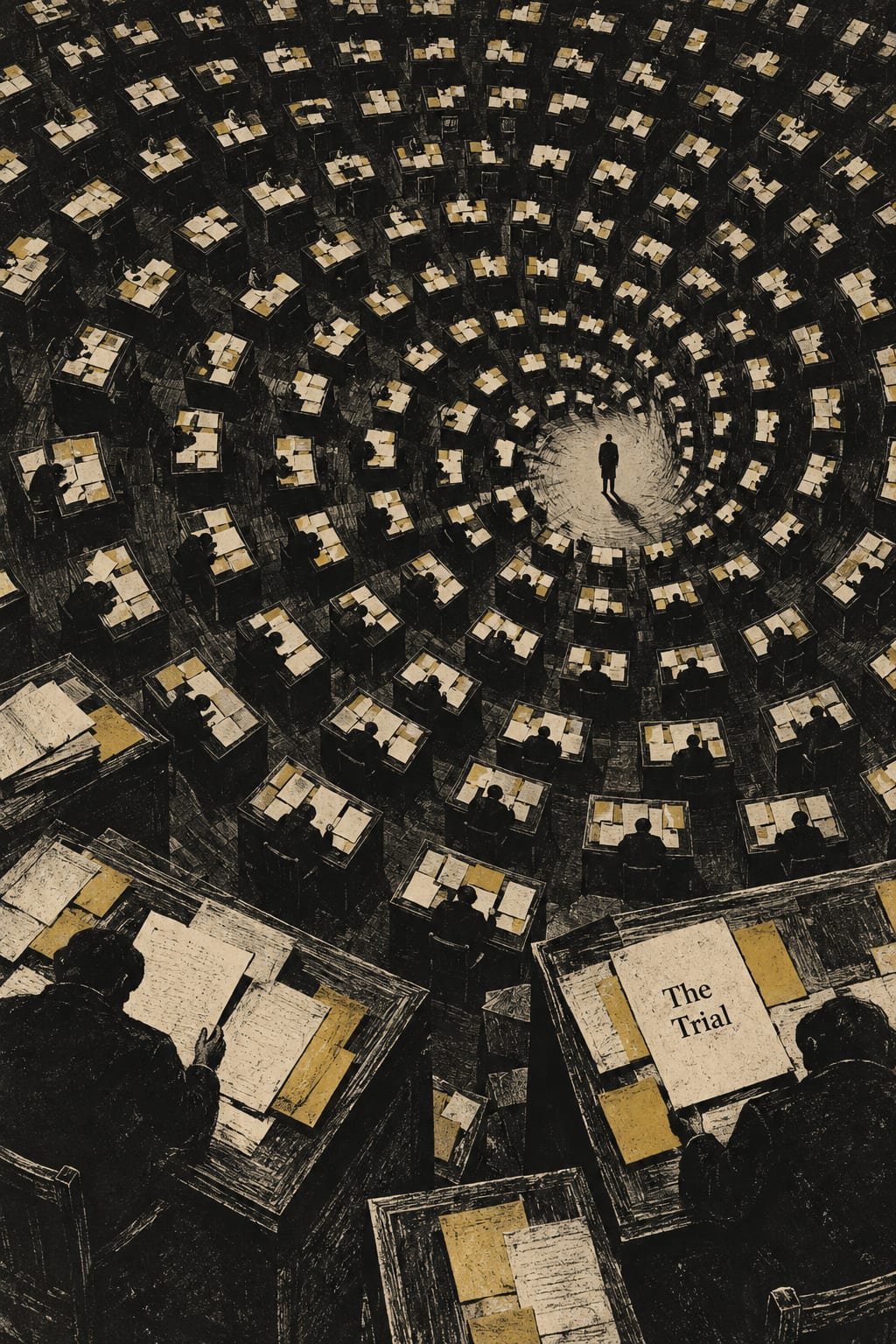
A dense spiral of desks and papers dwarfs one small central human figure.

Image: Monocurator · source · Original Monocurator artwork

The Trial: the film and Kafka’s ending

Compare Josef K.’s final encounter with the published novel and Welles’s explanation of his changes.

Does Josef K. die, and why does Welles change the ending? · Ending spoilers

What happens in the film and novel

Josef K. dies in Welles’s film. At the quarry, he laughs at the men sent to kill him; an explosion brings the encounter to an end. The laugh gives his final response a defiant quality, even though it does not save his life.

In Chapter Ten of Kafka’s novel, the men pass a knife between them. K. thinks he should take it and kill himself, but does not. One man restrains him while the other stabs him. The published ending is therefore a killing by the executioners, despite K.’s troubled thoughts about co-operating.

How Welles explains the change

In his 1962 BBC interview with Huw Wheldon, Welles says he wanted K. to remain defiant. He explicitly confirms that K. is murdered in the film. Welles connects his revision to the Holocaust, arguing that he could not present the earlier ending unchanged after the Nazi death camps. That is the director’s explanation of his adaptation; it does not establish what Kafka would have written later.

Jonathan Lethem’s Criterion essay reports that the smoke’s resemblance to a mushroom cloud was unintended. Production circumstances then prevented Welles from replacing the image. A nuclear reading is possible for a viewer, but it should remain distinct from Welles’s stated intention.

どんな作品か

Welles turns Kafka’s bureaucracy into vast offices, cramped rooms, shifting scales, and crowds that make accusation spatial. Anthony Perkins gives Josef K. enough nervous resistance to keep the nightmare active rather than purely passive.

無理なく楽しむために

Do not try to solve the charge. Follow where Josef is permitted to stand, whom he believes can help, and how each attempted explanation gives the system another way to define him.

観る前の注意

簡単な補足(網羅的ではありません) Includes institutional persecution, sexual coercion, psychological distress, violence, and an oppressive unresolved structure.
Momo's Note ネタバレを含む場合があります Momoって誰? → (英語のページが開きます)
ノートを開く ↓ ノートを閉じる ↑

I see every doorway promise an explanation and deliver another audience. Josef keeps speaking as if the right sentence could restore ordinary life, while the spaces insist that ordinary life has already been absorbed.

— Momo

Momo thinking about this film

クレジットと版

作品情報の出典

次の一本へ

次はもっと穏やかな作品、短い作品、それとも風変わりな作品? 似た作品をMomoに相談する → (英語のページが開きます)
Momoはただいま勤務中。 Momo Cinemaへ → (英語のページが開きます)
作品一覧をさらに見る →