The window scene
At what moment do the separate actions start to look like a plan?
A free film classroom resource
A broken window. A repairman arriving just in time. The order of the pictures lets us in on the joke. What could your class tell in four shots?
Get the free worksheetA problem
A choice
An action
A change

Look. Connect. Draw.
Student activities, an original storyboard sheet and teacher notes, with Momo on every page. Free to download, print and adapt. No registration.
The suggested age range is our guide to the activity. Teachers can use sketches, spoken answers or short written notes to suit the class.
Print at “Fit to page” on A4 or US Letter. The Word version includes both the student and teacher pages.
Before the lesson
These links open the clips on Chaplin’s official site. Preview them and cue the actions you want the class to follow. The core activity uses these scenes; a whole-film screening is optional.
At what moment do the separate actions start to look like a plan?
Which action tells us something about the relationship?
The official education page explains classroom use of its YouTube clips and gives separate guidance for screening full films.
Inside the activity
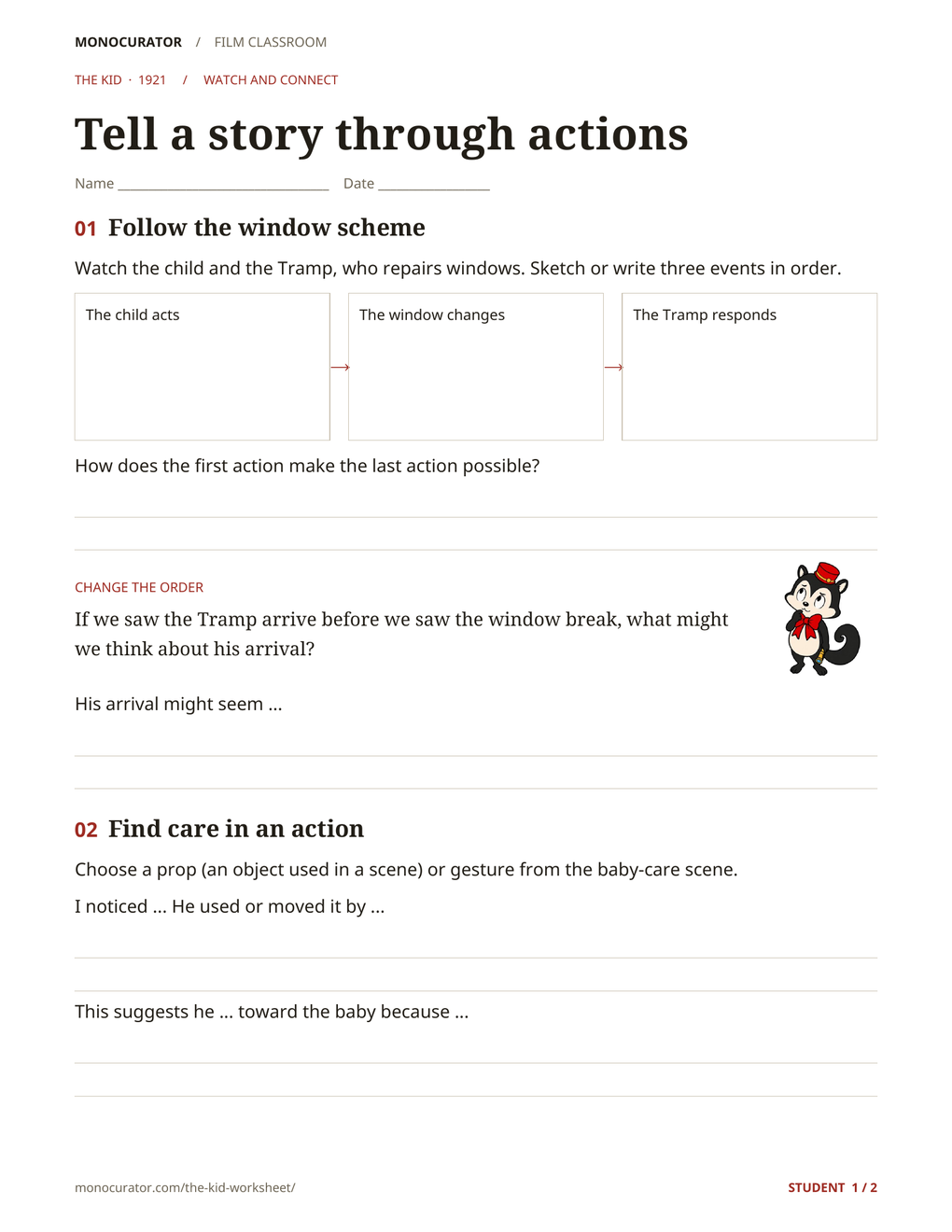
In the window routine, the child creates a problem and the Tramp appears to offer the solution. Students trace the actions in order and explain what connects them. Then they consider what an audience might think if it saw the repairman before it saw the window being broken.
The Tramp makes everyday objects do new jobs as he cares for the baby. Students pick one object or gesture and explain what it shows us about the pair. A useful response names something the character does, then connects it to an idea about the relationship.
Try a question now
How could you show that someone wants to help, before they say a word?
Choose an action another person could recognise. Decide what needs to be visible in the picture.
Students turn a simple situation into a short sequence: a problem appears, someone makes a choice, and something changes. The worksheet has four large frames for drawings or descriptions. A close view might reveal an important object; a wider view might show who can reach it.
The challenge is to make the action readable without dialogue. Stick figures are welcome. A partner reads the sequence, describes what happened and points to any missing connection. The creator changes one shot in response.
The teacher notes include a 45-minute activity sequence, sample reasoning and criteria for reviewing the stories. Viewing time is additional. No camera or editing software is needed: the storyboard is the finished classroom task.
The Kid uses intertitles and musical accompaniment. The lesson focuses on visual clues within that film experience, then asks students to try telling their own story through pictures.
Use scene names when planning the lesson and record the source you will show. Criterion’s edition presents Chaplin’s 1972 rerelease of the 1921 film, so its running time and titles need not match another copy. The official scene links above offer a direct way to prepare the two activities.
You may print, share and adapt Monocurator’s original teaching materials, including the Momo illustrations, for your classes free of charge. Keep the source references with adapted copies. The editable Word file lets you change the prompts and writing space.
The Chaplin Studio’s synopsis describes the window scheme. Tom Gunning’s Criterion essay discusses the improvised care and the relationship at the centre of the film. The BFI’s primary-school recommendations include The Kid. The activities and suggested teaching sequence here are Monocurator’s own.
Sources checked 14 September 2026.