A free film classroom resource
12 Angry Men
Evidence, inference
& doubt.
What does the evidence actually show? A printable worksheet and teacher notes for examining the arguments in Sidney Lumet’s 1957 film.
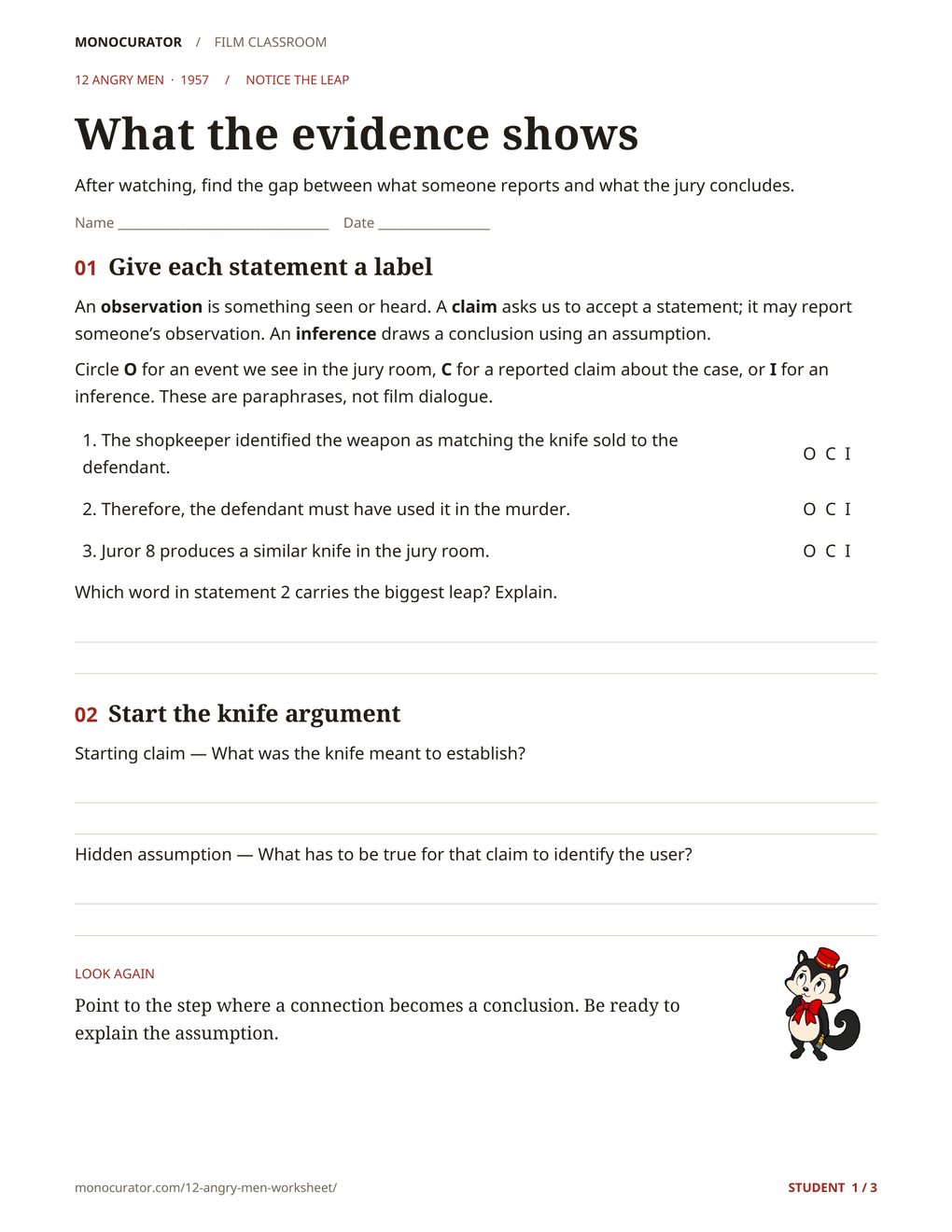
Print it. Question it. Make it your own.
Download the lesson
All three files are free. No account or email address is needed.
Print at “Fit to page” on A4 or US Letter. The editable version contains the student sheets followed by the teacher notes.
Designed for discussion after watching the film; the materials include its evidence and verdict.
1. Reconstruct the knife argument
Students separate a reported claim about the knife, an inference drawn from it, and an action seen in the jury room. Then they write the hidden assumption, the challenge posed by the second knife, and what the demonstration still leaves unresolved.
2. Test the eyesight argument
The witness’s glasses introduce another chain of reasoning. Students identify the steps between the remembered observation and a conclusion about what she could see. They suggest missing information and consider an alternative explanation.
3. Examine what makes an argument persuasive
Pair discussion considers prejudice or personal feeling in the room, alongside a choice in the filmmaking. A close-up can make hesitation compelling. Students ask whether that feeling changes the evidence or the way they receive it.
4. Leave with an unresolved question
A short exit ticket asks students to distinguish a reason for doubt from proof of a different account. The teacher notes include a suggested 45-minute sequence, sample reasoning and four things to look for in the responses.
A question from the worksheet
What would we have to assume for that to follow?
Underline a conclusion in a partner’s answer. Find the step that connects the information to it.
What does the teacher need?
Students should have watched the 1957 film and can use their viewing notes. The activity time does not include the screening. The pack contains original prompts and notes; it does not include the film, a screenplay or film stills.
It is written for discussion, English and film-analysis classes. The central task is analysing the film’s arguments. Students can disagree about the defendant’s innocence while giving careful, well-supported answers.
Can I adapt or share the worksheets?
Yes. You may print, copy, share and adapt Monocurator’s original worksheet and notes for teaching, free of charge. Keep the source references with adapted copies. The Word version lets you change the prompts and give your class more space for a particular question.
Keep the film close at hand
Our juror guide identifies all twelve men. For a closer reading of one argument, see why Juror 3 is trying the wrong son. To build a second discussion, compare three films to watch after 12 Angry Men.
Sources behind the scene notes
The scene cues were checked against the AFI Catalog’s record of the 1957 film. Thane Rosenbaum’s Criterion essay discusses Juror 8’s uncertainty about the defendant’s innocence. These support the factual notes; the activities and suggested teaching sequence are Monocurator’s own.
Sources checked 13 September 2026. The teacher notes include the references.