See Films Differently Momo Notices
Can Opinions Be Wrong? What “I Think” Does—and Doesn’t—Change
Can an opinion be wrong? Explore taste, factual beliefs and what a recommendation asks us to trust, with a visit to The Shop Around the Corner.

A feeling, a judgement and a guess can begin with the same two words. They are not asking us to believe the same thing. With a visit to The Shop Around the Corner (1940).
Imagine a conversation after a screening.
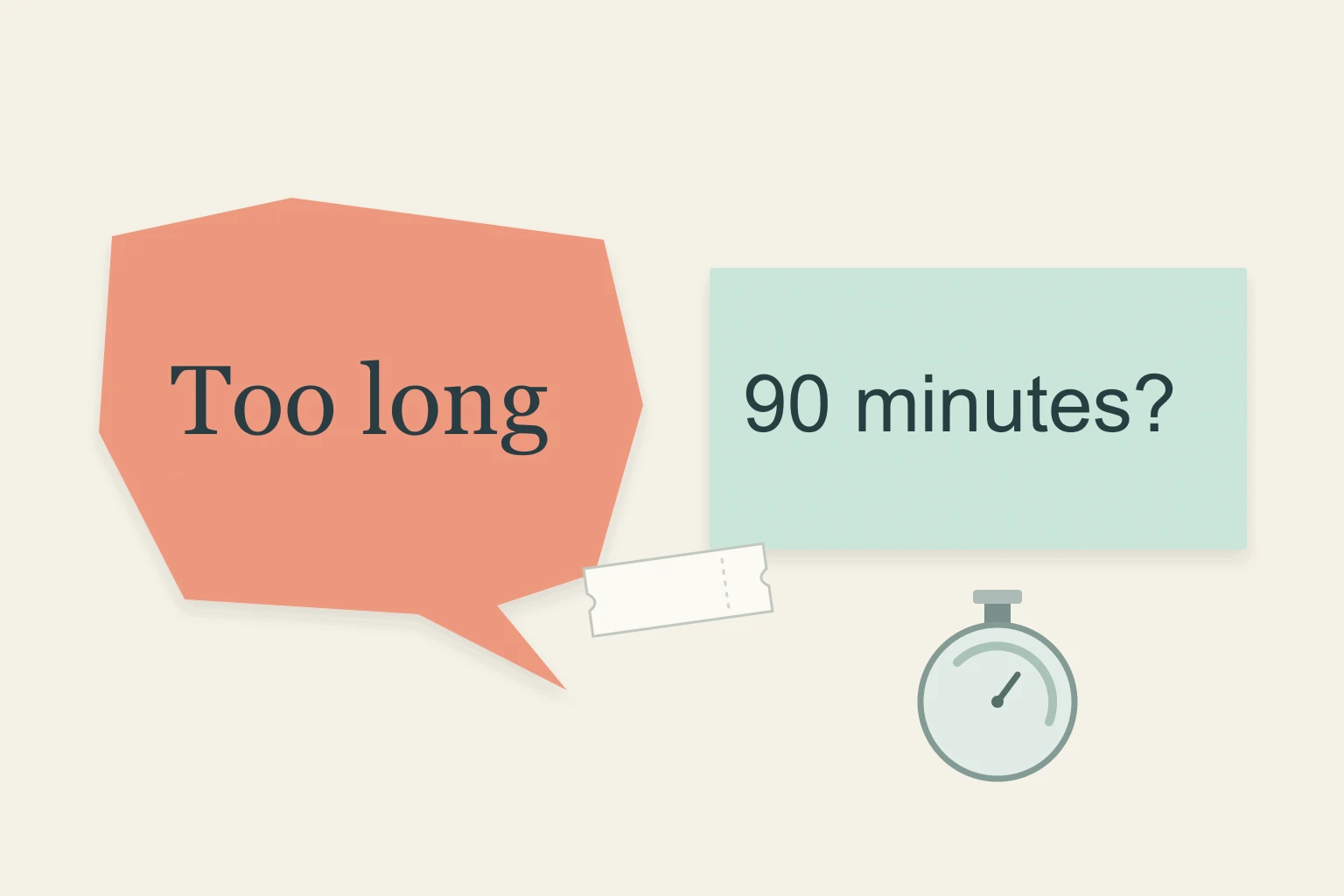
“I think that film was far too long.”
“I think it was ninety minutes.”
The sentences look like neighbours. They are doing rather different jobs.
The first evaluates the time the film took. The second estimates its running time. We could agree on the exact number of minutes and still disagree about whether they were well spent. But adding “I think” cannot make two incompatible running times equally accurate for the same screening.
An opinion can be mistaken about facts, poorly supported or misleadingly presented. A difference in taste is not, by itself, any of those things. To decide what can be challenged, we need to look beyond the word opinion and ask what the speaker is actually saying.
Being mistaken, having weak reasons and misleading a listener are different problems. A guess can turn out right; a reasonable expectation can fail.
That matters when we recommend a film, describe a restaurant or offer a judgement about another person. We need room for different responses without treating every claim as beyond correction. Equally, we need to correct mistakes without behaving as though enjoyment requires a licence.
A disagreement is not always a correction
Consider four remarks about an imaginary film:
| Remark | What is at issue? |
|---|---|
| “I enjoyed it.” | The speaker’s response. |
| “It is beautifully paced.” | An evaluation, with room to discuss standards and particular scenes. |
| “It was filmed in a single take.” | A claim about how the film was made. |
| “You’ll love it.” | A prediction about someone else’s response. |
Calling all four opinions does not make them interchangeable. These are useful distinctions, not sealed categories: a single review can combine all of them.
If you enjoyed the film, another viewer’s boredom does not demonstrate that your pleasure was a mistake. You do not have to stop liking it because an expert can name its weaknesses.
But suppose your reason for admiring it is that it was filmed in a single take. Evidence of several concealed edits would challenge that reason. You might instead admire the editing, or value the sequence less because a continuous take mattered to you. Either way, learning how it was made gives you a reason to revise your account; it does not oblige you to dislike the film.
The middle cases are worth keeping, too. “Beautifully paced” is neither a stopwatch reading nor necessarily a private feeling with nothing further to discuss. You might point to the placement of a pause, the length of an awkward exchange or the way a scene prepares the next one. Another viewer might notice the same features and value them differently.
Discussion can improve our understanding without producing a compulsory verdict. This does not settle every question about artistic value. The narrower point is that disagreeing about enjoyment and correcting a claim about production are different moves.
Does “I think” make a statement subjective?
Not automatically. Sometimes it marks uncertainty about a question that has a factual answer.
Imagine asking when a cinema closes and hearing, “I think it closes at ten.” You have probably been offered a tentative answer about the cinema, not invited to contemplate the speaker’s personal taste in closing times.
Linguist Mandy Simons distinguishes a sentence’s grammatical structure from the main point of a conversation. With phrases such as I think, the main point may be what follows. The opening words can still signal the speaker’s uncertainty or their source of information; focusing on a claim is not the same as asserting it without qualification. [1]
The qualification still matters. “I think it closes at ten” is not as firm an assurance as “I checked: it closes at ten.” It may give you a reason to verify the time. But the uncertainty concerns the answer; it does not turn opening hours into a matter of taste.
Sometimes the belief itself really is the point. “I thought the cinema was open” can explain why you went there, without claiming that it was open after all. Context tells us which question is being answered.
Two words cannot do that work on their own.
Even a subjective judgement can imply experience
There is another question hiding inside an opinion: what has this person encountered?
Christopher Kennedy and Malte Willer discuss familiarity inferences: describing food as tasty can suggest experience of its taste. But their theoretical account does not require first-hand experience for every opinion. It distinguishes finding something tasty from believing it is tasty; the latter may rest on other people’s reports. Relevant familiarity depends on the kind of claim, not simply on whether we label it subjective. [2]
For an everyday example, imagine a writer reporting that a film’s closing exchange moved them. They have not seen or heard that exchange: all they have is a trailer that does not contain it.
The objection is not that second-hand information is worthless. It is that the writer has presented a first-hand response without encountering the exchange. That is different from failing to share someone else’s taste.
There is nothing inherently wrong with anticipating a film. “The trailer looks promising” tells the reader what was encountered and leaves the unseen film unseen. “I haven’t watched the ending, but your description makes it sound moving” is also candid about its basis.
A useful distinction is between disagreeing with someone’s response and discovering that they have represented their access to the subject misleadingly. Those are different reasons to distrust a recommendation.
A weakly supported opinion is not automatically a misleading one
It would be easy to turn this into a demand that every casual opinion arrive with a supporting dossier. That would miss something important.
A related distinction appears in Shinichi Yuhara’s analysis of securities disclosure, Opinion and Misstatements. In that legal context, he argues that lacking reasonable grounds does not by itself establish either a false statement or a misleading omission. He also argues that some statements cast as opinions can present their subject matter as fact. This is an argument about securities disclosure, not a legal test for film reviews. It helps keep two everyday questions apart: what supports a judgement, and what its presentation asks a listener to believe. [3]
For an everyday comparison, imagine two people making predictions from the same short trailer. One says, “I haven’t seen the film, but this looks like your sort of thing.” The other writes as though they are offering an assessment of the complete work.
Both may have limited evidence. Only one has made that limitation clear.

That does not establish anyone’s legal liability. It shows why, in assessing a recommendation, “How much evidence do you have?” and “What have you led me to believe you know?” deserve separate answers.
Conversely, a well-informed prediction can fail. The friend who knows your taste and has watched the film may still recommend something you dislike. An unsuccessful recommendation is not, by itself, proof of carelessness or dishonesty.
Even a misleading presentation does not, on its own, tell us whether the person meant to mislead. Intent is another question.
We can ask for candour without demanding certainty.
Recommendations are where the distinctions meet
“I liked it” and “you’ll like it” look similar on the page. The second nevertheless makes a different claim.
A personal response has become a prediction. To make it useful, the recommender needs some account of the other person’s interests and of the work’s relevant features.
Compare these invented recommendations:
“I think you’ll love this. It’s a classic.”
“I enjoyed its long, awkward conversations. You liked that in the last film we watched, so this might suit you too.”
The second does not promise success. It gives the listener something to assess. Someone who dislikes drawn-out conversations can decline the recommendation without having to disprove the recommender’s enjoyment.
This also changes what a disagreement can accomplish. Rather than arguing over who has the correct taste, we can identify the difference that matters: a preference for pace, an appetite for ambiguity, an interest in a particular kind of performance.
Sometimes there is a straightforward correction to make. Sometimes there is a reason to ask how a conclusion was reached. Sometimes two people simply wanted different evenings.
Calling all three situations “just opinion” makes them harder, not easier, to understand.
The Shop Around the Corner: sincere feelings, mistaken assumptions
Ernst Lubitsch’s The Shop Around the Corner (1940) gives this distinction a particularly inviting setting. Its premise places two antagonistic employees in a Budapest shop, initially unaware that they are also exchanging anonymous love letters with one another. [4]
The premise lets us consider two things separately. Their responses to the letters and to their encounters at work need not be insincere. Yet their understanding of who they are responding to is incomplete.
One way to read this premise is to keep both impressions in view. Discovering who wrote the letters need not erase either their charm or the irritation at work. It does require reconsidering impressions that seemed to belong to two different people. A judgement about a person may be sincere while resting on an incomplete understanding of them.
That is a richer invitation than “all opinions are valid” or “opinions are just failed facts”. We can acknowledge a response, examine its explanation and remain open to information that changes the picture.
You can keep liking a film while correcting your explanation of it. But when a sentence makes a claim about the world, beginning with “I think” does not settle whether that claim is right.

References
- Mandy Simons, ‘Observations on Embedding Verbs, Evidentiality, and Presupposition’, Lingua, 117(6), 2007, 1034–1056. Version consulted: author-posted submitted manuscript, especially §§1.1–1.3.
- Christopher Kennedy and Malte Willer, ‘Familiarity Inferences, Subjective Attitudes and Counterstance Contingency: Towards a Pragmatic Theory of Subjective Meaning’, Linguistics and Philosophy, 45, 2022, 1395–1445. Version consulted: author-hosted manuscript dated 3 November 2021, especially §§1, 2.2 and 4.2–4.3; not compared line by line with the final journal version.
- Shinichi Yuhara, ‘Iken to kyogi kisai [Opinion and Misstatements]’, Japanese manuscript dated 3 March 2021, hosted by the Japan Securities Dealers Association, especially §§III.2(3), III.4 and IV. The cited text is the draft, not a separately verified journal version. The comparison with film recommendations is this article’s application.
- The Criterion Collection, The Shop Around the Corner (1940), film catalogue entry. Film information and the premise of the anonymous correspondence; the interpretation above is a reading of that premise.
For the next unexpected question, follow the Journal in your RSS reader.
On screen
Films discussed
- The Shop Around the Corner (1940) · Ernst Lubitsch
Further reading
Read next in the Journal


Want a recommendation shaped around your evening? Ask Momo what to watch next →