What to watch next
10 Classic Musical Films: Find Your Next Showstopper
Choose a classic musical for tonight: ten films compared by mood, running time and musical style, from Top Hat and Singin’ in the Rain to Cabaret.
Start with Singin’ in the Rain for comic exhilaration, Top Hat for elegant romance, or The Umbrellas of Cherbourg for a love story that sings through everyday life. A musical need not promise the same feeling from its first number to its last. Some turn annoyance into flirtation; others let a brilliant performance reveal what a character cannot bear to say.
These ten classic musical films span 1933–1979. The selection includes black-and-white dance comedies, Technicolor spectacle, a story sung throughout and a ballet drama. It also makes room for films in which applause is a troubling sound. If you usually say that you dislike musicals, the useful question may be which kind.
Compare the 10 classic musical films
| Film | Time to allow | Choose it for | Before choosing |
|---|---|---|---|
| Gold Diggers of 1933 (1933) | 97 min | Sharp backstage comedy and spectacular group patterns | Sexual innuendo and Depression hardship |
| Top Hat (1935) | About 100 min | Flirtation that becomes a dance | A deliberately elaborate mistaken-identity plot |
| The Red Shoes (1948) | 133 min, Criterion edition | Ballet becoming an impossible visual world | Tragic drama and controlling relationships; not a song musical |
| Singin’ in the Rain (1952) | 103 min | Hollywood mishaps, romance and physical comedy | A playful view of the transition to sound |
| The Band Wagon (1953) | 111–112 min | Creative egos and a comeback show | More theatre-making than a straightforward romance |
| West Side Story (1961) | About 2½ hours | Love and conflict expressed through movement | Racism, violence and attempted sexual assault |
| The Umbrellas of Cherbourg (1964) | 92 min, current Criterion edition | A bittersweet romance sung from beginning to end | French; separation, pregnancy and wartime absence |
| The Sound of Music (1965) | 174 min, Park Circus presentation | An expansive, song-filled family story | Nazi threat; a long evening rather than a quick watch |
| Cabaret (1972) | 124 min, Park Circus presentation | Stage entertainment with a dark political charge | Antisemitism, sexual themes and violence |
| All That Jazz (1979) | 123 min | Performance, ambition and a mind in overdrive | Sex, drug use, surgery and death |
Allow time for an interval during the longer films. The year distinguishes the original West Side Story from the 2021 adaptation.
Gold Diggers of 1933: spectacle with unpaid bills
The showgirls can sing about money without having any. That contradiction gives this backstage comedy its bite: flirtation, rent, rich relatives and the possibility of employment occupy the same world. Mervyn LeRoy’s story scenes are quick and knowing; Busby Berkeley’s musical numbers expand beyond anything the ordinary theatre around them seems able to contain.
Pick it if you want a musical that can be mischievous and socially angry within one programme. The bodies become patterns for the camera, but the Depression is never entirely outside the frame. The closing number changes the weight of everything that precedes it. AFI; Park Circus lists the 97-minute presentation. For its unusually frank comic world, see our Pre-Code Hollywood guide.
Next: Top Hat for a more buoyant escape from the same decade.
Top Hat (1935): a conversation conducted with feet
Jerry’s dancing first reaches Dale as an irritating noise from the hotel room above. It is a wonderful starting point for Fred Astaire and Ginger Rogers: the very skill that will make them compatible first gets in the way. As their relationship develops, dancing can test, challenge and answer the other person with a precision their conversations lack.
The mistaken identities are deliberately absurd, and the Venice sets belong to a luxurious theatrical dream. Choose the film for the pleasure of two distinct personalities finding a shared rhythm. Rogers is not simply someone Astaire displays; her resistance makes the partnership interesting. Irving Berlin’s songs give their misunderstandings a wonderfully assured musical setting. Park Circus.
Next: The Band Wagon, with an older Astaire negotiating a very different partnership.
The Red Shoes (1948): when the performance escapes the stage
This is a ballet drama rather than a film in which characters break into song. Its central performance belongs in a musical selection because dance, music, design and editing become the story’s most intense language. A theatre opens into spaces that no physical stage could hold; the dancer’s experience takes over the image.
Moira Shearer’s Vicky is caught between a composer and an impresario whose devotion to art includes a demand to control her life. Choose Powell and Pressburger’s film for beauty with pressure behind it. The backstage work matters as much as the red shoes themselves: talent must exist inside an institution and a body. Criterion.
Next: All That Jazz for another artist whose working life becomes a dangerous spectacle.
Singin’ in the Rain (1952): the machinery of happiness
A microphone can make an expensive production ridiculous. Voices refuse to match the glamorous images built around them, actors must learn where to stand, and a studio discovers that its familiar skills are suddenly insufficient. Gene Kelly and Stanley Donen turn Hollywood’s transition to sound into a succession of practical comic problems.
That makes the freedom of the musical numbers particularly satisfying. Donald O’Connor can turn a room into an obstacle course; a pavement can become a place to spill happiness. Choose this as the broadest introduction to the genre here: romance, physical comedy and filmmaking jokes keep renewing one another. Park Circus. Our silent-film music guide explains why silent cinema itself was not generally a silent experience.
Next: The Band Wagon for a stage show in comparable trouble.
The Band Wagon (1953): making a show by getting it wrong
An actor wants a comeback. His collaborators want a successful show. Their director wants an artistic event of overwhelming importance. Those wishes do not necessarily describe the same production, and the attempt to reconcile them gives this musical its comic engine.
Fred Astaire and Cyd Charisse also bring different kinds of authority to the rehearsal room. Their eventual ease together has to be discovered, which makes the dancing feel like a practical solution to a human difficulty. Pick this if you enjoy watching talented people struggle to collaborate. Vincente Minnelli moves between the bustle of theatre-making and numbers that create their own self-contained worlds. AFI.
Next: Gold Diggers of 1933 for a less comfortable set of backstage financial problems.
West Side Story (1961): the city becomes choreography
The opening teaches you to read movement as territory. Fingers snap; bodies occupy a playground; a challenge becomes a phrase of dance. By the time Tony and Maria meet, the surrounding divisions already have a physical form. Leonard Bernstein’s music and Jerome Robbins’s choreography make attraction and hostility equally capable of taking over the street.
Choose the 1961 film for a large, emotionally direct musical tragedy. Its stylisation does not soften the racism or violence of the story, and some of its casting and representation of Puerto Rican characters show their period. The performances and group arrangements reward a large screen. AFI.
Next: The Umbrellas of Cherbourg for romance separated by quieter pressures.

The Umbrellas of Cherbourg (1964): even the small talk sings
Jacques Demy does not wait for a heightened moment before allowing a song. Work, money, errands and declarations all share Michel Legrand’s musical flow. At first that can seem peculiar; then ordinary words begin to carry an emotional weight they would not have in speech.
The brilliant colours promise a world organised around young love, while the story brings in absence, practical decisions and time. Catherine Deneuve and Nino Castelnuovo’s lovers do not inhabit an escape from material life. Choose it if you want a short, concentrated musical that can leave you subdued rather than exhilarated. Criterion. If you do not speak French, subtitles will carry the conversation as well as the declarations of love.
Next: The Sound of Music for a more expansive relationship between songs and domestic life.
The Sound of Music (1965): learning how to be a household
The landscape gives this film space to breathe, but much of its appeal lies in small changes inside the von Trapp home. A governess and seven children discover ways of responding to one another; a household governed by commands starts to acquire a different rhythm. Songs let Julie Andrews’s Maria teach, comfort, improvise and expose feelings she has not fully understood.
Choose it when you can give a musical an evening. The familiar numbers are part of a long movement from domestic comedy towards romance and the threat of Nazism. Its songs make the family feel like people who have learnt to listen to one another. Park Circus.
Next: Cabaret if you want to see musical performance set against a far more corrosive view of the same political menace.
Cabaret (1972): the club is not outside history
Most of the musical numbers have a visible place to happen: the Kit Kat Club. That makes this a useful choice for somebody who struggles with characters spontaneously singing their conversations. Bob Fosse instead cuts between performance and life, allowing a routine to comment on desires or dangers that its audience may prefer to ignore.
Liza Minnelli’s Sally Bowles is both an arresting performer and a person caught in her own self-invention. Joel Grey’s emcee makes welcome feel increasingly unstable. Choose the film for sharp editing, sexual frankness and entertainment whose meaning keeps changing as Nazism gains ground. AFI.
Next: All That Jazz, with performance moving inside the director’s head.
All That Jazz (1979): the show consumes its maker
Joe Gideon’s routine is brisk enough to pass for efficiency until its repetitions begin to look like damage. He rehearses a show, edits a film and keeps his body working with substances and sheer insistence. The question is not whether he has talent; it is what his way of using it does to everyone nearby.
Fosse lets rehearsal, memory, fantasy and medical crisis collide through Alan Heim’s editing. Roy Scheider’s charm keeps the central figure compelling without making him a model to admire. Pick this for a musical that is inventive, adult and morbidly funny. The surgical imagery is as much part of the experience as the dancing. Criterion.
Next: The Red Shoes for ambition organised around a different artistic institution.
Choose what you want the music to do
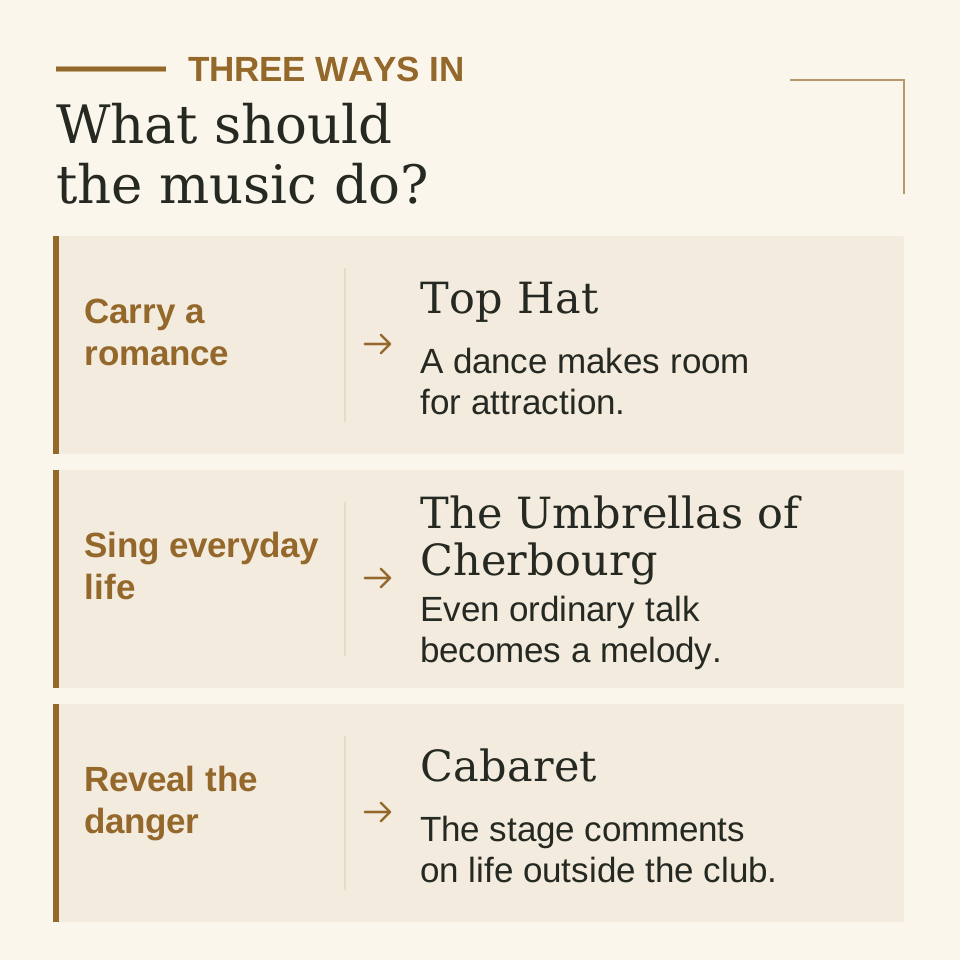
To lift the evening: Singin’ in the Rain is the most varied starting point; Top Hat concentrates on the pleasure of a partnership. The Band Wagon adds the comedy of people trying to make that pleasure for an audience.
To tell the whole story: try The Umbrellas of Cherbourg. Its continuous singing is a different contract from a film that alternates conversation and set pieces. Give it a little time to establish its rhythm.
To make you uneasy: Cabaret locates music in a public place and asks what that place permits people to overlook. All That Jazz turns inward. The Red Shoes reaches its most extraordinary passages without needing lyrics at all.
Momo’s Note: In Top Hat, the dancing begins as a complaint from the room downstairs. That is an encouraging amount of trouble for a romance to start with.
On screen
Films discussed
- Gold Diggers of 1933 (1933) · Mervyn LeRoy
- Top Hat (1935) · Mark Sandrich
- The Red Shoes (1948) · Michael Powell and Emeric Pressburger
- Singin’ in the Rain (1952) · Gene Kelly and Stanley Donen
- The Band Wagon (1953) · Vincente Minnelli
- West Side Story (1961) · Robert Wise and Jerome Robbins
- The Umbrellas of Cherbourg (1964) · Jacques Demy
- The Sound of Music (1965) · Robert Wise
- Cabaret (1972) · Bob Fosse
- All That Jazz (1979) · Bob Fosse
Further reading
Read next in the Journal


Want a recommendation shaped around your evening? Ask Momo what to watch next →