See Films Differently Momo Notices
Is London Really Such a Rainy City?
Compare Heathrow, Kew and Cardiff rainfall with the same period and rain-day threshold, then take Momo’s London detour into It Always Rains on Sunday.
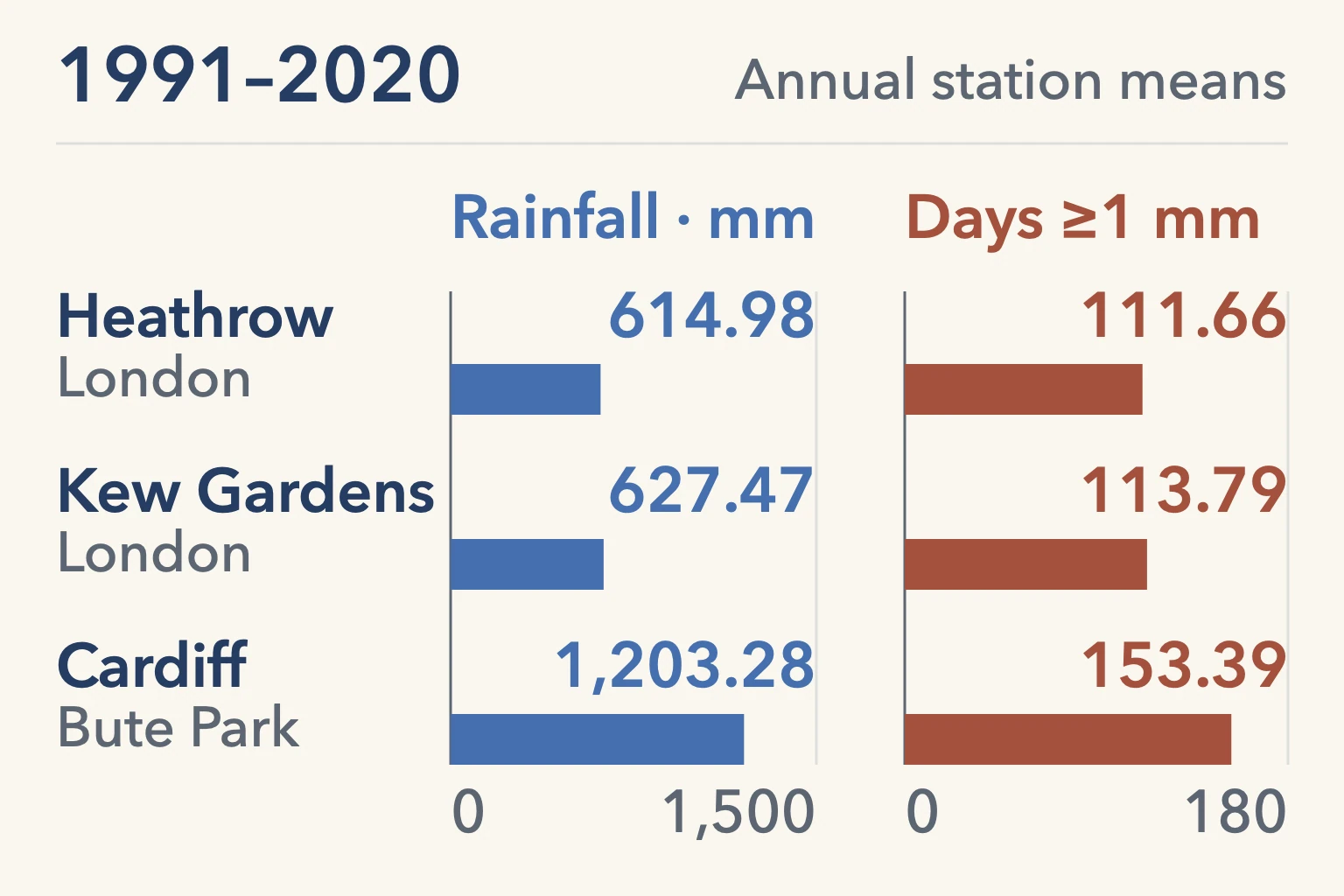
At Heathrow, the Met Office’s 1991–2020 averages record about 615 mm of rainfall a year. At Cardiff’s Bute Park, the figure is about 1,203 mm. On that comparison, London’s rain has been given rather a large speaking part.13
There is a clear answer here: the two London stations below have less rainfall, and fewer days reaching 1 mm, than the Cardiff station. Calling London a “rainy city”, though, leaves several questions bundled together. How much water arrives? How often does it arrive? How long does it keep you indoors? And which London are you picturing?
How much, and how often?
These are annual averages for the same thirty years, 1991–2020, from three named Met Office stations. The rain-day column counts days with at least 1 mm of rainfall. The decimal days come from averaging across years; nobody recorded two-thirds of a Tuesday.4
| Weather station | Average annual rainfall | Average days per year with rainfall ≥1 mm |
|---|---|---|
| Heathrow, London | 614.98 mm | 111.66 |
| Kew Gardens, London | 627.47 mm | 113.79 |
| Cardiff, Bute Park | 1,203.28 mm | 153.39 |
Sources: Met Office station tables.123 These are station averages for particular locations, rather than averages over each whole city. Heathrow and Kew provide two London examples; they do not cover every neighbourhood.
Dividing Cardiff’s annual total by Heathrow’s gives about 1.96 times as much rainfall: 1,203.28 ÷ 614.98. Dividing their rain-day figures gives about 1.37 times as many days: 153.39 ÷ 111.66. The gaps in amount and frequency are quite different.
Kew’s annual total is 12.49 mm above Heathrow’s, with 2.13 more days reaching the threshold. Changing between these two London stations leaves the direction of the Cardiff comparison intact. It gives us a useful local check, without turning three rows into a world league table.
A rain day can be a very small appointment
The 1 mm threshold makes the count comparable, but leaves plenty of weather outside it. Rain below that amount can still fall on a day that fails to qualify. Subtracting 111.66 from the number of days in a year would therefore overstate the number of completely rain-free days at Heathrow.
Duration asks a different question. Imagine a day with a twenty-minute shower and another with hours of drizzle. Provided both reach 1 mm, each earns one rain day. Your afternoon may give them very different reviews.

Intensity asks how quickly the water falls. An annual total divided by a count of days cannot tell us that rate, because we still do not know the hours spent raining. These averages cannot establish that London specialises in lingering drizzle, however neatly that might fit the picture in your head.
Cloudiness needs its own evidence too. The Heathrow table records 1,674.81 hours of sunshine a year.1 That does not translate into a count of cloudy days: days differ in length, and one day can contain both sunshine and cloud. A grey-looking sky and measurable rainfall are separate observations.
I find “rainy” most useful when it keeps its chosen meaning attached. A rainfall total can answer a question about water. A count of qualifying days answers a question about frequency. An umbrella left by the door is a practical decision, rather than a third weather station.
The London I am taking you to next
For my next London, I am choosing Robert Hamer’s It Always Rains on Sunday (1947), a black-and-white film photographed by Douglas Slocombe.5 A magnificently unhelpful title if you are trying to organise a picnic.
My association starts with the BFI’s account of Tommy seeking shelter from the rain in a church doorway. The church is Holy Trinity in Camden. The story’s Bethnal Green is assembled from several parts of London: the main residential street is Clarence Way in Camden, while actual East End locations also appear.6
That makes this a particularly good companion to our table. Choosing a London weather station and constructing a London on screen both involve deciding which place will stand for the city. The decisions serve different purposes. A station supplies a long-term average for its location; a film can make a doorway, a street and someone’s need for shelter matter within a story.
I like this detour because it gives the word “rainy” something the table cannot supply: a situation. For the person seeking shelter, the relevant question is where to go. Cardiff’s larger annual total would be of very little assistance.

This is my reading of the connection. It supplies no evidence that this film created London’s rainy reputation, or that its rain represents the city’s usual weather.
So, is London really such a rainy city? In the matched comparison here, Heathrow and Kew receive less annual rainfall and have fewer days reaching 1 mm than Cardiff’s Bute Park. The broader image still needs you to say what you mean by “rainy”. I would keep the measurements beside that image—and allow Hamer his church doorway.
References
- Met Office. “Heathrow Location-specific long-term averages.” Station table, 1991–2020. metoffice.gov.uk. Accessed 2 October 2026.
- Met Office. “Kew Gardens Location-specific long-term averages.” Station table, 1991–2020. metoffice.gov.uk. Accessed 2 October 2026.
- Met Office. “Cardiff, Bute Park Location-specific long-term averages.” Station table, 1991–2020. metoffice.gov.uk. Accessed 2 October 2026.
- Met Office. “Location-specific long-term averages.” Climate averages notes and explanation of tables. metoffice.gov.uk. Accessed 2 October 2026.
- Rialto Pictures. “It Always Rains on Sunday.” Distributor catalogue; credits and Black & White format. rialtopictures.com. Accessed 2 October 2026.
- Scovell, Adam. “The pretend East End of It Always Rains on Sunday, the classic Ealing noir.” BFI, 11 September 2024. bfi.org.uk. Accessed 2 October 2026.
For the next unexpected question, follow the Journal in your RSS reader.
On screen
Films discussed
- It Always Rains on Sunday (1947) · Robert Hamer
Further reading
Read next in the Journal


Want a recommendation shaped around your evening? Ask Momo what to watch next →