Why Do Wet Roads Look Darker?
Why do wet roads look darker yet shine under street lights? Explore the optics, then see the effect in the black-and-white thriller The Third Man.

Wet roads often look darker because water changes how light enters and leaves their rough, absorbing surfaces. More light can enter the material or be returned to it for another chance of being absorbed, leaving less scattered light to reach your eyes.
At the same time, a smoother water surface can reflect a lamp brightly towards you. A dark road and a shining reflection are therefore entirely compatible: they involve different paths and directions of light. [1] [2]
Clear water has not dyed the road black. The change is largely in how you see the existing material through water instead of air. The same question applies to concrete pavements and paving stones, though the strength of the effect varies.
Start with a Dry Road
A road does not produce the light by which you see it. Sunlight, skylight or artificial light arrives, interacts with the surface, and some of it reaches your eyes.
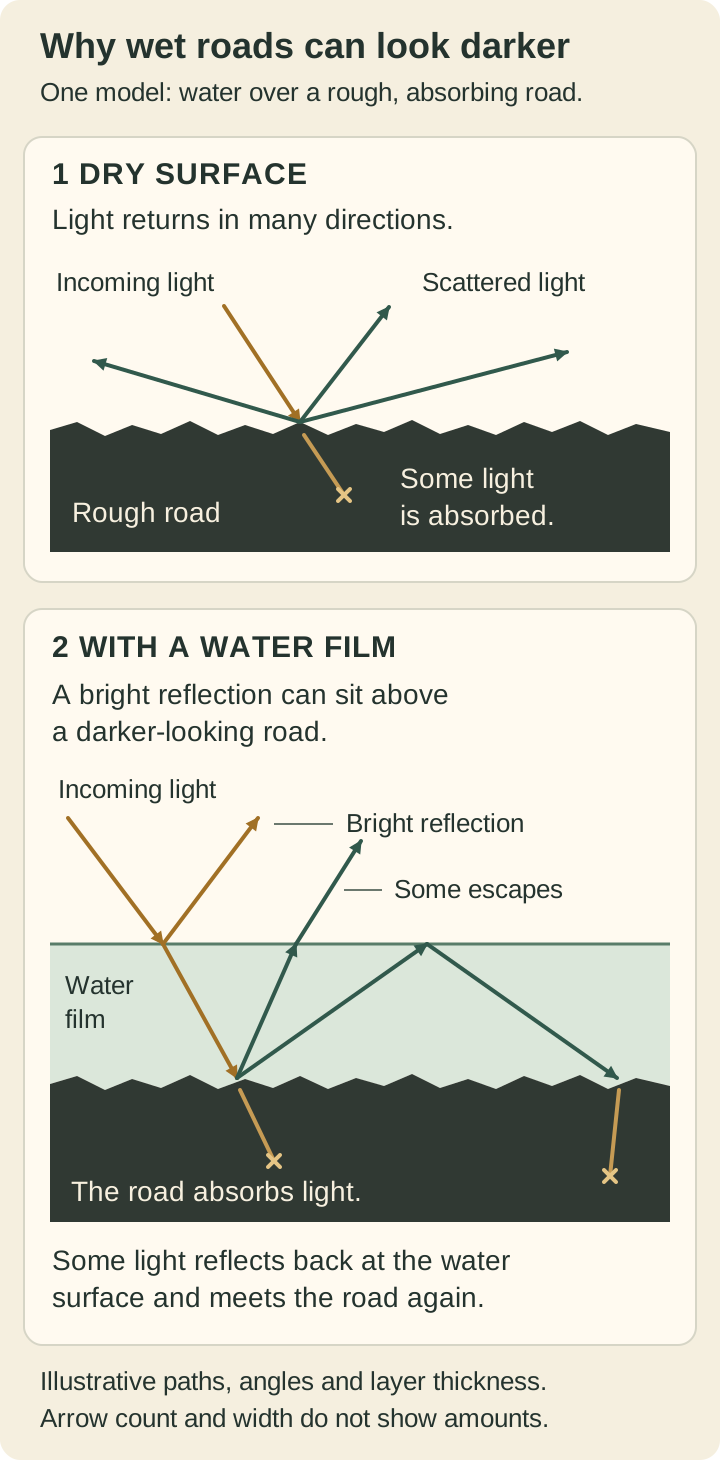
On a dry, rough surface, small features face different directions. Light reflected from them spreads out rather than forming one neat reflection of the source. Light can also enter the material and scatter at grains, pores and other internal boundaries. Some escapes; some is absorbed. This broadly scattered return is what gives a surface its matt appearance. [1] [3]
The useful distinction is between diffuse reflection, spread across many directions, and specular reflection, concentrated around the mirror-like direction. A surface can provide both. Even a dull patch of asphalt reflects some light; without that return, you could not make out its texture. [3]
What Water Changes
Water can collect in small hollows, coat exposed material and, where the structure allows it, enter spaces previously occupied by air. A damp patch and a continuous film of water need not behave identically.
Light Can Enter the Material More Readily
Air, water and the solids in a road have different refractive indices. A refractive index describes how light travels through a material; differences between neighbouring materials affect how light bends and reflects at their boundary. Transparency does not mean that a boundary has no optical effect. A clear window, for example, can transmit a view and reflect part of the room at the same time. [3]
Water’s refractive index is often closer to that of the solid than air’s is. Replacing an air–solid boundary with a water–solid boundary can reduce reflection there, allowing more light into an absorbing material. This is one contribution to wet darkening, not a claim that water reduces every reflection everywhere. [1]
Some Returning Light Gets Sent Back Down
Now follow light that has passed through a water film, struck the rough road and scattered upwards. It must cross the water–air boundary to escape. Depending on its direction, some is reflected back towards the road instead. NC State’s explanation highlights this return from the underside of the water surface. [4]
For light travelling inside water, meeting that boundary at a sufficiently shallow angle to its surface produces total internal reflection: the light is sent back into the water rather than transmitted out into the air. Other angles permit escape, with some partial reflection. The redirected light can meet the road again and be absorbed there. It is not trapped forever, and the water need not contain any dark pigment. [1] [4]
Water in Pores Changes Scattering Too
There is another route, particularly important in granular materials such as sand. Water between grains reduces the optical difference between a grain and its surroundings. Scattering then tends to turn light less sharply, keeping more of it travelling forwards into the material.
Light may consequently need more scattering encounters before it turns back out. Those extra encounters increase its chances of being absorbed. Twomey, Bohren and Mergenthaler’s research describes this mechanism for sand and soils. It should not be treated as an identical microscopic account of every road, fabric or window. [5]
These explanations share an important feature: the absorbing material matters. Water changes the routes; the road or grains can absorb more of the light travelling along them. Saying only that water smooths the surface leaves out this part of the darkening.
Why Are Wet Roads Shiny at Night?
Not all incoming light reaches the road beneath the water. Some reflects directly from the upper air–water boundary. Where water forms a relatively smooth surface, that reflection is more directional than the scattered return from the dry road. [2]
A street lamp therefore need not brighten the whole wet patch evenly. Its reflection reaches you where the lamp, the reflecting surface and your eyes have the right alignment. Elsewhere, the surface may be reflecting a much darker part of the surroundings towards you. The reflection is not a bright stripe painted permanently onto the road: another observer can see it in a different place. [3]
Real wet streets are uneven. Water covers bumps, fills hollows and sometimes ripples. Many small areas with slightly different slopes can send parts of a lamp’s reflection towards the same observer, stretching or breaking it into a bright trail rather than a tidy image. The same principle spreads a reflected moon across an uneven lake. [3]
This also happens in daylight. At night, an isolated bright lamp against dark surroundings makes the contrast especially conspicuous. Looking along a water-covered surface at a shallow angle can make its reflections prominent, but there still has to be something bright in the appropriate direction to reflect. [2]
A surface can return less light overall yet give a strong reflection in one direction. Your eye receives light from a particular direction, not a total collected from every possible viewing position. Away from the highlight, the darker material can dominate; within it, the reflection of the light source can dominate.
Why the Material and Conditions Matter
There is no universal wetness-to-darkness ratio. A rough, pale paving slab, dark asphalt and a polished stone can start with very different scattering and absorption. The amount and distribution of water matter too: separate droplets, a damp porous surface and a puddle do not create the same boundaries.
It helps to keep these cases separate:
- Asphalt and concrete: a water film over a rough, absorbing solid is a useful starting model. Their texture and composition still differ.
- Sand: spaces between separate grains make changes to internal scattering particularly important.
- Cloth: fibres, gaps, dyes and thickness all matter. Wetting can change how much light passes through, as well as how much comes back.
- Smooth, clear glass: much of the light already passes through it. Adding water changes surface reflections and refraction, but does not turn it into a rough, opaque road.
Lekner and Dorf explicitly distinguish rough solid surfaces, granular materials and fabric when discussing the limits of their models. Research on rendering wet materials likewise considers both surface water and water within a material, including increased translucency in thin sheets. Neither justifies saying that everything must become darker from every angle. [1] [2]
A Small Indoor Observation
Try an uncoated stone or terracotta coaster that is safe to wet. Place it in a tray, leave one part dry and put a little clean water on another.
Under a fixed light, change your seated viewing position slightly. The wet patch may look darker until a bright reflection comes into view. If the water soaks in quickly, the sheen may be weak or absent.
The useful observation is the difference between the patch’s general tone and a highlight that depends on where you look. This is not a measurement of absorption: it is a way to notice two kinds of light return on the same surface.
A Black-and-White Film to Watch: The Third Man
Carol Reed’s The Third Man (1949) follows an American writer into postwar Vienna, where an expected reunion becomes a mystery. Its black-and-white photography, by Robert Krasker, gives wet streets a striking presence. The BFI describes the deliberate dousing of streets with water to create night-time reflections as part of the film’s visual treatment. A wet street on screen is not, by itself, evidence that rain was falling during the take. [6]
When watching, look at the ground between the characters. Notice how a bright reflection picks out a stretch of street while neighbouring areas remain dark, and how the broken highlights help reveal its texture. Follow where the light appears, rather than looking only for its source.
This is a film to enjoy, not an experiment proving an optical theory. Lighting, exposure and the finished image shape what reaches the screen. The pleasure is in seeing how filmmakers can make a familiar surface carry so much light without making the whole street bright.
Our guide to The Third Man offers a fuller introduction if you would like to watch it.
References
The optics sources support the explanation of light and materials. The BFI supports the film context and deliberate wetting of streets; the viewing suggestions are Monocurator’s editorial connection.
- John Lekner and Michael C. Dorf, ‘Why some things are darker when wet’, Applied Optics 27(7), 1278–1280 (1988), DOI: 10.1364/AO.27.001278. Full text consulted through the author-uploaded PDF, especially sections II–IV.
- Henrik Wann Jensen, Justin Legakis and Julie Dorsey, ‘Rendering of Wet Materials’, in Rendering Techniques ’99, 273–281 (1999), DOI: 10.1007/978-3-7091-6809-7_24. University-hosted manuscript, introduction and sections 2 and 5. This is a modelling study; its rendered examples were not directly validated against measurements.
- Paul Peter Urone and Roger Hinrichs, College Physics 2e, OpenStax (2022), section 25.2, ‘The Law of Reflection’, and section 25.3, ‘The Law of Refraction’.
- Matt Shipman, ‘Why Do Things Look Darker When They’re Wet?’, NC State University, 5 July 2024, with expertise from Michael Kudenov. Used for the water–air internal-reflection explanation, not as a complete account of all wet materials.
- Sean A. Twomey, Craig F. Bohren and John L. Mergenthaler, ‘Reflectance and albedo differences between wet and dry surfaces’, Applied Optics 25(3), 431–437 (1986), DOI: 10.1364/AO.25.000431. Abstract consulted; cited for its stated account of scattering and absorption in sand and soils.
- Neil Mitchell, ‘Location, location, location: Vienna and The Third Man’, British Film Institute, 24 June 2015.
On screen
Films discussed
- The Third Man (1949) · Carol Reed
Continue exploring on Monocurator

Want a recommendation shaped around your evening? Ask Momo what to watch next →