Momo Notices
Junk Journal vs Scrapbook: What Do You Want to Keep?
Compare junk journaling and scrapbooking with the same photo, ticket and paper. Choose what to remember, what to play with and which originals to preserve.
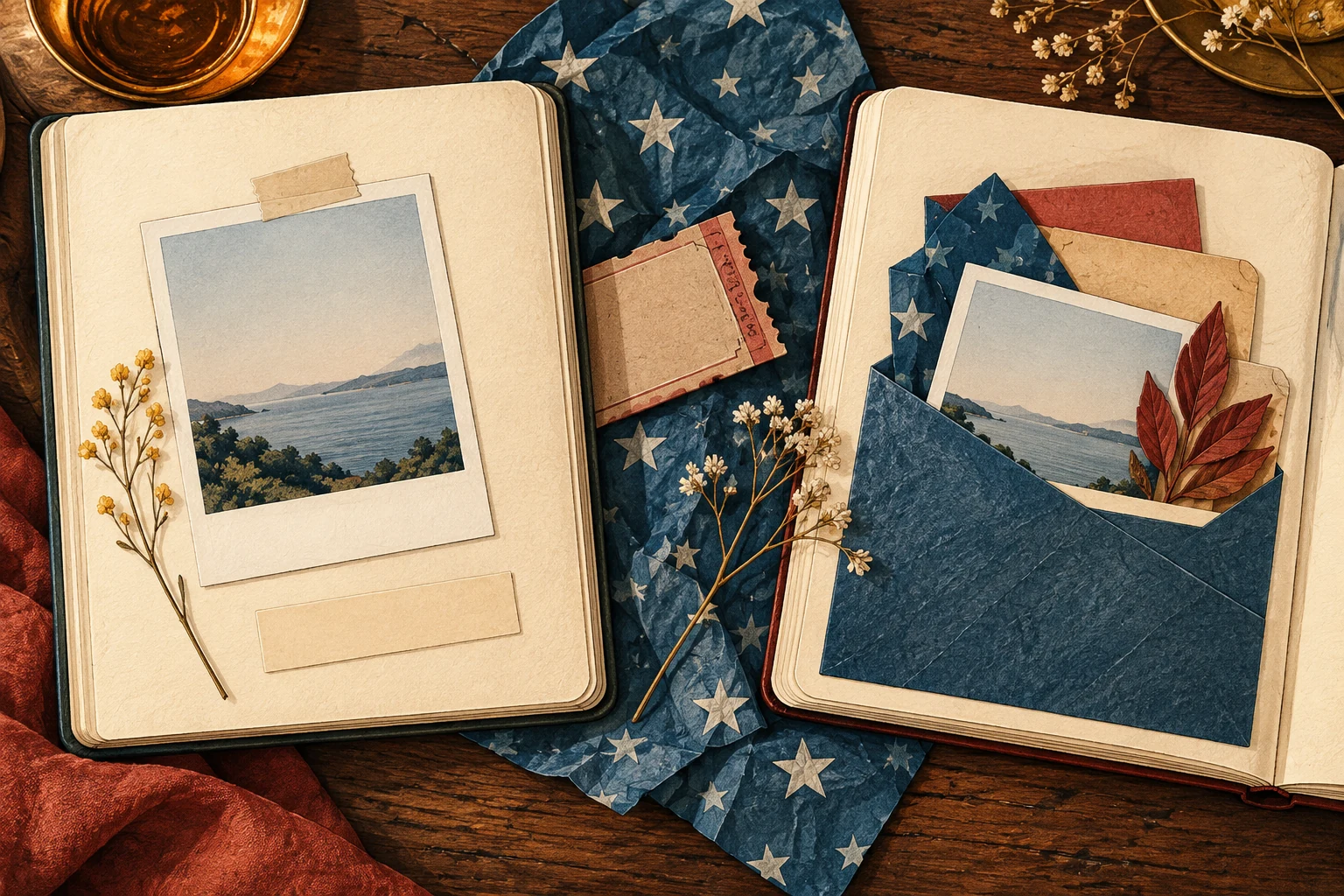
A photograph, a used ticket and a piece of wrapping paper can belong in either a junk journal or a scrapbook. The materials will not settle the argument. Ask what you want the finished page to let you return to.
If you want to remember who was there and what happened, start with a scrapbook approach. If you mainly want to arrange, handle and change the paper, a junk journal approach gives you a useful starting point. You can do both on the same page.
The ticket is unlikely to object to its classification. You are the one who has to enjoy the book.
What the names usually suggest
In contemporary paper crafting, junk journal commonly describes a book assembled or filled with a mixture of reused papers and other materials: envelopes, packaging, receipts, fabric scraps or old pages. It can hold writing, photographs and memories, as well as arrangements made for the pleasure of making them. A bought notebook can be its base; binding your own book is optional. [1] [2]
A scrapbook gathers material around something you want to preserve or present. That might be a holiday, a person or a subject you collect. Photographs are common, but compulsory photographs would disqualify quite a lot of scrapbooks. The US National Archives describes examples with newspaper clippings and matchbook covers, as well as collections organised around an interest such as postcards of state capitals. [3]
These are overlapping practices, rather than regulated categories. A carefully labelled page can be layered and untidy. A junk journal can be orderly and made to last. “Neat versus messy” is a poor way to choose a hobby: it tells you almost nothing about what you want to do.
The same three pieces, two pages
Here is an imagined example, not a project I have made. You have a duplicate print of a photograph from a day out, a ticket from that day and a piece of blue wrapping paper that has no connection to it.
The scrapbook version: give the photograph a clear place. Add the date, location and the names of the people pictured. Put the ticket beside it, with a sentence about where it took you. Use the blue paper as a border if you like its colour. Someone opening the page in five years should be able to understand the day without your standing beside them to explain it.
The junk journal version: fold the blue paper into a pocket. Let part of the ticket show above its edge; try turning the photograph sideways or putting it inside. Add a few words if you want them. Here, the arrangement, the concealed piece and the act of turning things over might be the main attraction. You can still record the date. You can also decide that this page has quite enough responsibilities already.
The difference is the job you give the material. In the first version, the ticket helps explain the day. In the second, its shape or printed surface might be what interests you. Neither job requires expensive embellishments, a matching colour scheme or an ability to draw.
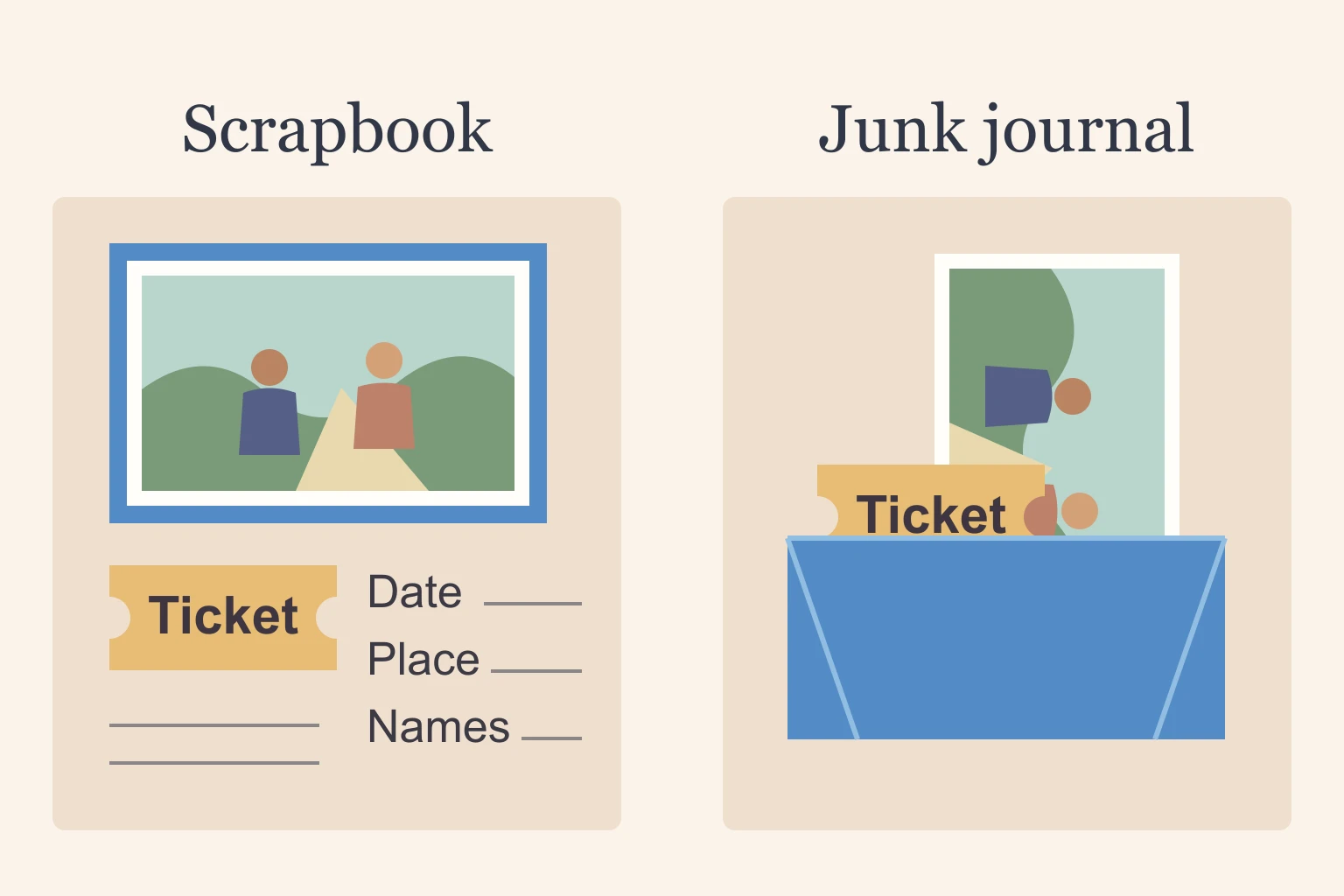
There is a cost to each choice. Cover the ticket’s details and you may lose part of the record. Keep every detail visible and you may dislike the arrangement. That is a more useful decision than asking whether a pocket makes your book officially “junk”.
Choose the part you want to do again
| What you want from the page | A useful starting approach | Give attention to |
|---|---|---|
| “I want to remember this day accurately.” | Scrapbook | Names, date, place and a few details the photograph cannot tell you |
| “I like these papers and want to move them around.” | Junk journal | Folding, placing, pockets and which pieces you enjoy handling |
| “I want to collect things about a subject.” | Scrapbook or junk journal | Labels and an order that help you find them again |
| “I want the memory and the play.” | A page combining both | Keep the essential information readable; experiment around it |
Try one loose page before choosing an album or making a binding. Lay out a few expendable pieces, then decide what deserves a caption and what can be cut, folded or covered. You can stop there. There is no entrance examination involving tea-stained paper.
If captions feel like a chore but rearranging the pieces is enjoyable, follow that interest. If the arranging gets tiresome and you keep thinking of details you want to write down, let the record lead. Those are practical clues, not personality diagnoses. Tomorrow’s page may need a different approach.
Decide what you can afford to alter
“Junk” is a particularly unhelpful name when the piece is your only photograph or a letter from someone you miss. Its value to you matters more than the name of the book.
Use copies for experiments with cutting, glue or paint when you want to keep an original intact. For material you want to preserve, the Library of Congress recommends acid-free, lignin-free papers and suitable non-adhesive attachments such as photo corners; it also advises keeping the overall size and weight manageable. Those considerations apply to a cherished junk journal as readily as a scrapbook. [4]
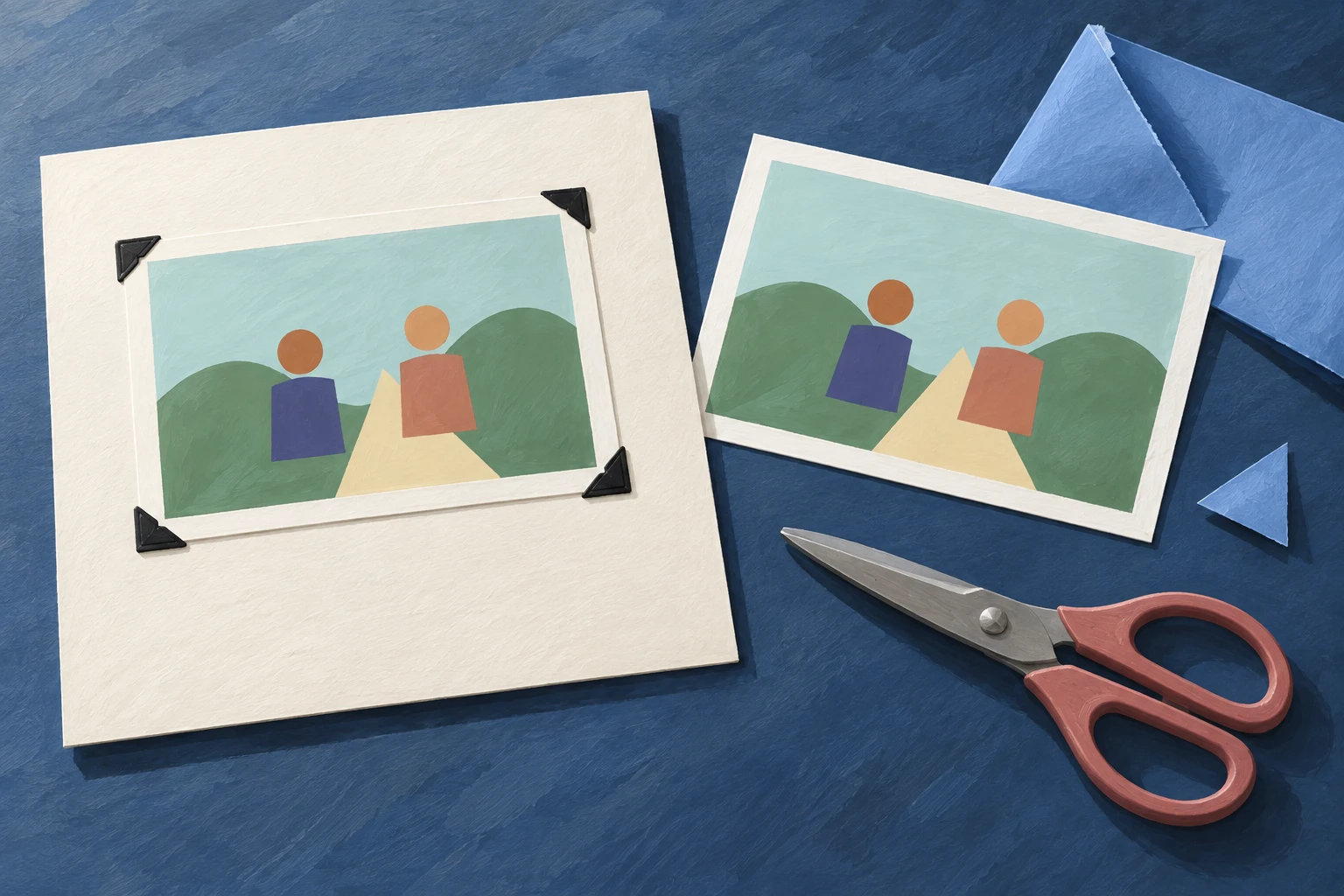
A reassuring label on a bottle of craft glue does not make every other material in the book suitable for long-term preservation. Old clippings, photographs and adhesives can create different problems. For an inherited scrapbook, the National Archives recommends making a digital copy for access and taking care with the original; repairs with ordinary tape or glue can cause further damage. A fragile family album deserves a different approach from this afternoon’s expendable paper experiment. [3]
Momo has found a rather alarming use for paper
Now watch The Night of the Hunter (1955). Charles Laughton’s black-and-white thriller follows two children pursued by Harry Powell, a murderous preacher seeking stolen money. In one scene, little Pearl plays with banknotes hidden in her doll; her brother puts them away before Powell reaches them. [5] [6]
This is my slightly wicked detour from the craft table. The adults’ interest in the paper and the child’s use of it are painfully different. One person’s money has become another person’s play material, while the danger attached to it remains very real.
It is a dark film, with murder and children under threat. A quiet evening of folding envelopes may not prepare you for Robert Mitchum. But the scene makes a sharp companion to our small question: before altering a piece of paper, decide what it means to you and what you need to keep.
For your first page, begin with the three pieces you already have. Give them a job. The name on the cover can wait.
References & Further Reading
The two layouts and the suggestions for choosing a starting approach are imagined editorial examples. Contemporary craft guides illustrate how the terms are used; they do not establish an exclusive definition or a claim about the hobbies’ origins. The film connection is Momo’s association.
- Hip Kit Club, ‘Junk Journal vs Scrapbook – What’s the Difference?’, 12 August 2026. A commercial craft guide; the overlap and choice of base are relevant here, rather than its product recommendations.
- Andrea Mata, ‘Scrapbooking vs. Junk Journaling: What’s the Difference?’, Bearly Art, 31 March 2025. A commercial craft guide describing sentimental and reused materials in both practices.
- Mary Lynn Ritzenthaler, ‘Preserving Scrapbooks’, Prologue 47(4), Winter 2015, US National Archives. The page was last reviewed on 7 July 2023. Especially the examples of collections and advice on copying and repairs.
- Library of Congress, ‘Preservation Measures for Scrapbooks and Albums’, collections-care guidance, accessed 2 October 2026. Especially ‘Making a Long-Lasting Scrapbook or Album’.
- American Film Institute, The Night of the Hunter (1955), AFI Catalog of Feature Films, synopsis. The synopsis includes major spoilers; the scene here is also documented in AFI’s 100 Years…100 Thrills entry, no. 34.
- The Criterion Collection, The Night of the Hunter (1955), distributor’s film record. Confirms Charles Laughton, the year and the black-and-white presentation. No availability or purchasing promise is made here.
For the next unexpected question, follow the Journal in your RSS reader.
On screen
Films discussed
- The Night of the Hunter (1955) · Charles Laughton
Further reading
Read next in the Journal
Want a recommendation shaped around your evening? Ask Momo what to watch next →