See Films Differently Film history
Making Room Between Words: The Linotype’s Expanding Spaces
How Linotype spacebands widened the gaps between words, and why correcting one letter meant casting a new line of type.
How do you make different words fill the same width without stretching the letters? Inside the Linotype, a pair of wedges helped do the work.
Consider a newspaper column with straight edges on both sides. Each line contains different words and a different number of letters. Yet the lines arrive neatly at the same right-hand boundary.
In Linotype setting, extra width could be taken up between words. The gaps widened while the letters kept their shapes.
Inside a Linotype composing and casting machine, those gaps had dedicated metal parts. Even the places where nothing would be printed needed something to occupy space.
A keyboard that makes a metal line
Pressing a key selects a matrix: a small piece carrying the recessed shape of a character. The matrices assemble in sequence. From the assembled line, the machine casts a strip of type metal bearing a whole line of characters, called a slug. It produces metal type for printing, with paper and the printing press coming later in the process. [2][4]
Selecting the right letters is only part of the job. The line must also fit its allotted width.
Upwards becomes sideways
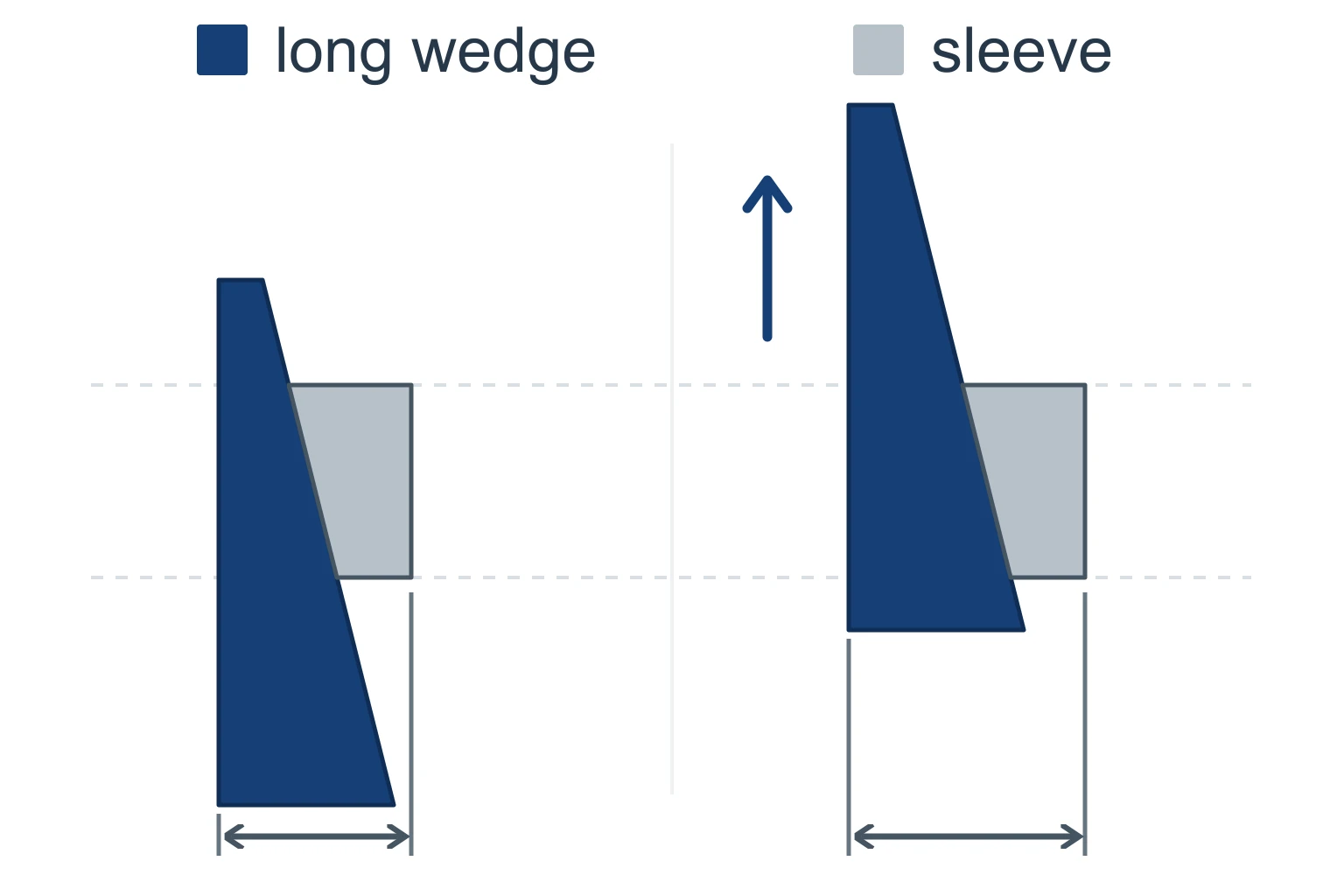
A part called a spaceband occupies a word space. It consists of a long wedge and a shorter sleeve which slide against one another. [2]
Hold the shorter part in position and push the long wedge upwards: their combined thickness increases. A vertical movement makes room sideways. A 1927 patent for an improved spaceband describes this underlying arrangement. [3]
The sloping surfaces move past each other, changing the width of the pair. The metal itself does not stretch. Widening the word spaces makes the assembled line fill its allotted width, a process called justification. [2]
Imagine that a line is 2 mm short, with four word spaces. Widening those spaces by an average of 0.5 mm would use up the shortfall. That is an illustrative calculation, not a specification for a particular machine; it shows where the missing width can go.
The wedges have a finite range. A compositor still has to decide where a line should end; the machine cannot fit an arbitrary number of words into a column. This explanation concerns text adjusted through word spaces, not every writing system or method of setting type.
One wrong letter, one new line
After casting, the matrices and spacebands return by separate routes to be used again. [2] The white space on the page is not a trace left by a part touching the paper. The spacing established by the parts passes into the cast line, ready for printing.
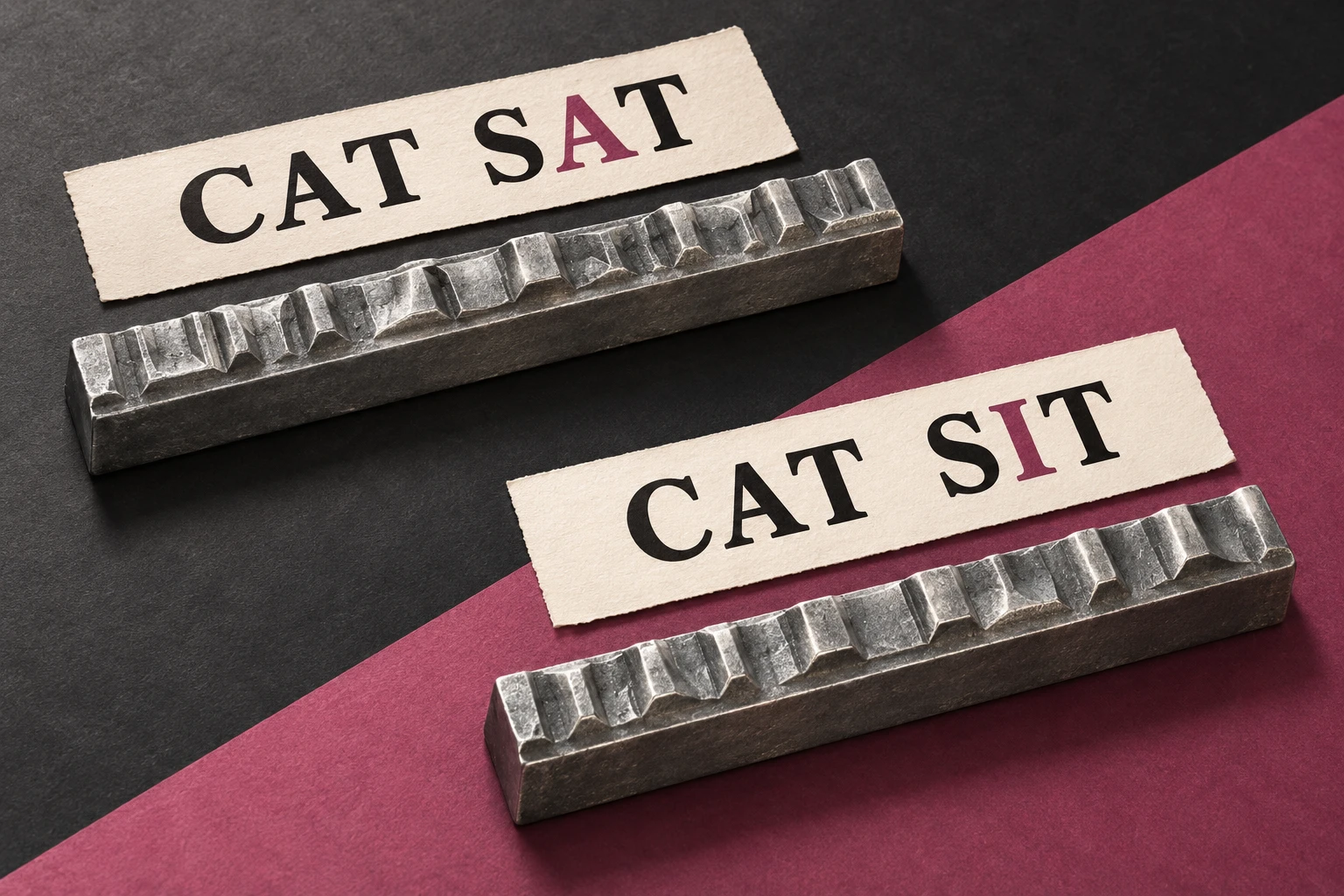
Casting a whole line also establishes the unit of correction. The Museum of Printing explains that a typographical error required the line to be reset and recast. If the correction changed the spacing enough, neighbouring lines could need attention too. [4]
On a screen, replacing one letter can appear to be a tiny, isolated action. In a cast Linotype slug, the wrong character cannot simply be lifted out like a separate piece of type. Correcting one letter means making another line.
A machine still needs someone who knows it
Doug Wilson’s documentary Linotype: The Film (2012) concerns the machine and the people connected to it. Its makers identify the passing of operators’ skills to another generation as one of its questions. [1]
The mechanics explain why those skills matter. Choosing a line break and correcting a proof are decisions made around the machine’s capacity to cast a whole line. Preserving the equipment alone does not preserve the judgement needed to use it.
After casting, the spaceband returns to its box. Its work survives in the line of type and, eventually, in the gaps a reader sees on the page. Even the blank parts of a newspaper had machinery behind them.
I’m taking you to the pictures
We’ve made room between the words. Naturally, I’m taking you to Howard Hawks’s His Girl Friday (1940), where Cary Grant and Rosalind Russell seem determined to leave none in the dialogue. [5][6] I shall count that as a connection.
References & Further Reading
-
Linotype: The Film, ‘About the Film’. The production’s introduction, filmmaker credits and release history; film released in 2012. Page undated.
-
Alvin G. Swank and Raymond Means, Linotype Mechanism, Indianapolis: Swank and Means, 1924. A contemporary technical textbook, especially ‘The Keyboard’, ‘The Spacebands’ (pp. 33–35), and ‘The Justification Levers and Vise Justification’ (pp. 118–119). Public text at Project Gutenberg.
-
Joseph Lee Rousseau, ‘Justifying spacer or space band’, US Patent 1,635,960, 12 July 1927. A patent for an improvement, describing the two-part spacing mechanism as an existing arrangement; not evidence that it was invented in 1927.
-
Museum of Printing, ‘The Museum Collection’, ‘Linotype Model 31’ and ‘Make-up and Correction’. Museum account of machines and processes; undated.
-
The Criterion Collection, His Girl Friday (1940). Film information, synopsis and credits; directed by Howard Hawks, black and white. Page undated.
-
The Criterion Collection, ‘Words in Edgewise: Dialogue in His Girl Friday’, Current, 12 January 2017. The accompanying text discusses overlapping speech; the embedded interview clip was not used.
The mechanical account draws on technical and museum sources. The film introduction uses the production’s description. The connection between the mechanism and the documentary is Monocurator’s interpretation; Momo’s detour into His Girl Friday is an association about word spacing and overlapping speech.
For the next unexpected question, follow the Journal in your RSS reader.
On screen
Films discussed
- His Girl Friday (1940) · Howard Hawks
Further reading
Read next in the Journal
Want a recommendation shaped around your evening? Ask Momo what to watch next →