What to watch next
10 Classic Comedy Movies: Choose Your Kind of Laugh
Find a classic comedy for tonight: ten films compared by humour, mood and running time, from Buster Keaton and screwball romance to Mel Brooks and Airplane!
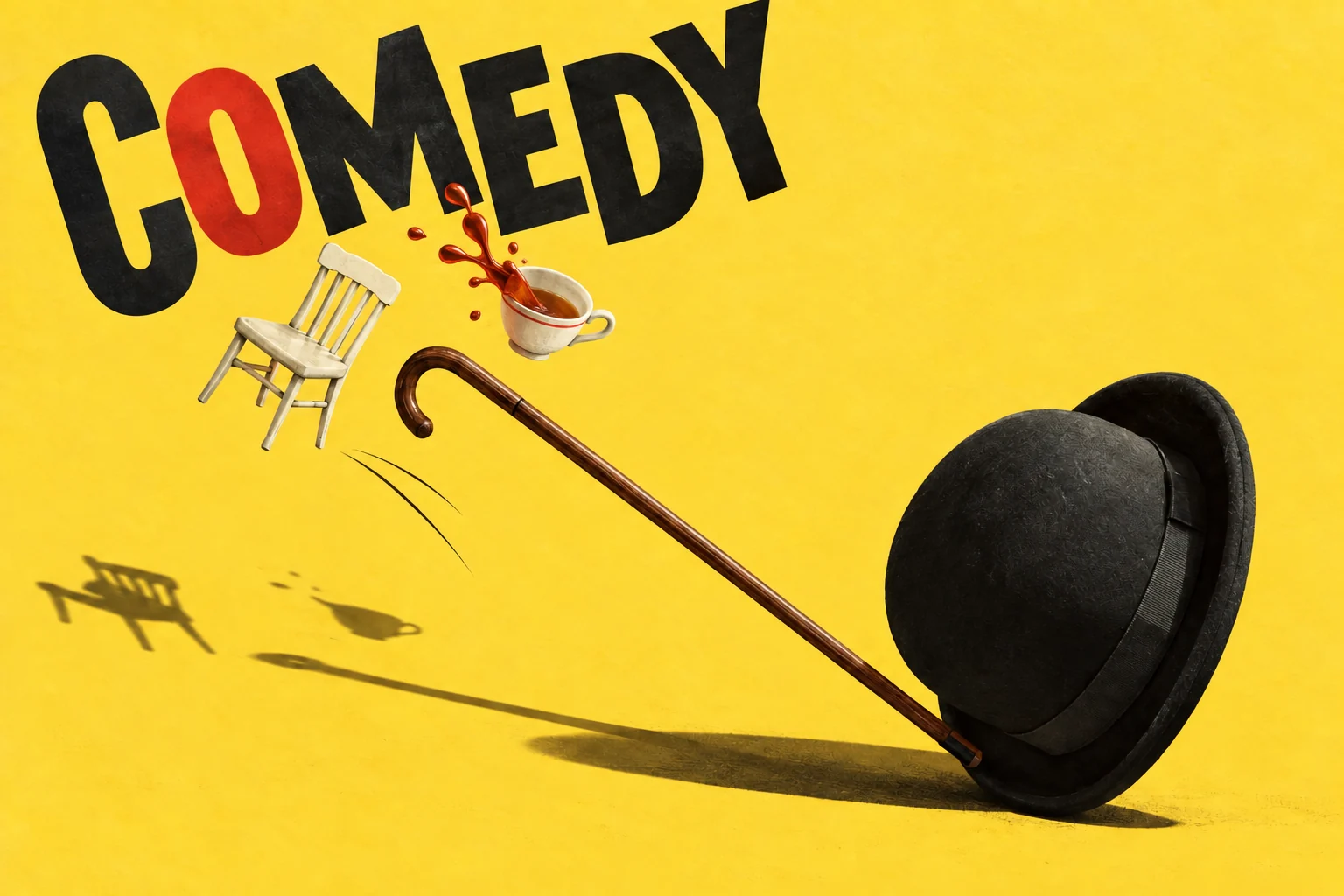
The best classic comedy for tonight depends on what makes you laugh. A beautifully timed fall, two people interrupting each other and a joke so ridiculous that nobody acknowledges it offer quite different evenings.
For a quick choice:
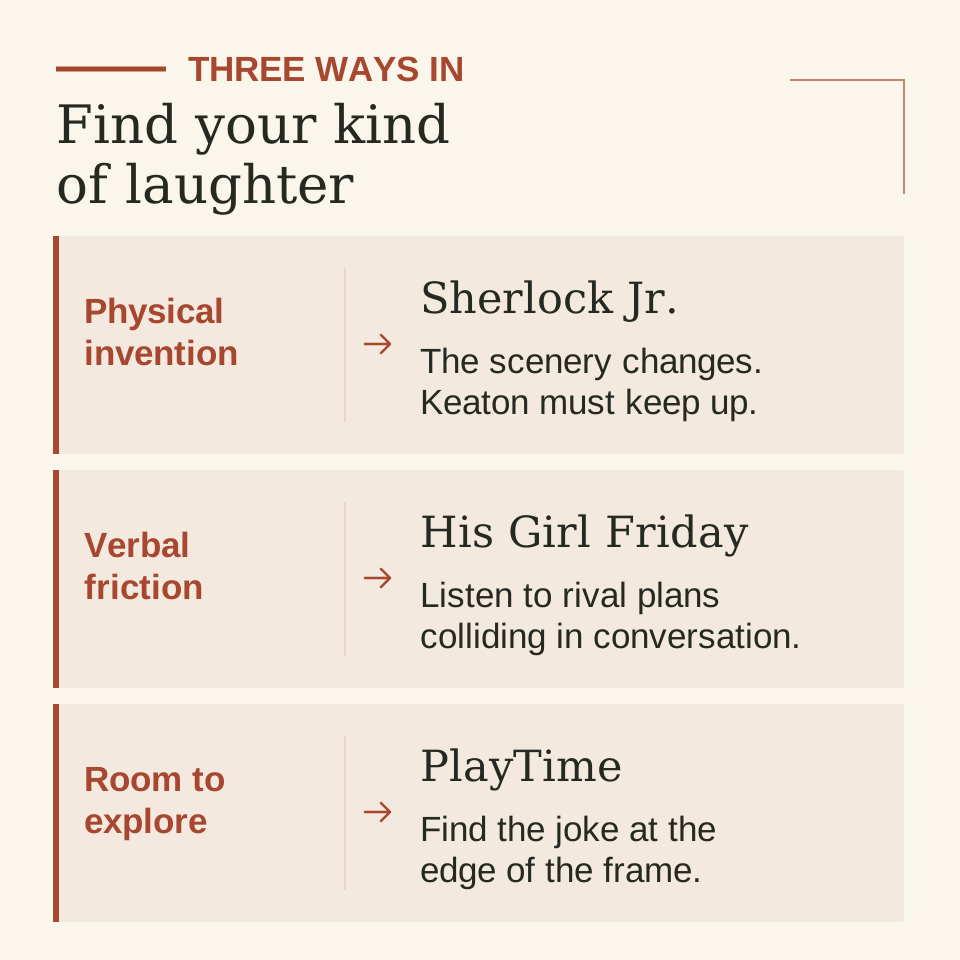
- A short burst of visual invention: Sherlock Jr., in which a cinema projectionist dreams himself into the picture.
- People who think faster than they behave: His Girl Friday, a newspaper comedy with competing conversations and very questionable ethics.
- As many jokes as the running time can hold: Airplane!, where the background can be as funny as the person speaking.
These ten films span silent comedy, screwball romance, British black comedy and colour spoofs. We chose them for the different pleasures they offer, rather than trying to arrange laughter into a historical league table.
Compare the films
| Film | Year | Time | Kind of comedy | Choose it for |
|---|---|---|---|---|
| Sherlock Jr. | 1924 | 45 min | Visual fantasy | One ingenious predicament after another |
| Duck Soup | 1933 | 70 min | Verbal and physical anarchy | Watching authority lose its dignity |
| Modern Times | 1936 | 87 min | Physical comedy with feeling | People trying to survive an unreasonable world |
| Bringing Up Baby | 1938 | 102 min | Screwball romance | Flirtation conducted as a chain reaction |
| His Girl Friday | 1940 | 92 min | Newspaper screwball | Fast talk and competing agendas |
| Kind Hearts and Coronets | 1949 | 106 min | Black comedy | Murderous ambition expressed with perfect manners |
| PlayTime | 1967 | 123 min | Observational visual comedy | Finding your own joke in a crowded frame |
| The Producers | 1968 | 88 min | Theatrical farce | An outrageous plan collapsing in public |
| Young Frankenstein | 1974 | About 105 min | Horror parody | Affectionate monsters and serious faces |
| Airplane! | 1980 | 88 min | Disaster-film spoof | Literal-minded nonsense at speed |
Times follow the institutional or distributor presentations linked below. Silent-film editions can differ in accompaniment and speed; the 45-minute Sherlock Jr. is the BFI listing. Young Frankenstein is listed at 105 minutes by its studio.
Sherlock Jr. (1924): when the screen stops behaving
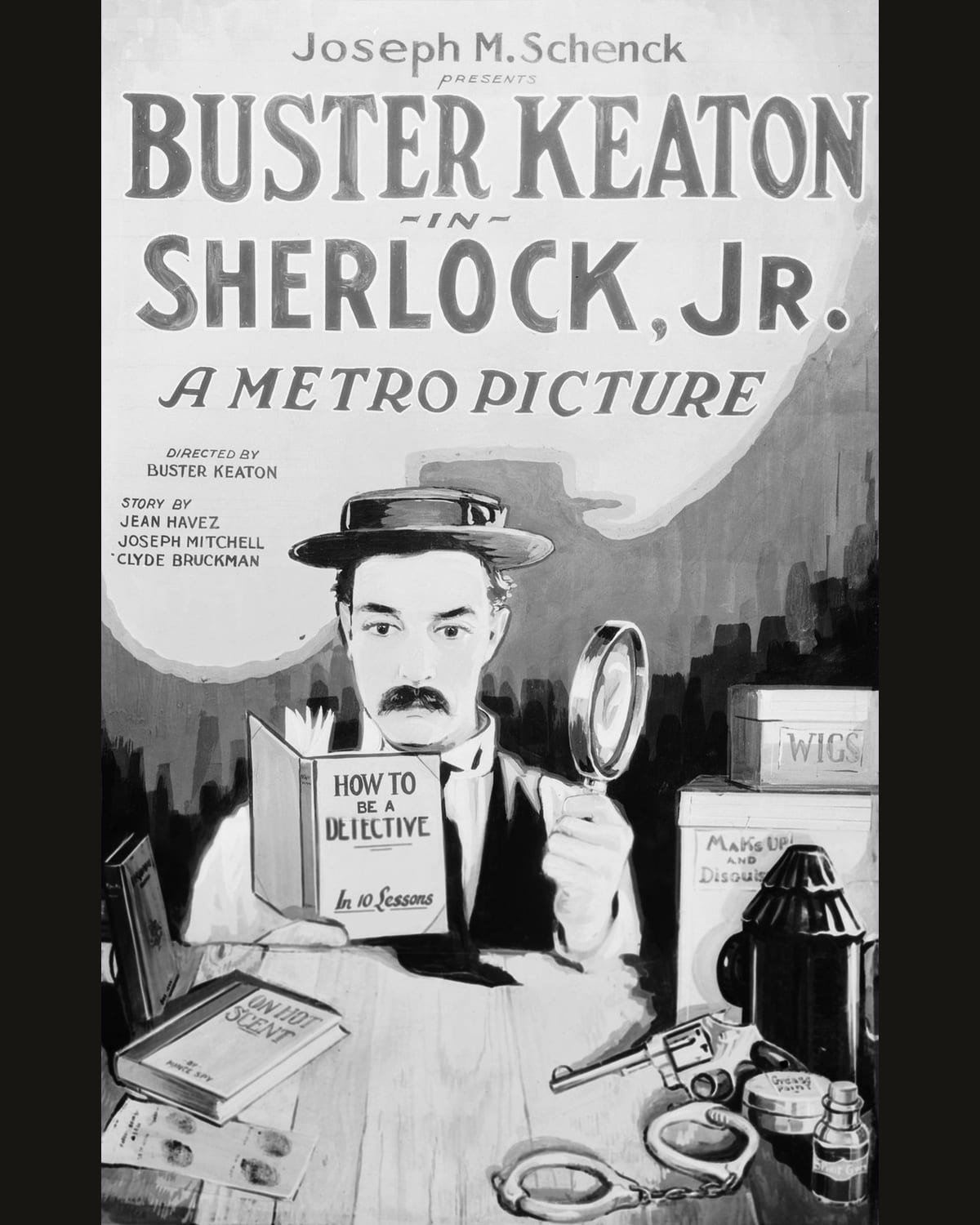
A cinema projectionist would like to be a detective. Once Buster Keaton’s daydream takes him inside a film, scenery changes around him with the ruthlessness of an editor who has forgotten there is a person standing there. The pleasure is partly anticipation: you see the arrangement, recognise the danger and still cannot quite predict the solution. 1
The attraction is how much can happen without dialogue. Keaton’s steady face leaves room for the furniture, vehicles and frame itself to misbehave. Our guide to Minions and silent comedy follows some of the same pleasures into modern animation. Explore the film.
Duck Soup (1933): absolutely nobody is in charge
The Marx Brothers take a government, a diplomatic crisis and the idea of respectable behaviour and leave very little standing. Groucho’s Rufus T. Firefly treats conversation as an opportunity to ambush whoever has spoken. Harpo and Chico find equally destructive uses for doors, hats and other people’s patience. 2
This is a good choice when you want comedy to be insolent. Apparently sensible phrases turn into insults, then a physical routine changes the rhythm. The brothers keep derailing diplomatic business instead of drawing you towards a romance or a tidy reconciliation. If you want an affectionate partnership to care about as well as jokes, try Modern Times. Explore the film.
Modern Times (1936): laughter under pressure
Chaplin puts the Tramp on a production line whose pace his body cannot comfortably obey. Work, hunger and the search for shelter keep creating practical problems; his solutions are graceful, ridiculous and sometimes briefly successful. Paulette Goddard’s resourceful young woman gives the film a second centre of energy. Made in the sound era, it still relies heavily on physical storytelling. 3
Choose this for feeling as well as movement. The production line turns a simple task into a losing contest with speed; Chaplin keeps the worker’s exhaustion at the centre of the joke. Compared with Keaton’s dreamlike precision, Chaplin invites more concern for the people caught in the mechanism. Poverty, prison and desperation are part of the evening; this is cheerful company in an uncheerful world. Explore the film.
Bringing Up Baby (1938): a romance with no brakes
Cary Grant’s palaeontologist wants to complete his skeleton, secure funding and get on with his carefully organised life. Katharine Hepburn’s Susan has other ideas, as does a leopard called Baby. Howard Hawks keeps objects, excuses and people circulating until a small misunderstanding becomes an environment from which nobody can escape. 4
The choice here is intensity. Susan’s attraction to David expresses itself through interruptions, improvised stories and a refusal to let the day settle. The comedy gets funnier as his confidence in his own dignity deteriorates. If you enjoy characters cooperating sensibly, their evening may exhaust you; if you like to watch a precise plan acquire one impossible complication after another, it is exhilarating. Explore the film.
His Girl Friday (1940): the conversation is the chase
Hildy Johnson intends to leave journalism and marry a dependable man. Her editor and former husband, Walter Burns, sees a major story as a means of keeping her at the newspaper. Rosalind Russell and Cary Grant conduct the resulting struggle through speech that overlaps, changes direction and rarely allows the other person a clear exit. 5
Choose it when you want verbal energy rather than visual gentleness. You can hear why Hildy belongs in this newsroom even while noticing how badly the newsroom treats people. That tension makes the romance more interesting than a simple contest between a boring suitor and an exciting one. The story involves an impending execution, and its treatment of suffering is deliberately hard-edged. Give the dialogue your attention; a distracted viewing loses much of the pleasure. Explore the film.
Kind Hearts and Coronets (1949): very civilised bad behaviour
Dennis Price plays a man whose route to an aristocratic inheritance has several relatives standing in it. Alec Guinness supplies the extraordinary family, while the narration keeps an elegant distance from the conduct it describes. Robert Hamer’s film gives its murders the measured delivery of somebody explaining an unfortunate administrative difficulty. 6
This is the quietest form of cruelty in the selection. Choose it for the gap between courteous language and dreadful intention, or for the enjoyment of recognising Guinness in another transformation. The joke depends on composure: a raised eyebrow can do more work than a frantic escape. Where Duck Soup attacks respectability with noise and disruption, this film lets perfect manners carry a very ugly intention. Explore the film.

PlayTime (1967): choose where to look
Jacques Tati’s modern Paris is built from glass, reflections, straight lines and systems that seem to have been designed for people who do not exist. The visitors and workers who actually occupy it produce all sorts of gentle disorder. In the Royal Garden restaurant, an evening out becomes an increasingly elaborate negotiation with the building itself. 7
Give this one an evening when you want to explore a picture. A gesture at the edge of the frame or a small sound may quietly redirect your attention; the film often lets several potential jokes coexist. The early passages are deliberately unhurried, and a phone screen conceals some of the fun. Watch on the largest comfortable display available and allow the spaces to become familiar. Our look at the door without glass follows one especially revealing example of people keeping a social ritual alive.
The Producers (1968): a terrible idea, lavishly staged
Max Bialystock and Leo Bloom plan to raise far more money than their production needs, stage a guaranteed flop and keep what is left. With more than 100 per cent of the profits promised to investors, a hit would expose the fraud. Mel Brooks builds the comedy around a useful difference: Zero Mostel’s producer charges into trouble while Gene Wilder’s accountant can panic at the prospect of entering the room. 8
Choose it for noisy, expansive farce and the satisfaction of seeing a scheme develop consequences its authors have not imagined. The deliberately tasteless Nazi musical at its centre makes this a poor choice for someone wanting gentle humour. The original film is the one meant here, rather than the later screen adaptation of the stage musical.
Young Frankenstein (1974): a monster with comic timing
Gene Wilder’s young scientist inherits the family castle and discovers how difficult it is to maintain a respectable distance from his grandfather’s experiments. Brooks gives the laboratory, shadows and black-and-white photography enough conviction for a ridiculous interruption to land with force. 9
The fun comes from actors taking absurd situations seriously. Wilder’s determination and Peter Boyle’s creature make room for embarrassment, irritation and unexpected tenderness alongside the jokes. Familiarity with the early Frankenstein films adds another layer, but the practical business of an experiment going wrong needs little explanation. The sexual humour is much broader than the handsome old-fashioned presentation might suggest. For someone wary of straight horror, this is a lively way to enjoy its castles, thunderstorms and scientific overconfidence without committing to a night of sustained fear.
Airplane! (1980): keep an eye on the background
When illness incapacitates an airliner’s crew, a troubled former pilot has to confront both the emergency and his past. That premise supplies the straight line around which Jim Abrahams, David Zucker and Jerry Zucker build verbal misunderstandings, ridiculous flashbacks and visual jokes. 10
For sheer comic density, it is hard to find a busier evening here. A solemn delivery lets an absurd line pass almost unnoticed before the next joke arrives, while supporting characters may be doing something equally foolish behind the conversation. Its momentum makes it an easy contrast to PlayTime, which gives you room to discover things at your own pace. Some sexual, racial and cultural jokes have aged much less comfortably than the literal-minded wordplay. The rapid turnover suits an evening of quick, separate laughs more than a story whose characters you want to spend time with.
Which kind of evening do you want?
For physical invention in a small space of time, begin with Sherlock Jr. For something warm enough to care about, choose Modern Times. Conversation drives His Girl Friday, while Kind Hearts and Coronets makes its voice almost dangerously reassuring.
With friends, Airplane! offers a readily shared rhythm. On an unhurried evening with a good-sized screen, PlayTime offers the pleasure of discovering that someone sitting beside you has noticed a completely different joke. There is no need to watch these in order: the useful starting point is the kind of laughter you want tonight.
Sources and presentation notes
- BFI: Sherlock Jr. — 1924, Buster Keaton, 45 minutes.
- BFI: Duck Soup — 1933, Leo McCarey, 70 minutes.
- Criterion: Modern Times — 1936, Charles Chaplin, 87 minutes; the official Chaplin synopsis describes the factory setting.
- Criterion: Bringing Up Baby — 1938, Howard Hawks, 102 minutes.
- Criterion: His Girl Friday — 1940, Howard Hawks, 92 minutes.
- BFI: Kind Hearts and Coronets — 1949, Robert Hamer, 106 minutes; BFI on the film’s family and premise.
- Criterion: PlayTime — 1967, Jacques Tati, restored presentation, 123 minutes.
- BFI: The Producers — 1968, Mel Brooks, 88 minutes; AFI details the financing scheme and records screenings in 1967, before the 1968 New York opening. The year here follows the BFI film record.
- 20th Century Studios: Young Frankenstein — 1974, Mel Brooks, 1 hour 45 minutes.
- Paramount: Airplane! — 1980, Jim Abrahams, David Zucker and Jerry Zucker, 88 minutes.
On screen
Films discussed
- Sherlock Jr. (1924) · Buster Keaton
- Duck Soup (1933) · Leo McCarey
- Modern Times (1936) · Charles Chaplin
- Bringing Up Baby (1938) · Howard Hawks
- His Girl Friday (1940) · Howard Hawks
- Kind Hearts and Coronets (1949) · Robert Hamer
- PlayTime (1967) · Jacques Tati
- The Producers (1968) · Mel Brooks
- Young Frankenstein (1974) · Mel Brooks
- Airplane! (1980) · Jim Abrahams and David Zucker and Jerry Zucker
Continue exploring on Monocurator
Further reading
Read next in the Journal
Want a recommendation shaped around your evening? Ask Momo what to watch next →