See Films Differently Film history
How Do You Deliver the Correct Time? Ruth Belville’s Weekly Rounds
How Ruth Belville carried a checked pocket watch from Greenwich to London subscribers, while telegraph signals and radio pips joined the story.
Ruth Belville brought the correct time to paying customers in London by carrying a pocket chronometer from the Royal Observatory at Greenwich. She checked it against the Observatory’s standard clock; her customers then compared their own clocks with hers. Royal Museums Greenwich describes a weekly round of thirty to forty subscribers. [1]
You could own a clock and still need this service. The clock told you what time it thought it was. Belville provided a way to check.
I rather like the practicality of that distinction. Selling time sounds like an ambitious occupation. Bringing a reliable comparison to somebody’s shop is a job you can actually explain.
A watch that travelled between clocks
The watch was known as Arnold, after its maker, John Arnold. Its surviving movement dates from about 1794, although the Science Museum Group’s catalogue records later alterations and a silver case hallmarked in 1840. The little instrument had a longer working life than its present appearance might suggest. [2]
Let’s follow its journey rather than admire it as an antique. At Greenwich, a comparison connected the portable watch to the Observatory’s time. At the customer’s premises, another comparison connected their clock to the watch. The hands on the subscriber’s wall could be adjusted without the owner making the trip to Greenwich.
That makes the visit part of the equipment’s usefulness. The watch kept running while it travelled; Belville was carrying a working reference, rather than a note of what the time had been when she left.
Her father, John Henry Belville, had operated the service before her mother, Maria. Ruth took over in 1892. Science Museum keeper and biographer David Rooney describes customers paying an annual fee for a weekly visit, and asking the family to continue the service at each change of generation. [3]
A dependable instrument needed somebody to take it where it was wanted.
Wires were already doing the journey too
It would be easy to put Belville in a quaint world before electrical communication. The surviving equipment makes that story awkward.
Royal Museums Greenwich holds a time-signal instrument once displayed in the window of Hancocks & Co., a London jeweller. It received an hourly signal. The catalogue traces telegraph distribution from the Shepherd master clock installed at Greenwich in 1852, and describes commercial time services operating alongside it. [4]
So the pocket watch and the wire belong on the same timeline. By the time Ruth inherited the rounds, telegraph time was established. Rooney reports finding written complaints about the Post Office service in his research; customers’ preference for the familiar visit had a context of reliability as well as habit. [3]
That evidence concerns a particular service and its subscribers. It does not prove that a person with a watch was always more accurate than an electrical network. We need to ask which network, when, and what happened between its reference clock and the customer.
Hearing the time did not end the rounds overnight
The BBC first broadcast the six-pip Greenwich Time Signal on 5 February 1924. A clock at the Observatory sent electrical impulses along a telephone wire to the BBC, where they became the audio signal. [5] The sound offered another way for a distant listener to obtain a common reference.
In 1936, the General Post Office introduced the telephone speaking clock, with Ethel Cain as its first voice. [6] Belville nevertheless continued her rounds until 1940, when wartime danger contributed to her retirement. [1][3]
There is no single moment here when the watch becomes obsolete and everybody immediately puts it away. Several methods of distributing time coexisted. Belville’s business depended on customers continuing to find her particular weekly visit worth paying for. Its persistence tells us about that relationship; it cannot tell us that every older service deserves to survive.
I’ve found a less sensible clock-related job
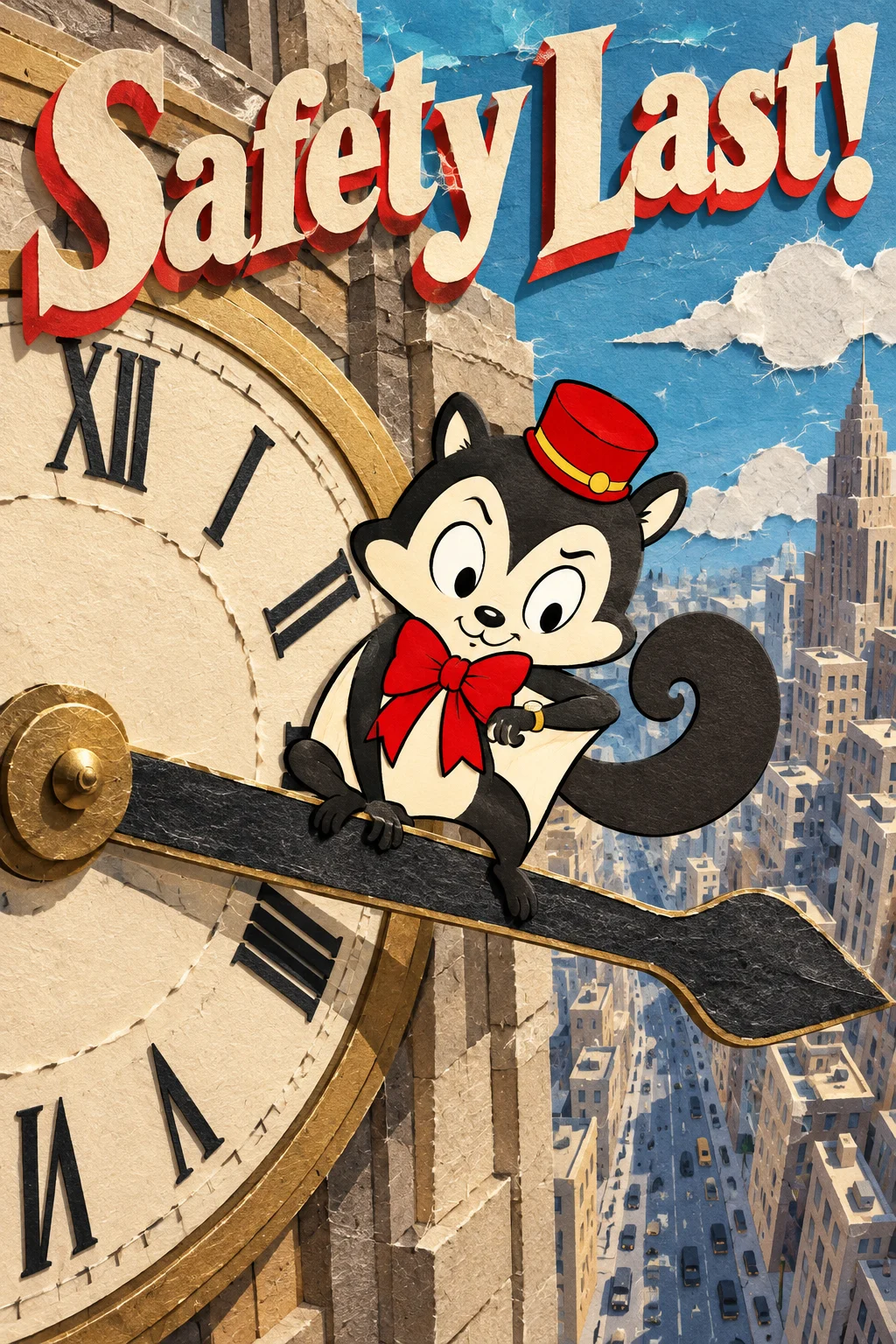
Naturally, I’m taking you to Safety Last! (1923). Harold Lloyd’s department-store clerk attempts a publicity stunt, with the famous result of Lloyd dangling from a clock high on a building. Criterion identifies both the premise and the clock gag, and lists the film as black and white. [7]
Belville brought a clock reading to her customers. Lloyd’s character gets rather more involved with the clock itself. That is my connection, and I recommend considering it from ground level.
After the detour, the distinction remains useful. A clock can be visible, impressive and ticking away without answering the question of how its reading has been checked. Belville’s rounds supplied that missing comparison, one customer at a time.
References & Further Reading
These institutional histories and catalogue records support the work, equipment and dates described above. Rooney’s account reports his archival research; the original complaints and his book have not been consulted here. The explanation of the chain of comparisons and the film association are Monocurator’s own framing.
- Royal Museums Greenwich. “The Greenwich Time Lady: Ruth Belville.” 8 March 2023.
- Science Museum Group. “Spring detent watch by John Arnold, used by Ruth Bellville and family to distribute GMT c.1834–1940.” Collection Online, object L2015-3341, n.d.
- David Rooney. “Ruth Belville: the Greenwich time lady.” Science Museum Blog, 23 October 2015.
- Royal Museums Greenwich. “Time signal apparatus.” Collections Online, object ZAA0653, n.d.
- Emily Akkermans. “The BBC pips, the Royal Observatory and the Greenwich Time Service.” Royal Museums Greenwich, n.d.
- Royal Museums Greenwich. “MkIII speaking clock announcer module.” Collections Online, object ZBA4264, n.d. This is a later machine; the catalogue also identifies the service’s 1936 introduction.
- The Criterion Collection. Safety Last! Film information, synopsis and “Perfect Timing” feature introduction, n.d.
For the next unexpected question, follow the Journal in your RSS reader.
On screen
Films discussed
- Safety Last! (1923) · Fred C. Newmeyer and Sam Taylor
Further reading
Read next in the Journal


Want a recommendation shaped around your evening? Ask Momo what to watch next →