See Films Differently Film history
When Did Movies Get Colour? More Than One Beginning
When did colour reach cinema? Hand-colouring, Kinemacolor and three-strip Technicolor explain why the first colour movie needs a precise definition.
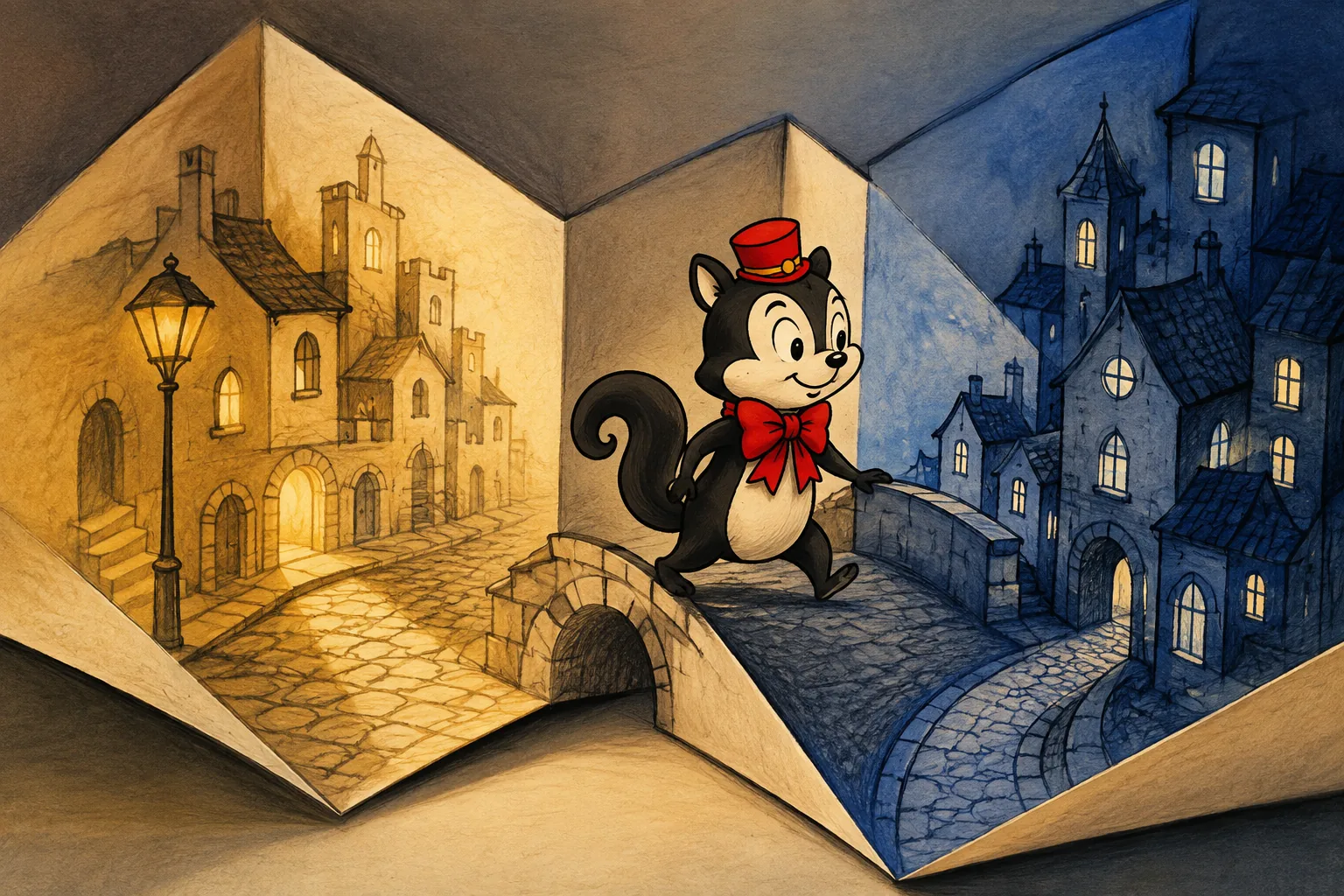
Hand-coloured moving pictures already existed in the 1890s. Experiments in recording colour photographically followed around the turn of the century. The three-strip Technicolor camera arrived in 1932, and the economics of colour production continued changing long afterwards.[1][3][5]
So the short answer is: films had colour remarkably early, but the way they acquired it changed. The date depends on whether we mean colour added to an image, colour recorded by a camera, a commercially usable system, or a process adopted for a whole feature.
Colour could arrive after the camera
Hand-colouring supplies the first complication. A film could be photographed in black and white and still present coloured moving images. The National Science and Media Museum’s chronology places the practice in the 1890s.[1] Colour on the screen did not require the camera to record colour.
That changes how we imagine early audiences. They did not have to wait for the camera to solve every problem before colour could become part of the attraction. The photographic record and the finished presentation were separate opportunities for invention.
Other approaches, including tinting and toning, belong to this wider history. Our silent-film colour guide explains those processes and why restored copies can differ. Here, the essential point is simpler: “photographed in black and white” does not always mean “originally shown without colour”.
Recording colour was a different problem
The Lee and Turner process attempted to record colour information through successive red, green and blue filters on black-and-white film. Edward Raymond Turner’s surviving tests date from 1901–1903. The National Science and Media Museum reconstructed their colour digitally in 2012.[1]
These surviving tests establish an early experiment. They do not establish that cinemas could use it as a reliable everyday system.
Kinemacolor took a different route. Developed by George Albert Smith and marketed by Charles Urban, it used alternating red and green filters during photography and corresponding filters in projection. Public screenings began in London in 1909.[1][2]
Colour was therefore partly the projector’s job. The film strip carried monochrome records that required the appropriate apparatus to turn them into a coloured screen image. BFI curator Bryony Dixon describes both the appeal of Kinemacolor and the flicker at a screening she attended using the original process.[2] The process had a particular viewing experience, not merely a position on a timeline.
What was the first colour movie?
The answer needs a qualification. Here are three different questions often hidden inside it:
| What do we mean? | A useful historical answer |
|---|---|
| Moving images presented with added colour | Hand-colouring was already practised in the 1890s.[1] |
| Early surviving experiments in photographic colour | Turner’s test films from 1901–1903 provide important evidence.[1] |
| The first feature photographed entirely in three-strip Technicolor | Becky Sharp (1935), directed by Rouben Mamoulian.[4] |
The last distinction is precise. It does not make Becky Sharp the first film to show any colour, or the first film to use Technicolor in any form. AFI notes that the three-strip process had already appeared in shorts, animation and sequences within features.[4]
Technicolor itself was not one unchanging invention. Its 1932 camera recorded colour information on three separate black-and-white strips, which could be combined in printing to produce colour.[3] Looking only at those monochrome negatives would give a very misleading account of what the audience saw.
By the time The Wizard of Oz appeared in 1939, colour had a substantial history. Its famous achievement belongs to what it does with colour, rather than to being the first to possess it. Our article on the doorway into Oz follows that particular piece of filmmaking.
Invention was not the same as becoming ordinary
A process must fit the work of making and distributing films. The George Eastman Museum describes how cheaper alternatives such as Eastmancolor challenged three-strip Technicolor in the 1950s. Technicolor adapted by printing films photographed with other systems.[5]
That creates one more useful distinction: the camera process and the printing process need not share a name. A Technicolor credit does not always mean that a three-strip Technicolor camera was used.
Nor does the invention of a successful colour process tell us when every filmmaker began using it. Availability, expense and a production’s desired appearance are different questions. A film made after a celebrated colour milestone has not necessarily missed an upgrade.
This is why one worldwide changeover date would mislead. The examples above follow particular British experiments and developments in Hollywood production; they are not a timetable for every national cinema.
When an early film unexpectedly turns blue, or a colour credit appears on a film older than expected, there is no need to treat it as an anomaly. Colour had several ways into the moving image. Part of the pleasure is discovering which one a particular film found.
References & Further Reading
- National Science and Media Museum. “The first colour moving pictures: A complete timeline.” Museum blog, 29 September 2012.
- Bryony Dixon. “Kinemacolor: dazzling colour film frames from more than 100 years ago.” BFI, 10 October 2017.
- George Eastman Museum. “Three-Strip Camera.” Technicolor online exhibition, n.d.
- American Film Institute. “Becky Sharp (1935).” AFI Catalog of Feature Films, n.d.
- George Eastman Museum. “1955–1975.” Technicolor online exhibition, n.d.
For the next unexpected question, follow the Journal in your RSS reader.
On screen
Films discussed
- Becky Sharp (1935) · Rouben Mamoulian
Further reading
Read next in the Journal
Want a recommendation shaped around your evening? Ask Momo what to watch next →