See Films Differently Momo Notices
Why Does Having Fun Feel Like Wasting Time?
Why does an enjoyable evening need a useful excuse? Leisure research, a little economics and Sullivan’s Travels offer another way to value a good laugh.
Imagine you’ve watched a comedy. You laughed. Someone asks what you got out of it, and you find yourself reaching for something more impressive: an insight into society, perhaps, or a useful lesson about communication.
A pleasant evening. Now for the supporting evidence.
One reason fun can feel like wasted time is that we judge the experience by what it produces afterwards. An enjoyable present has to compete with a future benefit: a new skill, a completed task, something to show for the hours. The laughter starts to look like a rather poorly documented expense.
Of course, a comedy can teach you something. The curious part is feeling that the laughter needs a lesson before it counts. Enjoying an experience and explaining why you chose it are different things. A black-and-white comedy about a director determined to make more important films gives that distinction an unexpectedly sharp edge.
Does enjoyment have to be useful?
In everyday speech, something useful often helps you accomplish something else. A course helps you learn a skill; a train gets you somewhere. Ask what a comedy is useful for, and you may start looking for a similar destination beyond the film.
Economics uses utility differently. In standard consumer-choice theory, a utility function represents a ranking of preferences. Its numbers aren’t units of happiness that can simply be added across people. Enjoyment can inform those preferences; earning money isn’t a condition for counting. MIT’s introductory lecture summary explains this ordinal meaning.
A preference for an evening with a comedy therefore needs no certificate of productivity. I’m quite prepared to let a film finish without issuing one.
You’ll also meet the terms hedonic and utilitarian in consumer research: broadly, pleasure-oriented and practical. A warm coat and an enjoyable film can both have economic utility. The distinction concerns what attracts us to them.
The ordinary question remains: why can the coat seem easier to explain?
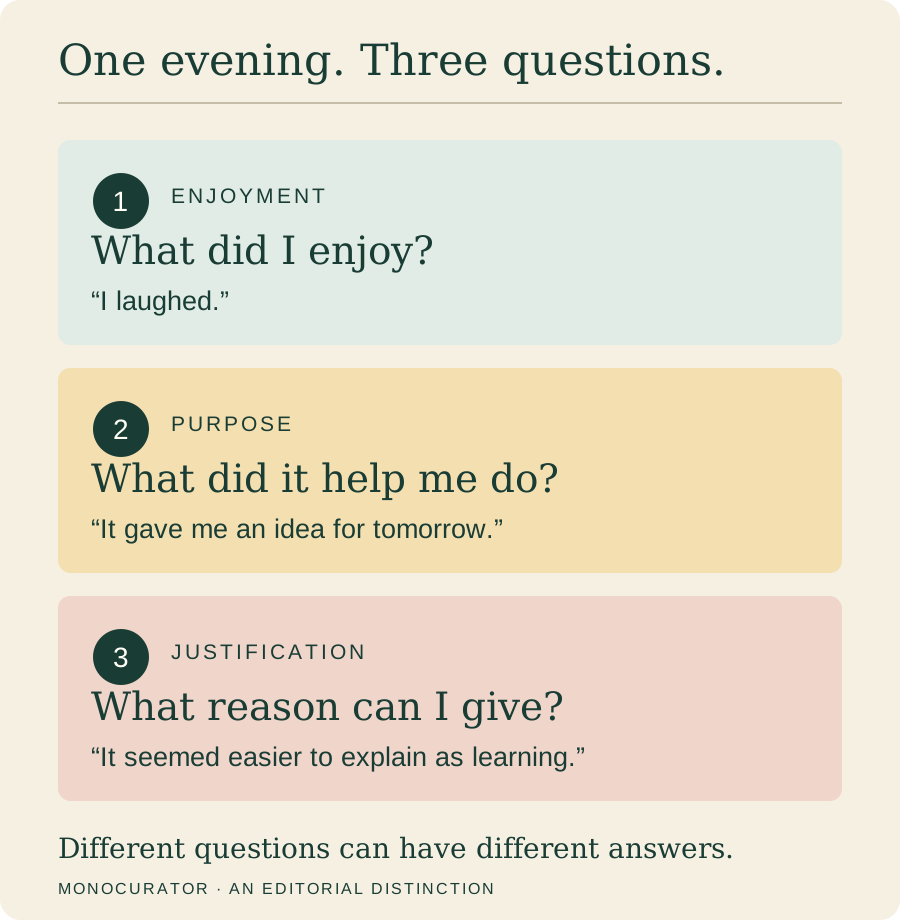
Why a useful excuse can feel more convincing
“I needed something warm” gives another person a familiar problem and a solution. “I liked it” asks them to accept an experience they may not share. Some reasons seem to travel more easily between people than others.
Erica Mina Okada’s 2005 paper reports a related pattern in consumption choices. Its abstract describes pleasure-oriented options receiving more favourable ratings when considered separately, while comparable practical options tended to be chosen when the two were presented together. The paper connects that reversal with the need to justify a choice.
Imagine putting a comedy beside a training course. You might find yourself comparing their explanations as well as their attractions. The course has a tidy future benefit to offer. The comedy has to explain why an enjoyable present is also worth considering.
That imagined comparison is where the problem becomes interesting. The evening hasn’t changed, but the account you feel obliged to give of it has.
Can calling leisure wasteful make it less enjoyable?
There’s evidence that dismissing leisure can affect the experience itself. Surveys in Gabriela Tonietto and colleagues’ 2021 paper linked viewing leisure as wasteful with lower reported enjoyment, especially for activities pursued for their own sake.
The researchers also tested the idea experimentally. In one study, 351 undergraduates were randomly assigned to read either an article framing leisure as wasteful—even while praising that wastefulness—or a control article about coffee makers. They then watched a funny cat video. The first group reported lower enjoyment.
A separate experiment found no significant enjoyment boost from describing leisure as productive rather than using the control condition. The research supports an effect on reported enjoyment in those settings; it doesn’t supply a trick for making every evening more fun.
If the defence is always “this will make me better at work tomorrow”, pleasure remains on probation. It has been given a job, and we’re waiting to see whether it performs.

What are you actually giving up?
You might enjoy another film and still need to go to bed. A ticket can be worth wanting and beyond tonight’s budget. Enjoyment belongs in the decision alongside those things.
Economics calls the alternative you give up the opportunity cost. The relevant comparison is with the best alternative actually available to you. MIT’s introductory summary sets out that idea. Automatically multiplying two hours by your wage invents earnings you might never have had the option to make. The real alternative could be sleep, a conversation, reading, or paid work if that work was available.
Pleasure can lose a comparison without having entered it at zero.
What I’d resist is a test that admits enjoyment only after it promises a later return. An experience can matter while it happens. It needn’t leave behind an improved skill, a memorable anecdote or a result you can show someone on Monday.
Which brings me to a director with a rather demanding idea of what his films should accomplish.
Sullivan’s Travels: a comedy director wants serious work
Preston Sturges’s Sullivan’s Travels (1941) follows John L. Sullivan, a successful comedy director played by Joel McCrea. Sullivan wants to make a socially significant film about suffering. To learn about poverty, he sets out disguised as a tramp. His ambition raises an awkward question: how much does he understand the people whose lives he wants to put on screen? Criterion’s synopsis introduces the journey.
Watch the gap between the value Sullivan wants his work to have and what people might find in a comedy already. A serious subject offers him a way to describe his purpose. An audience’s enjoyment asks him to look at what the work actually gives them.
This is a lively comedy with poverty, violence and confinement in it. Its argument doesn’t arrive through an uninterrupted pleasant afternoon.
Spoilers: the late-film screening and what it changes
Sullivan eventually becomes a prisoner. In the AFI synopsis, prisoners are taken to a Black church for a cartoon screening. Sullivan finds himself laughing with the audience at Mickey Mouse. AFI identifies the cartoon as Playful Pluto (1934).
The entertainment he considered insufficiently important now becomes an experience he shares with people in desperate circumstances. The value is happening in the room.
Laughter doesn’t end their imprisonment. That is part of the scene’s force: the joy and the brutality belong to the same world. Stuart Klawans’s Criterion essay resists reducing the film to a lesson about making people laugh, drawing attention to the church sequence’s moral seriousness and the film’s engagement with social divisions.
My reading is that the screening changes the scale on which Sullivan recognises value. He begins with the importance of his project; the audience makes him notice the experience of its recipients. The laughter matters. So do the circumstances surrounding it.
Back with your own evening, “I enjoyed it” won’t settle every question about money or time. It does answer what the comedy gave you. You laughed. That belongs in the account before you start looking for anything else to add.
If you fancy testing the argument with an actual evening, our classic comedy guide offers a few different kinds of laughter. If the difficulty is getting your mind out of the office in the first place, try switching off after work.
References & further reading
- Economics: MIT OpenCourseWare, 14.01 Principles of Microeconomics (2023), Jonathan Gruber. Introduction to Microeconomics and Preferences and Utility Functions. Student-prepared summaries based on Gruber’s lecture notes.
- Choice and justification: Erica Mina Okada (2005), “Justification Effects on Consumer Choice of Hedonic and Utilitarian Goods”, Journal of Marketing Research 42(1), 43–53. Publisher abstract consulted.
- Leisure and enjoyment: Gabriela N. Tonietto, Selin A. Malkoc, Rebecca W. Reczek and Michael I. Norton (2021), “Viewing Leisure as Wasteful Undermines Enjoyment”, Journal of Experimental Social Psychology 97, 104198. Full paper, particularly Studies 3 and 4.
- Film: Criterion’s film record; AFI’s synopsis and production history; Stuart Klawans (2015), “Sullivan’s Travels: Self-Portrait in a Fun-House Mirror”.
On screen
Films discussed
- Sullivan’s Travels (1941) · Preston Sturges
Further reading
Read next in the Journal

Want a recommendation shaped around your evening? Ask Momo what to watch next →