See Films Differently Film analysis
Why Is Casablanca So Great?
Why is Casablanca so great? Its romance, wit and music all drive Rick to one ending: he proves his love for Ilsa by helping her leave with Laszlo.
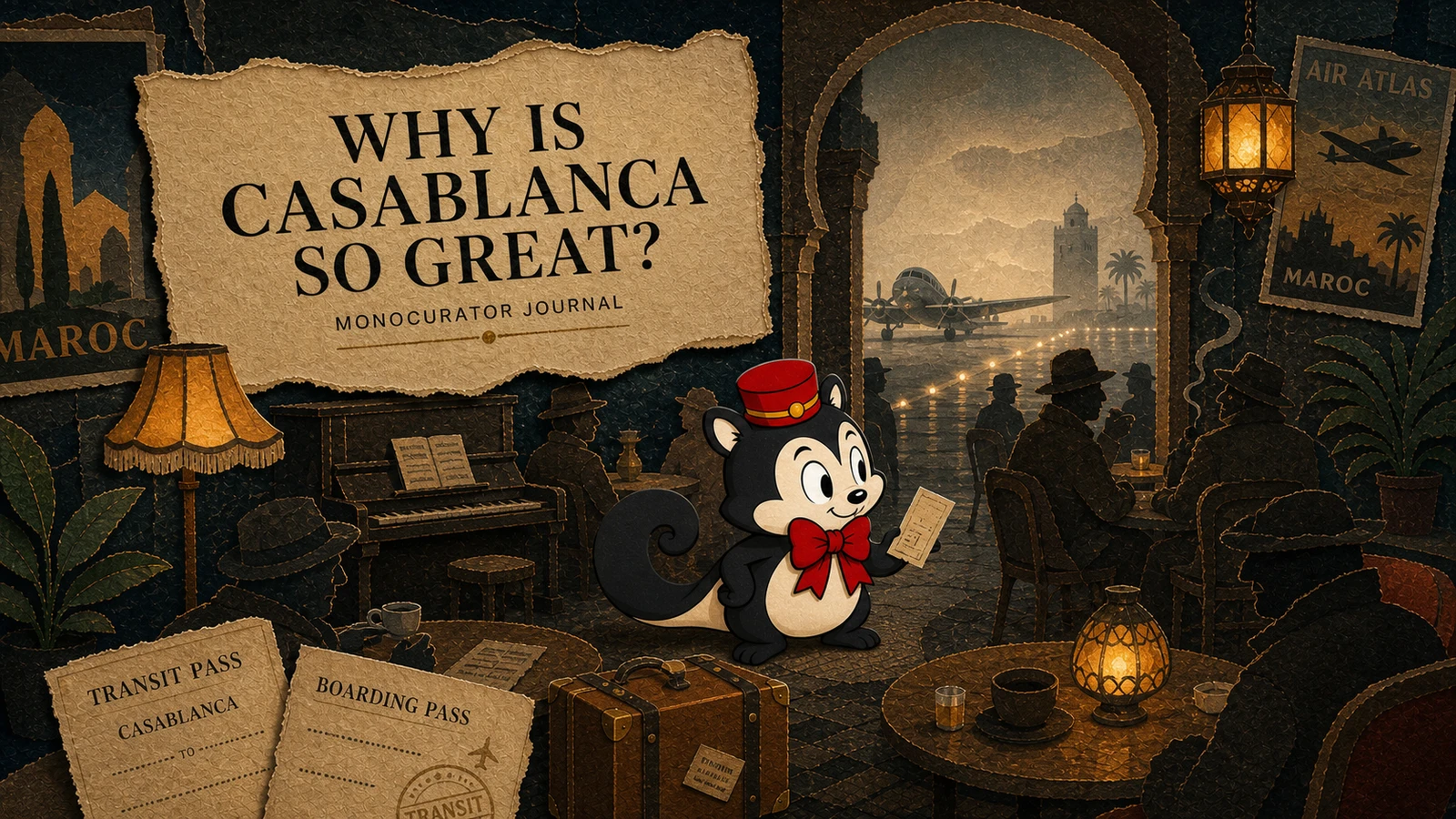
Spoiler note: This article explains the final choice in Casablanca.
Casablanca can feel famous before you have seen it. Its lines have escaped into everyday speech. Its piano, white dinner jacket and foggy airport have been copied, quoted and parodied for decades. The result is a strange problem: a first-time viewer may recognise almost everything and still wonder what all the fuss is about.
So why is Casablanca considered so great?
The shortest answer is that it makes romance, comedy, wartime danger and moral choice perform the same job. Every important part of the film pushes Rick Blaine from private hurt towards public action. The jokes keep the story moving. The songs measure what its characters cannot leave behind. The love triangle prevents anyone from getting everything they want. Even the famous dialogue changes meaning as Rick changes.
Casablanca is not great because it contains a collection of great moments. It is great because those moments all point towards one decision.
What does the ending mean? Rick helps Ilsa leave with Laszlo because their love is real, but it is not the only value at stake. By sacrificing private happiness for Laszlo’s resistance work, Rick stops using hurt as an excuse for neutrality. Renault’s protection turns the final friendship into a political alliance.
The Café Turns a World War into a Room
The film opens with maps, routes and refugees trying to reach Lisbon and then the Americas. That information could have remained distant history. Instead, the story concentrates it inside Rick’s Café Américain.
At one table, somebody is selling an exit visa. At another, a frightened couple is calculating what they can afford to lose. Officials gamble beside refugees whose futures depend on official permission. A resistance leader, a German officer, a corrupt police captain and a black-market trader can all enter the same door.
The café makes the war understandable because nearly everyone wants something concrete: papers, money, protection, information or passage out. The letters of transit at the centre of the plot are deliberately simple objects. We do not need to master wartime bureaucracy. We only need to understand that two pieces of paper can decide who leaves and who remains trapped.
Michael Curtiz keeps returning to the busy room while preserving many small dramas inside it. The plot can move from danger to flirtation to bargaining without feeling as if it has changed films. Rick appears to control this miniature world, yet he is also hiding inside it. He owns the room where everybody waits, and has arranged his life so that he never has to go anywhere himself.
That contrast is the story’s first elegant design: the most stationary man in Casablanca possesses the means of escape.
Rick’s Cynicism Is a Position, Not a Personality
Rick is often remembered as the model of effortless cool. Bogart’s performance makes the pose attractive: the measured voice, unreadable face and refusal to be impressed. But the film does not treat cynicism as wisdom.
It treats cynicism as protection.
Before Ilsa arrives, Rick repeatedly claims that he does not take sides. His café admits everyone because neutrality is profitable and emotionally safe. Yet the film quietly shows that this identity is incomplete. His past includes support for losing anti-fascist causes, and he helps vulnerable people even while pretending not to care. The hard surface and the buried idealist are present from the beginning.
Ilsa’s return does not create a new Rick. It forces the two existing versions of him into the same room.
This is why Bogart’s restraint matters. Rick’s pain rarely needs a speech. A pause before a reply, the effort required to look away, or the change in his posture when a familiar song begins tells us that the controlled man is spending energy on control. Bogart lets us see the armour working.
By the airport ending, Rick’s action feels surprising without feeling unprepared. The film has not transformed a selfish man into a saint in five minutes. It has removed the excuse that allowed a disappointed idealist to behave like a spectator.
The Love Triangle Has No Convenient Villain
Many romantic triangles solve themselves by making one partner obviously wrong. Casablanca refuses that convenience.
Victor Laszlo is not cruel, foolish or unworthy of Ilsa. He is courageous and politically necessary. Ilsa is not simply choosing between an exciting man and a dull husband. She is caught between a love she believed lost and a commitment formed under extraordinary circumstances. Rick cannot win by exposing Laszlo as a fraud, because Laszlo’s integrity is part of the problem.
That design gives the romance moral weight. Rick and Ilsa’s desire is real, but reality does not grant it automatic priority over every other life.
Ingrid Bergman’s performance holds that conflict without reducing Ilsa to indecision. She can look relieved, frightened and guilty within the same exchange because each feeling has a valid cause. Paul Henreid plays Laszlo with enough composure to make him a credible public figure, while still allowing moments in which he understands more about Rick and Ilsa than either would prefer.
The triangle becomes powerful because all three people can see beyond themselves. Laszlo knows that Ilsa may love Rick. Ilsa knows what Laszlo’s work means to people beyond their marriage. Rick finally understands that asking Ilsa to stay would turn their private happiness into someone else’s political defeat.
Nobody receives the ending they would choose in isolation. That is what makes the choice feel adult rather than merely sad.
The Dialogue Works Twice
Casablanca is celebrated for its lines, but quotability alone does not make a screenplay great. A line can sound clever and still stop a story.
The best dialogue here performs two tasks at once. It entertains us on the surface while exposing a defence, a bargain or a change of allegiance underneath.
Captain Renault’s wit makes corruption feel almost graceful, but it also allows him to avoid declaring what he believes. Rick’s dry replies turn pain into social control. Ilsa and Rick speak about Paris because speaking directly about the present would make an immediate decision unavoidable. “Here’s looking at you, kid” matters because repetition gives the same words different emotional conditions: intimacy, memory, farewell.
The screenplay also gives minor characters their own rhythms. A nervous exchange about money can communicate the scale of exile more effectively than another paragraph of political explanation. Renault’s jokes, Carl’s warmth, Ugarte’s anxious speed and Ferrari’s relaxed bargaining keep the café socially alive.
The American Film Institute’s catalogue records Julius J. Epstein, Philip G. Epstein and Howard Koch as the credited screenwriters, and notes that Casey Robinson also made an important uncredited contribution to the love story. The script emerged from multiple writers and an unproduced play rather than a single perfect blueprint. [1]
Its unity comes from function. However different the voices sound, they keep asking related questions: What can be bought? What must be concealed? When does a private feeling become a public responsibility?
Two Songs Carry Two Kinds of Memory
“As Time Goes By” is not background decoration. It is a device that makes the past enter the present.
When Sam plays it, the café remains physically unchanged, but Rick and Ilsa are returned to Paris. The melody can be requested, forbidden and requested again because memory behaves the same way: people try to control when it appears, then discover that recognition has already begun.
The song survived partly through production contingency. The Library of Congress recounts that composer Max Steiner wanted to replace it, but reshooting the relevant material became impractical after Bergman had changed her hair for another production. [2] What remained by accident became structurally indispensable. The tune binds the lovers’ private history to a public place where they can no longer live inside that history.
“La Marseillaise” does the opposite. Instead of pulling two people into a remembered room, it gathers a roomful of displaced people into a public act.
Laszlo asks the café band to play it over the German officers’ song. The contest is musical, but the stakes are political: frightened individuals become a collective voice. Yvonne, previously seen drinking with a German officer, sings through tears. Rick gives the band permission, but he does not take the centre. His choice allows other people to be heard.
The scene also carries the force of the production’s émigré cast. The Library of Congress notes that Bogart and Dooley Wilson were the only American-born performers among the leading cast. [2] The emotion does not need to be treated as documentary fact to matter; the fictional café and the lives of people making the film were both shaped by a Europe at war.
One song makes private loss return. The other turns private fear into shared resistance. Together they prepare Rick’s final movement from one kind of memory to the other.
The Images Keep Private Feeling inside Public Space
Arthur Edeson’s black-and-white cinematography gives faces romance without allowing the surrounding world to disappear. Bergman’s close-ups are luminous, while blinds, doorways and shadows divide Rick’s rooms. The visual contrast fits their different positions: Ilsa seems to bring a lost world back with her; Rick has built compartments in which to contain it.
Curtiz also stages conversations so that power can change without an announcement. A character enters behind another. A uniform becomes visible at the edge of an intimate exchange. The letters of transit move between hands while the people discussing them pretend to discuss something else.
Most importantly, the film rarely lets the central romance forget the crowd. Rick and Ilsa may speak privately upstairs, but below them the café is still full of people waiting to escape. The film’s geography keeps the lovers’ decision connected to consequences outside the couple.
At the airport, the design becomes almost abstract: fog, lights, a waiting aircraft, two letters and a small number of figures. After the density of the café, the empty space makes the choice feel exposed. There is nowhere left for Rick to hide behind business, performance or noise.
The Ending Turns Love into Evidence
If Rick and Ilsa stayed together, Casablanca would still contain chemistry, danger and memorable dialogue. It would lose the action that makes all of them cohere.
Rick tells Ilsa to leave with Laszlo. He does not do so because their Paris romance was false. He does it because it was true enough to teach him what another person’s future is worth.
This reverses the usual proof of cinematic love. The couple do not prove love by remaining together. Rick proves it by refusing to make Ilsa carry a choice that he now believes would destroy something larger than either of them.
The decision also completes his political arc. The man who claimed not to take sides uses the letters, deceives Strasser, sends the resistance leader onward and accepts that he can no longer remain a neutral proprietor. Private sacrifice and public commitment become the same action.
Renault then makes his own choice. By ordering the police to pursue the “usual suspects”, he converts one of his practised evasions into protection. The famous final reference to a new friendship is satisfying because it is also a new alliance. Two charmingly detached men have finally attached themselves to a cause.
Wartime Timing Made the Fiction Feel Immediate
The film was made while its political future was still unsettled. AFI records production from 25 May to 3 August 1942. Its New York opening was moved forward to 26 November, soon after the Allied landings in North Africa made Casablanca a prominent name in the news; the wider US release followed on 23 January 1943. [1]
The real Casablanca Conference ran during that same month. As the Library of Congress essay observes, events kept feeding the film’s resonance after production. [2]
Topical timing helped audiences feel its urgency, but timing cannot explain its endurance. Many films were close to major events and did not remain cultural reference points. Casablanca lasts because it turns an enormous political crisis into choices that remain legible after the headlines change: whether fear justifies neutrality, whether love can demand sacrifice, and whether a person who has withdrawn from the world can return to it.
Its recognition was immediate and lasting. At the 16th Academy Awards, it won Outstanding Motion Picture, Directing and Writing (Screenplay), with five further nominations. [3] The Library of Congress selected it for the first group of 25 films added to the National Film Registry in 1989. [2] AFI later placed it within the top three of both editions of its greatest American films list and ranked it first among American screen romances. [5]
Those honours explain why the film is called famous. They do not explain why people keep finding it usable. Viewers return to it for romance, political courage, performance, jokes, music or craft, and each route leads back to the same decision.
Fame Can Hide the Technique
The danger of watching a canonical film is that every effect can look inevitable. The airport must be foggy. Sam must be at the piano. Rick must say the line we already know he will say.
But none of those elements was inevitable before the film joined them.
Try watching the famous moments as pieces of construction rather than monuments. Notice how early the film gives Rick a political past. Notice how often the letters of transit bring public danger into private conversation. Notice that Renault’s jokes gradually change from self-protection to active complicity with Rick. Notice that the two important songs move emotion in opposite directions.
Familiarity tells us what happens. Craft determines why it feels complete.
Why Casablanca Is So Great
The clearest answer is this:
Every major pleasure in the film—romance, dialogue, music, atmosphere and wit—places pressure on the same moral choice.
The café turns global conflict into human traffic. The triangle makes personal desire ethically difficult. The dialogue lets people conceal themselves until their actions reveal them. The songs connect private memory with collective history. The ending proves Rick’s love and his return to political life in one decision.
That concentration is why Casablanca can be easy to watch without being slight. A beginner can follow the romance and suspense. A returning viewer can follow the glances, transactions, repeated phrases and shifts of allegiance underneath them.
Its fame may make the film look like a cabinet of quotations. Watch the choices connecting those quotations, and the cabinet becomes a machine.
For a spoiler-light introduction and verified version notes, start with the Monocurator Film page for Casablanca. The Maltese Falcon shows Bogart’s cool persona before it became tragic romance; Brief Encounter builds another great love story around restraint and an ending that refuses simple fulfilment. For a wartime comedy in which performance itself becomes resistance, try To Be or Not to Be.
If the label “masterpiece” makes classic films harder to approach, Can You Taste a Masterpiece? offers a way to use reputation without surrendering your own judgement.
Frequently asked questions
Why is Casablanca so famous?
It combines an accessible love story with wartime urgency, memorable performances, music and unusually repeatable dialogue. Its November 1942 New York opening also arrived when the real city of Casablanca was in the news. Awards, revival culture, quotation and parody then kept its images and lines in circulation for generations.
Why is Casablanca considered one of the greatest films?
Its parts reinforce one another with exceptional economy. The romance creates Rick’s private conflict, the war gives that conflict public consequences, and the letters, songs, jokes and supporting characters all push him towards the same final choice. It offers immediate pleasure and rewards close rewatching.
What is the main message of Casablanca?
The film suggests that private pain does not remove public responsibility. Rick’s disappointment has made withdrawal understandable, but not sufficient. His final sacrifice reconnects love with solidarity: caring for one person becomes a reason to act beyond himself.
Why does Ilsa leave with Laszlo?
Rick decides that Ilsa must leave with Laszlo because Laszlo’s resistance work and safety matter beyond the couple. Ilsa’s love for Rick is not dismissed; it is what gives the farewell its cost. The ending values that love without claiming it is the only value in the story.
Is Casablanca difficult for a first-time classic-film viewer?
No. The opening contains many names and political details, but the central movement is clear. Follow Rick, Ilsa, Laszlo and Renault; treat the café as the centre of the story; and remember that the letters of transit mean escape. The remaining context becomes visible through what each character wants.
References
The sources below support the production history, credits, honours and institutional record. The close readings of staging, performance, dialogue and the film’s moral design are Monocurator’s interpretation.
- American Film Institute, Casablanca, AFI Catalog of Feature Films, including production dates, release history, credits and production notes (accessed 29 August 2026).
- Jay Carr, ‘Casablanca’, National Film Registry essay, Library of Congress; and Cary O'Dell, ‘National Film Registry: Celebrating “Casablanca” (1942)’, Library of Congress, 3 March 2022.
- Academy of Motion Picture Arts and Sciences, ‘The 16th Academy Awards | 1944’.
- British Film Institute, Casablanca (1942), film record and 2022 Sight and Sound poll placement.
- American Film Institute, ‘Casablanca (1942) — AFI Movie Club’, 20 June 2022.
On screen
Films discussed
- Casablanca (1942) · Michael Curtiz
Continue exploring on Monocurator
Want a recommendation shaped around your evening? Ask Momo what to watch next →