Momo Notices
The Moment the Fight Starts, the Story Gets Smaller
Why do some fight scenes feel predictable even when the choreography is complex? A look at combat, suspense, and the kinds of change that keep a story alive.
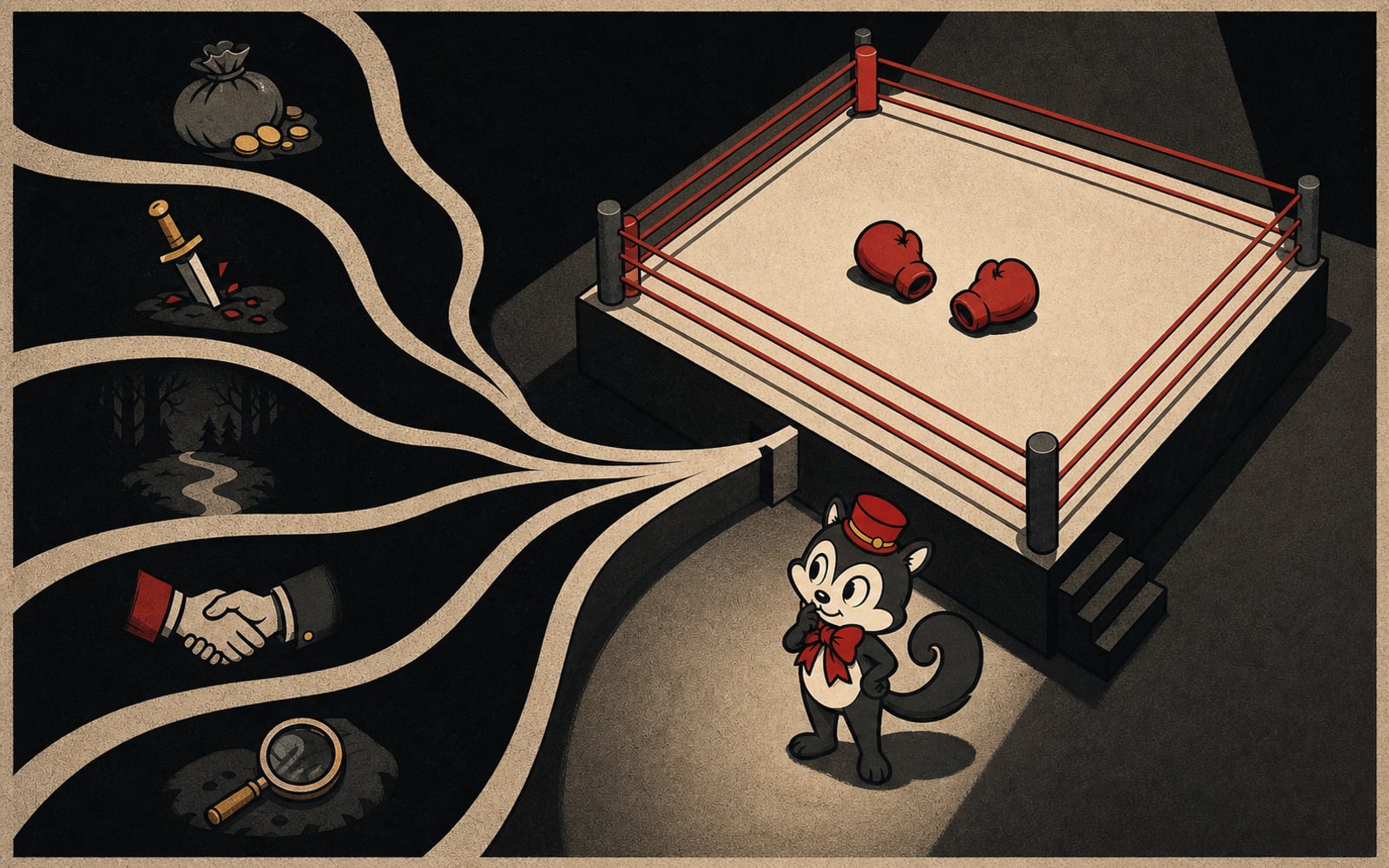
A fight can contain a hundred movements and still narrow a scene to one question. The strongest fights keep changing what the fight is for.
A man blocks the door.
Before anyone swings, the scene can still become a threat, a bargain, a betrayal, even an alliance. One sentence could change what everyone wants. Someone could reveal a secret. An enemy could become useful. A friend could walk away.
Then the first punch lands.
The scene becomes more active and less open.
Distance, balance, exits, and pain move to the foreground. The two bodies may make dozens of decisions, but most of those decisions now serve the same immediate purpose: control the other person, escape, protect someone, or survive.
Some fight scenes feel predictable because tactical complexity is serving one settled dramatic question. The choreography may keep changing while the goal, relationship, information, moral choice, and cost remain fixed.
The story has not stopped. It has become concentrated.
A Hundred Moves, One Question
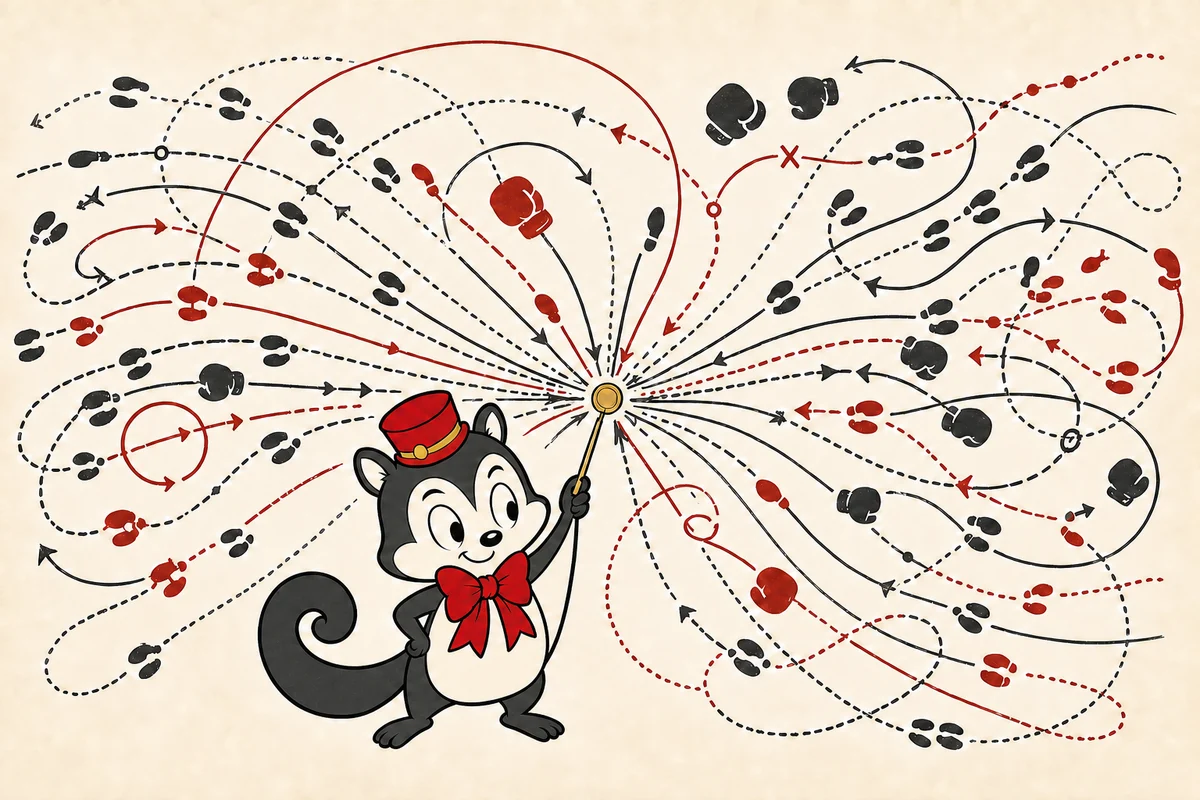
Fight choreography can be extraordinarily complex. A character advances, retreats, changes weapons, uses the room, reads an opponent, and improvises under pressure. The next movement may be impossible to predict.
But tactical variety is not the same as narrative variety.
Ten attacks can all answer one question: Who is winning?
The advantage changes hands, but nothing else does. The characters still want what they wanted before the fight began. Their relationship remains fixed. No new information changes the meaning of the conflict. The scene produces movement without producing many different kinds of change.
A courtroom also moves toward a limited result. Guilty or not guilty. A romance may end in union or separation. Those forms are not automatically more open because they offer more endings.
The difference lies in what can change on the way there.
A witness can alter our understanding of the past and redistribute trust across the room. A conversation between two lovers can change what either person desires, what they believe about themselves, and even what they think the relationship is. The endpoint remains limited while the meaning of that endpoint keeps moving.
The question is not how many actions a scene contains.
It is how many kinds of change remain alive while those actions occur. [9] [10] [12] [13]
When the Body Takes Over
Physical danger establishes a brutal hierarchy of attention.
When someone is trying to hit you, questions of survival, distance, and immediate control suppress other aims. Reconciliation, interpretation, and reflection become harder to sustain because the body demands an answer now. Research on goal shielding describes how an active focal goal can inhibit competing goals. [11]
The viewer follows much of the same hierarchy.
Research on suspense has found that intense scenes can narrow visual attention toward the center of the action, reducing the processing of peripheral information. [1] Threat can produce a similar concentration of attention. [2] In a fight, bodies, weapons, movement, and spatial position become unusually difficult to ignore.
That does not prove that the narrative itself has narrowed. A single bodily action can still change a relationship, reveal information, or force a moral decision.
But the pressure is there.
The fight directs both character and viewer toward the immediate physical problem. A scene that does nothing to resist that pressure will increasingly be organized around dominance, injury, escape, or survival.
The effect is local. A fight can transform everything that follows. Inside the fight itself, however, immediate bodily control tends to become the dominant dramatic question.
Knowing the Winner Is Not the Problem
The hero’s victory can be obvious and the scene can still grip us.
Suspense does not require genuine uncertainty about the result. Readers and viewers can experience it when the ending is already known, including in stories based on familiar historical events. [3] Experiments have also found that suspense can increase when the number of plausible routes to a solution becomes more restricted, even when success itself remains likely. [4]
A fight therefore contains at least three different questions:
- Who wins?
- How do they get there?
- What will winning cost?
The first may be predictable while the other two remain open.
A character may survive but lose a hand, a friendship, a principle, or any future worth surviving for. Victory may expose a betrayal. Refusing an easy killing blow may reveal more about a person than the result of the fight.
Nor is choreography merely decoration placed where the story has paused.
Action cinema can narrate through bodies, space, rhythm, and sound. [5] [8] The way someone fights can show training, fatigue, cruelty, restraint, panic, or affection. Clear staging can make power relations visible without dialogue. A hesitation can change the moral meaning of a victory. [7]
The distinction is not between action and story.
It is between action that executes a settled conflict and action that keeps changing the conflict.
What the Strongest Fights Keep Alive
A fight becomes narratively richer when its goal changes before the bodies stop moving.
An enemy becomes someone to protect. A rescue turns into a delay. New information changes who deserves to win. A character can end the fight efficiently but refuses because the method would make victory worthless.
Relationships can move as well. Hatred becomes respect. Loyalty collapses. Someone discovers that the opponent understands them better than their allies do.
The cost must also remain alive. An injury matters only when it changes the future rather than decorating the present. A death matters when it rearranges loyalties, obligations, or the meaning of the cause.
The strongest fight scenes keep several forms of change in motion at once:
- what the characters want;
- what they know;
- what they owe one another;
- what they are willing to do;
- what victory will cost;
- what victory will mean.
A fight is not narratively rich merely because it contains many moves.
The bodies can move constantly while the story stands still.
The Set-Up: One Fight, an Entire Life
Robert Wise’s The Set-Up was released in 1949. The AFI Catalog lists it at 72 minutes. Its story unfolds over almost the same span of time: the opening and closing clocks move from roughly 9:05 p.m. to 10:16 p.m. [6] [14]
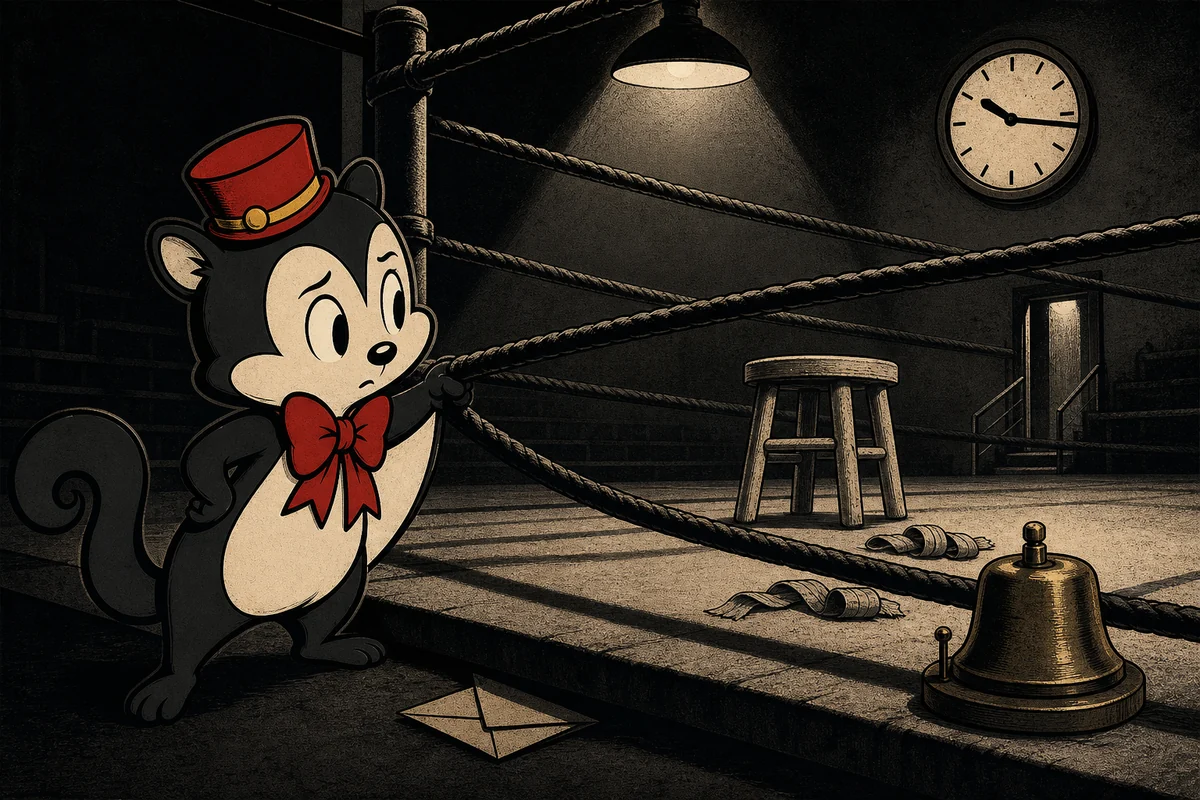
The film places nearly everything inside a few streets, a dressing room, and a boxing arena.
Bill “Stoker” Thompson is 35, an age that already makes him an old man in the world of professional boxing. Everyone around him believes his career is finished. Stoker believes that one good punch, one good round, one victory could still put him back on the way up.
His wife, Julie, no longer believes in the promise.
She has watched him absorb too many blows for too many years. Before the fight, she tells him she will not attend. Supporting his dream has become indistinguishable from helping him destroy himself.
Stoker’s manager, Tiny, has made a separate calculation. He accepts $50 from a gangster named Little Boy to ensure that Stoker loses a four-round bout against the younger Tiger Nelson.
Tiny does not tell Stoker about the arrangement.
He assumes Stoker will lose without assistance. [6]
The audience therefore enters the bout with knowledge the fighter does not possess. If Stoker loses, the fix succeeds and his hope of revival ends without his ever knowing he was sold. If he wins, he defies the gangsters and moves toward punishment.
Winning does not make him safe.
Losing does not mean only losing.
The terminal outcomes remain simple, but their meanings do not.
Several Clocks Are Running
The boxing match has its own clock, divided into four rounds.
Stoker’s career has another. Every punch suggests how little time remains before age and accumulated damage end it.
Julie’s decision has another. While Stoker fights inside the arena, she walks outside, trying to decide whether refusing to watch is an act of abandonment or the last form of care available to her.
The gangsters have their own deadline. They need the expected defeat to occur before Stoker can disrupt the arrangement.
Wise places all of these clocks inside the same compressed present.
The fight asks who will win, but the film also asks whether Stoker can still understand his own condition, whether Julie can remain inside this life, whether dignity has any value inside a corrupt business, and whether bodily victory can produce anything except further violence.
The Crowd Changes Sides, Not Principles
Wise repeatedly cuts from the ring to the spectators.
They laugh at failing fighters, demand blood, and switch their loyalties as soon as the momentum changes. They have no lasting commitment to either boxer. Their allegiance belongs to excitement itself.
These shots are not comic interruptions between rounds. They show the economy surrounding Stoker.
His pain is entertainment. His decline is a product. The crowd wants a winner, but it does not care who that winner is for longer than a few minutes.
The bout therefore changes more than Stoker’s physical position. It reveals the social position he occupies: a disposable body inside an industry that profits from his belief that one more fight will rescue him.
The Meaning of Victory Changes Mid-Fight
Before the fourth round, Stoker finally learns about the fix.
His opponent has not changed. The ropes have not moved. The formal objective remains victory.
But the meaning of the fight is now different.
Stoker entered the ring to prove that he still had a future. Once he learns that Tiny sold his defeat without even consulting him, the fight becomes a refusal to accept the identity everyone else has assigned him.
They have decided that he is already a loser.
Winning becomes his answer.
He wins the bout and refuses the fix. Outside the arena, Little Boy’s men punish him by crushing his hand, destroying the boxing career he had fought to preserve.
The film gives Stoker a physical victory, a professional ending, a moral victory, and a permanent bodily loss within the same result.
Julie finds him afterward. Their marriage begins to recover at the precise moment his future in boxing disappears.
Victory has not solved the story.
It has divided itself into several incompatible meanings.
The Winner Is Not the Whole Story
The Set-Up does not escape the narrowness of combat by inventing more possible endings.
The bout will still end in victory, defeat, or interruption.
Wise instead makes every outcome act upon several parts of Stoker’s life at once. His body, marriage, profession, dignity, and place within a corrupt business all remain active while the punches are being thrown.
The fight changes purpose after it has begun. Its cost grows before it has ended. Victory means something different in the fourth round from what it meant in the first.
Wise does not open the ring.
He places an entire life inside it.
Fight scenes are not dull because they end in victory or defeat.
They become small when, once the fighting starts, nothing except the winner is allowed to change.
References
- M. A. Bezdek, R. J. Gerrig, W. G. Wenzel, J. Shin, K. Pirog Revill, and E. H. Schumacher (2015), “Neural evidence that suspense narrows attentional focus,” Neuroscience 303, 338–345.
- H. van Steenbergen, G. P. H. Band, and B. Hommel (2011), “Threat but not arousal narrows attention: Evidence from pupil dilation and saccade control,” Frontiers in Psychology 2, 281.
- R. J. Gerrig (1989), “Suspense in the absence of uncertainty,” Journal of Memory and Language 28(6), 633–648.
- R. J. Gerrig and A. B. I. Bernardo (1994), “Readers as problem-solvers in the experience of suspense,” Poetics 22(6), 459–472.
- L. Purse (2011), Contemporary Action Cinema, Chapter 3, “The Action Sequence,” 56–75, Edinburgh University Press.
- American Film Institute, The Set-Up, AFI Catalog of Feature Films. Runtime and production details checked August 2, 2026.
- D. Bordwell (2002), “Intensified continuity: Visual style in contemporary American film,” Film Quarterly 55(3), 16–28.
- G. King (2000), Spectacular Narratives: Hollywood in the Age of the Blockbuster, I.B. Tauris.
- J. Phelan (2007), Experiencing Fiction: Judgments, Progressions, and the Rhetorical Theory of Narrative, Ohio State University Press.
- M.-L. Ryan (1991), Possible Worlds, Artificial Intelligence, and Narrative Theory, Indiana University Press.
- J. Y. Shah, R. Friedman, and A. W. Kruglanski (2002), “Forgetting all else: On the antecedents and consequences of goal shielding,” Journal of Personality and Social Psychology 83(6), 1261–1280.
- M. Sternberg (1992), “Telling in time (II): Chronology, teleology, narrativity,” Poetics Today 13(3), 463–541.
- J. M. Zacks, N. K. Speer, K. M. Swallow, T. S. Braver, and J. R. Reynolds (2007), “Event perception: A mind–brain perspective,” Psychological Bulletin 133(2), 273–293.
- R. Wise (Director) (1949), The Set-Up [Film], RKO Radio Pictures.
Want a recommendation shaped around your evening? Ask Momo what to watch next →