What to watch next
10 Classic Action and Adventure Movies: Pick Your Next Thrill
Compare ten classic action movies by style and running time: train chases, samurai, spy adventures, car getaways, martial arts and Die Hard.
An action film can make a train, a village or an office building feel like a machine whose moving parts you understand. Then somebody changes the plan. These ten classic action and adventure films offer different kinds of excitement, from Buster Keaton’s physical ingenuity to Jackie Chan’s acrobatics and a very difficult Christmas visit.
For a quick choice:
- A varied adventure with a clear goal: Raiders of the Lost Ark, for escapes, chases and improvisation.
- Extraordinary movement in recognisable spaces: Police Story, for fights that turn the surroundings into equipment.
- A sustained contest inside one building: Die Hard, for a hero forced to keep revising his options.
The selection covers films released before 1990, including comedy, martial arts, crime and adventure within a broad action tradition. We chose contrasting experiences rather than ten versions of the same hero, and have left the major outcomes unspoiled.
Compare the films
| Film | Year | Time | Kind of action | Choose it for |
|---|---|---|---|---|
| The General | 1926 | 79 min | Silent train chase | Physical ingenuity and comic cause and effect |
| Seven Samurai | 1954 | 207 min | Village defence | A team and a place worth investing in |
| Goldfinger | 1964 | 107 min | Spy adventure | Gadgets, formidable opponents and stylish danger |
| The Italian Job | 1969 | 101 min | Comic heist | A city-sized getaway plan |
| The French Connection | 1971 | 103 min | Police pursuit | Surveillance, street pressure and rough edges |
| Enter the Dragon | 1973 | 102 min | Martial-arts adventure | Bruce Lee’s concentration and explosive movement |
| Raiders of the Lost Ark | 1981 | 115 min | Cliffhanger adventure | Escapes that produce the next problem |
| Mad Max 2 | 1981 | 96 min | Road pursuit | Clear, fierce vehicle choreography |
| Police Story | 1985 | 100 min | Martial-arts action comedy | Acrobatics, impact and inventive use of space |
| Die Hard | 1988 | 132 min | Siege thriller | Improvisation under mounting pressure |
Times refer to the cited presentations or records: BFI for The General, Goldfinger and Mad Max 2; the named distributors for the others. Some editions differ, especially silent films and alternate cuts, so check the length offered by your player.
The General (1926): every obstacle has a shape
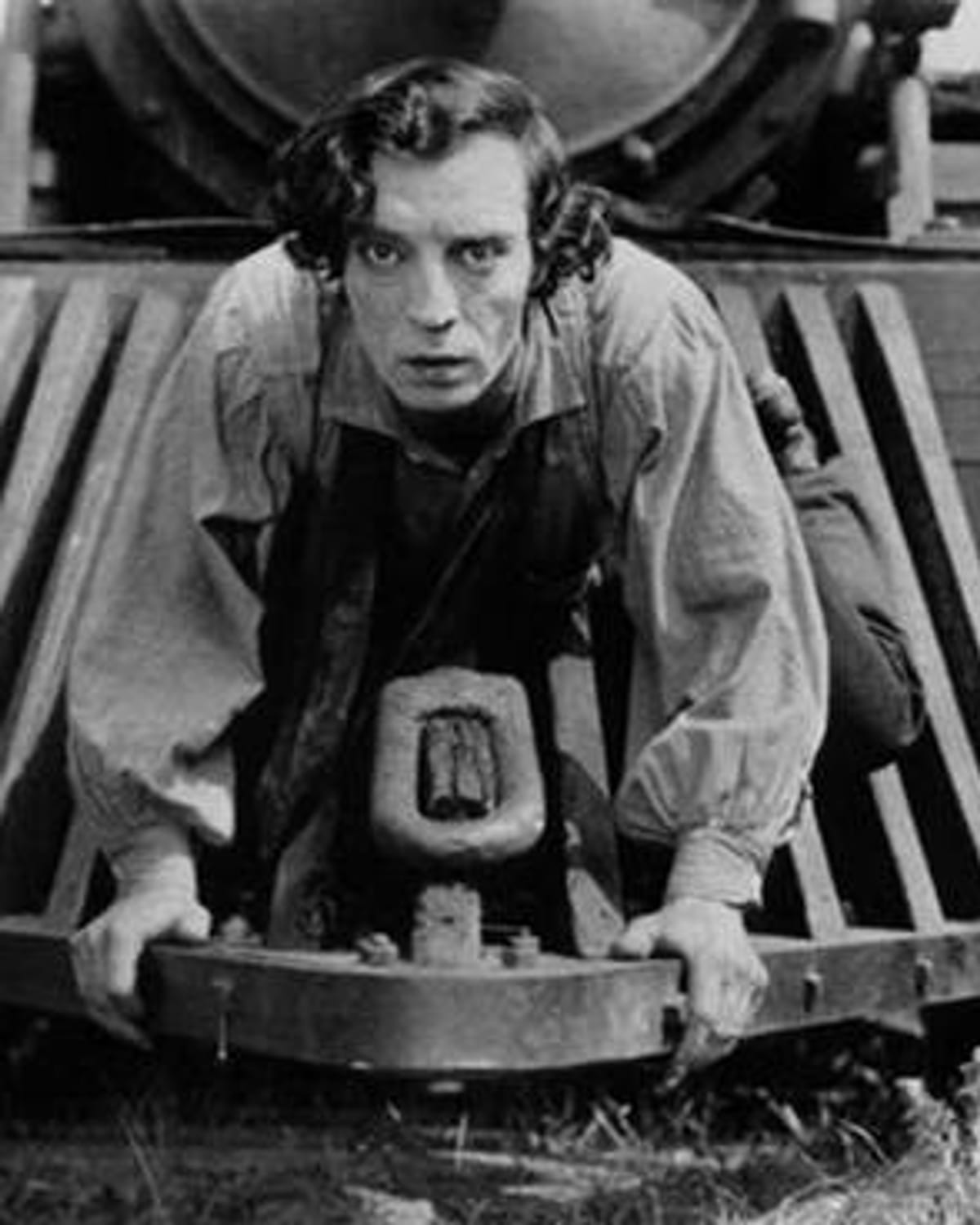
When soldiers steal a locomotive with his sweetheart aboard, Keaton’s railway engineer pursues it. Tracks, sleepers, wheels and other trains provide a wonderfully concrete series of problems. You can usually see what is obstructing him, which makes both an ingenious solution and a disastrous miscalculation immediately satisfying. 1
Begin here if you enjoy action that lets you read the movement. Keaton’s body remains in a clear relationship with the machinery; the joke often arrives at the exact moment you understand a physical danger. The Civil War chase is told from a Confederate railway engineer’s side, with Union raiders cast as the antagonists. Its chase construction remains a rewarding bridge between silent comedy and later action cinema. Explore the film.
Seven Samurai (1954): learn the ground before the fight
Farmers recruit samurai to protect their village from bandits. Akira Kurosawa gives recruiting, planning and training enough time for the defence to become a shared undertaking. The village gradually turns from a location into a place whose entrances, vulnerabilities and inhabitants you know. 2
Set aside a long evening for this one. Its reward is knowing why an individual action matters within a larger struggle, and how different temperaments contribute to a team. Toshiro Mifune’s unruly energy keeps disturbing everyone’s idea of proper conduct. If you want fighting to begin almost immediately, Police Story offers a faster entry. Here the waiting and preparation are substantial pleasures, and the casualties carry the weight of the time spent getting acquainted. Explore the film.
Goldfinger (1964): danger with an extravagant design
Sean Connery’s James Bond investigates a gold dealer whose ambitions require more than ordinary security. Guy Hamilton’s film moves between competitive games, traps, machinery and opponents with sharply defined signatures. An Aston Martin is allowed considerably more possibilities than a normal car. 3
Pick this for a stylish adventure rather than continuous fighting. The pleasure includes entering an elaborate space and wondering what terrible use it has been designed for. Bond’s confidence meets opponents who can temporarily make that confidence useless, giving the film room for suspense as well as display. A scene in which Bond forces a kiss on a resisting woman is played as seduction. 3 For a more vulnerable hero whose charm does not keep him comfortably in control, Raiders of the Lost Ark makes a useful next choice.
The Italian Job (1969): give the getaway its own personality
Michael Caine’s Charlie Croker assembles a crew for a gold robbery in Turin. Preparation and criminal showmanship lead towards a getaway whose small cars have to negotiate a much larger city. Peter Collinson’s film enjoys the spectacle of a plan as much as the prospect of its success. 4
For a lighter action evening, start here. The Minis provide a different scale of excitement from the enormous vehicles in Mad Max 2: the fun lies in agility, teamwork and routes that do not look like sensible roads. The preparatory comedy takes up real space, so do not expect the chase to occupy the whole film. The national stereotypes and broad sexual humour also belong to its era. This is the 1969 British caper, distinct from the 2003 remake.
The French Connection (1971): pursuit without glamour
New York detectives follow a narcotics operation with connections to France. William Friedkin builds momentum from watching, waiting and trying to hold onto a suspect in a busy city. Gene Hackman’s Popeye Doyle is persistent enough to be effective and unpleasant enough to make that persistence troubling. 5
Streets, weather and fatigue enter the action. The celebrated vehicle pursuit matters partly because the earlier surveillance has taught you how much effort staying close to someone can require. This is a police thriller with long stretches of observation, rather than a succession of set pieces. Brutality and racism are integral to its abrasive protagonist, and the film offers little of an adventure hero’s reassuring glow. Its excitement comes with an uncomfortable question about the person generating it.
Enter the Dragon (1973): watch the pause before the strike
Bruce Lee infiltrates an island controlled by a criminal who hosts a martial-arts tournament. Robert Clouse’s film gives the investigation an adventure framework, but Lee’s physical presence is the chief attraction: a change in stance or a moment of stillness can focus the scene before movement erupts. 6
The strongest attraction is the contrast between composure and speed. Watching how Lee sizes up distance can be as compelling as the strikes themselves. John Saxon and Jim Kelly give the tournament other personalities and rhythms. The plot’s exploitative criminal world includes sexual threat and drug trafficking; the polished fighting should not suggest an uncomplicated family adventure. If you prefer a performer to show strain, embarrassment and comic recovery more openly, follow it with Jackie Chan in Police Story.
Raiders of the Lost Ark (1981): the escape is another problem
Indiana Jones races the Nazis to the Ark of the Covenant, accompanied for part of the journey by the very capable Marion Ravenwood. Steven Spielberg keeps turning apparently successful escapes into new practical difficulties. Harrison Ford’s hero can be skilled, frightened, injured and annoyed without losing his forward momentum. 7
This is the easiest all-round starting point for variety. Traps, vehicles, fights and confined spaces ask different things of the characters, so the action keeps changing its texture. Karen Allen’s Marion brings force and resistance of her own. The serial-adventure energy comes with period stereotypes and some surprisingly gruesome supernatural imagery. The original film gives you a complete evening without requiring familiarity with the sequels; its immediate problems are clear long before you need to think about the larger mythology.
Mad Max 2 (1981): make the road legible
Also known as The Road Warrior, George Miller’s sequel sets a solitary driver among people fighting over fuel in a devastated landscape. Its world is quickly understandable: resources are scarce, vehicles confer power and a road can become both an escape route and a trap. 8
Choose it for vehicle action with a strong sense of position and momentum. The relative sizes, speeds and vulnerabilities of the machines make each manoeuvre matter; you can follow a struggle while it grows increasingly chaotic. It supplies enough context for a newcomer to enter without completing a series first. The violence is savage, including sexual violence and threat, and the desolation leaves little cushioning around it. The Italian Job offers the more playful vehicle-led evening; this one makes speed feel desperate.
Police Story (1985): the room joins the fight
Jackie Chan plays a Hong Kong police inspector trying to bring down a drug boss and protect a witness. The story creates opportunities for action that treats everyday surroundings as an abundance of possible routes, handholds and very bad landing places. 9
Athletic invention and the sensation of physical impact drive the film. Chan’s character can scramble, improvise and look ridiculous, making the effort of surviving a fight visible. The shopping-centre sequence turns floors, glass and height into a complicated moving arrangement. Broad domestic comedy between the action scenes gives the film a noticeably different rhythm from Enter the Dragon. The shifts can feel ungainly if you want a taut thriller throughout, but the mixture is central to Chan’s appeal: extraordinary skill belongs to someone who can still have a disastrous ordinary day.
Die Hard (1988): understand the building, then change the plan
A New York policeman visiting his estranged wife in Los Angeles finds her office building seized by armed intruders. John McTiernan turns its floors, stairs and service spaces into an evolving contest between John McClane and the people controlling the hostages. 10
The reward is sustained problem-solving. Bruce Willis’s character has limited information and resources, and succeeding at one task can expose him to another danger. Alan Rickman’s opponent is composed enough to make the clash of temperaments entertaining between the action scenes. Its length allows the outside response and the hostage situation to develop alongside McClane’s movements. The injuries, violence and language are forceful; the Christmas setting supplies irony and personal stakes rather than a guarantee of festive comfort.
Pick the kind of movement you want
For physical invention with a comic edge, pair The General with Police Story. For cars, choose the playful coordination of The Italian Job or the brutal urgency of Mad Max 2. Seven Samurai offers the deepest investment in a group, provided you have the time.
For a slower build, The French Connection makes surveillance part of the attraction. Goldfinger offers more conspicuous gadgetry and villains with theatrical confidence.
If you simply want a varied adventure tonight, start with Raiders. If you would rather stay in one place and learn every dangerous corner, choose Die Hard. The scale of the explosion matters less than how clearly the film makes you understand the predicament.
Sources and presentation notes
- BFI Player: The General — 1926, Buster Keaton and Clyde Bruckman, listed presentation 79 minutes; BFI on the premise.
- Criterion: Seven Samurai — 1954, Akira Kurosawa, complete presentation 207 minutes.
- BFI: Goldfinger — 1964, Guy Hamilton, 107 minutes in this record; BBFC discussion addresses the non-consensual kiss.
- Paramount: The Italian Job — 1969, Peter Collinson, 101 minutes in the studio listing.
- 20th Century Studios: The French Connection — 1971, William Friedkin, 1 hour 43 minutes.
- Warner Bros.: Enter the Dragon — 1973, Robert Clouse, 102 minutes; original title confirmed on the Italian catalogue page.
- Paramount: Raiders of the Lost Ark — 1981, Steven Spielberg, 115 minutes.
- BFI: Mad Max 2 — 1981, George Miller, 96 minutes; BFI’s George Miller guide discusses the series.
- Criterion: Police Story — 1985, Jackie Chan, restored presentation 100 minutes.
- 20th Century Studios: Die Hard — 1988, John McTiernan, 132 minutes.
On screen
Films discussed
- The General (1926) · Buster Keaton and Clyde Bruckman
- Seven Samurai (1954) · Akira Kurosawa
- Goldfinger (1964) · Guy Hamilton
- The Italian Job (1969) · Peter Collinson
- The French Connection (1971) · William Friedkin
- Enter the Dragon (1973) · Robert Clouse
- Raiders of the Lost Ark (1981) · Steven Spielberg
- Mad Max 2 (1981) · George Miller
- Police Story (1985) · Jackie Chan
- Die Hard (1988) · John McTiernan
Continue exploring on Monocurator
Further reading
Read next in the Journal

Want a recommendation shaped around your evening? Ask Momo what to watch next →