ページの操作項目を翻訳しています。作品名は目録の表記のままです。解説本文と出典の説明は英語です。

← 作品一覧に戻る

Surrealist satire

The Exterminating Angel

上映時間
未確定

After an elegant dinner, a group of wealthy guests discover that none of them can bring themselves to leave the room.

購入用の版を探す ↓ 観る前に ↓

Amazon.comで検索 · 広告リンク。購入前に版と対応地域をご確認ください。

言語
Spanish
StrangeFunnyBleak 親しみやすい · じっくり観たい方へ Surrealist satire
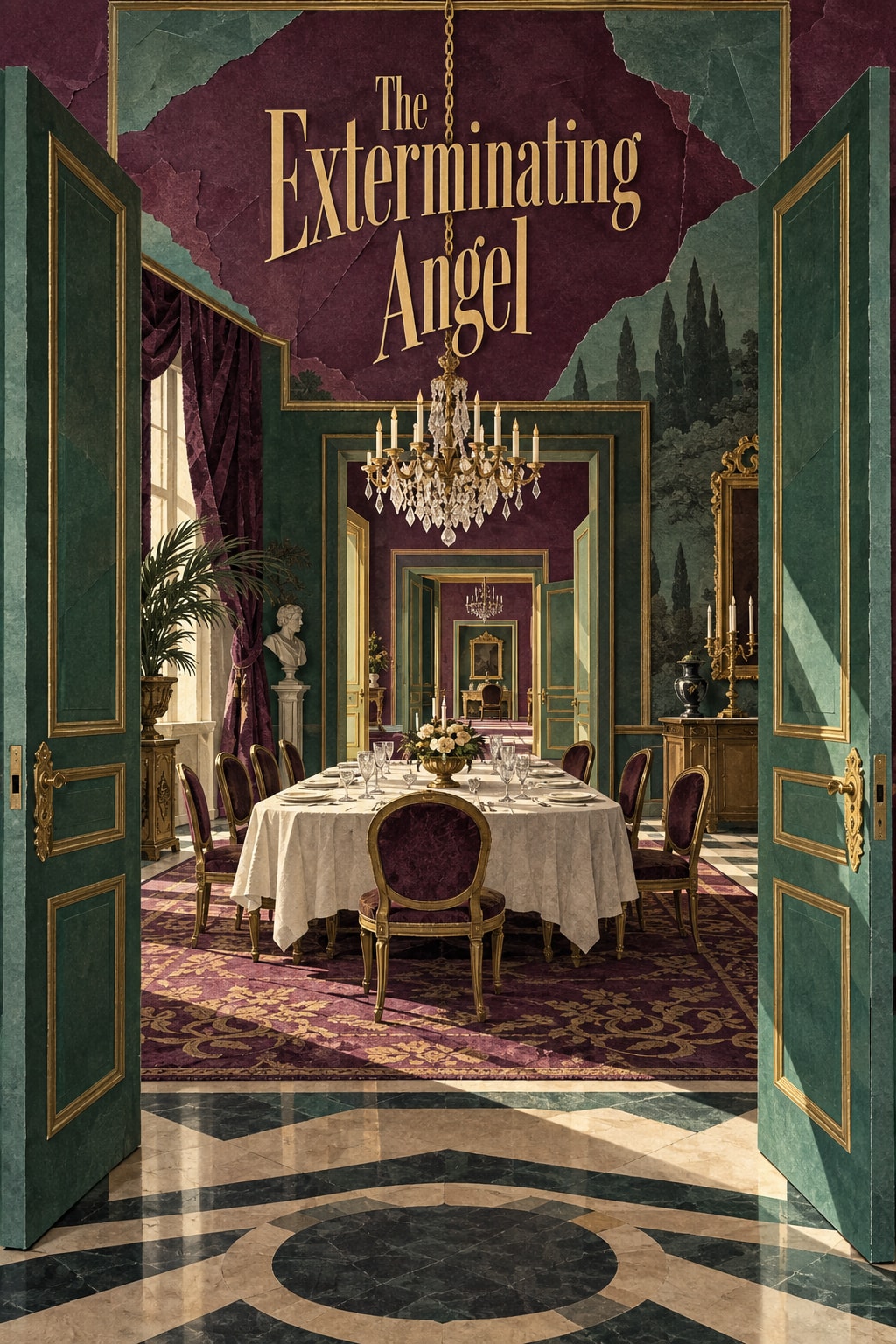
Original illustration for The Exterminating Angel: An extravagant dining room viewed through an enormous completely open doorway: empty table setting, chandelier, rugs and doors that loop into further doors, all precise overlapping paper planes.

Image: Monocurator · source · Original Monocurator artwork

The Exterminating Angel: reading the ending

Follow the sequence of the final scenes, then consider what their repetition might mean.

Follow the final scenes and their repetition · Ending spoilers

What happens in the scenes

Leticia, one of the guests, believes the group has returned to the arrangement of an earlier moment in the drawing room. She asks the others to repeat what they said and did that first night. After this reenactment, they can leave the room and the house.

Her recognition is the character’s claim. In her Criterion essay, Marsha Kinder points out that some guests have died, complicating any literal return to the original gathering. The repetition brings a way out without establishing a dependable rule for how the confinement works.

The apparent release is followed by a church service. At its close, members of the congregation and clergy find that they cannot leave. Michael Joshua Rowin’s MUBI account traces this renewed confinement; the story has moved beyond the private dinner party.

One reading of the ending

The move from drawing room to church widens the satire: a public institution associated with order becomes another place of collective paralysis. On this reading, leaving the first room has not freed the wider society from the pattern. Alex Cox’s Criterion essay likewise treats the ending as a return of the problem. This is an interpretation of the recurrence; the film supplies no final mechanical, theological or psychological explanation for it.

どんな作品か

Buñuel refuses to explain the invisible barrier, making social ritual itself feel like the trap. Courtesy, status, religion, and appetite lose their civilised surfaces while the doorway remains physically open.

無理なく楽しむために

Do not search for a mechanical cause. Watch repeated actions and social roles; the film treats repetition as evidence that the group is imprisoned by more than architecture.

観る前の注意

簡単な補足(網羅的ではありません) Includes death, suicide, animal slaughter, starvation, illness, class cruelty, and religious satire.
Momo's Note ネタバレを含む場合があります Momoって誰? → (英語のページが開きます)
ノートを開く ↓ ノートを閉じる ↑

I enjoy how quickly an impeccable room becomes a complete social system. Nobody needs to lock the door when everyone has learned the same rules about who may move first.

— Momo

Momo thinking about this film

クレジットと版

作品情報の出典

次の一本へ

次はもっと穏やかな作品、短い作品、それとも風変わりな作品? 似た作品をMomoに相談する → (英語のページが開きます)
Momoはただいま勤務中。 Momo Cinemaへ → (英語のページが開きます)
作品一覧をさらに見る →