What to watch next
10 Classic Thriller Films: Choose Your Kind of Tension
From Rear Window and Duel to Notorious and The Conversation: compare ten classic thrillers by pace, runtime and the kind of suspense you enjoy.

A lorry will not stop following you. A small key needs to be returned before anyone notices. The person in danger is across a courtyard, beyond your reach. Classic thrillers can make ordinary distances and everyday objects feel unbearably important.
The ten films below range from Hitchcock’s polished adventures to bleak surveillance and nerve-racking physical tasks. All were made before 1990. Compare the kind of pressure they create: an entertaining chase, a confined-room ordeal or a slower evening of suspicion.
For suspects and deduction, try our classic mystery films. These thrillers place more weight on pursuit, danger and mounting pressure; several do both.
Three places to start
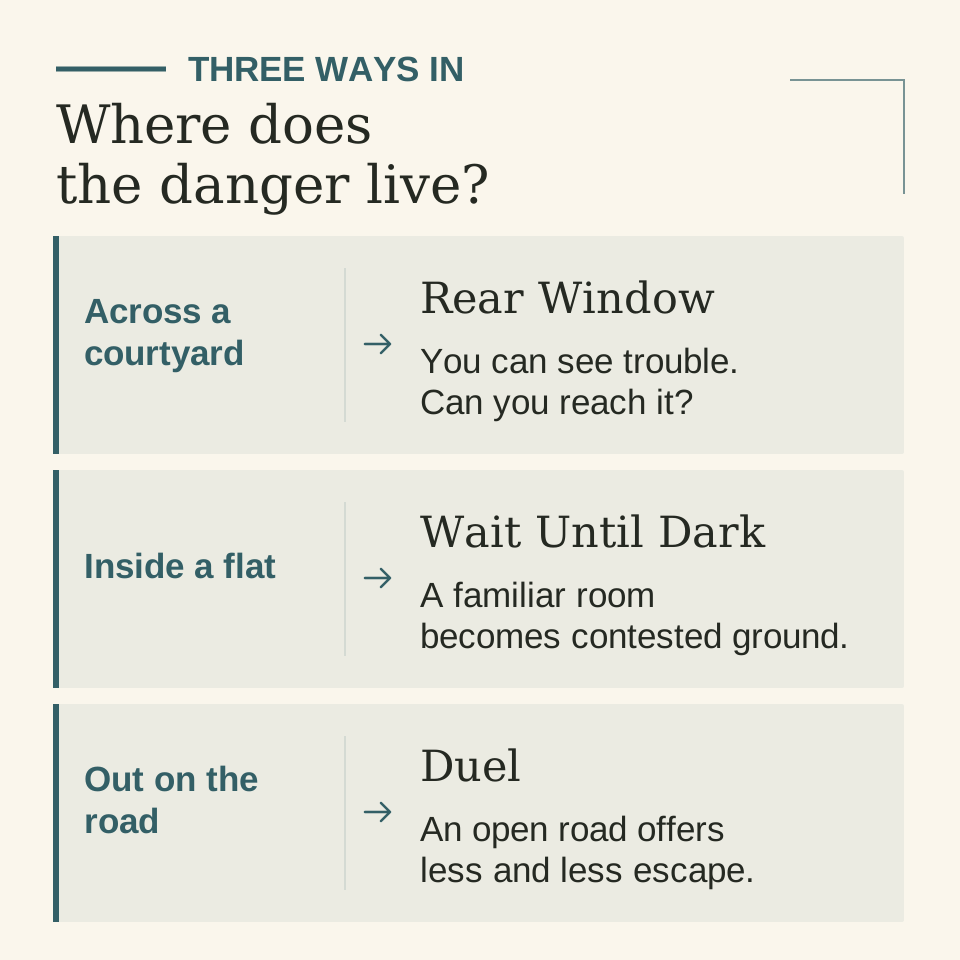
- For the best all-round introduction: Rear Window. Neighbourhood observation turns into danger, with romance and humour woven into the suspense.
- For immediate, physical tension: Duel. One driver, one threatening lorry and increasingly little room to escape.
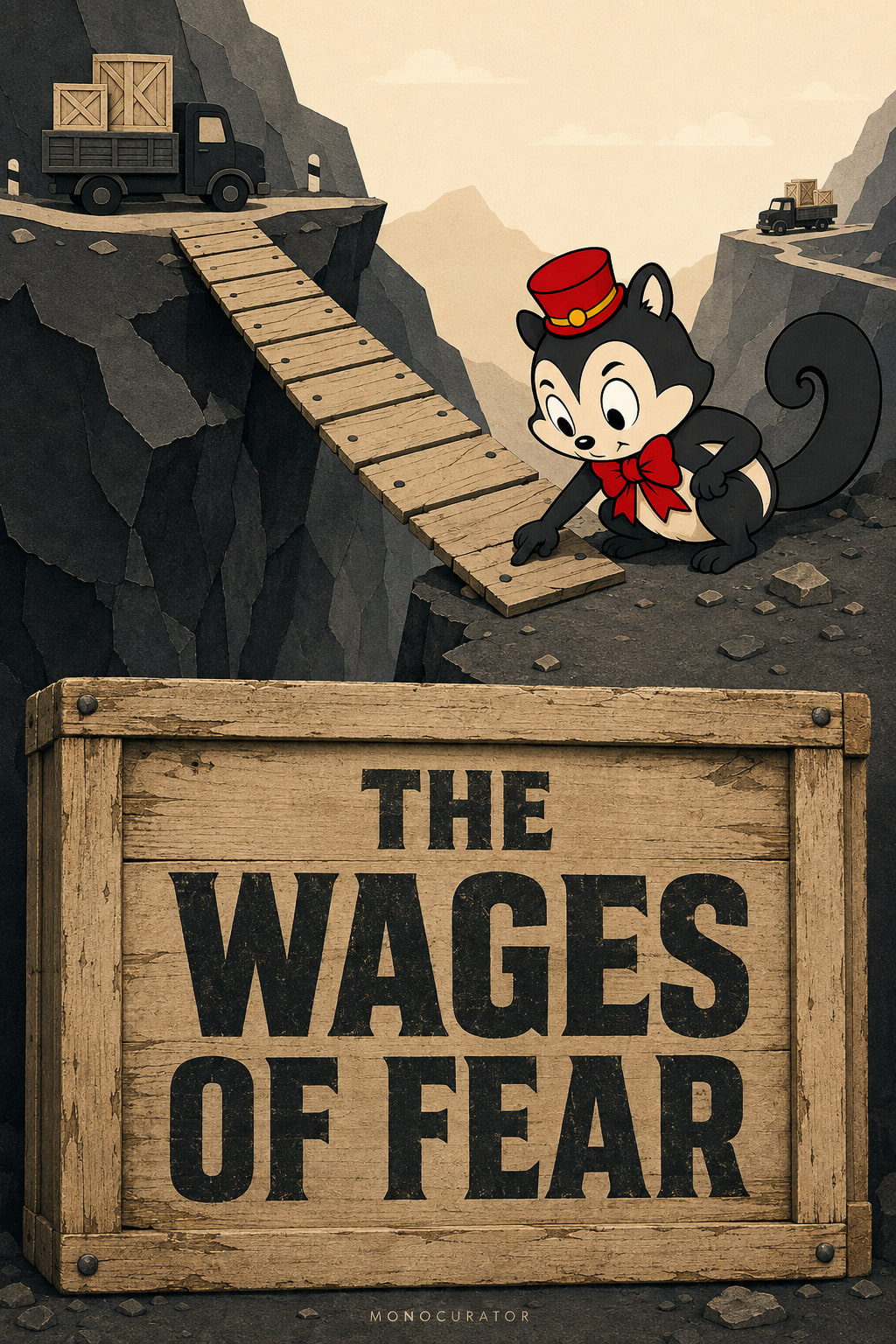
- For a demanding, tightly wound evening: The Wages of Fear. Four men transport an explosive cargo over roads where the smallest mistake matters.
Choose tonight's kind of tension
These are the runtimes listed for the archive or distributor presentations cited below. Duel uses the approximately 90-minute theatrical version; The Wages of Fear uses Criterion’s 152-minute restoration presentation.
| Film | Year | Minutes | What creates the pressure | Before you choose |
|---|---|---|---|---|
| Rear Window | 1954 | 112 | Seeing danger without being able to intervene easily | Murder suspicion, voyeurism and threatened violence |
| The Wages of Fear | 1953 | 152 | A hazardous job that must be completed slowly | Long build-up; severe danger and bleakness |
| Diabolique | 1955 | 117 | A revenge plot and uncertainty about its aftermath | Domestic cruelty and disturbing death imagery |
| Wait Until Dark | 1967 | 108 | Intruders manipulate someone in her own home | Sustained home-invasion threat |
| The Night of the Hunter | 1955 | 93 | Children pursued by an adult they cannot trust | Children in danger; religious intimidation |
| North by Northwest | 1959 | 136 | Mistaken identity and pursuit across changing locations | Violence, heights and sexual innuendo |
| Notorious | 1946 | 101 | Espionage complicated by love and distrust | Coercion, emotional cruelty and physical peril |
| The Conversation | 1974 | 113 | A recording whose meaning will not stay settled | Slow, anxious and emotionally cold |
| Duel | 1971 | About 90 | Being hunted on an exposed road | Road violence and near-collisions |
| Witness | 1985 | 112 | Hiding a witness while danger follows | A brutal opening murder; later violence |
Rear Window (1954): when looking becomes involvement
A photographer recovering from an injury watches the lives across his courtyard and begins to suspect a murder. Alfred Hitchcock builds the film around James Stewart’s restricted viewpoint, with Grace Kelly and Thelma Ritter complicating both his theory and his private life. BFI
Choose it for suspense that depends on where people are. An open window, a dark room or someone moving out of sight can change what you think is happening. The courtyard gradually becomes a place you know well enough to fear.
It is also unusually inviting company for a thriller. The neighbours supply other little dramas, while the central romance stops the investigation from becoming an abstract exercise. Watch when you can give the frame your attention: events at its edges matter. If you enjoy that spatial concentration, follow with Wait Until Dark.
The Wages of Fear (1953): the thriller where going faster may be fatal
Four men take a dangerous job transporting nitroglycerine by lorry to an oil fire. Henri-Georges Clouzot first spends time with the circumstances that make the offer attractive, then turns the journey into a series of physical problems. Criterion
The length is part of the choice. This is not a succession of quick spectacular escapes. The early stretch gives desperation a social setting; later, a road surface or the position of a wheel can demand excruciating concentration. You begin measuring progress in very small movements.
Pick it for sustained pressure and a harsh view of how money can make terrible risks seem reasonable. If you want a shorter road thriller that reaches its central confrontation faster, choose Duel. For more on the oppressive atmosphere, see what to watch on a hot night. Film guide.
Diabolique (1955): an uneasy alliance in a decaying school
The wife and mistress of a cruel headmaster join forces in a revenge plot. Clouzot makes their school a place where routine continues around fear and concealed hostility. Criterion
The pairing of the two women gives the film a particularly unstable centre. Cooperation does not automatically create trust, and a plan does not guarantee control of what follows. Small uncertainties acquire force because the setting is so mundane: this is somewhere people must still eat, work and face one another the next morning.
Choose it for clammy unease and unsettling reversals rather than glamorous adventure. Avoid detailed synopses before a first viewing. Its reputation can encourage you to wait for one famous surprise; paying attention to the relationships makes the whole film more rewarding. Film guide.
Wait Until Dark (1967): learn the room before the danger peaks
Criminals searching for a doll containing heroin target Susy, a blind woman played by Audrey Hepburn, in her apartment. Terence Young directs the adaptation of Frederick Knott’s play. TCM
This is a good choice if you enjoy watching somebody assess a situation and use what is available. An apartment has entrances, familiar objects and sounds; as the pressure builds, those details become resources as well as vulnerabilities. The men also rely on deception, so discovering what is happening matters before the confrontation becomes physical.
The setting stays concentrated, but the intensity is substantial. Where Rear Window keeps its observer apart from the danger, this puts Susy inside it. Her knowledge of the flat gives her resources the intruders underestimate. Choose this for close, practical suspense; choose Rear Window for more comic and romantic relief.
The Night of the Hunter (1955): a pursuit shaped like a dark fairy tale
Robert Mitchum plays a travelling preacher who marries a widow and threatens her children. Charles Laughton’s film combines pursuit with a stylised world of shadows, songs and frightening adult authority. Criterion
Its distinctive quality is how easily beauty and danger occupy the same image. The world can look almost storybook-simple while a child has to make a serious judgement about whom to trust. Mitchum’s confident public manner makes that judgement harder: menace does not always announce itself as menace.
Pick this if you want the atmosphere to linger after the immediate peril has passed. It sits close to horror, and the threatened children make it an emotionally different choice from an adult spy adventure. It is not a gentle family film merely because much of its world is encountered through children. Film guide.
North by Northwest (1959): the most expansive adventure here
A case of mistaken identity sends Cary Grant’s advertising executive into a cross-country pursuit. Hitchcock’s film also brings in Eva Marie Saint, James Mason and a romantic intrigue that refuses to stay separate from the danger. BFI
Choose this for movement, wit and changing scale. It can make a crowded social setting feel unsafe, then find a different kind of exposure in an enormous open landscape. Grant’s composure is part of the fun: the film keeps finding circumstances in which a polished manner is a hopelessly inadequate defence.
Of these ten, it is the easiest recommendation for someone wanting a thriller to feel like a big night at the cinema. The changing locations give each escape a fresh shape, while the flirtation keeps the chase buoyant. Pick it over Duel when you want danger to arrive with glamour, conversation and a much larger cast.

Notorious (1946): the mission makes the romance more dangerous
An American intelligence agent recruits Alicia, played by Ingrid Bergman, to infiltrate a Nazi circle in South America. Her feelings for the agent complicate the assignment. Hitchcock directs Bergman, Cary Grant and Claude Rains. Criterion
The suspense comes partly from concealment, but the emotional arrangement gives it weight. People need to trust one another while judging, using or testing one another. A small practical action can therefore carry several risks at once: exposure, professional failure and rejection.
The camera can survey a crowded party and then draw your attention to a key hidden in Alicia’s hand. Suddenly that small object matters more than the entire room: carrying out the mission also means deceiving someone close to her. Choose this for romance made painful by the work of espionage; it is less playful than North by Northwest. Criterion essay · Film guide.
The Conversation (1974): hearing clearly is not the same as understanding
Surveillance expert Harry Caul records a conversation and begins to worry about the consequences of handing it to his client. Gene Hackman stars in Francis Ford Coppola’s film. Rialto Pictures
Choose it for psychological pressure built through listening. Repetition can seem to promise certainty: play the recording again, isolate the words and surely the meaning will settle. The film makes that desire increasingly uncomfortable, because professional skill does not relieve Harry of responsibility for what he thinks he knows.
It is a quieter and lonelier evening than the chase films here. Sound deserves the same attention that the courtyard receives in Rear Window. If you enjoy that concentration but prefer more warmth and a visible external threat, Witness offers another professional pulled into a situation he cannot keep at arm’s length.
Duel (1971): a simple pursuit with nowhere comfortable to stop
A travelling motorist is terrorised by a tanker lorry on rural roads. Steven Spielberg directed the original television film in 1971; the longer theatrical presentation is approximately 90 minutes. Amblin · BBFC
The attraction is the stripped-down contest. A familiar activity becomes a problem of distance, visibility, speed and dwindling confidence. Stopping does not necessarily end the encounter; another vehicle on the horizon can change the emotional temperature of a whole shot.
Choose it for direct physical tension without a large cast or elaborate backstory. Compared with The Wages of Fear, the danger is an antagonist pursuing you rather than a cargo you have agreed to carry. When selecting a copy, check whether it is the television or theatrical version instead of treating every runtime as a mistake.
Witness (1985): the refuge is a world worth protecting
An Amish boy witnesses a murder, and detective John Book becomes involved in protecting him and his mother. Peter Weir’s film takes Harrison Ford’s policeman into a community with different habits and values. Arrow Films
The quieter passages are the reason to choose it. Work, attraction and the rhythms of communal life give substance to what is threatened. A hiding place becomes somewhere with its own claims on the people inside it, rather than a pause before the next violent incident.
Pick this when you want a thriller with a romantic and social life beyond its plot. The opening murder is brutal, and the eventual danger remains real, but the film gives tenderness and practical activity room to exist. It makes a satisfying alternative to the more isolated, suspicious world of The Conversation.
How intense an evening do you want?
For wit and adventure, begin with North by Northwest or Rear Window. For concentrated physical danger, choose Duel or Wait Until Dark. For a longer accumulation of dread, choose The Wages of Fear or The Conversation. Notorious and Witness are the strongest choices when the emotional relationship needs to matter as much as the threat.
Runtime alone will not tell you how demanding a film feels. Duel has little breathing room, while the longer North by Northwest changes locations and moods. Likewise, a film with limited graphic detail can still be extremely tense. Choose the kind of pressure you enjoy, then leave the plot summary alone.
Momo’s Note
A very good thriller can make me worry about a doorknob. No monster, no explosion: just somebody turning it at the wrong moment. I have considerable respect for a film that can make ordinary furniture behave so badly.
On screen
Films discussed
- Rear Window (1954) · Alfred Hitchcock
- The Wages of Fear (1953) · Henri-Georges Clouzot
- Diabolique (1955) · Henri-Georges Clouzot
- Wait Until Dark (1967) · Terence Young
- The Night of the Hunter (1955) · Charles Laughton
- North by Northwest (1959) · Alfred Hitchcock
- Notorious (1946) · Alfred Hitchcock
- The Conversation (1974) · Francis Ford Coppola
- Duel (1971) · Steven Spielberg
- Witness (1985) · Peter Weir
Continue exploring on Monocurator
Further reading
Read next in the Journal

Want a recommendation shaped around your evening? Ask Momo what to watch next →