See Films Differently Film history
How a Revolving Fresnel Lens Makes a Lighthouse Flash
How stepped glass and a rotating optic turn steady lamplight into a recognisable flash, with Point Reyes and Michael Powell’s The Phantom Light.
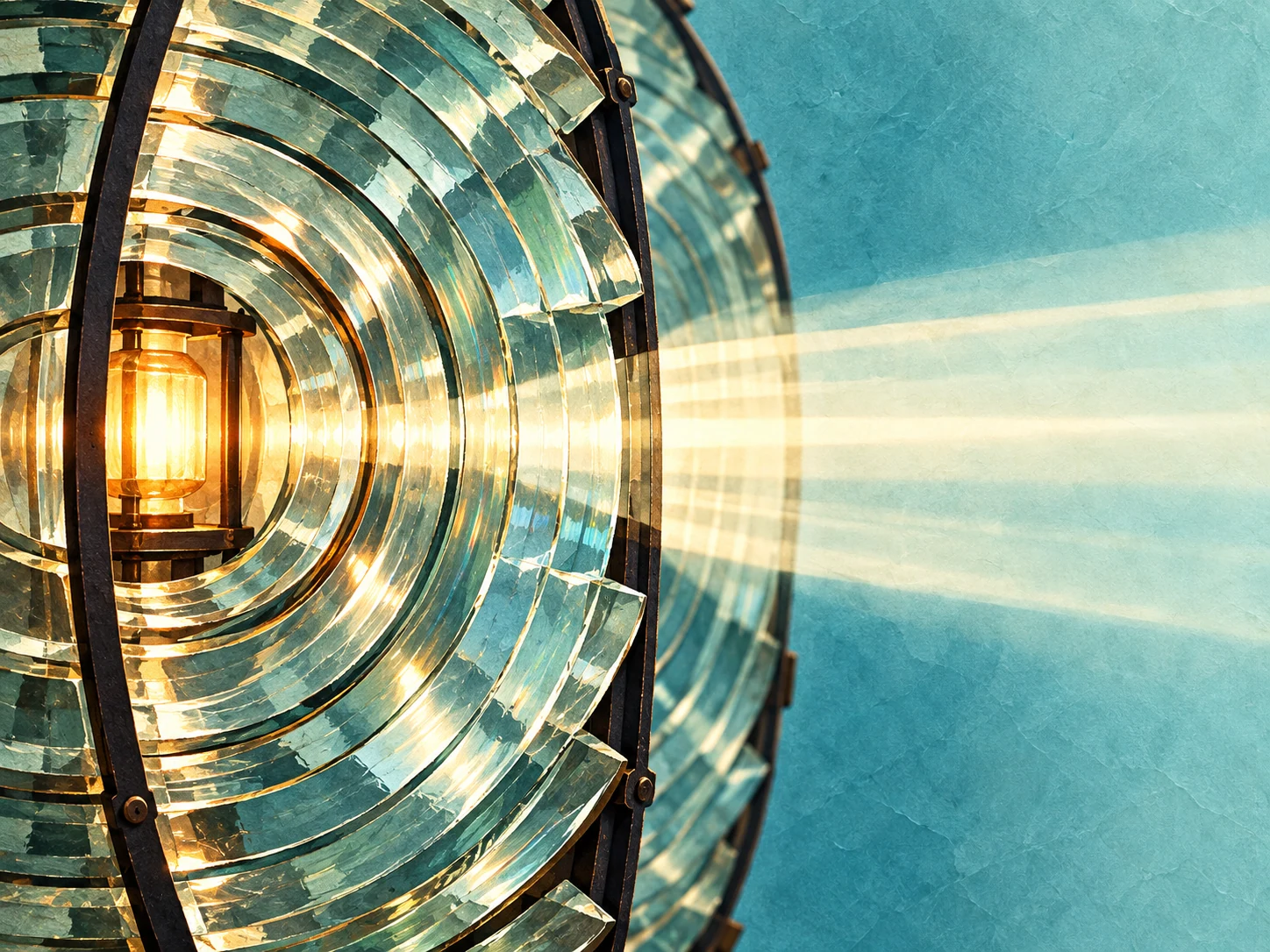
Rings of glass gather and direct the light. In a revolving optic, that arrangement produces the flashes a ship can recognise.
A large lighthouse Fresnel lens can seem like a small piece of glass architecture. Curved components sit in a metal framework, arranged around a light source that occupies surprisingly little of the structure. The apparatus directs light towards vessels out at sea.
A lamp sends light in many directions. The glass surrounding it redirects some of that light towards the sea. [1]
A lens assembled in rings
Early lighthouse lenses presented an awkward material problem. They could be thick and excessively heavy, while their glass absorbed light that was supposed to reach a mariner. In 1822, the French physicist Augustin Fresnel completed a flashing-lens design using thin panels with a concentric-ring structure. [2]
Concentric rings of prisms are central to the arrangement. Their surfaces bend and direct light, with separate pieces doing work that would otherwise require a much bulkier lens. The Science Museum explains that this construction makes the optic lighter than a one-piece lens. [3]
Lighter is a relative description. The museum’s account of the Eilean Glas lighthouse optic puts the weight of its glass alone at several tons. [3] Even after the saving, this was equipment for a tower, not something a keeper could tuck under an arm.
Giving light somewhere to go
In a lighthouse optic, numerous cut glass components surround the source. Refraction and reflection redirect rays that would otherwise spread away from the useful beam. The lens and the lamp have different tasks: the lamp produces light; the optic arranges its distribution. [1]
A part near the top or bottom receives light at a different angle from a part facing straight outwards. The shape of the glass must account for where the ray comes from and where it should go.
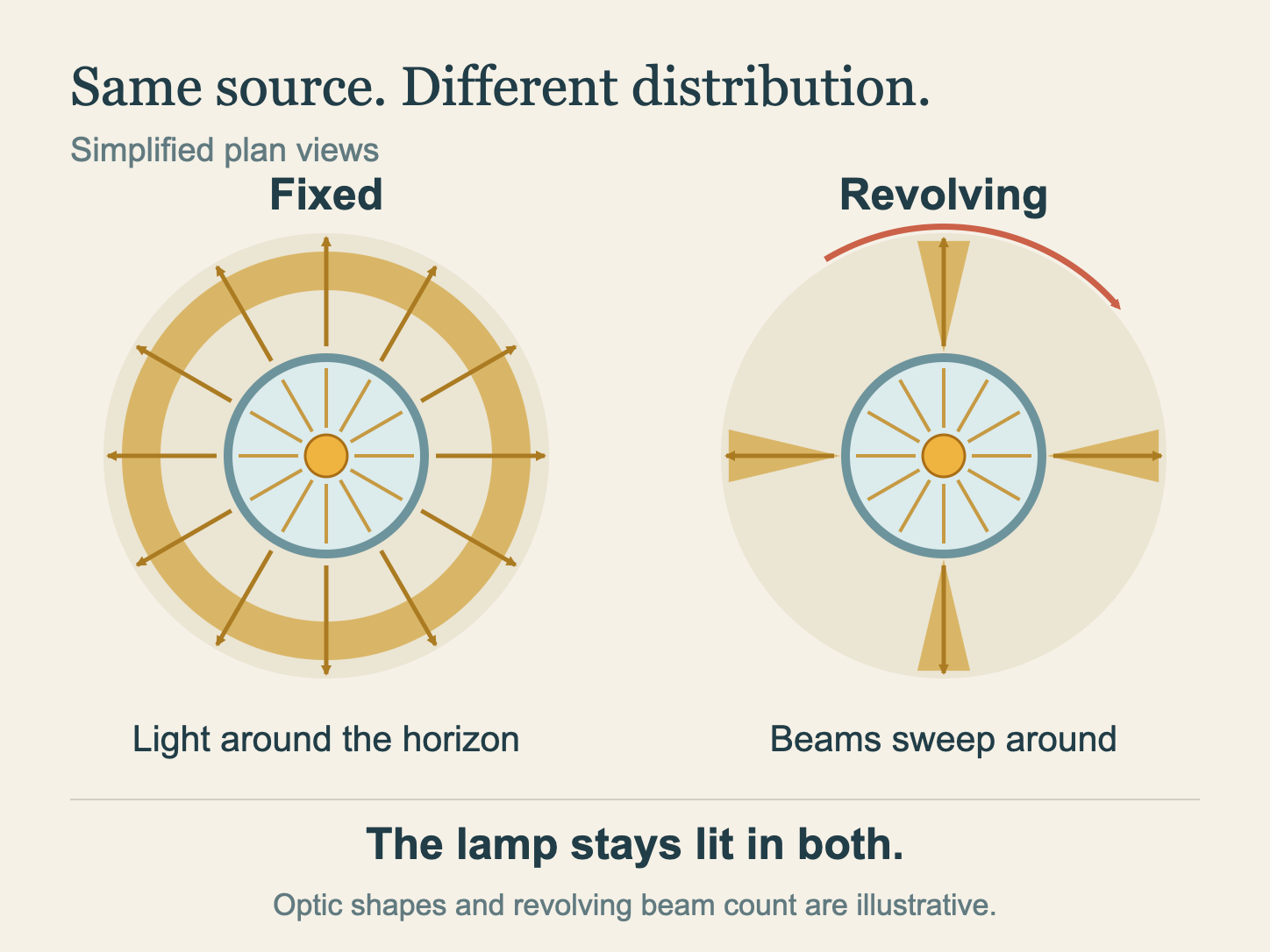
Nor do all Fresnel lighthouse optics behave in the same way. Fixed arrangements can show a steady light around the horizon. Revolving arrangements can produce flashes. [2] We cannot deduce a lighthouse’s whole performance merely from recognising the name of its lens.
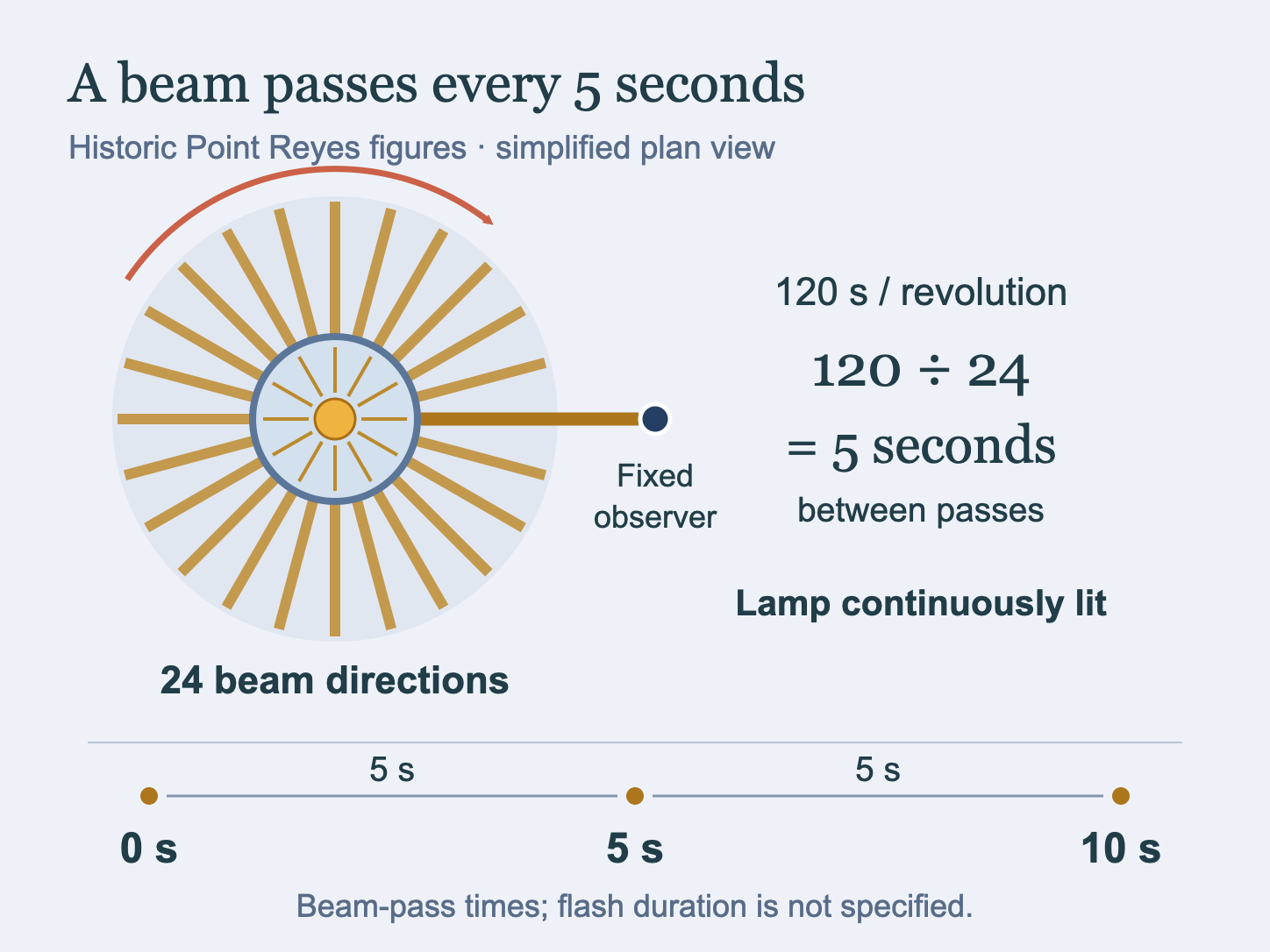
A flash without extinguishing the lamp
At Point Reyes in California, the historic optic divided its output into 24 beams through 24 vertical panels. A mechanism driven by a weight and gears turned it once every two minutes, giving the lighthouse a flash every five seconds. [4] The numbers fit: 120 seconds divided among 24 beams gives a five-second interval.
From a vessel, the light appeared, disappeared and returned. Inside the apparatus, the lamp did not need to be extinguished for each dark interval. Rotation carried a beam past the observer and brought the next one round.
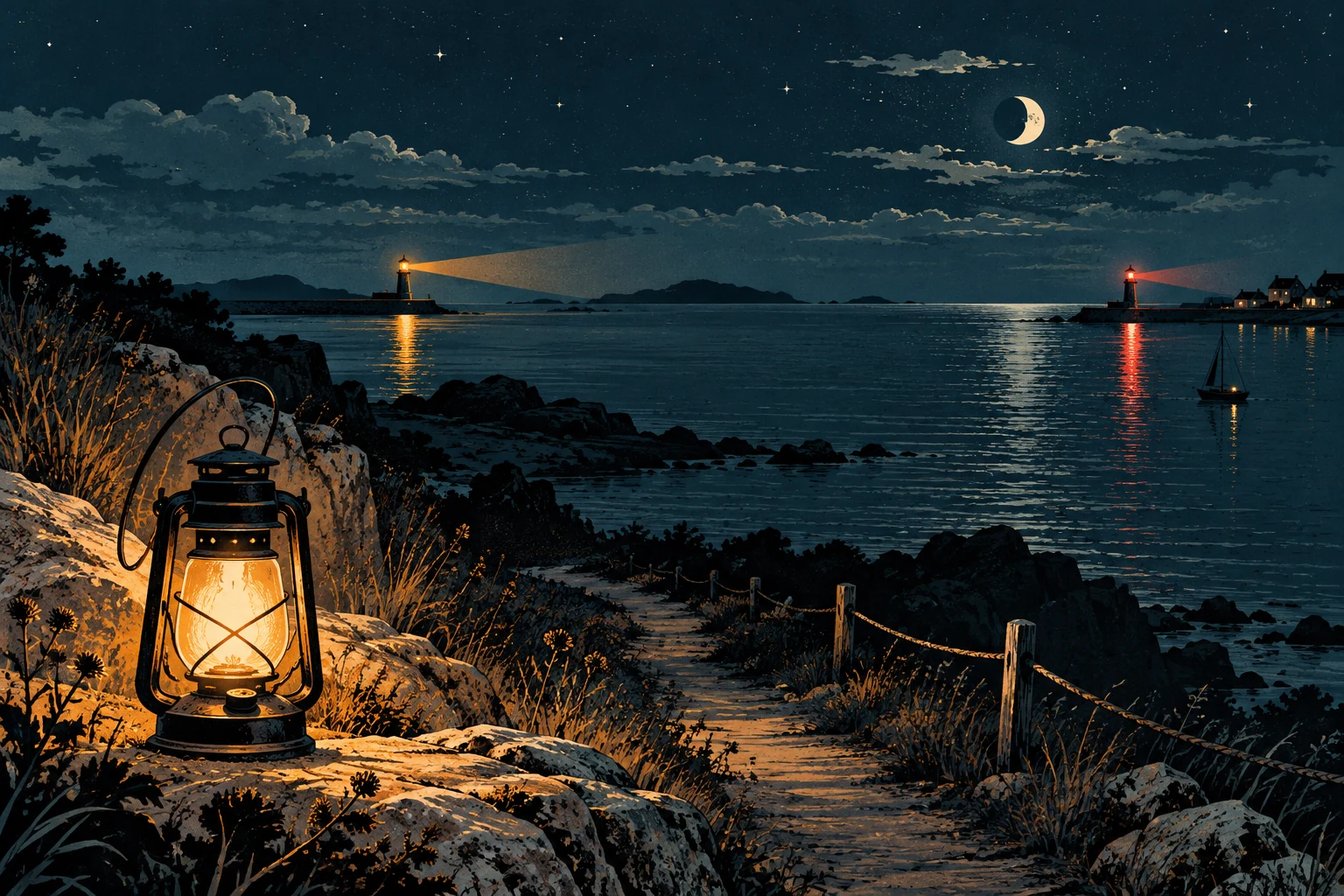
Trinity House explains that lighthouses near one another have different flash characteristics to aid identification. The same pattern may occur in widely separated areas. [5] The signal is therefore a local clue to position, rather than necessarily a signature unique across the world.
Which light can be trusted?
Michael Powell’s The Phantom Light (1935) brings a new keeper, Sam Higgins, to a lighthouse off the Welsh coast, where stories circulate about a haunted light. The BFI’s programme notes describe a comic thriller with a mysterious light appearing on the rocky coast. [6]
The premise gives a useful turn to the familiar reassurance of a lighthouse. Seeing a light leaves further questions: what produced it, and what place does it indicate? An uncertain answer is enough to make the setting uneasy.
A mariner needs more than a bright object on the horizon. The pattern can help identify a light, which is why uncertainty about its source makes such a useful premise for a mystery.
Up close, a Fresnel optic offers a complicated construction to examine. With a revolving optic, its work reaches a vessel in an economical form: a flash, a wait, another flash. The arrangement of the glass and the speed of its rotation shape those few seconds of waiting.
References & Further Reading
- National Park Service, ‘The Fresnel Lens’, Cape Hatteras National Seashore, updated 14 April 2015. Glass components and the concentration of light.
- National Park Service, ‘Fresnel Lens’, updated 25 July 2024. Early lenses, Fresnel’s 1822 design, and fixed and revolving optics.
- David Rooney, ‘Chance would be a fine thing’, Science Museum, 8 February 2010. Concentric prisms and the Eilean Glas optic.
- National Park Service, ‘Lighthouse History at Point Reyes’, updated 26 June 2025. The historic lens and its rotation mechanism.
- Trinity House, ‘Trinity House FAQs’, ‘Why are lighthouses different colours and heights?’ Identification through flash characteristics.
- BFI, The Phantom Light: programme notes, 6 December 2023. Used for the film’s premise; the linked page includes plot spoilers.
The film discussion draws on institutional descriptions. The connection with lighthouse optics is Monocurator’s interpretation.
For the next unexpected question, follow the Journal in your RSS reader.
On screen
Films discussed
- The Phantom Light (1935) · Michael Powell
Further reading
Read next in the Journal
Want a recommendation shaped around your evening? Ask Momo what to watch next →