See Films Differently Momo Notices
Why Is Rain Easier to See Under Streetlights?
Why does rain light up under streetlights? See how light, drops and a dark background work together, then discover the silent film Regen (1929).
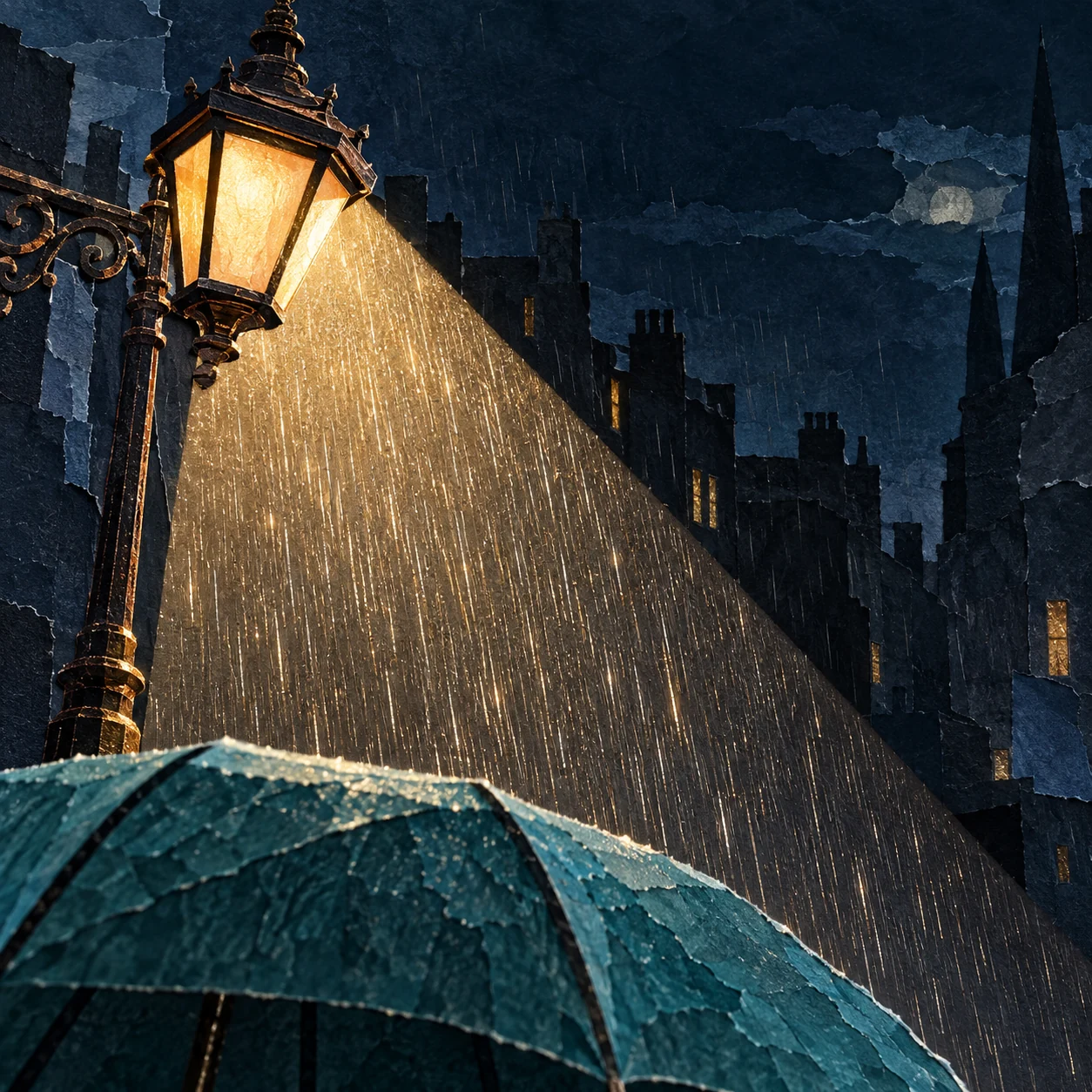
Rain is usually a nuisance. Then it passes a streetlight and starts showing off.
From a window, you can barely make it out against the dark street. Beside a lamp or a brightly lit building, a patch of falling water suddenly becomes a curtain of silver lines. It can look as though the weather has reserved that particular spot for extra rain.
The short answer is that light reaches the drops, some is redirected towards your eyes, and the drops stand out against their background. A change in visibility can look like a change in rainfall. The bright patch alone doesn’t tell you that more water is falling there. [1] [2]
Clear water can still send light your way
Transparent doesn’t mean optically absent. At the boundary between air and water, some light is reflected; light passing through can change direction, or refract. A curved water surface therefore does more than let you see straight through it. [1]
Picture one journey: light leaves a lamp, bends as it enters and leaves a drop, and reaches your eye. Other light can reach you after reflection from the outer surface, or after reflection inside the drop. Only light redirected along a path to your eye contributes to what you see. The water hasn’t switched on a tiny bulb. [2]
A lamp beyond the rain can help light reach you through the drops. Move, and the useful light paths change too. [2] The background matters as well.
The lamp and the background have different jobs
A bright building can be a light source, a background, or both. These are different jobs: illuminating the rain isn’t the same as appearing behind it.
A dark background helps bright drops stand out. The reverse is possible too: if less light reaches you through a drop than from the unobstructed background, the drop can look dark. That is a consequence of the light paths, rather than a rule that rain must always look white. [2]
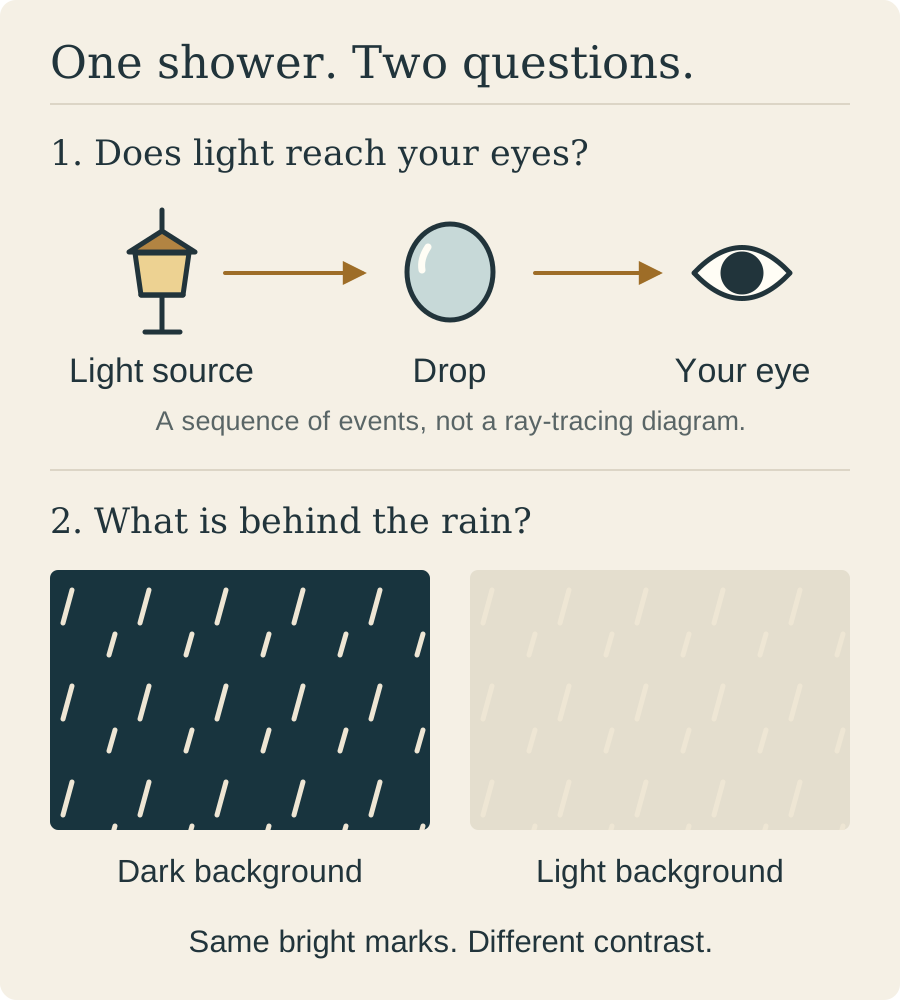
For the bright streaks, I find the dark bit deserves some credit. It has done very little, which is occasionally an excellent contribution.
Kshitiz Garg and Shree K. Nayar’s 2006 study compared photographs of falling drops under different lighting and viewing directions with a physical model. Their results connect the streaks’ varied brightness patterns to light interacting with changes in drop shape. The accompanying database contains rendered streaks, distinct from those photographs. [3] Rain doesn’t have one fixed appearance waiting for a sufficiently powerful lamp to reveal it.
For the next rainy evening, the useful question is simply where the light comes from and what you’re seeing behind the rain. A view from indoors will do. Look beyond the glass at the falling water; drops clinging to the window are a different subject. There is no need to relocate to a traffic island for a better understanding of optics.
The shining road below has its own explanation: water changes the way a surface reflects and absorbs light. I’ve kept that in our article on why wet roads look darker. Here, the little optical objects are still in the air.

Why do drops look like lines?
In a photograph, a moving drop sends light to different positions on the image during the exposure. The camera records that movement as a streak. With the same motion, framing and steady illumination, a longer exposure allows a longer trace; a sufficiently short one can show a much more compact drop. The line records travel during an interval. It isn’t the physical length of the drop. Garg and Nayar’s rendering model explicitly accounts for exposure time, viewing angle and camera focus. [3]
Your vision also combines information over brief intervals, but it doesn’t operate with one fixed shutter speed. In a laboratory study, David Alais and colleagues used moving dots to interfere with people’s detection of briefly presented striped patterns. Fast dots interfered more when the stripes aligned with their motion, supporting the presence of elongated traces in visual processing. The authors also distinguish these traces from what we consciously see: such streak information needn’t appear as an obvious trail. [4]
That gives a basis for discussing time in the perception of moving rain, without turning a camera explanation into a complete account of the eye. The experiment used screen displays, not people watching a storm. I wouldn’t use it to assign your eyes a frame rate—or expect a photograph to reproduce exactly the lines you saw.
Now, a film that gives the rain the screen
Regen, also known as Rain (1929), is a short black-and-white silent film by Joris Ivens and Mannus Franken. Its subject is a passing Amsterdam shower. [5] [6] It takes us beyond the night-time streetlight to other ways rain becomes visible.
Eye Filmmuseum’s account picks out a man turning up his collar, a window closing and an umbrella opening as the shower arrives. [5] Those are good things to watch for. Each makes the weather legible differently: clothing moves closer to a body; an opening closes; a portable roof appears.
Try following the change from seeing water to seeing someone accommodate it. You don’t need every falling drop to remain visible for rain to occupy the picture. A small action can give it a presence just as surely as a bright streak can. This is the pleasure I would bring to the film: noticing how many forms one shower can take on screen, including the forms made by people who would prefer to stay dry.
The framing and editing give those details their place. Let the changes between water, clothing and shelter guide your attention, without needing to explain every drop.
I don’t think admiring any of this obliges you to become a rain enthusiast. It can still spoil the walk and find the gap in your coat. For a moment beside a light, though, it can be rather beautiful. Then you can close the window.
References
- Samuel J. Ling, Jeff Sanny and William Moebs. University Physics Volume 3. OpenStax, 2016. Sections 1.2, ‘The Law of Reflection’, and 1.3, ‘Refraction’.
- Kshitiz Garg and Shree K. Nayar. ‘Photometric Model of a Rain Drop’. Columbia University technical report, 2004. Listed as ‘Appearance of a Raindrop’ on Garg’s university page; the linked report supplies the title used here. Sections 3–5.
- Kshitiz Garg and Shree K. Nayar. ‘Photorealistic Rendering of Rain Streaks’. ACM Transactions on Graphics 25(3), 996–1002, 2006. DOI: 10.1145/1141911.1141985. University-hosted full text, particularly sections 3–5 and figures 1, 3 and 4.
- David Alais, Deborah Apthorp, Anna Karmann and John Cass. ‘Temporal Integration of Movement: The Time-Course of Motion Streaks Revealed by Masking’. PLOS ONE 6(12), e28675, 2011. DOI: 10.1371/journal.pone.0028675.
- Eye Filmmuseum. ‘Regen’. Film record and descriptive synopsis.
- International Documentary Film Festival Amsterdam. ‘Regen (1929)’. Archive record, including directing credits.
On screen
Films discussed
- Regen (1929) · Joris Ivens and Mannus Franken
Further reading
Read next in the Journal

Want a recommendation shaped around your evening? Ask Momo what to watch next →