See Films Differently Momo Notices
How Are Dinosaur Skeletons Made for Museums?
How museum dinosaur mounts combine fossils, copies, reconstructed gaps and revised poses, with a missing-bone detour to Bringing Up Baby.
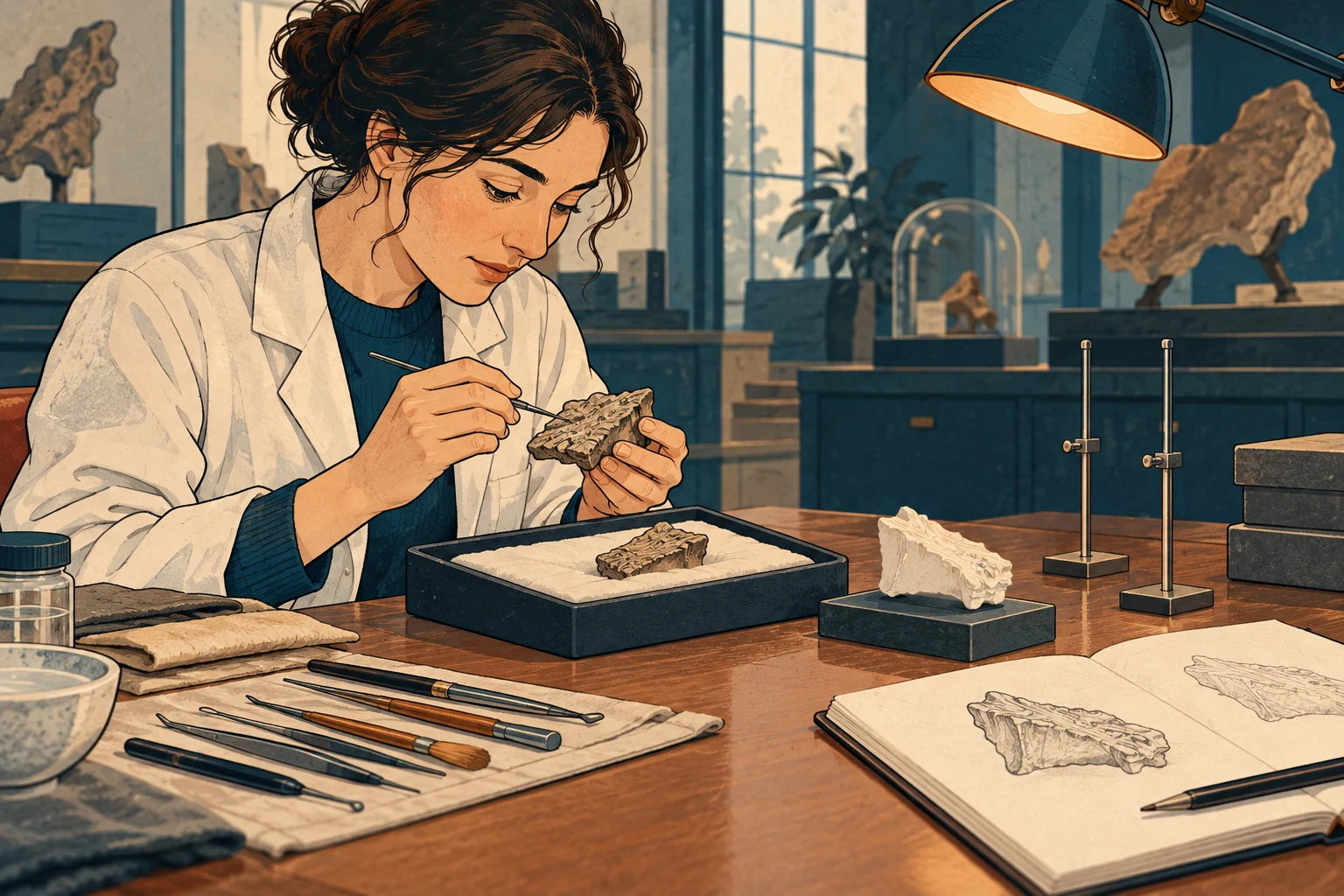
A museum can display a recognisable dinosaur without possessing every bone of one animal. A mounted skeleton may combine original fossils, copies of known bones and reconstructed missing parts. Its arrangement also reflects researchers’ understanding of the animal’s anatomy. Those are different kinds of work, even when they meet in one display. [1][2]
I’d start with a smaller question than “Is it real?”: which part are we asking about? A copied bone and a proposed posture need explaining in different ways. Neither becomes clearer if we simply call the whole dinosaur a fake.
First, get the fossil ready
Excavation does not deliver a clean skeleton ready to stand up. The Natural History Museum describes fossils arriving surrounded by rock, often supported in protective plaster jackets. Preparators remove the surrounding rock, known as matrix, with methods suited to the specimen. Their work also includes repairs and stabilising fragile areas. [3]
Some preparation uses hand tools or compressed-air tools; some exploits chemical differences between fossil and rock. The choices matter because revealing a bone can also damage it. The Museum describes using reversible repair materials where possible, so pieces can be separated again if needed. [3]
I’m rather taken with that last detail. Making something ready for display needn’t mean closing the case on further investigation.
A copy needs something to copy
A cast reproduces an existing fossil’s shape. The Field Museum explains that moulds can be taken from fossil bones; scanning and 3D printing provide other ways to duplicate them. A sculpted replacement for a missing bone involves a different step: its form is inferred from surviving bones or comparable specimens of the same or related species. [1]
That distinction survives whatever material the finished part is made from. You can ask which specimen supplied a copied shape. For a reconstructed gap, you can ask what comparison supported the proposed shape.
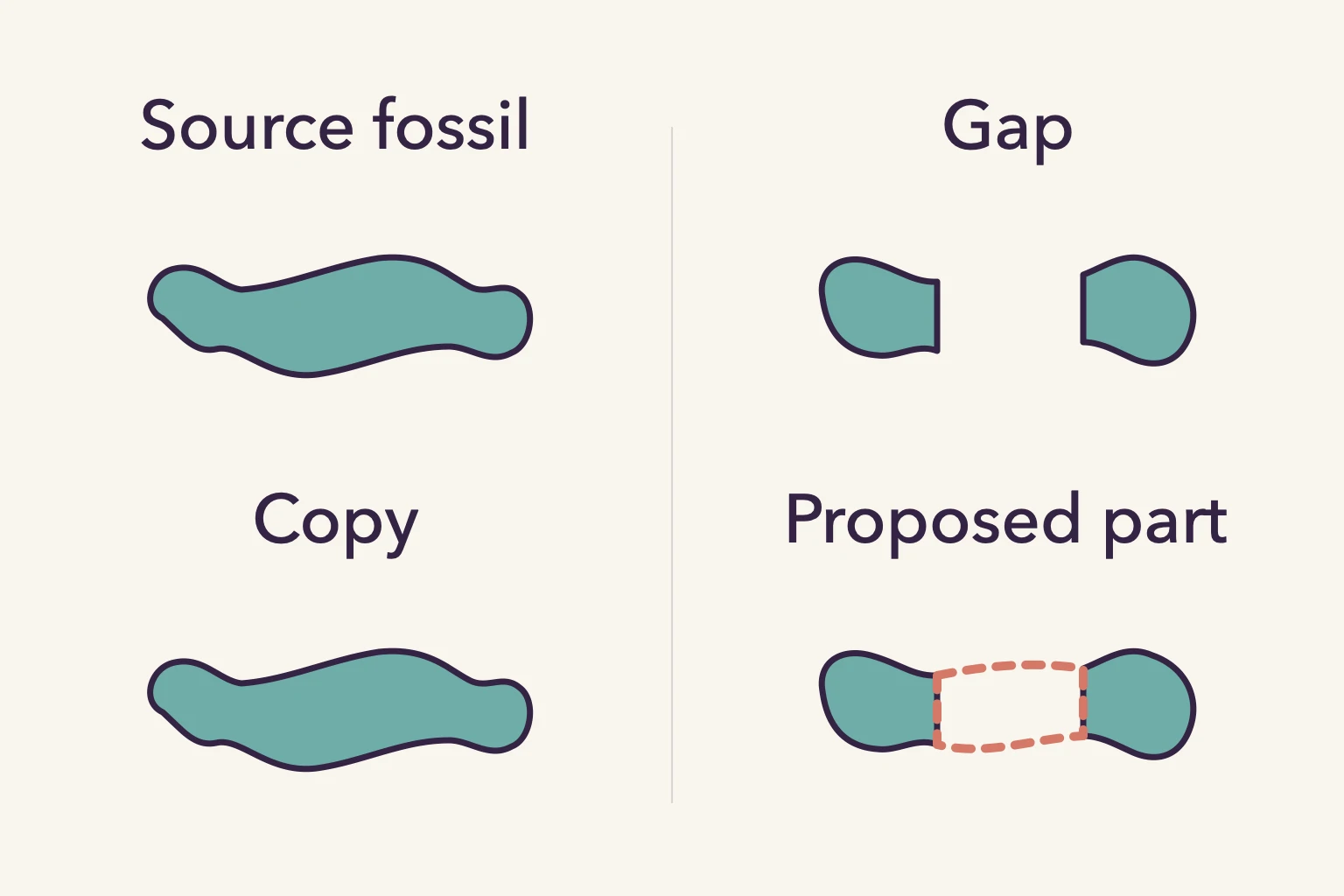
The Natural History Museum’s account of its Mantellisaurus makes the difference nicely tangible. In 2019, staff temporarily removed fossil bones from the display for scanning, leaving cast elements on the mount. [2] Its separate preparation account explains that the displayed skull cast draws on two partial specimens. The dinosaur’s own skull remains in pieces in the collection, where that condition is valuable for research. [3]
It also gives a straightforward way to complete a missing side: if a left arm survives but the right does not, its form can be mirrored. [2] That is an anatomical comparison with an available counterpart, rather than an invitation to invent an interesting new arm.
I’d prefer my own replacement arm to match, too. Two left ones would make the sleeves unnecessarily complicated.
Standing up is another job
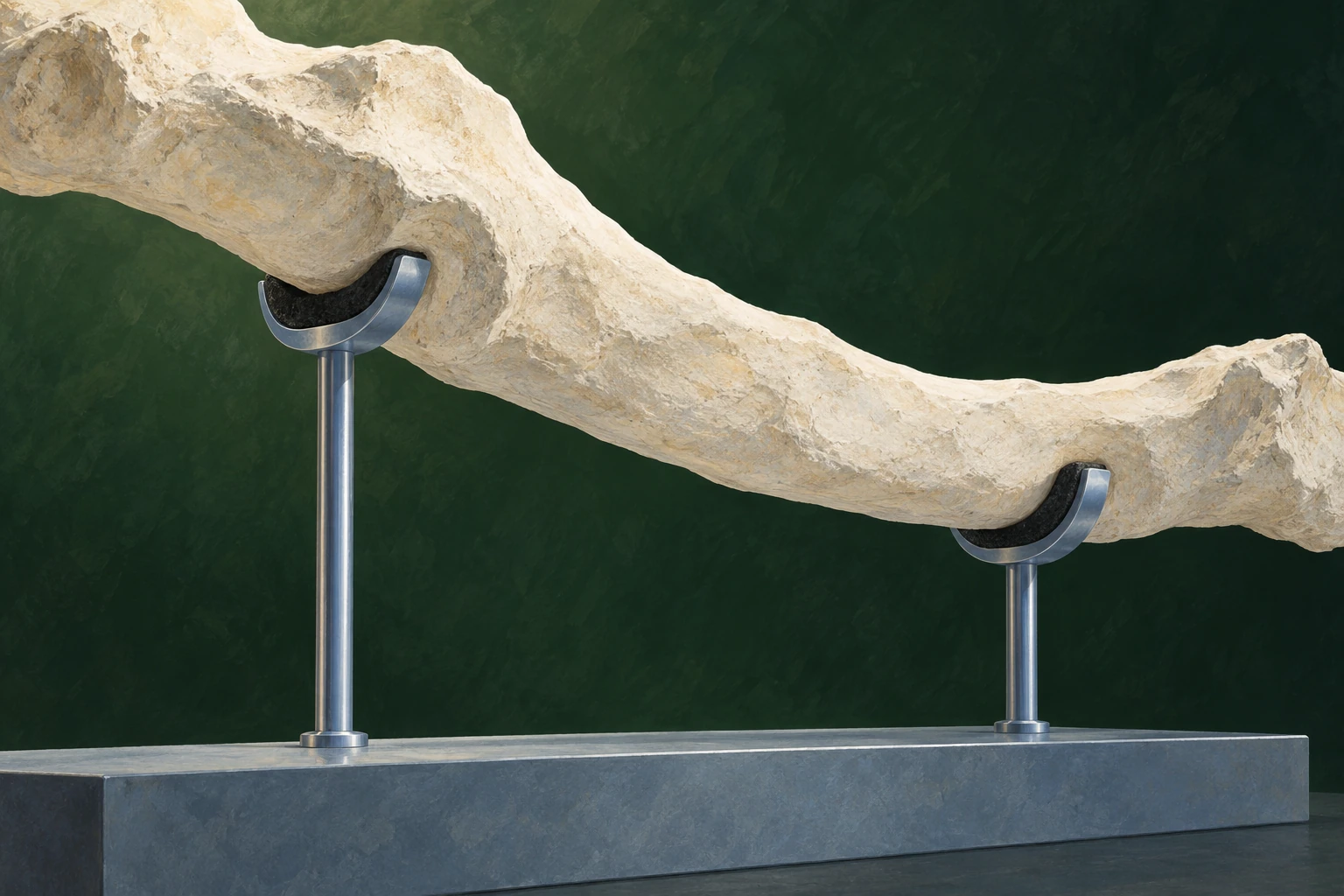
The bones also need physical support. In its account of making the bronze Diplodocus called Fern, the Natural History Museum describes ordinary indoor fossil and cast displays being hung, propped or cradled to protect them. Dippy’s existing cast had a supporting mount. [4] A skeleton on display is therefore an arrangement of objects with engineering underneath it.
That support answers a practical question: how can these particular pieces be held safely in place? Anatomy answers another: how should the pieces relate to one another? Copying every available bone would still leave you with the task of assembling them.
A pose can change without a new dinosaur being found
Dippy offers a clear example. The Museum records that the cast’s tail was remade in lighter material in 1993 and raised off the ground. It links the change to research indicating that Diplodocus held its tail in the air instead of dragging it. [5] The material change made a revised interpretation possible in the display.
The Field Museum’s 2018 account of SUE’s remounting describes adding gastralia, bones along the belly that had been found with the dinosaur but whose placement was initially uncertain. Including them required widening the ribs; changes to the wishbone and shoulder blades also altered the position of the arms. [6]
These examples give us something more precise than “scientists changed their minds”. Particular anatomical questions led to particular adjustments. A convincing-looking mount can still contain decisions that later research revises.
One missing bone, plus a leopard
For a film detour, I’m choosing Howard Hawks’s black-and-white Bringing Up Baby (1938). Criterion’s synopsis gives us Cary Grant’s palaeontologist seeking a museum endowment, Katharine Hepburn’s heiress, a missing dinosaur bone and a loose leopard. [7] That is quite enough disruption for one working day.
The missing bone makes an appealing link to our question. In the comedy’s premise, it becomes one of the objects around which trouble gathers. In the museum accounts, a gap opens several practical questions: what survives, what can be copied, and what needs reconstruction?
I like having those two ways of thinking about an incomplete skeleton alongside each other. One gives a comedy something to go wrong with; the other gives researchers something to work out. This is my comparison, rather than a claim about how the film’s dinosaur prop was made.
Back in a dinosaur gallery, I’d look for the label explaining the mount. Knowing which parts are fossil, copied or reconstructed gives you more to look at. The complete outline gets your attention; the account of how it was assembled rewards keeping it there.
References & Further Reading
These are museums’ accounts of their own specimens and working methods. Individual examples do not establish one procedure used by every museum. Film information comes from the distributor’s synopsis and credits; the comparison is Monocurator’s own.
- Field Museum. “Which Dinosaur Bones Are ‘Real’?” 11 June 2019. Fossils, duplication methods and reconstructed missing elements.
- Emily Osterloff. “Mantellisaurus: 3D-scanning One of the Most Complete British Dinosaurs.” Natural History Museum, 20 August 2019. A particular display’s fossil and cast elements, and a mirrored counterpart example.
- Emily Osterloff. “Fossil Preparation: How Do We Get Specimens Ready for Display?” Natural History Museum, n.d. Preparation, stabilisation and reversible repairs.
- Josh Davis. “The Making of Fern the Diplodocus: Engineering Meets Natural History.” Natural History Museum, 16 July 2024. Indoor display supports and Dippy’s mount; Fern is a separate bronze project.
- Lisa Hendry. “Dippy the Dino-star.” Natural History Museum, n.d. The 1993 tail replacement and revised posture.
- Field Museum. “A Fresh Science Makeover for SUE.” 30 November 2018. Placement of gastralia and changes to the mounted skeleton.
- The Criterion Collection. Bringing Up Baby. Film information and synopsis, n.d. Howard Hawks, 1938, black-and-white format and the museum/missing-bone premise.
For the next unexpected question, follow the Journal in your RSS reader.
On screen
Films discussed
- Bringing Up Baby (1938) · Howard Hawks
Further reading
Read next in the Journal
Want a recommendation shaped around your evening? Ask Momo what to watch next →