See Films Differently Film craft
Why PlayTime’s Doorman Keeps Opening a Door Without Glass
Why does PlayTime’s doorman keep opening a broken door? Separate the passage from the gesture with Don Norman’s distinction between affordances and signifiers.
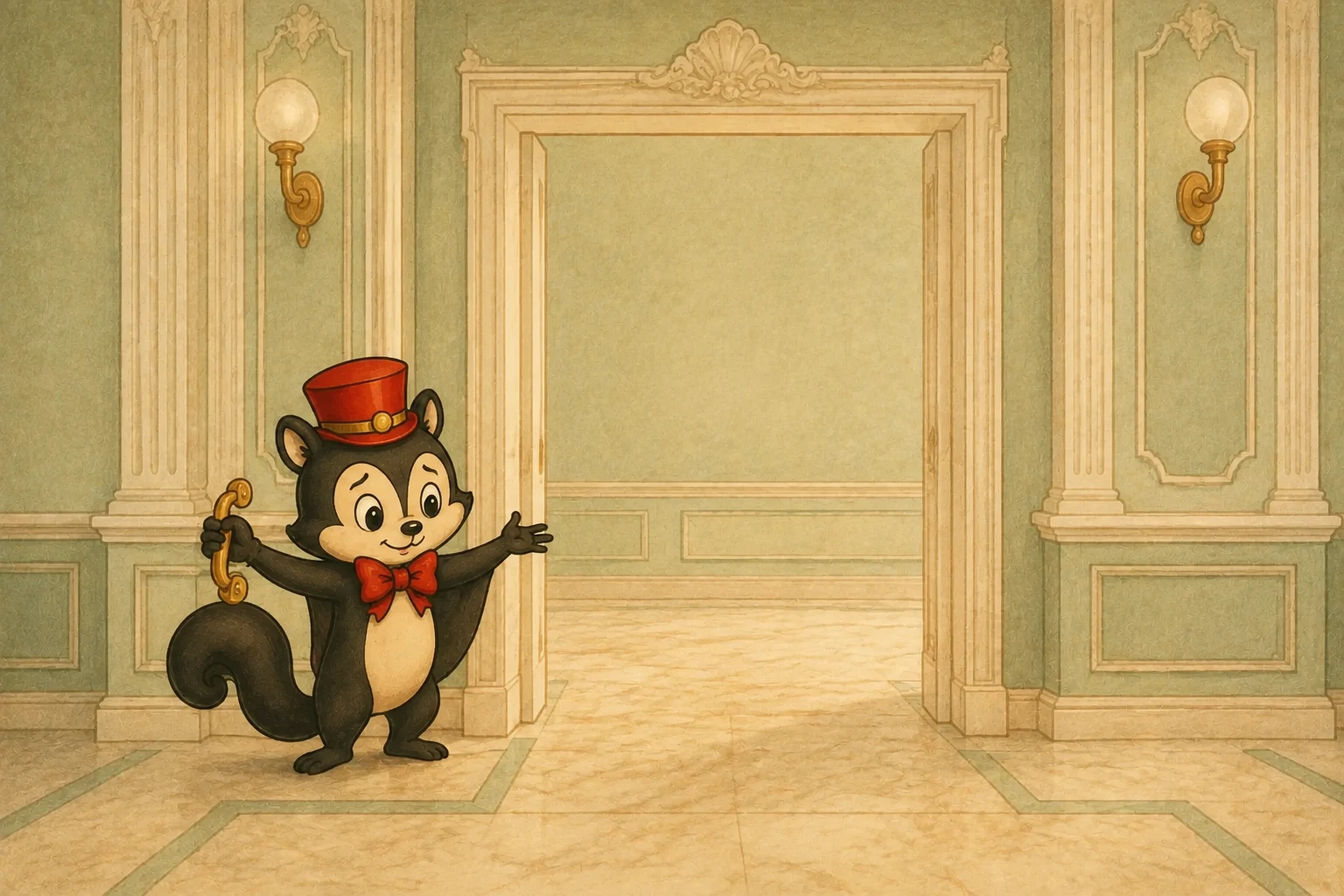
The restaurant’s glass door has shattered. In Jacques Tati’s PlayTime (1967), the doorman carries on with its detached handle, moving it through the motions of opening and closing. David Cairns describes this as a pretence that nothing has gone wrong, and reads the gag as a joke about pantomime itself. [1] [3]
What persists is a recognisable act of service. The glass no longer blocks the entrance, but the doorman can still perform the gesture that normally accompanies making a way through. The physical work and the performance of that work have come apart.
Two terms from design help separate them. An affordance concerns what a particular person can do in relation to their surroundings. A signifier is a perceptible clue that helps someone interpret a situation or an available action. In his account of this distinction, Don Norman includes people’s behaviour among the clues we use. Such clues can be deliberate or unintended. [2]
Apply that distinction to the entrance. With the glass intact, a person’s passage depends on the panel’s position: a closed pane can obstruct a body, while an open door can leave a route through. Breaking the glass therefore changes the conditions of passage; it does not create the first possibility of entering. Nor does it remove everything the doorman can do with the remaining object. He can still grasp and move the handle. That movement simply no longer swings a glass panel out of somebody’s way.
The gesture can nevertheless carry information. We can read its motion as opening a door because it preserves the shape of that familiar action. It can also be read as an invitation to enter, marking the moment at which the doorman offers passage. On this reading, the signifier is the handle’s movement in the setting of his work: a performed cue whose meaning survives the loss of its usual mechanical purpose.
Watch the space where the panel would have been, then the handle travelling through it. Consider separately what the movement changes about the route through and what it still communicates.
References
- David Cairns, “Jacques Tati: Things Fall Together”, The Criterion Collection, 4 November 2014. The paragraph on the shattered door supplies the scene description and the reading of the gag as pantomime about pantomime.
- Don Norman, “Signifiers, not affordances”, 17 November 2008, author’s version of an article in ACM Interactions, 15(6). The distinction between possible actions and perceptible cues comes from this essay; its application to the doorman here is Monocurator’s reading.
- The Criterion Collection, PlayTime, synopsis and film information. Tati’s 1967 film is in colour and uses sound; its largely wordless comedy should not be confused with silent cinema.
On screen
Films discussed
- PlayTime (1967) · Jacques Tati
Want a recommendation shaped around your evening? Ask Momo what to watch next →