See Films Differently Film craft
Love Toy Story? Discover the Living Doll in A Christmas Dream
Love Toy Story? Discover A Christmas Dream, an eleven-minute black-and-white short where an old rag doll turns a piano into music, skating and play.
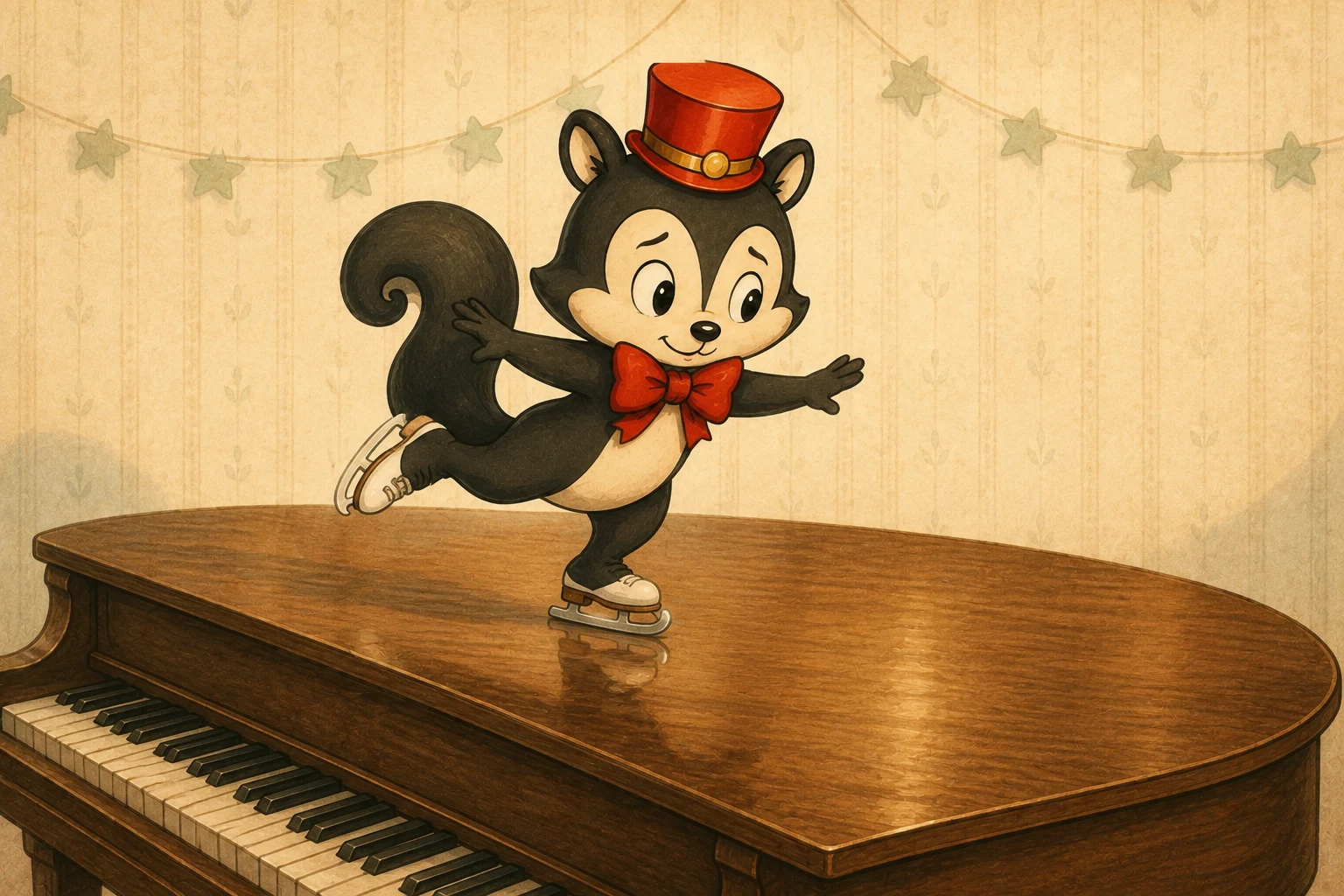
If you like Toy Story, try A Christmas Dream: an eleven-minute black-and-white short in which an old rag doll puts on a show for the child who has discarded it. New Christmas presents have claimed a little girl’s attention. In her dream, the old toy comes to life and tries to win her affection through performance. It is a small, playful film with an especially good reason to watch the furniture: a piano gives the doll more than one way to entertain her. [1] [2]
The Czechoslovak film, also known as Christmas Dream or Vánoční sen, had its Prague premiere in 1945. Bořivoj Zeman directed the live action and Karel Zeman the puppet animation; Hermína Týrlová shares the screenstory credit with Bořivoj. It has sound and music, without dialogue. You can follow its central appeal through what the doll does and whom it wants to interest. [1]
A piano becomes a place to play
Watch what happens when the doll reaches the piano. It climbs up and hops along the keys. Then it performs a skating routine on the polished piano surface. The archive’s synopsis records the girl’s pleasure in these antics. These are two distinct acts, using different parts of the same object. [1]
On the keys, movement makes music. On the smooth surface, movement suggests ice. The room has acquired a miniature performer, and that performer discovers several uses for its surroundings. A piece of adult furniture can become an instrument scaled to a whole body, then a skating rink.
That change is worth keeping in view. A piano does not need to disappear for the skating to work as make-believe. We can recognise the furniture and the imaginary rink together. The doll’s act asks us to entertain both possibilities, much as play can give an ordinary object a second purpose without changing what it is made of.
The child’s attention gives the routine a second stake. We are watching an act, but also an attempt to find an audience. A successful movement matters to the doll because somebody might enjoy it. The question extends beyond whether this discarded object can move: what can it offer the girl now that she has other things to look at?
The old toy offers something new
The connection with Toy Story is easy to recognise. Woody fears losing his place with Andy when Buzz Lightyear arrives. Pixar’s own account puts that rivalry and Andy’s attention at the heart of the original film’s premise. [3] Both stories make room for the old toy’s stake in being chosen.
That resemblance has been discussed before. Writing in the East European Film Bulletin in 2012, Moritz Pfeifer compared the films through replacement and attachment. [4] The performance in A Christmas Dream gives us a more particular way into that shared concern.
The rag doll has a repertoire. Playing music and skating offer different pleasures, even though the performer remains the same. Its appeal can change without a new toy arriving. Seen this way, the routine makes affection depend partly on discovery: the familiar object can still suggest something the girl wants to watch.
There is a little pressure in that arrangement. The doll is working to recover attention it once had. Yet the delight of the acts prevents the film from being only a complaint about abandonment. Its energy comes from trying things. Looking at it solely as a lesson about keeping old possessions would leave much of the performance unexplained. Keeping a toy and finding something to do with it are different kinds of involvement.
The piano makes that distinction concrete. It provides possibilities for the doll, just as the doll provides possibilities for the child. The pleasure passes between performer, object and spectator.
The girl is also the dreamer
The dream matters to this relationship. A Christmas Dream places the toy’s return to life within the girl’s sleep. [2] She is the audience the doll hopes to win, and the dreamer within whose experience the performance takes place.
That lets us read the scene in two ways at once. From the doll’s side, an overlooked character is making an effort to be loved. From the girl’s side, the familiar toy has become capable of surprising her again. The film gives a body and an act to that renewed possibility.
There is a difference here from following Woody and Buzz through their rivalry and adventures. This short concentrates the relationship into a performance addressed to the child. Her presence gives the tricks somewhere to go. The doll’s ingenuity and her capacity to find it interesting belong to the same small drama.
The combination of a live child and an animated puppet makes that relationship visible. We see a recognisable plaything take on the activity of an actor. It can be something to hold, a character with a purpose and a performer to watch, all within the same story.
The performance was made, too
The doll’s apparent initiative has a counterpart in the work of animation. In their illustrated book about Karel Zeman, his daughter Ludmila Zemanová and granddaughter Linda Zeman Spaleny describe his preparation of the puppet’s movements and expressions in drawings. Their account also says that Jiří Šust’s music was prepared before filming. [5]
Those details make useful viewing prompts. Notice how a pose helps an action become legible, and how the musical movement of a routine helps it feel like an act presented to somebody. A puppet can change position without seeming to have a purpose; here, wanting the girl’s attention gives its activity direction.
The film offers a pleasing overlap between its story and its medium. The old toy must make itself worth watching, while the filmmakers must make an object hold our attention. We become another audience for the doll’s efforts.
Finding the eleven-minute film
The Criterion Channel lists A Christmas Dream. The service is available in the United States and Canada; availability of this title should be checked in your account. [6] The short is also listed among the supplements in Criterion’s Blu-ray and DVD box set Three Fantastic Journeys by Karel Zeman. [7]
When the doll reaches the piano, give the furniture a little attention too. Watch how an instrument becomes a place to skate, and how much a familiar toy can propose with the things already in the room.
References
- Národní filmový archiv, “Christmas Dream”, Filmový přehled, extant-film record 400510; detailed synopsis and credits in the Czech record. The current record gives production and copyright as 1944, and the Prague premiere at Sevastopol as 23 November 1945. Criterion lists the film under 1945. These labels should not be treated as an agreed production date.
- Národní filmový archiv, “Christmas Dream”, summary and film information: the girl's Christmas-Eve dream, eleven-minute duration and production credits.
- Pixar Animation Studios, “Toy Story”, synopsis and Woody and Buzz Lightyear character descriptions.
- Moritz Pfeifer, “Simplify, simplify, simplify: Hermína Týrlová's Les contes de la ferme (1972)”, East European Film Bulletin, vol. 20, August 2012. Cited for its existing Toy Story comparison, not for its conflicting date and production attribution.
- Ludmila Zemanová and Linda Zeman Spaleny, Karel Zeman a jeho kouzelný svět, CPress, 2015, pp. 28–31, available in the publisher's sample. A family account of the doll's performance and the preparation of movement and music.
- The Criterion Channel, “A Christmas Dream”; The Criterion Collection, Channel FAQ, service territories.
- The Criterion Collection, Three Fantastic Journeys by Karel Zeman, special-features listing for the Blu-ray and DVD box set.
On screen
Films discussed
- A Christmas Dream · Bořivoj Zeman and Karel Zeman
- Toy Story (1995) · John Lasseter
Want a recommendation shaped around your evening? Ask Momo what to watch next →