How Did the Dambusters’ Bouncing Bomb Work?
The Dambusters’ bomb combined about 232 mph, a 60-foot release, a shallow impact angle and backspin. Rain and shock waves reveal the fluid mechanics.
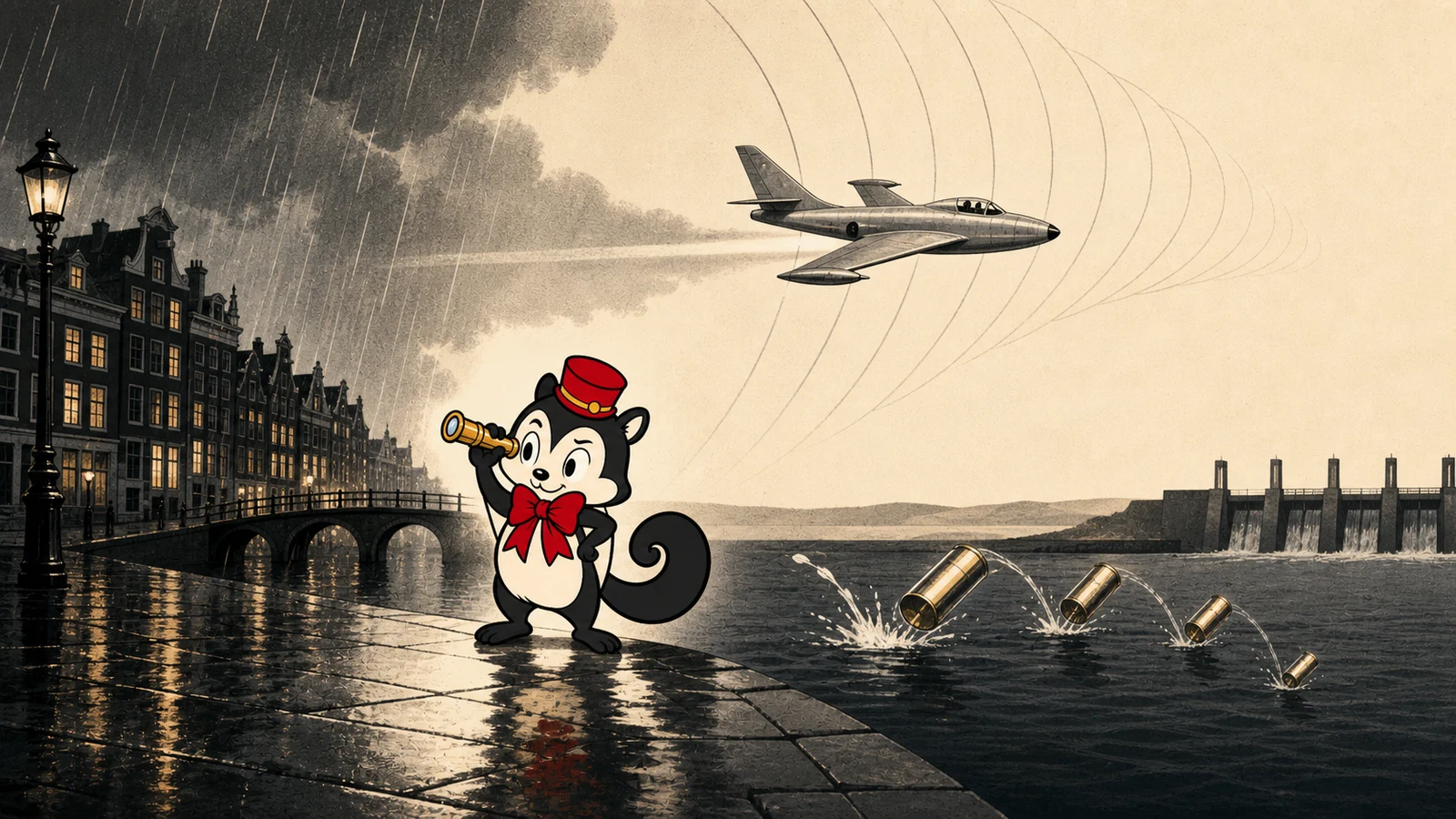
How did the Dambusters’ bouncing bomb work? Speed, height, impact angle and backspin had to stay inside a narrow range.
The Lancaster released the backspinning cylinder about 60 feet above the reservoir at roughly 232 miles per hour. Its low, fast path produced a shallow strike: pressure across the part touching the water pushed the bomb upwards before it submerged, carrying it through the air to the next contact. Backspin widened the conditions for ricochet, helped preserve rebound speed and, after the final skip, helped keep the weapon against the dam wall as it sank. The word ‘bounce’ makes this coordinated sequence sound automatic.
The rest of this essay approaches that sequence through two supporting films. Joris Ivens and Mannus Franken’s Regen (1929) makes water’s small impacts visible. David Lean’s The Sound Barrier (1952) turns compressed air and shock waves into drama. Michael Anderson’s The Dam Busters (1955) brings air, water and a rotating solid together.
The aim is a clearer way of watching, with the equations left off screen. The images keep their atmosphere while gaining causes, thresholds and consequences.
Jump to: How the bouncing bomb worked · Rain in Regen · Shock waves in The Sound Barrier
Regen: Watching Water Move
At first Amsterdam is dry. Then the film begins to notice anticipation: the gathering sky, an awning disturbed by wind, people adjusting themselves to weather that has not quite arrived. A drop marks the canal. A window closes. Umbrellas multiply. The city’s surfaces, previously separate and stable, begin to answer one another.
Regen is usually attached to Ivens’s name, but the archival credit belongs to both Ivens and Mannus Franken. Franken developed the scenario; Ivens handled the camera and editing. They gathered rain over two years and cut those separate showers into the impression of a single passing event. [1] [2] This fact makes the film’s apparent simplicity more interesting. The rain seems to give the city a natural rhythm, yet that rhythm is also an editorial construction. Weather and montage imitate one another.
The film belongs to the city-symphony tradition, in which documentary images of real streets are organised with the freedom of music. Such films sit between record and invention: a city is not built for the camera, but the camera can make its traffic, architecture and crowds behave like motifs. [3] [4] In Regen, the organising principle is not a clock or a commuter’s route. It is a fluid arriving from above.
That choice changes the film’s sense of time. The shower has no human destination, yet it gives the sequence an opening, development and release. Drops arrive, surfaces accumulate water, movement adapts, and the city eventually emerges with another sheen. Weather supplies a narrative without becoming a character.
Knowing a little about water makes the shower more eventful. When a raindrop meets a canal, its momentum opens a tiny cavity. The disturbed surface rises and travels outwards in small waves; gravity and surface tension help restore the interface. [5] [6] The familiar ring is not a symbol added by the filmmaker. It is a history of impact spreading across the water.
On stone, glass, cloth and metal, the encounter takes another form. Water adheres and spreads unevenly. A thin film can change the routes by which light enters and leaves a material, so a wet absorbing surface often appears darker. At the same time, the smoother boundary between air and water can give the surface a brighter, more mirror-like reflection. [7] A street can therefore become darker and more luminous at once.
Black-and-white photography is acutely receptive to that contradiction. Colour cannot tell us which umbrella is red or which tram is blue, so the eye attends instead to lustre, density and movement. Pale sky enters dark pavement. People appear twice, once upright and once trembling below themselves. Tram windows, canals and wet roads form a loose family of reflective surfaces. Rain connects materials that the dry city kept apart.
The same shower also reorganises people. Umbrellas open in clusters; pedestrians shorten their routes; windows and awnings become small negotiations with the weather. The film moves easily between microscopic effects and collective behaviour. A drop alters a surface, the surface alters light, and the changed street alters the rhythm of bodies crossing it.
Water changes the city’s optical contract. Walls return light, broad canal reflections break into rings, and pedestrians join a choreography of collars and umbrellas. The useful chain is impact, spreading, altered light, human response. Ivens and Franken filmed a city entering a temporary material state.
The Sound Barrier: When Air Becomes Visible
The first useful fact about The Sound Barrier is almost childishly simple: air is a fluid too.
We tend to reserve the word for things that can be poured. Yet gases, like liquids, deform under forces. [8] An aircraft moves immersed in a substance, and near the speed of sound changes in that substance’s density become part of the drama.
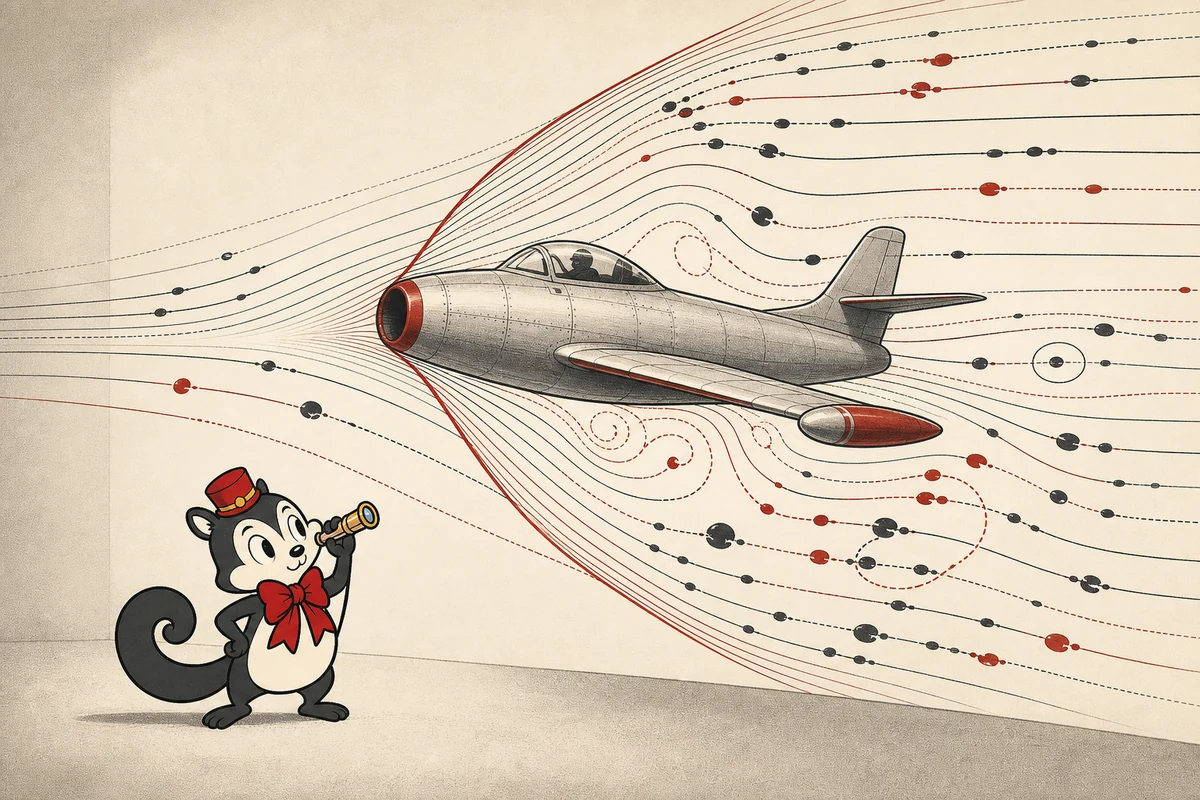
Lean’s film arrived in 1952, within the post-war British imagination of a coming jet age. Adrian Smith places it at the dawn of that age in ‘austerity Britain’. [9] The story moves between an aircraft manufacturer’s ambition, the pilots who risk themselves for it, and a family required to absorb the cost. Engineering is not a separate technical plot. It is the force that reorganises domestic life.
Lean performs this conversion by cutting from a solitary aircraft against pale sky to instruments, vibration, hands and waiting faces. Air stays invisible while its effects pass from wing to cockpit, control room and home.
Mach number expresses speed in relation to the local speed of sound. Near Mach 1, pockets of airflow may become supersonic before the aircraft as a whole does. Compression waves gather into shock waves—thin regions where pressure, density and temperature change abruptly. [10] [11] Drag can rise sharply while lift and control behaviour change. The ‘barrier’ is a threshold in the surrounding medium.
Researchers reveal shock waves with techniques such as schlieren and shadowgraph photography, turning density changes into visible patterns. [11] Lean uses consequences instead: the machine trembles, readings change, control becomes uncertain, and a face records what the sky will not show.
That dramatic translation matters because the aircraft can look almost serene from a distance. The pale sky offers no visible wall and no obvious current. Close-ups provide the missing pressure map: instruments become sensitive surfaces, vibration supplies texture, and the pilot’s body registers the medium before the audience can name it. The invisible acquires an editing pattern.
The science also creates useful resistance to the film. Chuck Yeager had flown the Bell X-1 to Mach 1.06 on 14 October 1947, and the documented solution to a major control problem involved an adjustable horizontal stabiliser; the transition itself was strikingly uneventful. [11] [12] Lean compresses institutional research, modified parts and previous flights into a fictional company, family and decisive control manoeuvre. It works as suspense, rather than as a literal history of the breakthrough.
This difference sharpens the film’s form. Aeronautical research accumulates across teams, test programmes and revised components. Drama prefers a decisive gesture, a single pilot and a moment after which the world feels different. Understanding the actual history lets us see both the genuine problem and the narrative machine Lean builds from it.
Once air becomes a fluid in the viewer’s mind, the simplified drama gains weight. The jet continually displaces and reshapes its medium, sending pressure waves it begins to catch near Mach 1. The pilot enters a regime in which air responds differently to every surface of the machine. Empty sky becomes crowded with consequences.
The Dam Busters: How the Bouncing Bomb Worked
The Dam Busters begins with a heavy object meeting water and skipping.
Michael Anderson devotes much of the film to Barnes Wallis’s attempts to make that movement repeatable: models, failed tests and revised measurements. By the raid of 16–17 May 1943, the audience knows how many variables can escape control.
BFI Screenonline notes that black-and-white allowed original bomb-trial footage to blend with newly filmed material while retaining a documentary texture. [13] Recorded experiment becomes part of the film’s visible fabric.
The blend also complicates the viewer’s trust. We may be watching evidence of an actual trial, a reconstruction made for the feature, or a cut that makes the two continuous. The film’s authority partly comes from keeping that distinction difficult to see.
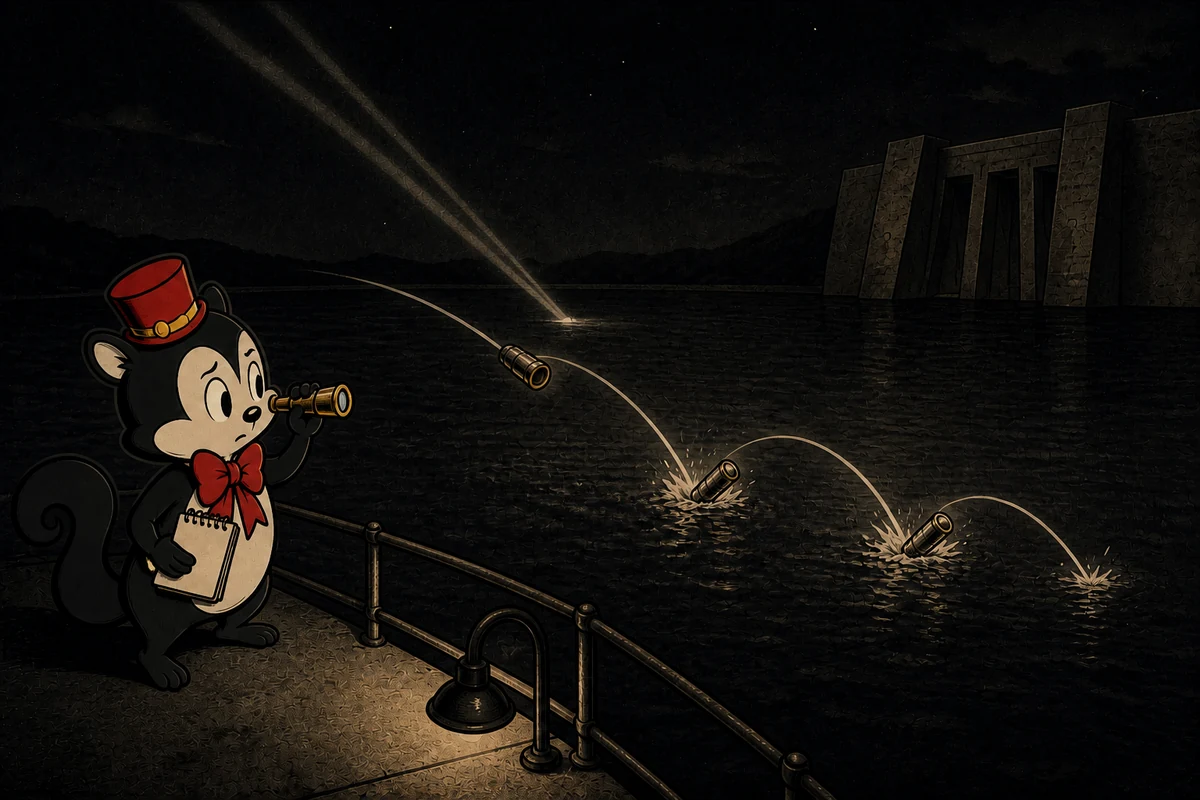
The Lancaster had to fly about 60 feet above the reservoir at roughly 232 miles per hour. [14] Two spotlights mounted at different angles converged on the water at the required height. [15] Geometry became a bright mark on a dark surface.
From release, the weapon moved through two fluids. It fell through air and struck the reservoir obliquely. At a shallow, fast impact, pressure over the wetted part of the cylinder could produce an upward impulse before submersion, sending it through air towards the next contact.
Each return to the surface resets the encounter with less speed and a slightly altered trajectory. Height controls the initial fall, speed controls the horizontal travel, angle shapes the impact, and rotation changes the relative motion at the wet boundary. The familiar word ‘bounce’ hides this coordination by making the rebound sound automatic.
Backspin widened the conditions under which the cylinder could ricochet and helped preserve rebound speed. Between impacts it could also create an aerodynamic transverse force, usually called the Magnus effect. Ian M. Hutchings makes an important distinction: Magnus lift may have helped after the first ricochet, while spin’s major effect on the first bounce was hydrodynamic, produced during contact with water. [16] [17]
For a fraction of a second, part of the cylinder is submerged and part remains in air. Pressure across the wet surface, forward and downward motion, and rotation decide whether it rises or dives. At this scale, inertia and hydrodynamic pressure dominate the surface tension that helped organise Regen’s raindrop. The fluid is familiar; the energy of the encounter has changed.
That contrast completes the article’s progression. In Amsterdam, water alters tone and reflection. Around the jet, air alters pressure and control. At the reservoir, a solid body crosses between the two, and success depends on how briefly the water is allowed to claim it.
After the final bounce, backspin helped the weapon remain against the dam wall as it sank to its intended detonation depth. [16] The movement is a designed sequence: fall, strike, ricochet, meet the dam, sink. Speed, height, angle and spin form the grammar of the action.
The spotlight pattern, bomb sight, low flight and rotating cylinder each hold one variable inside a narrow range. The suspense lies in keeping the chain intact for a few seconds.
Precision is not innocence. Operation Chastise cost the lives of 53 of the 133 aircrew, with three more captured. The floods killed almost 1,300 people on the ground, many of them forced labourers and prisoners of war. [14] [18] Admiration of the ingenuity must retain its purpose.
The film ends under the weight of absent men. Its elegant chain of forces became a chain of destruction as stored water moved through homes, factories, camps and valleys. Physics can explain how a weapon reaches its target; history must retain what followed.
Seeing More
Return to the three images. Rain, an aeroplane, a bomb.
After Regen, rain becomes impacts, thin films and reflections joining sky to canal. After The Sound Barrier, open sky carries pressure and resistance. After The Dam Busters, each skip becomes an exact exchange between air, metal and water.
The canal rings remain beautiful, the jet frightening and the bomb uncanny. Explanation adds events inside the shot: wet stone changing tone, air compressing around a wing, a ricochet holding for one more contact. Scientific knowledge can enlarge both the poetry and the responsibility we see.
The reward is a more active kind of looking. Instead of treating weather and atmosphere as backgrounds, we watch them perform work. Surfaces become temporary, empty space gains resistance, and a famous piece of engineering becomes a fragile passage through two moving media.
References
- Eye Filmmuseum, ‘Regen’, film database record (accessed 15 August 2026).
- European Foundation Joris Ivens, ‘Regen (1929)’, film record (accessed 15 August 2026).
- Eva Hielscher, ‘Regen (Rain) (1929)’, Routledge Encyclopedia of Modernism, 15 October 2018.
- Harvard Film Archive, ‘The City Symphony’, 14 August 2006.
- E. Berberović, N. P. van Hinsberg, S. Jakirlić, I. V. Roisman and C. Tropea, ‘Drop Impact onto a Liquid Layer of Finite Thickness: Dynamics of the Cavity Evolution’, Physical Review E, 79 (2009), 036306.
- John W. M. Bush, ‘Interfacial Phenomena: Lecture Notes’, MIT OpenCourseWare, Autumn 2010.
- John Lekner and Michael C. Dorf, ‘Why Some Things Are Darker When Wet’, Applied Optics, 27.7 (1988), 1278–80.
- OpenStax, ‘What Is a Fluid?’, in College Physics 2e (accessed 15 August 2026).
- Adrian Smith, ‘The Dawn of the Jet Age in Austerity Britain: David Lean's The Sound Barrier (1952)’, Historical Journal of Film, Radio and Television, 30.4 (2010), 487–514.
- NASA Glenn Research Center, ‘Mach Number’ (accessed 15 August 2026).
- John D. Anderson, Jr., ‘Research in Supersonic Flight and the Breaking of the Sound Barrier’, in Pamela E. Mack (ed.), From Engineering Science to Big Science, NASA SP-4219 (1998).
- Bob van der Linden, ‘Chuck Yeager Broke the Sound Barrier in the Bell X-1’, Smithsonian National Air and Space Museum, 13 October 2022.
- BFI Screenonline, ‘Dam Busters, The (1955)’ (accessed 15 August 2026).
- Imperial War Museums, ‘The Incredible Story of the Dambusters Raid’ (accessed 15 August 2026).
- Royal Air Force Museum, ‘Spotlights—Low Altitude Flying Modification’, 2020.
- Royal Air Force Museum, ‘Bouncing Bomb Diagram’, 2020.
- Ian M. Hutchings, ‘The Ricochet of Spheres and Cylinders from the Surface of Water’, International Journal of Mechanical Sciences, 18.5 (1976), 243–47.
- Royal Air Force Museum, ‘Casualties of the Dams Raid’, 2020.
On screen
Films discussed
- Regen (1929) · Joris Ivens and Mannus Franken
- The Sound Barrier (1952) · David Lean
- The Dam Busters (1955) · Michael Anderson
Want a recommendation shaped around your evening? Ask Momo what to watch next →