See Films Differently Cinematography
Why Does The Third Man Look Crooked?
The Third Man uses Dutch angles — a deliberately tilted camera — to make postwar Vienna feel unstable. See how crooked shots alter space, trust and moral balance.
Has the screen slipped, or has Vienna?
Watch a few minutes of The Third Man and the city starts to lean. Doorways tip sideways. Streets climb across the frame. A face that ought to be upright arrives at an angle, as though the ground beneath it cannot be trusted.
The short answer: The Third Man looks crooked because director Carol Reed and cinematographer Robert Krasker repeatedly tilt the camera away from a level horizon. These tilted shots — commonly called Dutch angles — make streets and rooms feel physically unstable, turning Holly Martins’s uncertainty about Harry Lime and Vienna into a visual effect.
The technique is obvious enough for a first-time viewer to notice, yet easy to dismiss as old-fashioned style. Naming it is only the first step. The more useful question is: what changes when a film refuses to keep the horizon level?
Carol Reed’s 1949 thriller follows Holly Martins, an American writer who arrives in postwar Vienna expecting to meet his old friend Harry Lime. Instead, he finds a funeral, contradictory stories and a city divided among occupying powers. The British Film Institute describes Reed and cinematographer Robert Krasker as using Vienna’s real locations while also manipulating them to heighten dramatic moments. [1] The crooked images belong to that mixture. They document a damaged city and make it feel even less settled.
This guide discusses the film’s famous doorway reveal, but not its ending.
First: What Is the Camera Doing?
Most films quietly teach us to accept a level horizon as neutral. Floors lie flat. Walls rise vertically. A person standing upright appears to agree with the frame.
In The Third Man, the camera is often rotated so that those ordinary reference points no longer match the screen. The technique is commonly called a tilted shot or Dutch angle. You do not need the terminology to recognise the feeling. Your eye looks for a stable vertical line and cannot quite find one.
That small disturbance matters because cinema is full of invisible agreements. We expect the bottom of the image to behave like ground. When it does not, a walk down a street can feel like a slide. Two people facing one another can look less like partners in a conversation and more like figures trapped on opposite slopes.
The film does not use the tilt merely to announce danger. It uses it to weaken our confidence in the space itself.
Vienna Cannot Settle
The Vienna of The Third Man is not a studio dream of Europe. Much of the film was shot in a real city still marked by war, occupation and rubble. The BFI notes that its locations record Vienna in transition while the filmmaking combines stark realism with expressionist distortion. [1]
Those two impulses pull against each other in a productive way. The broken buildings are evidence. The tilted compositions turn that evidence into an experience.
Holly arrives with a tidy story: Harry is his friend, friendship means loyalty, and a mystery can be solved by finding the missing fact. Vienna keeps refusing the shape of that story. Testimony shifts. Affection and guilt occupy the same rooms. A cheerful zither plays over streets where almost every certainty has a price.
If every image were level, Holly’s confidence might feel like the film’s natural centre. By making the city lean around him, Reed and Krasker suggest that his view is only one angle among several. The frame has already begun to doubt him.
This is why the technique fits The Third Man better than a generic thriller. The crookedness is not just fear. It is moral imbalance made visible.
For another route through the same contradictory testimony, the likelihood guide asks how the official accident story compares with explanations that fit the observed details better.
The Famous Doorway Works Because the Film Has Delayed Level Ground
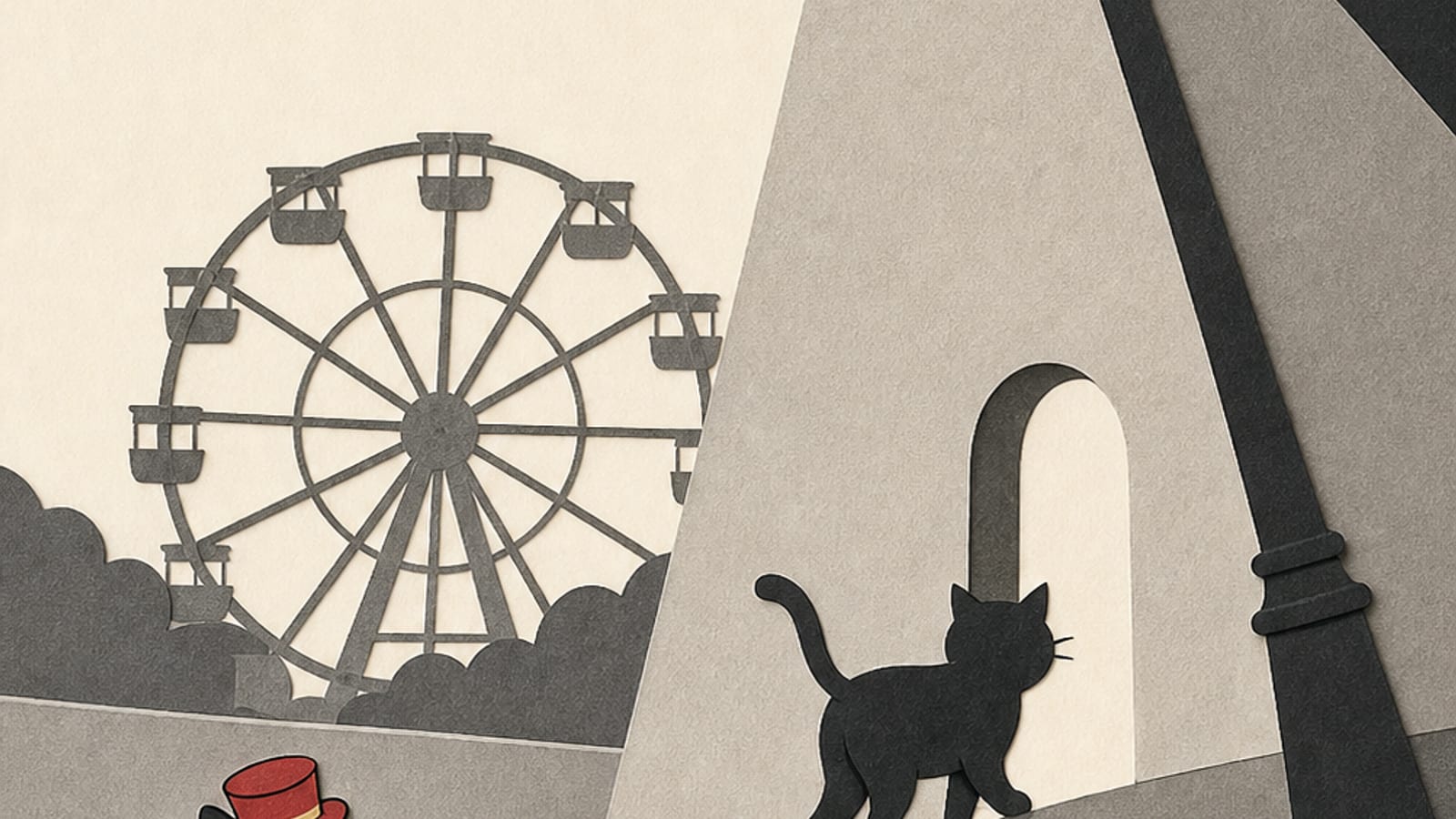
The film’s best-known entrance begins with an apparently ordinary patch of darkness. A cat lingers near a pair of shoes. Then a light from an upstairs window briefly reveals the face of the man hidden in the doorway.
The surprise does not come from a complicated effect. It comes from waiting, framing and the sudden conversion of background into person. The city has trained us to search its corners, but it can still conceal the most important figure in plain sight.
By this point, Harry Lime has accumulated enormous weight without occupying the screen. The BFI notes that Orson Welles appears late and only briefly, yet dominates the film. [2] When the face finally appears, the tilted street and deep shadow do not simply make him look sinister. They make his return feel like something Vienna itself has been withholding.
The angle also protects the moment from becoming a clean heroic entrance. Harry is charming, but the composition will not grant him a stable pedestal. He belongs to the same unstable city as everyone else.
Why the Tilts Do Not Become a Gimmick
If every shot leaned by the same amount, The Third Man would quickly become exhausting. Its style works through contrast.
Some images give us enough order to follow a conversation or read a face. Others press walls, staircases, shadows and street lines against one another until the frame seems unable to contain them. The tilt is one part of a larger visual language that includes hard light, deep darkness, wet surfaces, doorways and figures made small by architecture.
Krasker’s black-and-white cinematography won the Academy Award in 1951. [3] The award does not tell us why an image works, but it is a useful reminder that the film’s look was not an incidental flourish added to a famous performance. The photography is one of the film’s central achievements.
Compare it with The Cabinet of Dr. Caligari. In Caligari, instability is painted and built into the sets: streets and rooms reject ordinary geometry before the camera arrives. The Third Man begins with a real city and makes its existing streets feel psychologically unreliable. One distorts the world itself; the other distorts our position inside it.
Or compare it with Touch of Evil, where low angles, moving cameras and crowded depth turn a border town into a system of pressure. Both films make location carry moral information, but they do it with different rhythms. The Third Man often lets a single sloping frame do the work.
Three Things to Watch Instead of Following Only the Plot
On your next viewing, try these three small experiments.
1. Find the line your body wants to straighten
Look for a lamp post, doorway, window or building edge. Notice how quickly your eye tries to correct it. The physical urge to straighten the image is part of the film’s effect. You are not just looking at imbalance; you are attempting to repair it.
2. Notice who receives stable space
Do not count every tilted shot. Instead, notice when a conversation is allowed to settle and when the frame begins to lean. Does certainty arrive with a level image, or can an apparently orderly room hide a dishonest idea? The pattern is more interesting than a simple rule.
3. Listen to the zither while the image darkens
Anton Karas’s music is bright, nimble and instantly recognisable. It does not behave like the heavy orchestral warning a viewer might expect. That mismatch keeps the film mobile. The image says that the world is unstable; the music almost seems amused by our discomfort.
These observations do not require film-school vocabulary. They require only a willingness to look at the edges of the screen while the story continues in the centre.
A Crooked Image Can Be More Honest Than a Straight One
The tilted camera in The Third Man does not tell us that every person is evil or every statement is false. It tells us that the usual coordinates are no longer sufficient.
Holly wants friendship, guilt and justice to line up. Vienna shows him a world in which affection can survive terrible knowledge, charm can coexist with cruelty, and a familiar face can become difficult to place. A straight frame might describe the street accurately. The crooked frame describes what it is like to stand there without knowing whom to trust.
That is the pleasure of noticing cinematography. It does not replace the story with technique. It reveals that the story was already being told by walls, shadows and horizons.
If this way of looking appeals to you, Citizen Kane offers another experiment: instead of watching for tilted horizons, watch how deep focus keeps foreground and background available at once. Different visual choices, same question: where is the film asking your eyes to stand?
To carry the same question into another Orson Welles noir, compare the three principal versions of Touch of Evil, where the opening’s image and sound change with the cut you choose.
References
- ‘Location, Location, Location: Vienna and The Third Man’, British Film Institute (accessed 21 August 2026).
- The Third Man (1949), British Film Institute film record and programme note (accessed 21 August 2026).
- The 23rd Academy Awards, Academy of Motion Picture Arts and Sciences (accessed 21 August 2026).
- The Third Man, AFI Catalog of Feature Films (accessed 21 August 2026).
Continue exploring on Monocurator
Want a recommendation shaped around your evening? Ask Momo what to watch next →