See Films Differently What to watch next
The Long Walk, The Running Man and Ace in the Hole
The Long Walk and The Running Man make survival a spectacle. Ace in the Hole asks who benefits when a rescue is delayed.

Discusses premises, a visual choice in The Long Walk and a rescue decision in Ace in the Hole. The endings of the two 2025 films are not disclosed.
One group has to keep moving. One man has to keep escaping. Billy Wilder offers a third possibility: a man who cannot move, while somebody else finds a career in keeping him there.
It is easy to mix up The Long Walk and The Running Man. Both turn human survival into an organised attraction. This comparison concerns Francis Lawrence’s The Long Walk (2025) and Edgar Wright’s The Running Man (2025), rather than treating their Stephen King source novels or the 1987 Running Man as interchangeable versions.
A useful difference is where this comparison directs our attention. These are emphases to follow, rather than exclusive subjects assigned to each film. The Long Walk stays close to people whose bodies have to continue. The Running Man adds a battle over the image of the man being pursued. Then Ace in the Hole (1951), in black and white, makes the person reporting the danger part of the reason it continues.
The third recommendation changes the arrangement. Nobody has entered a futuristic death contest. An emergency has become a career opportunity for the person reporting it.
The Long Walk: staying beside someone
The basic ordeal is severe enough: young men walk until only one remains alive. Raymond Ang’s cast-and-director interview for GQ describes the 2025 film’s premise and identifies Cooper Hoffman and David Jonsson as Garraty and McVries. [1]
Walking puts rivals alongside one another. They have time in which to become particular people to each other, even though the competition gives them incompatible prospects. The same person can be company on the road and somebody the rules require you to outlast. That is a more painful relation than a row of anonymous obstacles between a hero and a prize.
The film’s cinematographer, Jo Willems, describes a precise choice in his interview with Filmmaker. Some deaths receive direct attention; elsewhere the camera stays with Garraty and McVries as an execution becomes a blur behind them. He also describes the film’s desolate roads, with relatively little crowd presence along the way. [2]
That choice gives a useful way into the film. A death can be unmistakable without becoming the central image. Keeping attention on those still walking makes continuing itself troublesome: an event has occurred which ought to demand a pause, while the surviving bodies carry on.
That gives The Long Walk a particular attraction: the conflict develops through company, conversation and the requirement to keep moving, rather than needing a succession of new kinds of contest. How much can remain between two people when their surroundings insist on reducing them to remaining competitors? Its spare situation gives that question room. The apparent simplicity of walking is part of the cruelty; an ordinary shared activity has acquired a lethal condition.
There is no need to know the winner to recognise the conflict. Nor does an account of the novel’s ending settle what the film does with it.

The Running Man: being pursued, being presented
Wright’s film spreads the danger differently. Paramount’s distribution synopsis describes contestants trying to survive thirty days while professional killers hunt them, their movements broadcast and the cash reward increasing by the day. Glen Powell plays Ben Richards. [3]
The pursuit supplies a readily graspable action problem: stay alive while somebody is looking for you. Broadcasting adds another. The person trying to escape can also become material from which other people manufacture a public character.
In Sight and Sound’s conversation with King, Wright discusses the network’s manipulation of Richards’s recorded image and compares its narrative construction to the editing of reality television. He distinguishes his adaptation from the 1987 film and explains why his film leaves its fictional year unstated. [4]
An accusation assembled for an audience can travel farther than the person trying to answer it. That is the extra attraction here: physical resourcefulness and control over one’s public appearance are different kinds of power. Escaping a pursuer does not, as a matter of logic, correct the story being told about you.
Compared with the sustained proximity of the walkers, this introduces a gap worth watching. There is the person experiencing the chase and the version delivered to spectators. Who selects what becomes visible? What happens when being seen makes someone easier to misrepresent?
The films need not be ranked to make that difference useful. The emphasis here is endurance and companionship in one, pursuit and manufactured public identity in the other. It does not follow that the walkers exist outside a spectacle, or that Richards has only an image and no body or relationships. The contrast is a way to choose what to notice, not a complete inventory of either film.

Ace in the Hole: the reporter needs another day
Now for the older film you may not have been looking for.
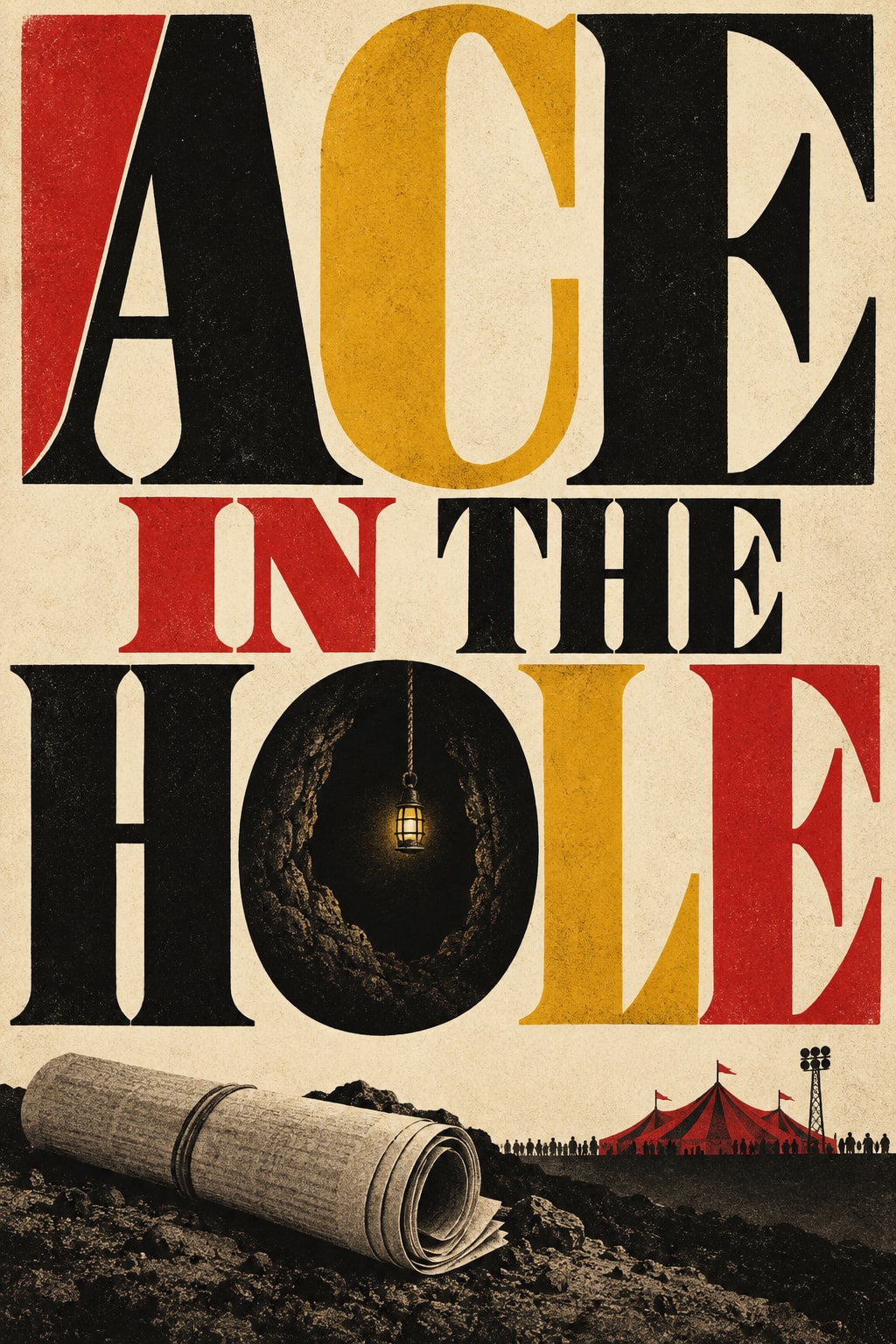
In Billy Wilder’s Ace in the Hole, Kirk Douglas plays Chuck Tatum, a newspaper reporter who sees a trapped man’s predicament as an opportunity to recover his career. Paramount’s official synopsis describes Tatum prolonging the rescue while supplying the story to other reporters. Criterion confirms the film’s 1951 date and black-and-white photography. [5] [6]
For the trapped man, this distinction is not abstract. He has not enrolled in a spectacle. He needs help. The person who can bring his situation to public attention has found an interest in its remaining unresolved.
AFI’s catalogue supplies the crucial mechanism: Tatum persuades the sheriff to prolong the operation, and the sheriff coerces the engineer into taking the slower route. The person telling the story has acquired influence over how long its subject remains in danger. [7]
That is why this film adds more than another competition with murderous rules. Wilder gives the danger a different route into existence. An accident becomes an opportunity; the opportunity makes delay profitable; someone with influence helps keep the emergency going.
The temptation would be to call all three films warnings about an audience’s appetite for cruelty. That description leaves out the most useful difference here. Tatum acts between the endangered person and the public, and his interest in the story changes the practical response to the emergency. The troubling question is who has the power to bring the danger to an end, and who benefits from delaying that action.
For a viewer drawn to the practical workings of manipulation, this is a strong reason to try Wilder’s film. The chain of decisions matters more than a general announcement that the media is corrupt. Tatum has a job to recover and a story to sell. A rescue would be excellent news for the trapped man. For the reporter, it would bring the opportunity to an inconvenient end.

Three different places to stand
The comparison becomes clearer if we leave its mismatches intact. The walkers are competitors in an organised ordeal. Richards is hunted for a broadcast. Wilder’s trapped man is a person needing rescue. They have different relations to the people who turn danger into an attraction.
If The Long Walk draws you through the intimacy of continuing beside somebody, notice how it distributes attention between the dead and the people still moving. If The Running Man interests you through its pursuit, notice the second contest over what spectators are allowed to believe. Then try Ace in the Hole for the person who can make a public account useful to himself by changing the course of the emergency.
That last distinction is the reason for the unexpected third film. There need be no futuristic arena, no official prize and no invitation to compete. Someone can make a spectacle of your danger while presenting himself as the person who will help.
References
- Raymond Ang, ‘Cooper Hoffman and David Jonsson on Breaking Out, Their Real-Life Bromance, and Adapting Stephen King’, GQ, 19 August 2025. Film premise and roles; participant interviews.
- Matt Mulcahey, ‘“The Movie is Set 100% Outside”: DP Jo Willems on Shooting “The Long Walk” Completely in Sequence’, Filmmaker, 29 September 2025. Willems's account of the desolate walk and choices of focus and point of view.
- Paramount Global Content, The Running Man, 2025 distribution record and synopsis.
- James Mottram, Stephen King in conversation with Edgar Wright, Sight and Sound, 7 November 2025. Wright's comments on adaptation, the film's undated setting and media manipulation.
- Paramount Pictures, Ace in the Hole (1951), official synopsis and cast information.
- The Criterion Collection, Ace in the Hole (1951), film information and credits.
- American Film Institute, Ace in the Hole (1951), AFI Catalog of Feature Films, synopsis: Tatum, the sheriff and the slower rescue operation.
For the next unexpected question, follow the Journal in your RSS reader.
On screen
Films discussed
- The Long Walk (2025) · Francis Lawrence
- The Running Man (2025) · Edgar Wright
- Ace in the Hole (1951) · Billy Wilder
Continue exploring on Monocurator
Further reading
Read next in the Journal

Want a recommendation shaped around your evening? Ask Momo what to watch next →