See Films Differently Film analysis
The Train: Loving a Painting Is Not the Same as Saving It
The Train puts an art-loving thief against a reluctant railway worker. What separates admiration, possession and the work of saving a painting?
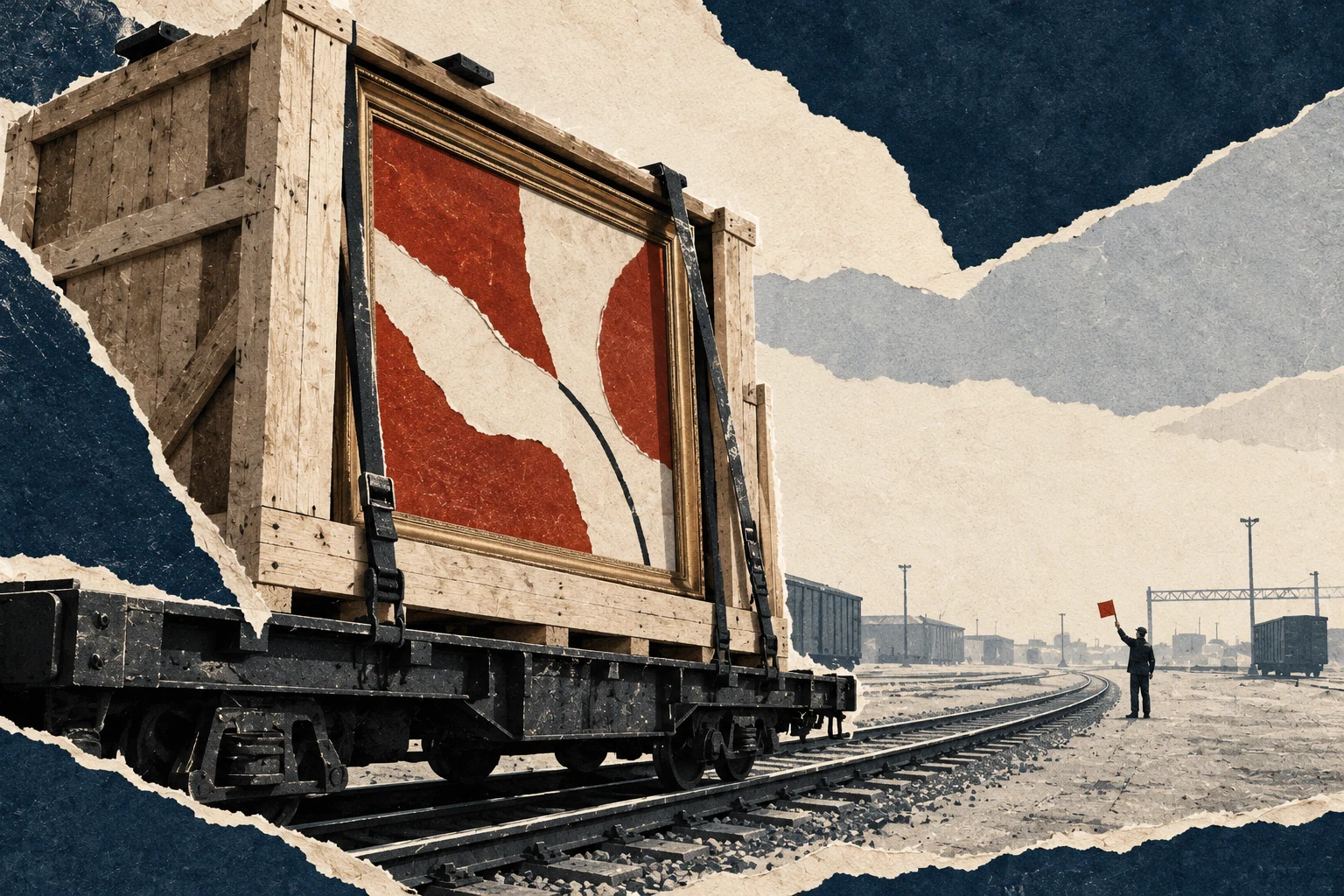
The man who appreciates the paintings is trying to steal them. The man who might stop him initially refuses to risk lives for them. That is the awkward arrangement at the heart of John Frankenheimer’s The Train (1964), a black-and-white thriller set during the German occupation of France. [1] [2]
Colonel von Waldheim, played by Paul Scofield, wants the art transported to Germany. Burt Lancaster’s Labiche is a railway inspector who can interfere with the shipment. Between them stands a question that an appeal to beauty cannot settle: what does caring about an object require you to do?
It is tempting to imagine a straightforward progression. First someone learns to recognise beauty; then they value it; then they protect it. The Train makes trouble at each step. Appreciation can accompany theft. Reluctance can precede protection. And successful protection can leave a terrible human cost.
Spoilers follow, including the ending. This reading draws on the AFI’s film synopsis and Michael Kerbel’s screening notes for the Yale Film Archive; the historical discussion uses separate institutional sources.
The connoisseur is on the wrong side
Kerbel points out that von Waldheim’s appreciation of art exceeds Labiche’s. He also describes museum curator Mlle. Villard’s appeal to the paintings’ cultural importance when Labiche refuses to become involved. [2] The film does not distribute taste as a reward for goodness.
That matters. If the colonel were simply unable to recognise the paintings’ value, his education could solve the moral problem. Instead, his appreciation sits comfortably beside his attempt to take them. Recognising an object’s beauty does not tell him to respect the people from whom it is being taken.
A painting can be handled delicately and still be stolen. Its material survival and its owner’s dispossession are compatible. We therefore need to be precise about the word protect: protect the canvas from damage, protect a collection from dispersal, preserve public access, or respect an owner’s claim? Those aims can reinforce one another, but they are not interchangeable.
Villard’s argument still deserves to be heard. Calling the paintings a shared cultural responsibility offers a reason to care beyond personal preference. It would be too easy to answer the colonel’s cultivated cruelty by deciding that aesthetic feeling is worthless. The more demanding distinction is between having a reason to care and deciding what that reason permits.

The railway worker brings another kind of knowledge
The AFI synopsis records Labiche’s deception: the Germans are made to believe that the shipment has entered Germany, while the train has actually been moved around Paris and returned to its starting depot. [1]
The paintings’ prestige cannot perform that manoeuvre. Someone must know what can move, where it can be sent and how to make a movement appear to mean something else. The cargo’s destination becomes a practical problem before it can become a cultural victory.
This gives Labiche a form of authority that an art-history examination would miss. He need not identify the finest painting to understand a railway operation. His knowledge can help preserve objects whose aesthetic distinctions he does not share with their admirer.
I find that a more interesting defence of art than a conversion in which the ordinary man finally acquires superior taste. It allows different kinds of attention to contribute without making one person become another. Villard can name the loss; a railway worker can recognise a possible intervention. Neither task automatically completes the other.
There is a limit to that reading. Practical skill is not morally good in itself: a functioning railway can carry stolen goods out as well as keep them back. Labiche’s competence needs a purpose. The point is that admiration needs means, and means need a decision about whose interests they serve.
The ending refuses to balance the account
By the close of the AFI’s account, the train has been derailed, hostages have been killed, and Labiche kills von Waldheim before walking away from the stranded art. [1]
It would be a peculiar victory report to list the recovered paintings and leave the people in a footnote. Yet the opposite formula — the deaths prove that nothing should have been attempted — is also too neat. It treats the killer’s actions as an inevitable price attached to the objects, rather than decisions made by people in a violent conflict.
Labiche’s initial objection survives the rescue. Once lives have been lost, the survival of the cargo cannot retrospectively turn every sacrifice into a sensible transaction. Nor can the paintings compensate those who died.
That is why I would resist giving the ending a final exchange rate between art and life. The action has reached an outcome; the value judgement remains unsettled. Preventing the theft and justifying everything that happened along the way are different achievements. The film can make us want the train stopped while leaving us uneasy about what stopping it has meant.
This is also where a familiar slogan — beautiful things must be saved — becomes inadequate. Who undertakes the danger? Who decides on another person’s behalf? Admiration alone provides no procedure for answering either question.
Saving the object also means remembering its owner
The historical context sharpens the problem. The Train draws on Rose Valland’s book Le Front de l’art, but its action should not be mistaken for a documentary reconstruction. [1] Kerbel contrasts the film’s elaborate adventure with the administrative obstruction that kept the historical shipment close to Paris. [2]
Nor should the story become a vague contest over France’s beautiful possessions. The United States Holocaust Memorial Museum places Nazi looting of Jewish art and household belongings within the attempt to destroy Jewish life and erase its history. [3] The identity of those dispossessed is part of what has to be preserved.
At the Jeu de Paume, Valland secretly compiled records of works, owners and storage locations. The institution’s history explains how that documentation contributed to tracing and recovering looted objects. [4] A list may be much less spectacular than a train wreck. It can nevertheless keep a painting connected to a person when theft has tried to sever that connection.
The work does not finish when a crate reaches a safe building. In her account for the US National Archives, Bryce McWhinnie describes restitution officer Mary J. Regan’s struggle with disordered files, missing pages and inadequate assistance after the war. [5] Physical custody did not, by itself, make a claim easy to investigate.
Here the question changes from “Who can appreciate this?” to “Whose is this, and what evidence lets that claim be pursued?” Taste cannot replace the record. The right to recover a stolen object should not depend on winning an argument about how beautiful it is.

Watch the work around the painting
When you watch The Train, follow the changes in responsibility. Villard asks for an intervention. Labiche questions its cost, then becomes involved. Von Waldheim’s appreciation never supplies the restraint it might appear to promise. Each position makes the others harder to dismiss.
My answer to the film’s uncomfortable arrangement is therefore quite practical. Beauty can give someone a reason to stop and pay attention. Protecting what they value requires further work: deciding what should happen, finding a way to act, recognising limits, and keeping sight of the people whose interests are at stake.
The railway worker and the person recording an owner’s name may understand a painting differently from its admirer. There is room for all that knowledge. The person who loves looking at it does not get to decide everything that happens to it.
Sources and reading notes
1. American Film Institute, The Train. Cast, premise, plot outcome and literary source. AFI lists the US release in 1965 and records the earlier 1964 European release; this article uses 1964, also the year in the BFI catalogue.
2. Michael Kerbel, Film Notes: The Train, Yale Film Archive. Notes for the 8 November 2015 screening. The discussion of Villard’s appeal and the colonel’s taste is Kerbel’s critical account. His distinction between the historical shipment and the film’s adventure is retained.
3. United States Holocaust Memorial Museum, Nazi Thieves, Looted Art, and Stolen Legacies. The Museum’s written event introduction and related reading establish the historical context; no claim is made to have watched the recorded programme.
4. Jeu de Paume, Rose Valland, une résistante au Jeu de Paume. Institutional history of Valland’s record-keeping and recovery work. The English summary here is a paraphrase of the French text.
5. Bryce McWhinnie, Defiant in the Defense of Art, Prologue, US National Archives. Historical essay drawing on archival records, including Regan’s reports. Those underlying archival files have not been independently examined for this article.
For the next unexpected question, follow the Journal in your RSS reader.
On screen
Films discussed
- The Train (1964) · John Frankenheimer
Further reading
Read next in the Journal
Want a recommendation shaped around your evening? Ask Momo what to watch next →