See Films Differently Film craft
What Is a Dissolve in Film? When Two Images Share the Screen
How a dissolve lets two images overlap, how it differs from a fade, and why the transition can do more than move a story forward in time.
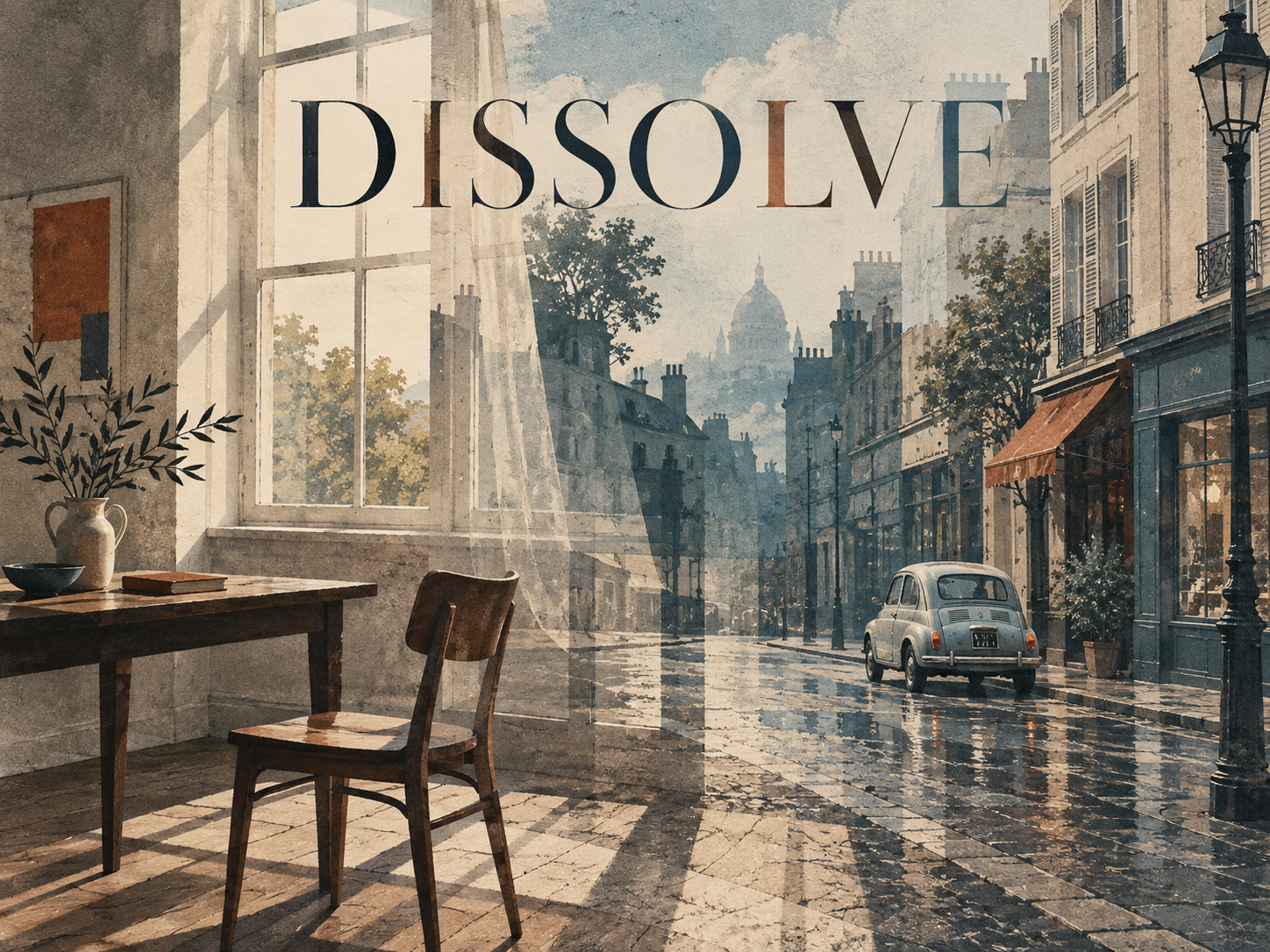
The next picture arrives before the previous one has finished leaving. That interval can be more than a polite way to change scenes.
Imagine an empty room giving way to a street. With a straight cut, the room disappears and the street takes its place. With a dissolve, the street begins to emerge while the room is still visible. For a moment, its traffic might seem to pass through the furniture.
We can see the places overlap without believing that they physically occupy the same space. We understand that the film is moving between them. Yet the transition briefly gives us a picture neither shot contains on its own.
A dissolve is this gradual replacement of one image by another, with an interval of overlap. Yale’s Film Analysis guide describes both images becoming superimposed during the change. [1] It is a transition with something to look at in the middle.
Leaving an image is not always the same operation
In a fade to black, an image darkens until it disappears. A subsequent fade-in can bring another image into view. [2] In a dissolve, the next image begins to appear before the previous one has fully disappeared, so both are visible during the transition. [1]
The distinction is easier to follow if we attend to what is visible, rather than whether the change feels gentle. Is one picture giving way to darkness? Or can we still recognise something of it inside the next picture?
The overlapping interval also explains the relationship with superimposition. Two images can be combined without either replacing the other; a dissolve uses that combination as part of a passage from one to the next. [1] A long transition may invite us to spend more time with the combined picture. There is no need to declare a particular number of seconds at which one name stops and the other begins.
A change of time, without a date on screen
Dissolves have often signalled a move to another time or place, including memories and dreams. Columbia’s glossary also notes that some dissolves in Citizen Kane (1941) take us from a narrator’s account back to the film’s present. [3]
Columbia also provides a short Citizen Kane extract with its dissolve entry. The external clip contains plot details.
That direction matters. A dissolve is not a universal sign for “later”. The surrounding story helps us decide where, or when, we have arrived. The pictures may blend smoothly even as the narrative makes a substantial leap.
Imagine the same room in two states: a table laid for dinner and the table after everyone has left. A dissolve could connect them without showing the meal. But it would not tell us exactly how long dinner lasted. It offers a relationship between moments, leaving the film to establish the calendar elsewhere if we need one.
The flowers change while the picture seems to stay
Terence Davies’s The Long Day Closes (1992) provides a more delicate example. In his Criterion essay, Michael Koresky describes the opening image of roses, which appears still while the credits run. A succession of subtle dissolves shows the flowers wilting. [4]
The device allows change to take place within an apparently persistent arrangement. This suggests a different way of thinking about a transition: it need not carry us away to somewhere new. It can make a familiar image gradually cease to be the image we first encountered.
Compare that with the imaginary dinner table. In one case, two clearly different conditions can announce an interval. In the other, successive differences can be small enough for the alteration to creep up on us. Knowing the name of the technique does not make those experiences identical.
A soft edge need not make a soft feeling
The blend can also acquire an emotional weight. In his BFI programme note for George Stevens’s A Place in the Sun (1951), Geoff Andrew connects the film’s lingering dissolves and close-ups with desire and a sense of inescapable fate. [5]
That reading offers a useful complication. A transition can be visually smooth without making a relationship reassuring. The ability of one image to remain while another arrives may suggest attachment, but it can also make departure feel difficult. Which possibility matters depends on the film around the effect.
The imaginary room and street have now become a small test. Instead of looking only for the last clear view of the room or the first clear view of the street, notice the brief picture between them. A window might share its space with a doorway; the edge of a table might cross a pavement.
Those combinations are temporary. Once the street has fully arrived, they are gone. A dissolve gives the transition its own image, then takes that image away too.
References & Further Reading
-
Yale University, ‘Part 4: Editing’, Film Analysis, ‘Dissolve’ and ‘Superimposition’. Page undated.
-
Columbia University, ‘Fade’, Film Language Glossary. Page undated.
-
Columbia University, ‘Dissolve’, Film Language Glossary. Especially its account of narrative transitions and Citizen Kane; page undated.
-
Michael Koresky, ‘The Long Day Closes: In His Own Good Time’, The Criterion Collection, 28 January 2014.
-
Geoff Andrew, ‘A Place in the Sun’, BFI Southbank programme note. Page undated.
The room, street and dinner-table sequences are imagined examples. The comparisons and readings of their effects are Monocurator’s interpretation.
For the next unexpected question, follow the Journal in your RSS reader.
On screen
Films discussed
- Citizen Kane (1941) · Orson Welles
- The Long Day Closes (1992) · Terence Davies
- A Place in the Sun (1951) · George Stevens
Further reading
Read next in the Journal
Want a recommendation shaped around your evening? Ask Momo what to watch next →