See Films Differently Cinematography
What Is a Dutch Angle? Definition and Film Examples
A Dutch angle rolls the camera sideways. See how it differs from a pan or tilt, and how The Third Man and Batman use canted framing for different effects.
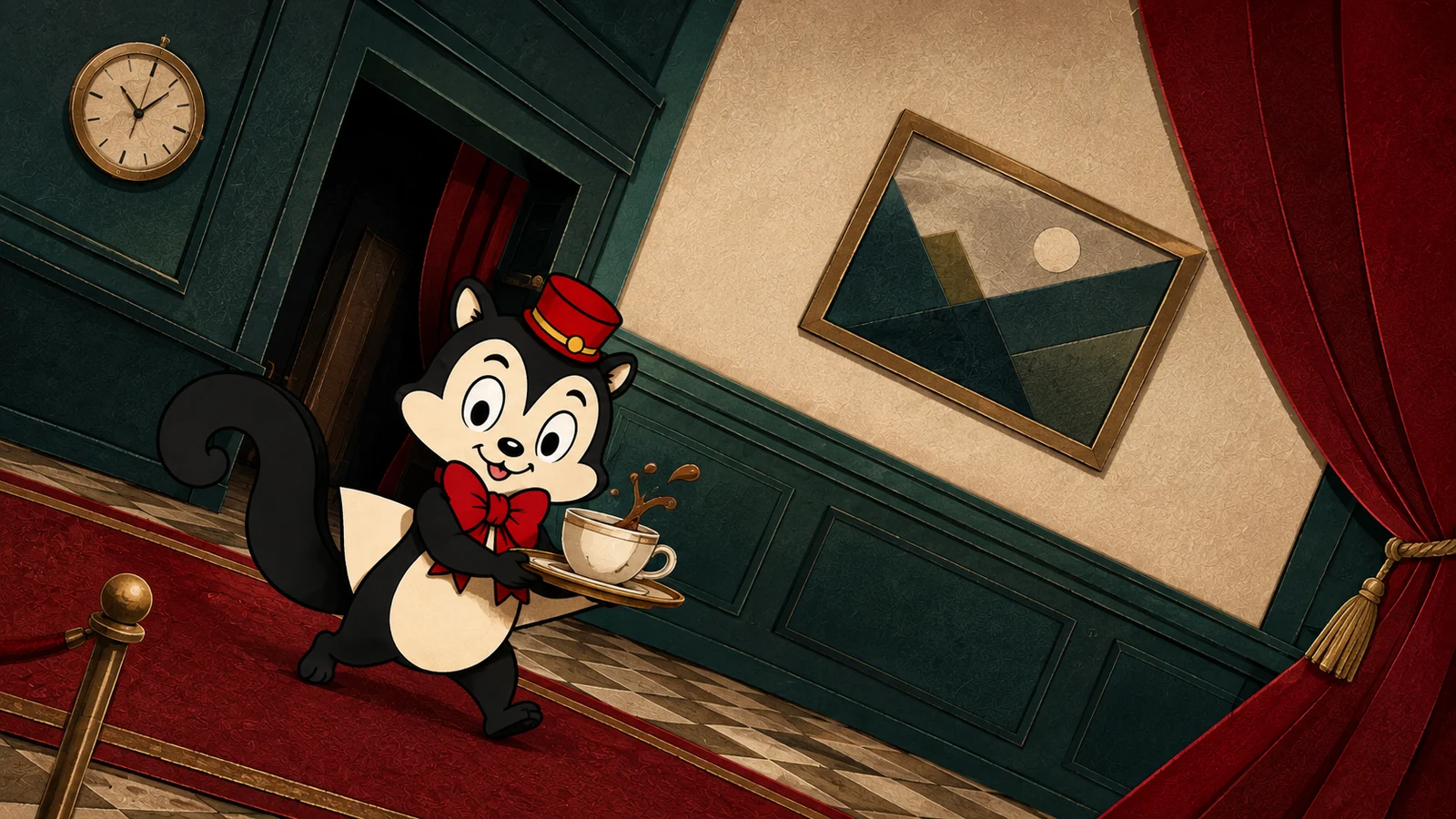
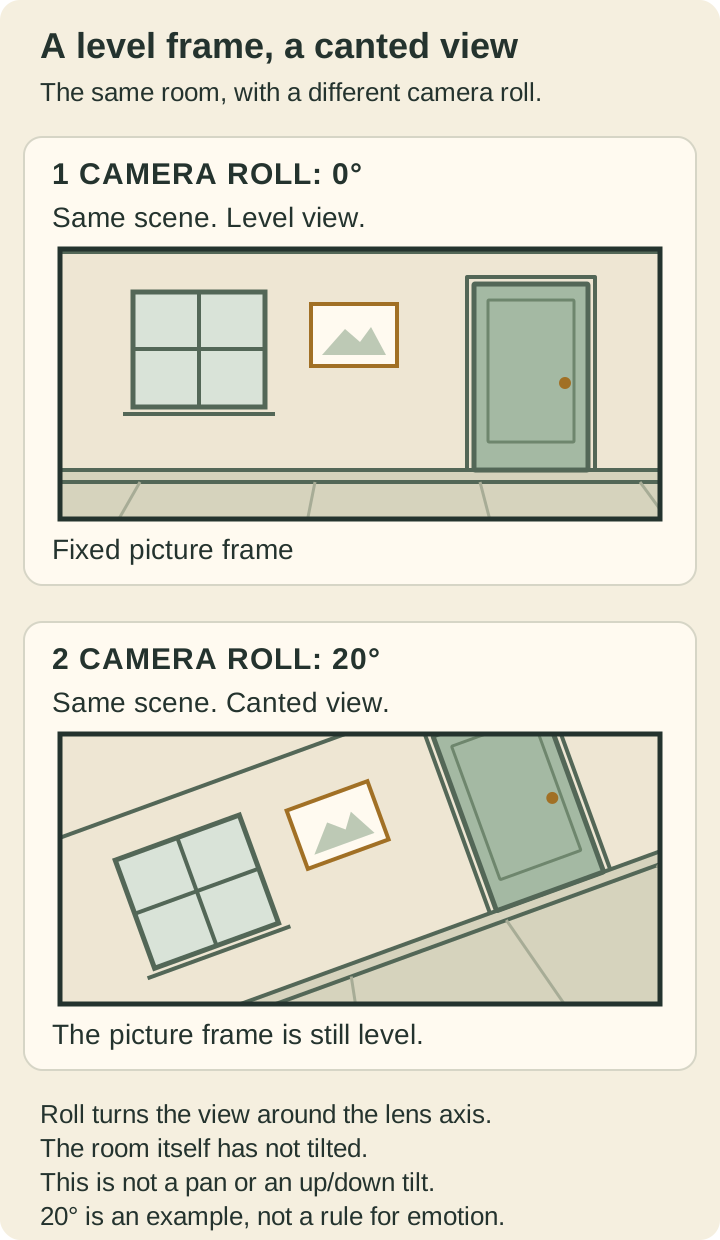
A Dutch angle is a shot made with the camera rolled sideways, so lines that would normally appear level or upright lean within the frame. Imagine keeping the lens pointed at a doorway while tipping one side of the camera upwards. The doorway appears slanted, although the door itself has not moved. The technique is also called a Dutch tilt or canted angle. [1] [2]
It can suggest unease, confusion or imbalance, but its meaning depends on the scene. The same tilted framing can make a thriller feel unsettled or give a comic adventure an exaggerated flourish.
What Actually Tilts?
The camera rotates around the direction in which the lens is pointing: an imaginary line running through the lens towards the subject. This is a sideways roll, rather than a change from looking straight ahead to looking up at the ceiling. [1]
The rectangular screen stays where it is; the world inside it no longer lines up with that rectangle.
An outdoor horizon makes the change easy to spot, but you do not need to see the sky. Doorframes, window edges and other familiar upright objects can provide the reference. The important distinction is between the orientation of the picture and the shape of what is being photographed.
Dutch Angle, Tilt, Pan, High Angle: What Is the Difference?
The word tilt can be confusing because a Dutch tilt and an ordinary camera tilt describe different changes.
| Term | What the camera does |
|---|---|
| Dutch angle / Dutch tilt | Rolls sideways, putting normally level or upright features at a slant in the frame. |
| Tilt | Turns to look upwards or downwards from a fixed position: from someone’s shoes towards their face, for example. |
| Pan | Turns to look left or right from a fixed position. |
| High angle | Looks down at the subject from above. |
| Low angle | Looks up at the subject from below. |
Pan and tilt name movements. High and low angles describe the camera’s viewpoint relative to its subject. A Dutch angle describes its off-level orientation. These choices can be combined: a camera can look up at someone and also be rolled sideways. [1] [3] [4]
A canted shot does not have to move. The camera can be set at an angle before filming and remain still while an actor speaks or walks through the picture. Alternatively, it can roll during the shot, changing from level to canted. A character moving across a sloping frame is not, by itself, evidence that the camera is moving.
Is Every Diagonal Line a Dutch Angle?
No. A staircase climbs diagonally even when the camera is level. The sides of a tall building can appear to converge when you look upwards. Neither feature alone establishes that the camera has been rolled.
A deliberately crooked set is another matter. If a door has been built with sloping sides, it can look strange through a level camera. That distortion belongs to the object; a Dutch angle changes its orientation within the frame. Filmmakers can use both together, so a single crooked wall is not enough to diagnose the technique. Look for several familiar reference lines, rather than treating every diagonal as a tilted camera.
Why Do Filmmakers Use Dutch Angles?
Off-level framing gives a scene another way to depart from an ordinary view. In a tense exchange, it can make the surrounding room seem less settled. A shift from level to canted framing can accompany a character’s disorientation. Elsewhere, a conspicuous slant can suit a flamboyant, playful style.
Those are possibilities, not a code in which one angle always means one emotion. Consider what accompanies the framing: the actors’ behaviour, the light, the sound and the shots on either side. A slanted room does not automatically tell you that someone is frightened, dishonest or losing their mind. Two films show how differently the choice can work.
The Third Man (1949): Unease in a Recognisable City
Carol Reed’s black-and-white thriller is a useful place to see the technique because its streets remain recognisable even when the frame makes them lean. Cinematographer Robert Krasker’s tilted compositions work alongside hard light, deep shadow and wet, reflective surfaces. The BFI’s account of the locations discusses this combination, rather than attributing the film’s atmosphere to the camera angle alone. [5]
Consider the night-time view of Holly Martins beside a large hanging street lamp, reproduced in that BFI article. The bright lamp dominates the foreground, while Martins stands deeper in the dark passage. The surrounding masonry gives the off-level composition a familiar reference.
The resulting unease is a reading of that combination, not proof of a particular emotion inside Martins. You can recognise the canted composition in a still image without knowing a plot secret or deciding that every object in Vienna is physically crooked.
Batman: The Movie (1966): A More Playful Exaggeration
The 1966 colour feature provides a useful contrast. Its cinematographer, Howard Schwartz, described a comic-strip approach built from lighting, costumes and set decoration. Tilted framing belongs to that deliberately exaggerated world. [6]
Schwartz explains that the television series used a tilted camera in villains’ hideouts to suggest approaching excitement. He then describes his enthusiasm for the same effect in the feature’s widescreen framing. [6]
In those hideout compositions, the surrounding room leans with the costumed villains. The framing makes their activity look more extravagant than an ordinary conversation in an ordinary room. Read alongside the colourful costumes and lighting, the slant offers theatrical menace with a sense of play. It need not produce the same unease as a shadowy Vienna street.
What to Look for in the Next Crooked Shot
First, find a reference: a doorframe, a lamp post or a horizon. Then ask whether the framing stays at that angle or changes during the shot. Finally, look at what the slant is doing alongside the performance and the surrounding scene. Is it a sudden departure from level shots, or part of the film’s usual style?
For a closer look at the main example, read why The Third Man looks crooked. That essay discusses a major reveal; the film page offers an introduction if you are deciding whether to watch it first.
References
The technical sources support the definitions and distinctions; the film-specific sources support the examples. Interpretations of their effects are Monocurator’s readings, not universal claims about viewers.
- Jon Fauer, ‘Denz Denzhead Dutch Head’, Film and Digital Times, 11 May 2014. The opening explains camera rotation around the optical axis; the equipment's particular range is not a standard angle for the technique.
- ‘Dutch Angle Shot: Everything You Need to Know’, Nashville Film Institute. Cited for the opening definition and alternative names only.
- Tom Barrance, ‘Filmmaking: Use Movement in Your Movie’, Learn About Film, ‘Static camera’ and ‘Moving the camera’ sections.
- Tom Barrance, ‘Filmmaking: Camera Position and Angle’, Learn About Film, ‘Camera angle’ section. Used for high- and low-angle definitions.
- Neil Mitchell, ‘Location, location, location: Vienna and The Third Man’, British Film Institute, 24 June 2015. Includes the night-time image of Martins beside a hanging street lamp discussed above.
- Howard Schwartz, ASC, ‘BAT-MATOGRAPHY or Capturing Batman on Film’, American Cinematographer, originally June 1966; online republication 11 May 2020. See the opening discussion of comic-strip style and ‘Creating Visual Excitement’.
On screen
Films discussed
- The Third Man (1949) · Carol Reed
- Batman: The Movie (1966) · Les Martinson
Continue exploring on Monocurator
Want a recommendation shaped around your evening? Ask Momo what to watch next →