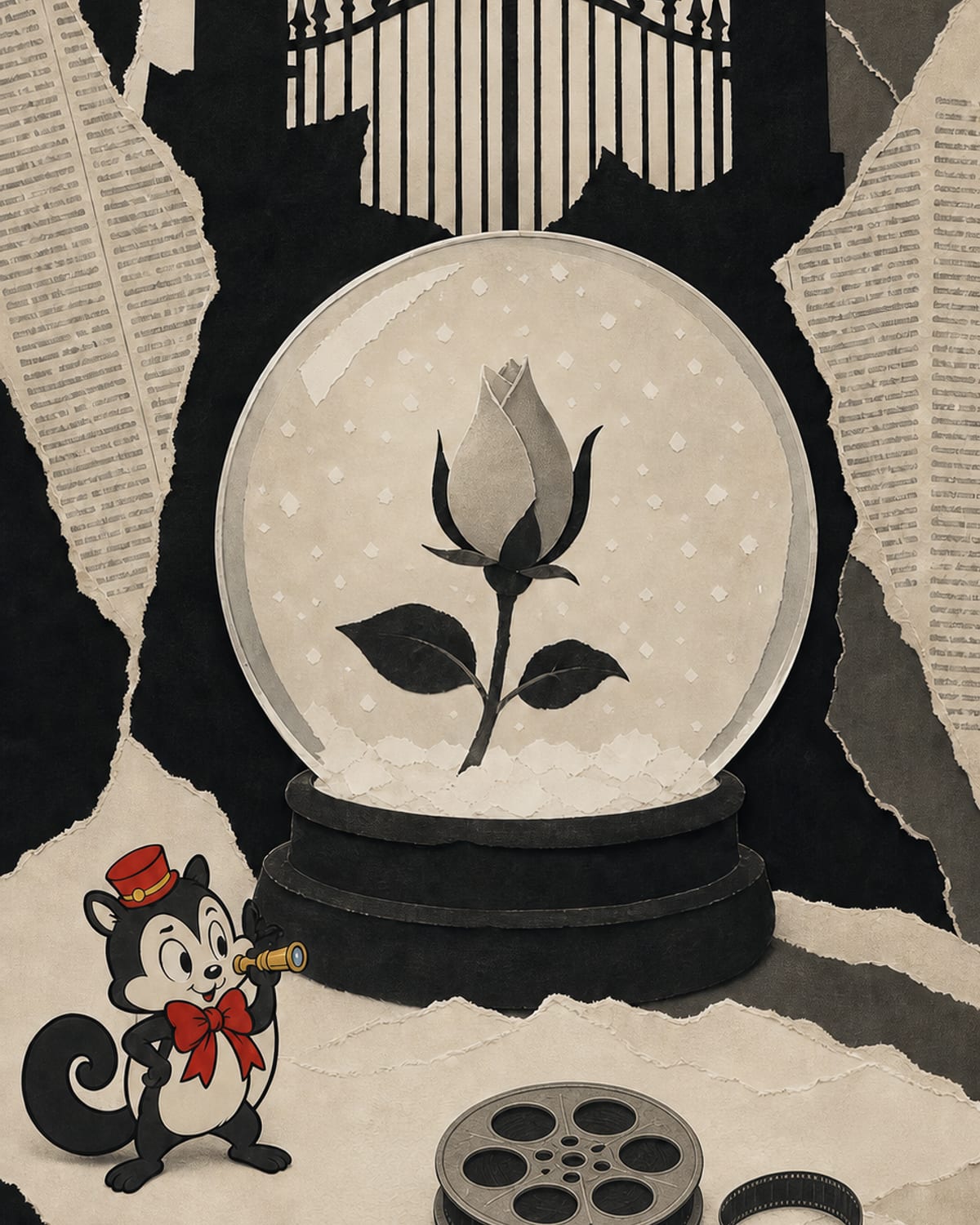

Original Monocurator collage for Citizen Kane

Image: Monocurator · source · Original Monocurator artwork

Citizen Kane

1941 · United States · Directed by Orson Welles · 119 min

MysteryBleak Approachable · Moderate Drama

Citizen Kane follows a reporter piecing together newspaper magnate Charles Foster Kane’s life through the people who knew him. Their accounts return to earlier events, giving familiar scenes a different personal weight.

Citizen Kane: who tells the story?

Reporter Jerry Thompson, played by William Alland, investigates Kane’s last word after the publisher’s death. He gathers five main accounts: Thatcher’s memoir, then Bernstein, Leland, Susan and Raymond. Susan initially refuses to speak; Thompson returns to her later. AFI’s synopsis follows this order.

Use the names as a way back into a scene. When the film returns to an earlier period, ask whose relationship with Kane is now at its centre. A new account can change the weight of an event you already recognise.

The five accounts, in the order their recollections begin
Person and actorConnectionA question to carry into the scene
Walter Parks ThatcherGeorge CoulourisGuardian and financier; his written memoirWhat does wealth allow other people to decide for Kane?
Mr. BernsteinEverett SloaneNewspaper colleagueWhat does affection for an employer bring into a memory?
Jedediah LelandJoseph CottenFriend and drama criticHow does disappointment change the story of a friendship?
Susan Alexander KaneDorothy ComingoreSecond wifeWhat does Kane’s ambition feel like to someone living with it?
RaymondPaul StewartButler at XanaduWhat can a servant observe without knowing what it means?

Criterion’s cast record · AFI’s character and story record

Kane’s life in chronological order Story spoilers

The investigation moves between these periods. This is a broad life sequence, rather than a shot-by-shot account.

  1. ChildhoodHis mother places him in Thatcher’s care.
  2. The newspaperHe takes over the Inquirer and expands it.
  3. Marriage and politicsHe marries Emily; scandal later defeats his campaign.
  4. Susan’s careerHe marries Susan and promotes her as an opera singer.
  5. XanaduThey retreat to the estate; Susan eventually leaves.
  6. Death and inquiryKane dies; Thompson begins his investigation.

Leland’s account reaches Susan’s opera debut; Susan’s takes us back into that experience. The return changes our place in the room: first beside a critical friend, then beside the performer whose life Kane is directing. The two accounts are detailed by AFI.

What is Rosebud? Final-scene spoilers

Rosebud is the name painted on Kane’s childhood sled. The audience sees it burn after Thompson has failed to discover its meaning. Roger P. Smith’s Criterion essay frames the film between its opening gate and that final burning sled.

The last image lets us connect an object to the child taken away from home. It gives that separation a new force when we think back through the film. The five accounts still matter: the adult Kane’s demands, generosity and injuries to other people have occupied lives beyond his own. A childhood object can illuminate those scenes without replacing everything we have heard from the people in them.

Watch · Rent · ReadWatchRentRead U.S. search links, not availability claims · Disclosure

What to expect

Citizen Kane approaches a powerful newspaper owner through memories, competing viewpoints, and fragments that never settle into one easy portrait. Deep spaces, bold shadows, expressive sound, and playful transitions make the investigation feel alive. Its reputation can sound intimidating, but the film itself is energetic and accessible: a mystery about how a public life is built, remembered, and misunderstood.

How to ease in

Do not treat the film as a test with one correct solution. Each witness offers a different angle, and the changes in time are usually announced by a voice, a location, or a striking visual transition. Follow the emotional pattern rather than every business detail: what Kane gains, what he tries to control, and what keeps moving beyond his reach.

Heads-up

A quick, non-exhaustive note Includes controlling relationships, emotional cruelty, heavy drinking, and a suicide attempt.
Momo's Note Who is Momo? →

The one everyone names — and it earns it.

The famous images are wonderful, but I keep returning to the empty spaces around Kane. Rooms grow larger as his world becomes smaller, and objects begin to outnumber people.

Open the note ↓

The famous images are wonderful, but I keep returning to the empty spaces around Kane. Rooms grow larger as his world becomes smaller, and objects begin to outnumber people. The film feels less like a monument when you watch those distances; it becomes a sad, restless study of someone who can acquire almost anything except closeness.

— Momo

Momo with notes about this film

Credits & versions

Credits
Cast
Orson Welles — Charles Foster Kane · Joseph Cotten — Jedediah Leland · Dorothy Comingore — Susan Alexander Kane · Agnes Moorehead — Mary Kane
Production
Orson Welles · Mercury Productions, Inc. · RKO Radio Pictures, Inc.
Cinematography
Gregg Toland

Version map

Criterion 4K digital restoration119 min · restoration · USCurrent Criterion presentation with the original monaural soundtrack.Runtime reference · Checked 2026-07-26
1941 RKO theatrical version119 min · theatrical cut · US · 1941-05-01AFI records a 10,734-foot final version after a longer 11,041-foot complete print was shortened before release.Checked 2026-07-26

Ways to watch and read

ActionSearch destination
WatchCheck availability on JustWatch
RentSearch rentals on Apple TV
ReadSearch books on Bookshop.org

U.S. search destinations · Links checked 2026-07-27 · Stock, editions, prices, and availability can change · Disclosure

Where to go next

Want a gentler, shorter, or stranger next film? Ask Momo for something like this →
Momo is on shift. Visit Momo Cinema →
Continue through the catalogue →