See Films Differently Cinematography
What Is Chiaroscuro in Film? Light, Shadow and the Shape of a Scene
Chiaroscuro uses strong contrasts between light and dark. See how it shapes faces and spaces in The Third Man, and why it is not confined to black-and-white film.
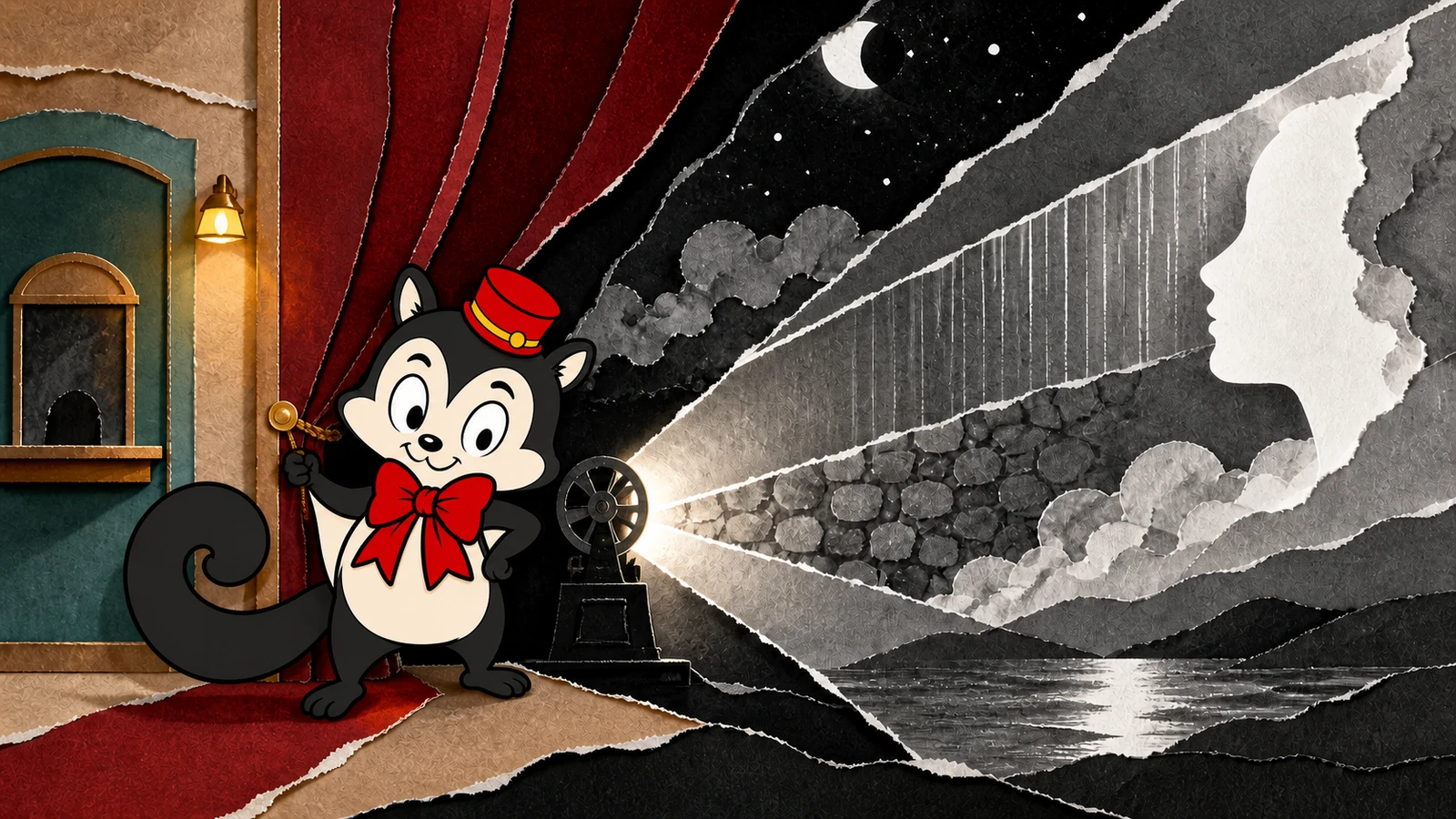
Chiaroscuro in film means strong contrasts between light and dark. The term is often associated with German Expressionism and film noir, but it describes a way of shaping the image rather than a genre. [2]
A face can be recognisable even when much of it falls into shadow. Imagine light catching a cheek and the bridge of a nose, while the far side of the face recedes. We have enough information to sense a solid head, although we cannot inspect every part equally well.
The Italian word chiaroscuro brings light and dark together. In painting, it describes tonal contrasts used to suggest volume and shape. The National Gallery distinguishes Leonardo da Vinci’s modelling of figures from Caravaggio’s more dramatic use of such contrasts. [1] The word has room for both a body becoming tangible and a picture becoming theatrical.
The useful thing to follow on screen is how brightness is distributed: which features the light picks out, and what happens where it ends.
Darkness needs something to work against
Imagine two views of a corridor. In the first, everything is dim and the differences between its surfaces are slight. In the second, a bright rectangle falls across the floor while the surrounding passage stays dark.
Both corridors may be difficult to see into. The second gives us a more pronounced arrangement of light and dark. The bright area has a shape, and that shape helps organise the rest of the view. A person standing within it would be more visible than someone waiting beyond its edge.
Simply calling both images “dark” loses this distinction. With chiaroscuro, it is useful to follow the meeting points: where a face becomes difficult to read, where a doorway stands out, where an object separates from its background.
There is no requirement that every shadow conceal an important clue. The light can give a face weight, isolate an ordinary gesture, or make a room feel divided before we know whether those divisions matter to the plot.
A city made from more than shadows
For Carol Reed’s black-and-white thriller The Third Man (1949), Neil Mitchell’s BFI account places chiaroscuro alongside tilted framing, damaged buildings and streets wetted to catch reflections. Together, these contribute to the film’s version of postwar Vienna. [3]
This combination is worth examining without losing the distinct work of each element. A reflective street, a sloping composition and a strong contrast in illumination do different things. Naming one technique should not make the others disappear into a general label such as “noir atmosphere”.
A wet surface can give light somewhere to appear inside a night scene. This makes a useful viewing question: how much of the image’s energy comes from the bright portions? A shadowy city may owe some of its force to the areas that shine.
For a comparison focused on the orientation of the camera, Monocurator’s Dutch-angle guide treats that separate part of the picture.
The shutters are doing some of the work
Chiaroscuro is not confined to monochrome. A production account of David Mamet’s colour thriller The Spanish Prisoner offers a practical example. Cinematographer Gabriel Beristain described controlling the light through louvred windows for an early meeting scene. He connected its use of chiaroscuro with the formal, guarded impression of powerful investors. [4]
That account brings the grand art-historical word down to a specific decision: which parts of a room receive light. It also reminds us that a bright daytime setting can contain strongly contrasted areas. “Daylight” does not tell us that everyone and everything will be equally legible.
This is a designed relationship among people, surfaces and illumination. Calling it chiaroscuro describes the visible result without requiring us to reconstruct every lamp outside the frame.
A shadow is not a character reference
A face partly hidden in darkness can invite suspicion. That does not make the lighting a reliable certificate of the person’s moral character. We still need the performance, the situation and what the film chooses to reveal later.
The pleasure of the technique can be more immediate than decoding a symbol. Return to the imagined corridor and let someone cross its patch of light. A face becomes available to us, then less available, while the corridor stays in place. The arrangement can change what we see without a cut or a new location.
Chiaroscuro makes that patch worth watching. Its boundary gives the actor another edge to cross, inside the edge of the screen.
References & Further Reading
- National Gallery, London, ‘Chiaroscuro’, Glossary. Page undated.
- Columbia University, ‘Chiaroscuro’, Film Language Glossary. Page undated.
- Neil Mitchell, ‘Location, location, location: Vienna and The Third Man’, BFI, 24 June 2015.
- Eric Rudolph, ‘Paging Machiavelli for The Spanish Prisoner’, American Cinematographer, originally March 1998; online republication 8 November 2020. Includes cinematographer Gabriel Beristain’s account.
The face and corridor examples are imagined demonstrations. Their possible effects and the proposed ways of looking are Monocurator’s interpretation.
For the next unexpected question, follow the Journal in your RSS reader.
On screen
Films discussed
- The Third Man (1949) · Carol Reed
- The Spanish Prisoner (1997) · David Mamet
Further reading
Read next in the Journal
Want a recommendation shaped around your evening? Ask Momo what to watch next →