See Films Differently Film history
When the Backgrounds in Old Films Become the Main Attraction
Why can an old film's shopfronts and passing traffic become as absorbing as its story? Look again with People on Sunday and A Trip Down Market Street.
A shop window can become more interesting than the people standing in front of it. The film has not changed, but the things we need it to explain have. A business, a way of travelling or an object that helps establish a scene can also offer a glimpse of a daily life we have never known. What takes little explanation inside the story may invite a great deal of curiosity outside it.
That is how a background can become a main attraction without displacing the plot. We can follow a meeting and still want to inspect the street that makes the meeting possible. Time changes the relationship between the image and our experience: some things become unfamiliar, while others remain surprisingly easy to recognise.
People on Sunday (Menschen am Sonntag, 1930) is a particularly inviting place to try this. Directed by Robert Siodmak and Edgar G. Ulmer, with photography by Eugen Schüfftan, it follows young Berliners through a weekend, mixing a fictional story with documentary images of the city. Its cast of nonprofessionals includes a taxi driver, a record seller and a wine seller. Their work and leisure belong to the film’s subject from the beginning. [1]
Two ways to look at a meeting
The story begins to take shape around an encounter near Berlin’s Bahnhof Zoo: Wolfgang meets Christl, and a plan for a Sunday outing develops. [2] There is a familiar question to follow here. Will a chance meeting turn into something worth giving up a day for?
Look at the street as well. In an image from this early encounter, reproduced in Criterion’s official gallery, a woman stands beside a shop window holding a hat in front of her. A suited man stands a few paces to her right. Behind her, pictures and lettering fill the window; a large image of a camera appears on an advertising board beside it. More printed material is displayed towards the pavement. The frame contains a social encounter and a busy arrangement of things to look at or buy. [1]
Follow the two people and the space between them matters: someone might approach, wait or respond. Let your attention move behind them and another set of questions opens. How much of the frontage is given over to pictures? How close does the display come to the pedestrian? What is competing for the attention of somebody passing this spot?
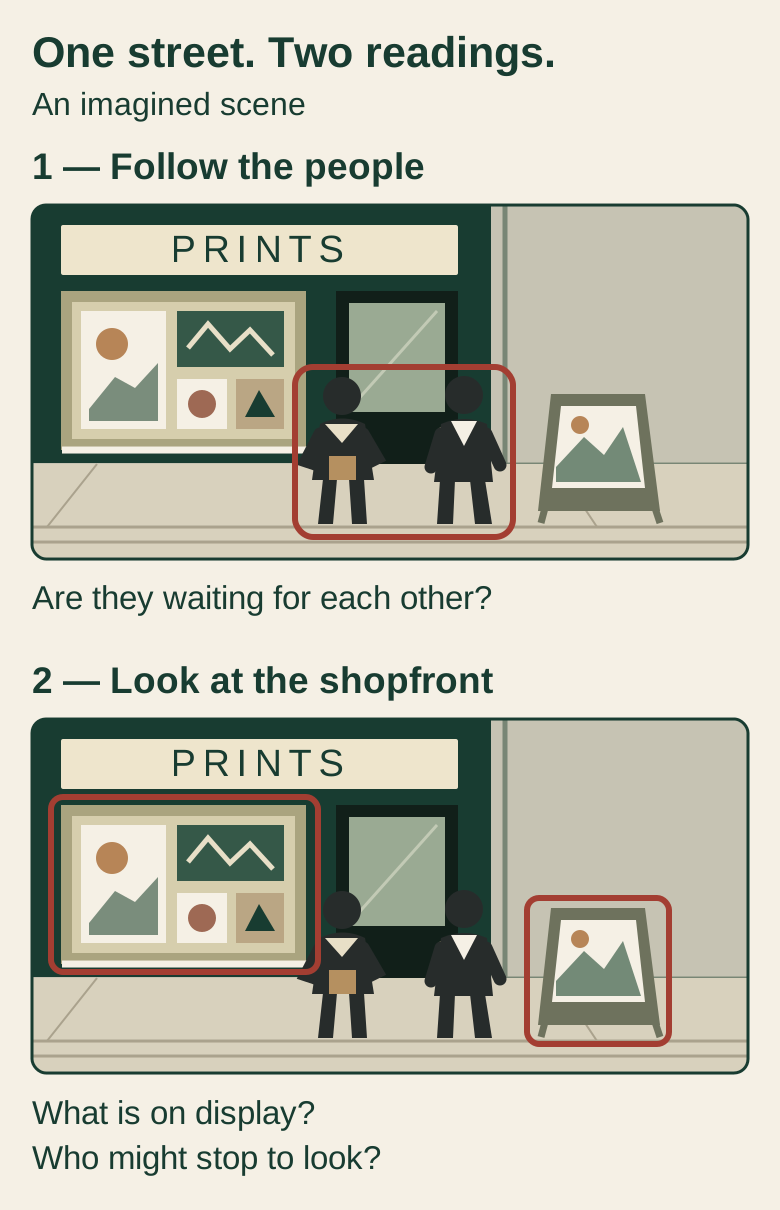
The advertising does not have to become a clue to the romance. Its interest can be independent. Yet it also changes the texture of the encounter. These people meet in a place where other activities continue, where they are potential customers as well as potential companions. A setting acquires uses beyond the one the story currently needs.
There is no requirement to read every word on a sign. Even the arrangement of a display can be absorbing. A viewer interested in photography might notice the camera advertisement first; someone who has worked in a shop might look at how the frontage uses its limited space. Neither needs to remember Berlin in 1929 to find something there.
Ordinary to whom?
It would be easy to say that these details were invisible to the original audience and have become fascinating only to us. People on Sunday makes that claim especially difficult. Its city streets, jobs and recreation were already being offered for attention. Film scholar Noah Isenberg describes its use of locations and performers whose roles drew on their occupations; Brigitte Borchert is introduced at the Electrola record shop. [2]
Three different things can be hidden inside the word ordinary. Something may be routine for a character. It may have been familiar to a particular contemporary viewer. Or the filmmakers may have given it little emphasis. None of those establishes the other two. A familiar workplace can be filmed with great care; an object the story takes for granted may already have seemed unusual to somebody living elsewhere.
What time can change is the question we bring. Knowing that Brigitte sells records helps place her among the film’s young workers. For a viewer used to getting music without entering a shop, it may also prompt interest in the work surrounding that purchase. For somebody who still buys records, it may offer a comparison with a familiar activity. The same detail can suggest distance or continuity, depending on who is looking.
This pleasure need not involve wishing to live in the past. Curiosity about how people bought, travelled or spent an afternoon is different from preferring their circumstances. Nor does learning the history of an object use up its appeal. Recognising more of what it does can make it more interesting to watch in somebody’s hands.
When the street was already the attraction
The Miles Brothers’ A Trip Down Market Street (1906) offers a useful comparison. With Harry J. Miles credited as cinematographer, it takes a camera along San Francisco’s Market Street on a cable car towards the Ferry Building. It was made as a nonfiction film for Hale’s Tours theatres. The travelling view was already an attraction. [3]
Unlike the Berlin film’s developing relationships, this journey gives us a route to follow. The Library of Congress catalogue’s shot description records cable cars, horse-drawn vehicles and motor cars sharing the street, with pedestrians crossing and boarding transport. [4] Watching the destination approach is one pleasure. Attending to how people and vehicles occupy the space offers another.
The distinction between a vehicle and a person’s use of it matters. An old car can be admired as a shape. Someone negotiating a crossing or getting aboard transport brings the street into the scale of a body. Alongside the unfamiliar machinery sits a practical problem a viewer may recognise: how to get from here to there while other people are moving too.
This is still a filmed and selected journey. The Library of Congress catalogue notes that some motor cars repeatedly circle the camera and suggests that the automobile traffic was staged. We should not turn its apparent density into a claim about an average day. [4] That qualification leaves plenty to watch: different kinds of transport, the space they take up, the relation between the passing foreground and the buildings beyond it.
The film was made before San Francisco’s 1906 earthquake and fire. [3] Knowing that can make the streets feel precarious. But the disaster need not take possession of every person in the image. They can also remain people making a journey, working or crossing a road. Historical knowledge adds a way of seeing; it need not become the only story available.
Familiar gestures in unfamiliar surroundings
Back in People on Sunday, a beach photographer offers a smaller encounter between past and present. The film leaves its main group to watch other day-trippers being photographed. Faces move and then become fixed portraits. One woman smooths her hair before posing; a boy’s expression changes as the photograph is prepared. Critic Imogen Sara Smith describes the sequence’s carefully arranged passage between movement and stillness. [5]
The equipment and clothing may draw our attention first. The preparations can then become more absorbing than the finished picture. Anyone who has adjusted their appearance for a camera has a possible point of recognition, even if the setting is unfamiliar. A recognisable action is enough to bring them closer.

These faces are not literally in the background once the film turns towards them. That is part of its usefulness here. People who have no responsibility for advancing the main characters’ story are allowed to occupy the screen. The film itself makes room for the kind of curiosity a later viewer can bring to other scenes.
Attention to such moments also resists a particular loss caused by looking backwards: treating everyone as an example of an era. A hairstyle may interest us as fashion history, but smoothing it is something a person does. A crowd contains both patterns and individuals, and a film can give us reasons to move between them.
Letting the story and the surroundings share the screen
An old film is not an unlimited view of a vanished world. Its framing, performances and editing have already chosen what reaches us. Survival adds another limit: Eye Filmmuseum reports that the original negative of People on Sunday is lost, and that its restoration compared distribution prints from several archives. [6] We encounter a preserved work, with particular views and omissions, rather than a complete inventory of Berlin life.
Within those limits, the image can answer questions beyond those needed to understand the plot. The characters give us a reason to enter a room or wait on a pavement. The surroundings offer reasons to linger there. Following one does not make the other a distraction, and studying the surroundings is no more compulsory than studying the editing.
With People on Sunday, begin by following the invitation to spend a day together. When the street encounter gives you room to look, let the shopfront claim a little attention. At the beach, watch what happens just before a face settles into its photograph. If the flirting pulls you back, go with it. The display, the gesture and the relationship can each have their turn.
References
- People on Sunday, The Criterion Collection. Film information, cast and credits, and official gallery: the third gallery image supplies the street encounter, shop window and camera advertisement described above.
- Noah Isenberg, ‘People on Sunday: Young People Like Us’, The Criterion Collection, 27 June 2011. Production history and descriptions of the opening encounter and the characters' introductions.
- David Kiehn, ‘The Brothers Who Filmed the Earthquake’, San Francisco Silent Film Festival, 2006 festival essay. Miles Brothers credits, the cable-car route, the Hale's Tours context and filming before the earthquake. No precise filming day is asserted here.
- ‘A trip down Market Street before the fire’, Library of Congress. Scene-by-scene description and catalogue notes on the repeated automobile traffic and its apparent staging.
- Imogen Sara Smith, ‘The Sun on Their Faces: One Scene from People on Sunday’, The Criterion Collection, 24 January 2018. Detailed description and analysis of the beach-photographer sequence.
- ‘Eye am Sonntag’, Eye Filmmuseum, ‘About the restoration’ section. Loss of the original negative and comparison of surviving distribution prints.
On screen
Films discussed
- People on Sunday (1930) · Robert Siodmak and Edgar G. Ulmer
Want a recommendation shaped around your evening? Ask Momo what to watch next →