See Films Differently Film craft
Why Can We See a Baseball Game When Keaton Plays Alone?
Keaton’s solo game in The Cameraman opens a question about baseball: how can the same starting shape hold a different situation?
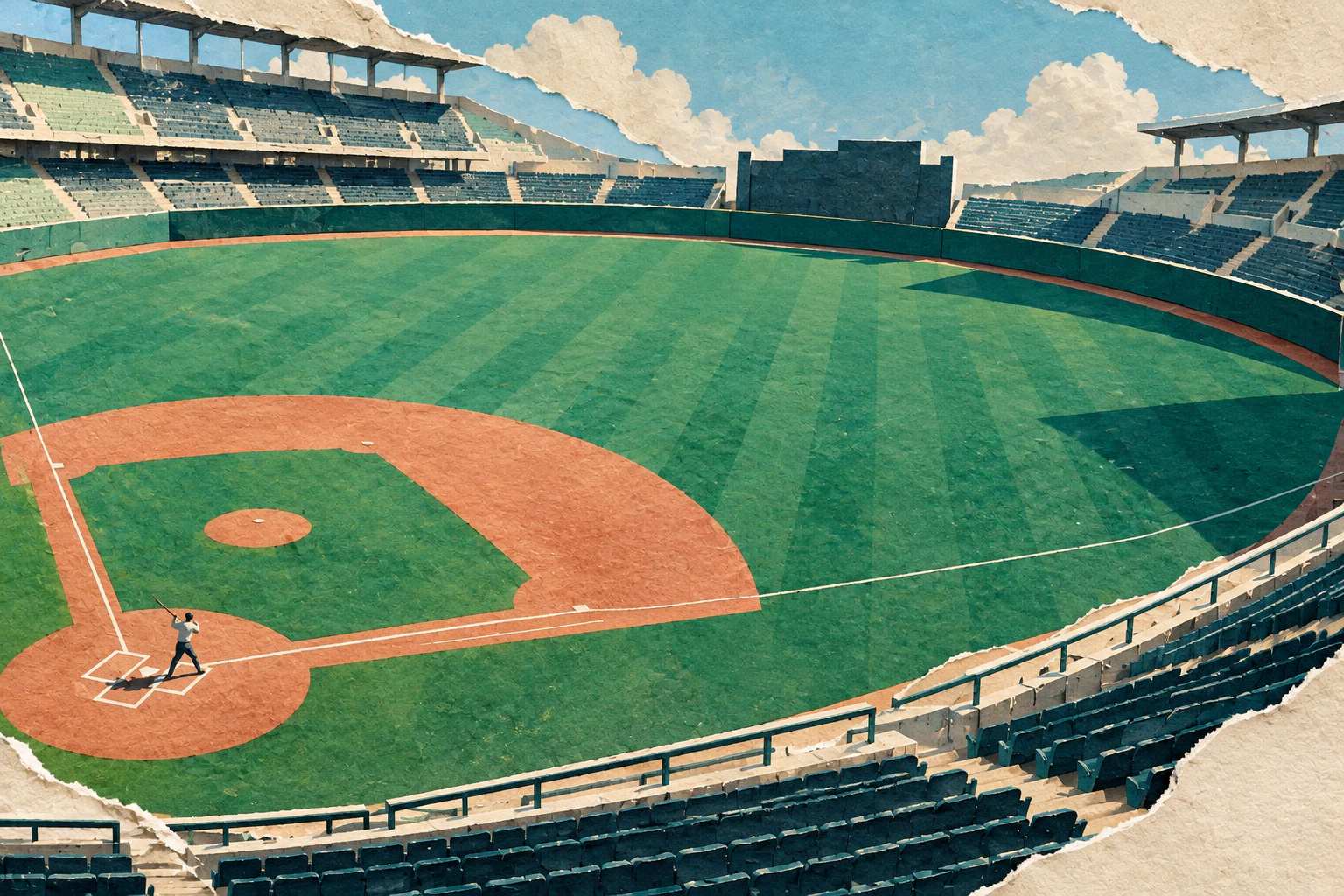
There is a baseball game in The Cameraman with a remarkable shortage of players. In an empty Yankee Stadium, Buster Keaton performs a game by himself. Imogen Sara Smith identifies the sequence as a solo pantomime in her essay for Criterion. The stadium supplies the place; one body has to supply the contest. [1]
The odd thing is that the missing players need not prevent us from following it. If we recognise baseball, we bring some of the game with us. A familiar movement can suggest somebody at its other end. The space around the performer begins to acquire jobs.
That offers a useful way into a sport which can look, from a distance, as though everyone keeps returning to where they started. Baseball repeatedly restores a recognisable arrangement. What happened before the next pitch, however, changes what that pitch can do.
Giving the empty space a job
Think of the difference between recognising a throw and recognising a pitch. A throw can go almost anywhere. A pitch belongs to a relationship: a pitcher delivers towards a batter, with a catcher behind the plate. Once that relationship is understood, even an absent partner has a place in the action. [3]
This is one way to read Keaton’s solitary game. We supply a relationship around a visible action. In pantomime generally, a performer who waits after throwing can invite us to imagine the time a ball takes to travel; a change of attention can suggest where the answer comes from. Those are possibilities of the form, rather than a list of this film’s shots. The important question is how an action gives the viewer enough information to anticipate another action.
The empty stadium gives the idea its particular scale. There is room for a whole game, and a conspicuous shortage of people to play it. We can entertain the game while remaining aware of the person making it up. Filling every position with another actor would remove that pleasure of seeing how much one performer can ask us to supply.
There is a further joke in the choice of protagonist. The Cameraman is a 1928 black-and-white silent comedy in which Keaton’s character tries to establish himself as a newsreel cameraman. His work depends on finding something worth recording. Here, the actor’s performance gives an empty sporting venue an event of its own. [2] The camera can record the body and the space; our reading of them makes the imaginary contest.
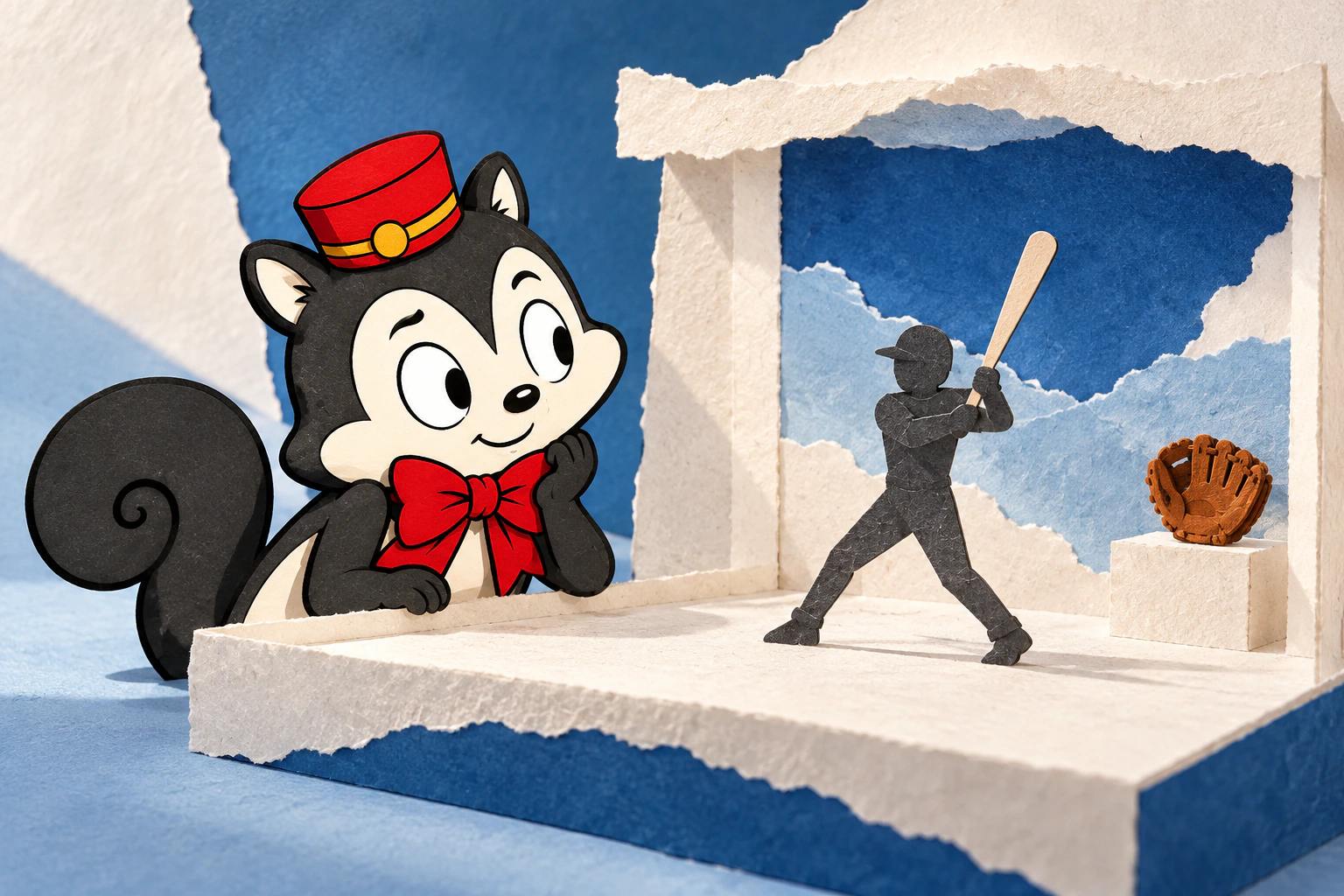
The same diamond, a different next pitch
Recognising who could answer a gesture gives us the encounter. Following what that answer could change gives us the situation. Now put the other players back in a real game: the next delivery may begin with the familiar pitcher–batter arrangement, but the situation has a memory.
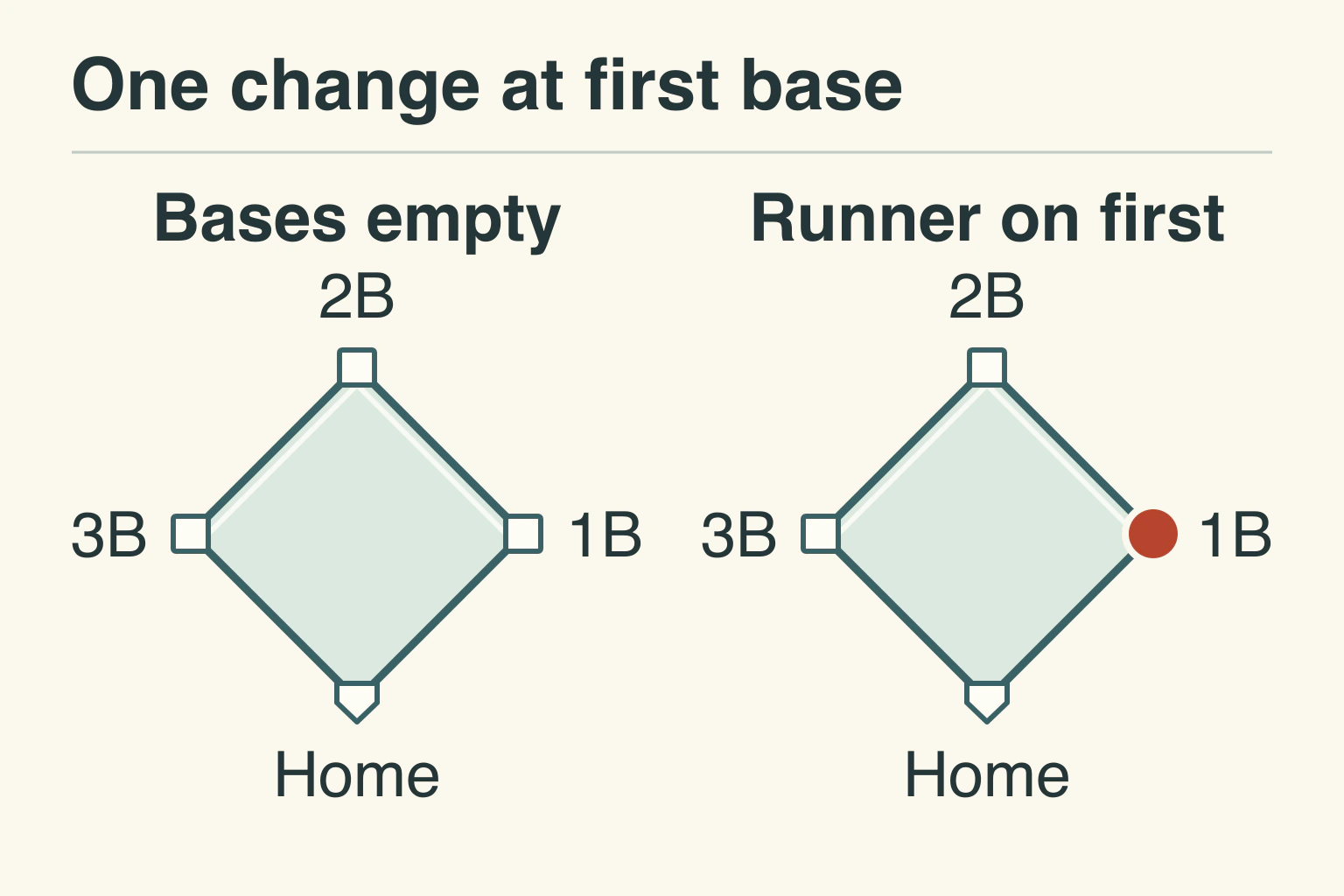
Imagine two moments: in one, the bases are empty; in the other, the previous batter has hit a single and occupies first. The field has the same shape. In the second situation, the defence has another person to attend to. That batter’s achievement is still present on the field when the next batter arrives.
The count carries a different kind of memory. With three balls already called, another ball awards the batter first base. The same call at the start of the plate appearance would leave the batter waiting for another pitch. [3] The visible beginning can look familiar while the consequence has changed.
This is why watching only the delivery can leave a newcomer puzzled by everyone else’s anticipation. Some of what they are watching happened earlier. A runner offers a visible clue; the count and score need to be remembered or looked up. The next pitch arrives inside those accumulated conditions.
The arrangement is also only broadly repeated. Players adjust their positions, and runners can move. Baseball continues between the neat units into which a spectator may divide it: under the rules, the ball remains live until a specified cause or the umpire’s call makes it dead. A pause in movement does not automatically stop play. [3]
A small beginning inside a larger game
A new batter and a change of sides are different sorts of beginning. A batter completes a turn by being put out or becoming a runner; three outs end the team’s turn on offence. Runs already scored continue to matter. [3]
Those different boundaries help explain the sport’s rhythm. The pitch offers a small, recognisable point of attention. The batter’s turn contains several possible developments. A team’s half-inning gathers those developments into a larger opportunity. Each scale lets something finish while something else continues.
For a simple viewing experiment, watch one plate appearance with a runner on base. Before each delivery, look for that runner, then check the count and outs. After the play, ask what has changed. A delivery which resembles the previous one can now carry another possibility because you have kept track of its setting.
The diagram here changes only one thing: whether first base is occupied. A real situation contains much more information. Holding most of the picture still makes that single difference easier to notice.
Tennis does this too
Repeated beginnings with consequences are familiar elsewhere. In tennis, the ball remains in play until the point is decided, subject to faults and lets. The next point begins with service, while the score carries the result forward. In a standard game, a point at deuce creates advantage. If the same player wins the next point, they win the game. Games, in turn, contribute to the set. [4]
So repetition and accumulation cannot, by themselves, explain what makes baseball distinctive. Tennis gives us a fresh rally without erasing the match. Baseball’s particularly visible form of carry-over is the runner: an earlier batter’s progress can remain embodied at a base while another batter takes a turn. The two sports organise their repeated encounters differently.
The comparison also puts a limit on what we should ask of Keaton’s pantomime. Recognising an imaginary ball game does not mean reconstructing a complete score, batting order or set of legal plays. We may understand the kind of encounter and enjoy its changing tensions without possessing all that information. A viewer unfamiliar with baseball may follow the bodily play while missing some of the sporting implications.

What the spectator keeps alive
The attraction of the stadium sequence lies partly in that uneven division of work. Keaton gives us a visible performer in a substantial place. We bring whatever knowledge lets an action reach beyond his body. The empty areas become places where something could be happening.
When you watch The Cameraman, try noticing what you have supplied before you notice what is missing. When does a movement start to imply an opponent? What makes you expect an answer from a particular direction? Which parts remain amusing even when the rules are unfamiliar?
Then carry that attention to an ordinary game. The players may settle into familiar positions, but the runner is still there, the count has advanced and the score has survived. There is a new pitch to watch. There is already a game around it.
References
- Imogen Sara Smith, ‘The Cameraman: Man with a Movie Camera’, The Criterion Collection, 16 June 2020. Identifies Keaton's solo baseball pantomime in an empty Yankee Stadium. The account of what a spectator supplies is this article's interpretation; the hypothetical examples of pantomime are not a shot-by-shot transcription.
- The Cameraman, The Criterion Collection, film information, synopsis and credits. 1928; black and white; silent; credited director Edward Sedgwick. The listed restored edition has a newly recorded score, so ‘silent’ does not mean a presentation without music.
- Major League Baseball, Official Baseball Rules, 2025 edition, rules 1.04–1.06, 5.01(b–c), 5.02(a), 5.04(c), 5.05(b)(1), 5.06 and 5.09(e). This is the edition linked from MLB's official information page when checked on 18 October 2026. It supports the explanation of the sport, not a claim that every current provision applied in 1928 or that the film depicts a complete regulation game.
- International Tennis Federation, 2026 Rules of Tennis, rules 5–7 and 11. The comparison uses standard-game scoring; alternative scoring systems also exist.
For the next unexpected question, follow the Journal in your RSS reader.
On screen
Films discussed
- The Cameraman (1928) · Edward Sedgwick
Continue exploring on Monocurator

Further reading
Read next in the Journal

Want a recommendation shaped around your evening? Ask Momo what to watch next →