← Back to the films

Drama

Bicycle Thieves

Ladri di biciclette

Year
1948
Length
89 minCriterion 89-minute 4K restoration Version sources ↓

One stolen bike, a father and son. Devastating.

Find viewing options ↓ Before you watch ↓

Search links, not confirmed availability. Check the edition and region.

Country
Italy
Language
Italian
GentleBleak Great first watch · Easy Drama
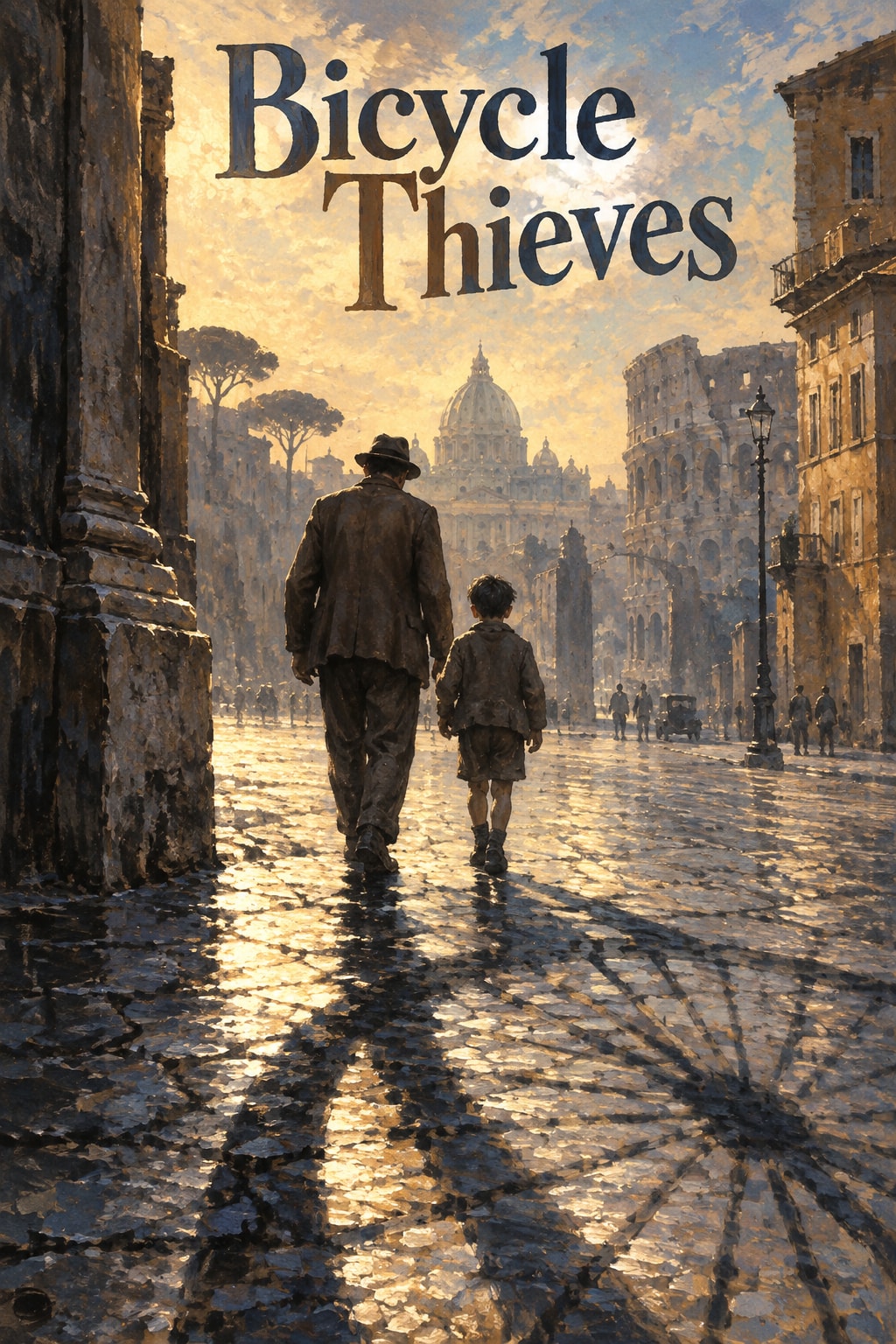
Bicycle Thieves: A father and child walk hand in hand along a glowing Roman street without a bicycle.

Image: Monocurator · source · Original Monocurator artwork

Bicycle Thieves ending explained: Antonio and Bruno

The closing minutes change the distance between father and son. Follow the final encounter, then look at what the camera lets Bruno discover.

Read the final scenes · Ending spoilers

Why does Antonio steal a bicycle?

Antonio needs a bicycle to keep the job that can support his family. After the search fails, he finds himself surrounded by other people’s bicycles outside a football stadium. He sends Bruno towards a tram, then takes an unattended bike. The man we have followed as a theft victim now inflicts that loss on somebody else. Desperation connects the two thefts; it does not make the second bicycle his to take.

Why does the owner let Antonio go?

Passers-by catch Antonio and recover the bicycle. The owner sees Bruno crying and decides against taking Antonio to the police. Bruce Bennett’s Cycling and Cinema follows this sequence from the stadium to the crowd. The owner’s mercy gets Antonio out of immediate trouble, but leaves him without a bicycle for work.

Why does Bruno take his father’s hand?

Bruno reaches for Antonio’s hand as they walk away, a gesture discussed in Sandra E. Lim’s account of the film. He has seen his father caught and humiliated, yet reaches towards him. The child offers comfort to the adult who was supposed to look after him. Godfrey Cheshire’s Criterion essay traces the film’s growing concern with what passes between the pair.

The search

No work bicycle. The family’s practical problem remains.

The relationship

Bruno has seen Antonio fail. He still takes his hand.

Read together, these two outcomes make the ending both painful and tender. Their closeness survives a day that has given them no economic escape. The handclasp offers something real, but it cannot put the day back as it was.

How a few seconds change the scene

The Taviani brothers remembered a long camera movement around Bruno as he realised that the thief was his father. When they checked the film, they found that the movement was very short. Their memory had stretched it because of its emotional force.

On another viewing, watch the moment Bruno recognises what is happening. The chase shows Antonio being caught; the boy’s reaction shows what the capture costs between father and son. The final handclasp follows that discovery.

What to expect

A simple search through postwar Rome becomes a clear, humane look at work, dignity, and the bond between a father and son. Bicycle Thieves finds drama in streets, crowds, and small choices rather than grand speeches. Its emotional power comes from how closely it watches ordinary people under pressure, allowing sympathy to grow without polishing away their frustration or mistakes.

How to ease in

The plot is deliberately plain: a father and son search for a bicycle the family cannot afford to lose. Let the city supply the complexity. Watch how crowds open and close around them, how each possible lead changes their pace, and how the son's attention sometimes tells us more than the father's words. The repetition is the pressure building, not the story standing still.

Heads-up

A quick, non-exhaustive note Depicts poverty, theft, public humiliation, family distress, and a child placed in frightening situations.
Momo's Note May contain spoilers Who is Momo? →
Open the note ↓ Close the note ↑

I keep watching the boy. He studies every adult decision, sometimes hurrying to keep up and sometimes seeing more clearly than the people above him. The search matters, but the film's deepest movement is the changing distance between two walkers. By the end, a crowded street can feel unbearably private.

— Momo

Momo thinking about this film

Credits & versions

Credits
Cast
Lamberto Maggiorani — Antonio Ricci · Enzo Staiola — Bruno Ricci
Cinematography
Carlo Montuori

Version map

BFI 96-minute presentation 96 min · GB BFI records a 96-minute presentation, kept distinct from Criterion’s 89-minute restoration. Source: BFI — Bicycle Thieves (1948) Checked 2026-08-13

Ways to watch and read

ActionSearch destination
Watch Check availability on JustWatch
Rent Search rentals on Apple TV
Read Search books on Bookshop.org

U.S. search destinations · Links checked 2026-07-27 · Stock, editions, prices, and availability can change · Disclosure

Where to go next

Want a gentler, shorter, or stranger next film? Ask Momo for something like this →
Momo is on shift. Visit Momo Cinema →

Continue through the catalogue →