What to watch next
15 Best Black and White Movies: Choose Your Next Film
Choose your next black-and-white movie: 15 classics and modern films compared by mood, time and viewing experience, from Casablanca to Frances Ha and Roma.
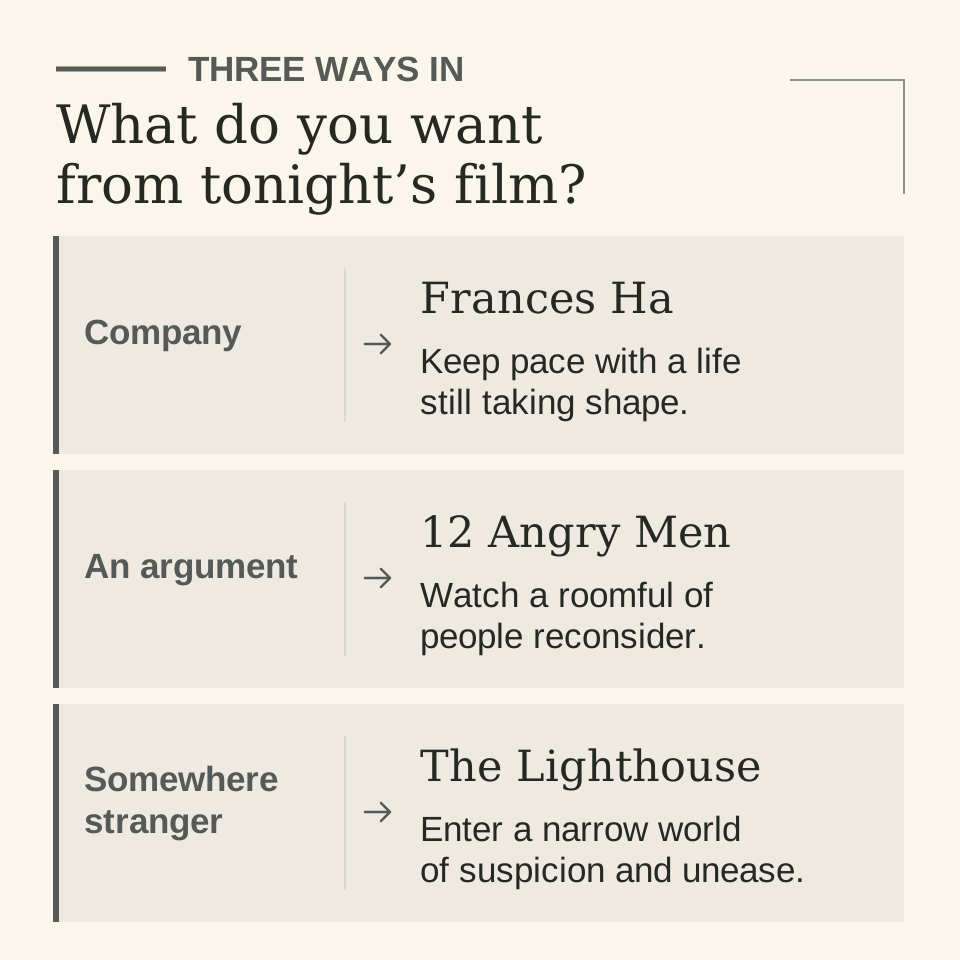
Choose 12 Angry Men for an argument that becomes a thriller, Casablanca for romance with a difficult decision at its centre, or Frances Ha for a brisk, funny evening about finding your feet. Those are three very different pleasures, and all three happen to be in black and white.
These fifteen picks range from Chaplin in 1931 to The Lighthouse in 2019, chosen to offer different kinds of evenings: comedy, romance, action, family drama and unease. We have included films that make their case immediately alongside slower, stranger choices worth setting time aside for.
For a shorter introduction, use Start Here. For the aesthetics, read why filmmakers choose black and white.
Compare the 15 films
| Film | Year | Time | The experience | Choose it if… |
|---|---|---|---|---|
| City Lights | 1931 | 86 min | Physical comedy and tenderness | You want laughter with an emotional landing |
| Casablanca | 1942 | 102 min | Romance in a city of refugees | You like wit, divided loyalties and difficult choices |
| Bicycle Thieves | 1948 | 89 min | A father and son search Rome | A small, urgent problem can hold your attention |
| Rashomon | 1950 | 88 min | Conflicting accounts of a violent encounter | You enjoy questioning the storyteller |
| Tokyo Story | 1953 | 137 min | A family visit with accumulating hurt | You have patience for ordinary conversations |
| Seven Samurai | 1954 | 207 min | A village prepares to defend itself | You want to live with a group before the battle |
| The Night of the Hunter | 1955 | 93 min | A children’s nightmare with a singing pursuer | You prefer a dark fairy tale to realistic horror |
| 12 Angry Men | 1957 | 96 min | Twelve jurors under pressure | You want clear stakes and changing minds |
| Some Like It Hot | 1959 | 121 min | Musicians, disguises and multiplying lies | You want exuberant farce with romantic complications |
| Psycho | 1960 | 108–109 min | A journey that becomes a trap | You want a thriller that redirects your attention |
| La Haine | 1995 | 97 min | Three friends move through a combustible day | You want restless energy and social anger |
| Frances Ha | 2012 | 86 min | Friendship, money and unfinished ambitions | You recognise the comedy of being left behind |
| Ida | 2013 | About 82 min | A novice nun investigates her family history | You want something quiet, spare and concentrated |
| Roma | 2018 | 135 min | Domestic life within a larger city | You enjoy watching a whole frame come alive |
| The Lighthouse | 2019 | 109 min | Two men becoming intolerable company | You want rough humour and hallucinatory horror |
Times follow the named presentations below; other releases may differ.
City Lights (1931): laughter that changes the stakes
Chaplin’s Tramp falls for a blind flower seller who mistakes him for a wealthy man. That misunderstanding gives his efforts a wonderfully precarious dignity: he wants to help her while barely managing his own survival. A boxing match becomes a desperate little dance, with the referee providing the only available shelter.
The physical logic is easy to follow, even on a first encounter with silent comedy. Watch how a movement solves one problem and creates another; the feeling grows out of that same attention to bodies. The film has a synchronised soundtrack, although the storytelling is silent. Allow yourself its sentimentality. If earnest affection makes you impatient tonight, Some Like It Hot offers a more mischievous evening. Film guide. [1]
Casablanca (1942): a love story with other people in the room
Rick’s café is full of people trying to leave, bargain or keep their past at a safe distance. Then Ilsa walks in. Humphrey Bogart and Ingrid Bergman give their reunion the discomfort of two people who remember the same happiness differently.
The surrounding characters make this a satisfying choice: a joke, a favour or a song can suddenly reveal what someone has been hiding. You get romantic glamour, but also the pressure of a world in which private decisions affect other lives. Where Tokyo Story lets a family visit gradually expose disappointment, Casablanca turns affection into a pressing choice about whom to help. Our Casablanca essay is a good next stop after watching. Film guide. [2]
Bicycle Thieves (1948): one missing object, an entire life
Antonio needs a bicycle for his new job. When it is stolen, he searches Rome with his young son, Bruno. Vittorio De Sica gives you the problem immediately; the growing difficulty is seeing how much of a family’s future depends upon solving it.
The boy changes the experience. Antonio must keep looking while also remaining a father in front of someone who notices more than he can explain. Choose this for a story that makes streets, crowds and a working day feel consequential. It is less verbally demanding than 12 Angry Men, with much of the strain visible in the pair’s behaviour. Expect distress rather than a reassuring detective adventure. Film guide. [3]
Rashomon (1950): listen to what each person needs you to believe
A violent encounter in a forest returns in incompatible accounts. Akira Kurosawa makes each telling vivid enough to occupy your attention before the next one unsettles it. The shifts concern pride, shame and self-presentation as much as the sequence of events.
There is plenty here to discuss afterwards. Instead of keeping a scorecard of contradictions alone, notice how each speaker casts themselves: who becomes brave, helpless, desirable or justified? The movement through the forest gives the ideas a physical urgency. Sexual assault and killing are central to the accounts, and the film offers a more troubling experience than a puzzle with a tidy solution. Our source-story guide can deepen the comparison afterwards. Film guide. [4]
Tokyo Story (1953): when a visit becomes an inconvenience
An older couple visit their grown children in Tokyo. Everyone has responsibilities, and everyone can explain why they are busy. Yasujirō Ozu lets the small arrangements of the visit accumulate until ordinary politeness begins to hurt.
This is the choice for an unhurried evening. Who makes time, who offers a practical solution, and who notices a disappointment? You can follow those questions without knowing anything about Ozu beforehand. The restraint leaves room for complicated feelings towards people who behave recognisably. Choose Roma for a later film equally attentive to domestic life, but with a wider, busier canvas. Tokyo Story asks for patience and deals with bereavement; leave it for a night when quietness feels welcome. Film and family guide. [5]
Seven Samurai (1954): earn the battle by knowing the village
Farmers recruit samurai to defend their village from bandits. Recruiting the group, learning its differences and working out the defence are substantial pleasures before the fighting begins. Kurosawa makes preparation into drama: every skill has a use, and every person brings a different idea of duty.
Choose this if you enjoy a team coming together. The action matters because you have learnt the ground and the people who must hold it; rain and mud turn the landscape into an obstacle of its own. At 207 minutes, it needs a real space in your day, with time for a break. If you have under ninety minutes, Rashomon offers a much tighter encounter with the same director. Film guide. [6]
The Night of the Hunter (1955): a fairy tale with a dangerous adult
Robert Mitchum’s preacher has a voice that can make a hymn sound threatening. Two children become the focus of his pursuit, and Charles Laughton’s film turns their world into an arrangement of enormous shadows, strange rooms and a river that seems to carry them into a storybook.
Its images feel dreamed rather than simply observed. Its mixture of menace and tenderness gives the danger an unusual scale: an adult can seem impossibly large, a place of refuge almost miraculous. It pairs naturally with The Lighthouse if you enjoy heavily shaped worlds, although this film’s perspective is far more protective of its vulnerable people. The child endangerment is intense; its fairy-tale appearance does not make it a children’s film. Film guide. [7]
12 Angry Men (1957): the easiest way into a difficult argument
Twelve jurors must decide whether a young defendant is guilty of murder. One man asks them to talk before reaching their verdict. Sidney Lumet gives the discussion immediate stakes, then makes listening, remembering and changing one’s mind into visible actions.
This is our most straightforward first recommendation. You need no historical preparation: follow the evidence, but also watch whose confidence comes from something other than evidence. Movement around the room helps distinguish the men as alliances shift. Choose it for sustained momentum without chases or elaborate scenery. The shouting, prejudice and possibility of a death sentence make it tense rather than cosy. If the argument leaves you wanting another, our films like 12 Angry Men offers several directions. Film guide. [8]
Some Like It Hot (1959): enjoy the lie getting out of hand
Two musicians witness a mob killing and flee in an all-female band. Survival requires a disguise; attraction then encourages more elaborate inventions. Tony Curtis and Jack Lemmon keep having to manage the practical consequences of pretending, while Marilyn Monroe’s Sugar has desires and disappointments of her own.
Choose Billy Wilder’s comedy when you want the evening to keep gathering speed. A convenient story creates a new obligation, and the characters rarely stop inventing long enough to consider it. Joe adds a millionaire’s persona to his existing disguise; Jerry attracts a millionaire who proves inconveniently persistent. The competing courtships give the farce its playful instability, quite unlike Casablanca’s weightier romantic choices. The opening mob violence gives that play a sharp edge: being found out is more than an embarrassment. Film guide. [9]
Psycho (1960): let the film decide what comes next
Marion Crane makes a decision and takes to the road. Alfred Hitchcock turns the ordinary details of travel into sources of discomfort: money, a policeman, a car and eventually a motel. The film keeps adjusting what you think its central problem is.
Choose it for narrative momentum and a sharp awareness of where your sympathy has gone. Anthony Perkins makes a polite conversation worth examining closely; rooms and objects seem to retain information their occupants would rather withhold. Avoid plot summaries, even if you already know the famous scene. The violence remains startling, and some of the film’s explanations feel firmly of their period. For more choices by type of fear, continue to our classic horror guide. Film guide. [10]
La Haine (1995): friendship under a ticking clock
Vinz, Hubert and Saïd move through the aftermath of unrest in a Paris suburb. Mathieu Kassovitz lets their friendship fill the time with teasing, performance and disagreement, while encounters with authority make that apparently aimless day increasingly dangerous.
Black and white feels contemporary and restless here. The friends do not react to humiliation in the same way, so staying together never means thinking together. Its bursts of style and humour make the pressure more immediate, rather than giving you a comfortable distance from it. Racist abuse, police violence and a mounting sense of catastrophe make it an abrasive evening. Compared with Bicycle Thieves, the anger is louder, but both films make movement through a city expose who has room to act. Film guide. [11]
Frances Ha (2012): growing up without a convincing plan
Frances wants to dance, pay her way and remain essential to her best friend. Those ambitions stop fitting together neatly. Greta Gerwig makes her buoyant and awkward at once: an attempt to sound relaxed can reveal exactly what she is worried about.
Friendship takes the emotional space often reserved for romance. Noah Baumbach keeps the film moving through rooms, addresses and changes of circumstance; the briskness lets a disappointment register without becoming the only thing in Frances’s life. At 86 minutes, it is an easy modern starting point. Her attempts to explain where she is going in life keep colliding with the practical matter of where she can afford to live. Pair it with City Lights for two very different people trying to look more secure than they feel. Film guide. [12]
Ida (2013): a quiet journey into a family's past
Before taking her vows, a young novice visits an aunt and learns something that unsettles her understanding of her family. Their journey through Poland brings together two women whose habits, beliefs and experience seem far apart.
Paweł Pawlikowski often leaves substantial space above the figures. You have time to notice where they stand, what they avoid saying and how little a person can occupy an image. Choose Ida for concentration: a small gesture or a pause can carry the force that another film gives to a speech. The Holocaust and bereavement shape the journey, and the film includes suicide. Its short running time should not be mistaken for lightness. Frances Ha offers a livelier alternative if you want uncertainty about identity with more conversational company. Film guide. [13]
Roma (2018): a household with a city beyond its walls
Cleo works for a family in early-1970s Mexico City. Alfonso Cuarón follows the routines that keep its home functioning while changes in her life and the family’s life unfold within a much larger social world.
Choose this when you want to look and listen. A frame can hold domestic work, passing traffic and an event developing at a distance; the soundtrack keeps suggesting life beyond its edges. That breadth distinguishes it from Tokyo Story’s more contained family encounters. Affection and dependence exist alongside an unequal relationship between employer and worker. The patient rhythm needs sustained attention, and scenes of political violence and pregnancy loss are distressing. Give it a reasonably large screen if you can, so the people at the edge of the image remain people. Film guide. [14]
The Lighthouse (2019): choose your company carefully
Two lighthouse keepers share an isolated post. Work, drink, suspicion and the senior man’s authority turn proximity into a problem. Willem Dafoe and Robert Pattinson give the arguments enough bodily unpleasantness that even an ordinary meal can feel like a challenge.
Robert Eggers squeezes them into a narrow image, making height and confinement unusually palpable. Choose it if you enjoy grotesque comedy mixed with horror, and can tolerate a film whose hallucinations resist a single comfortable explanation. The foul weather and rough speech are part of the attraction. So are they part of the warning: sexual imagery, violence and animal harm make this the harshest modern choice here. The Night of the Hunter offers a related pleasure in stark, uncanny images with a very different emotional destination. Film guide. [15]
Let the evening make the decision
Under ninety minutes, choose City Lights for tenderness, Frances Ha for social comedy, Bicycle Thieves for urgency, Rashomon for disputed testimony or Ida for stillness. A short running time can contain considerable emotional weight.
For a shared first watch, start with 12 Angry Men or Casablanca. Reserve an afternoon for Seven Samurai. For shadows and dangerous people, try our film noir selection.
Momo’s note: City Lights and Frances Ha make a lovely pair: two people with very little money trying to look as though life is going to plan. The clothes change; the predicament survives.
Follow the mood into another genre
If one of these films points you towards a particular kind of evening, our genre guides compare more possibilities, in colour as well as black and white.
For laughter, music or a little longing: try classic comedies for anything from silent invention to verbal chaos, musicals when movement and song should lead, or romances for choices that range from buoyant flirtation to bittersweet parting.
For a question that keeps you watching: thrillers build pressure around danger; mysteries centre the search for an explanation. A film can do both. Follow film noir into compromised loyalties, or classic horror into ghosts, monsters and the fear of an ordinary place turning strange.
For a change of world or pace: choose fantasy for impossible encounters, science fiction for unfamiliar worlds and unsettling possibilities, action and adventure for chases, physical invention and difficult escapes, or animation for the different worlds that drawing, cut-outs and puppets can make.
For lives shaped by a larger world: our historical films compare intimate period stories with expansive drama. Our documentaries offer different ways of paying attention to people, work and places beyond fiction.
Sources and presentation notes
Records checked 17 September 2026. Recommendations and comparisons are Monocurator’s editorial judgement.
- City Lights — Criterion restoration, 86 minutes.
- Casablanca — BFI, 102 minutes.
- Bicycle Thieves — Criterion restoration, 89 minutes.
- Rashomon — Criterion restoration, 88 minutes.
- Tokyo Story — Criterion restoration, 137 minutes.
- Seven Samurai — Criterion restoration, 207 minutes.
- The Night of the Hunter — Criterion, 93 minutes.
- 12 Angry Men — Criterion, 96 minutes.
- Some Like It Hot — Criterion, 121 minutes.
- Psycho — AFI, 108–109 minutes.
- La Haine — Criterion, 97 minutes.
- Frances Ha — BFI, 2012 and 86 minutes; Criterion dates its release to 2013 and also lists 86 minutes.
- Ida — Sight and Sound's UK presentation, 82 minutes 12 seconds; Music Box Films lists its US presentation at 80 minutes.
- Roma — Criterion, 135 minutes.
- The Lighthouse — A24's film record; collector's edition, 109 minutes.
On screen
Films discussed
- City Lights (1931) · Charlie Chaplin
- Casablanca (1942) · Michael Curtiz
- Bicycle Thieves (1948) · Vittorio De Sica
- Rashomon (1950) · Akira Kurosawa
- Tokyo Story (1953) · Yasujirō Ozu
- Seven Samurai (1954) · Akira Kurosawa
- The Night of the Hunter (1955) · Charles Laughton
- 12 Angry Men (1957) · Sidney Lumet
- Some Like It Hot (1959) · Billy Wilder
- Psycho (1960) · Alfred Hitchcock
- La Haine (1995) · Mathieu Kassovitz
- Frances Ha (2012) · Noah Baumbach
- Ida (2013) · Paweł Pawlikowski
- Roma (2018) · Alfonso Cuarón
- The Lighthouse (2019) · Robert Eggers
Continue exploring on Monocurator
Further reading
Read next in the Journal
Want a recommendation shaped around your evening? Ask Momo what to watch next →