
Les commandes de la page sont traduites. Les titres des films restent tels qu’ils figurent au catalogue. Les textes éditoriaux et les descriptions des sources sont en anglais.

← Retour aux films

Political thriller

The Manchurian Candidate

Durée
Non établie

A decorated soldier returns from war with a heroic story that his former commander cannot make fit his dreams.

Rechercher un exemplaire ↓ Avant de regarder le film ↓

Recherche sur Amazon.com · lien d’affiliation rémunéré. Vérifiez l’édition et la région avant d’acheter.

Langue
English
MysteryTenseStrange Idéal pour commencer · Modéré Political thriller
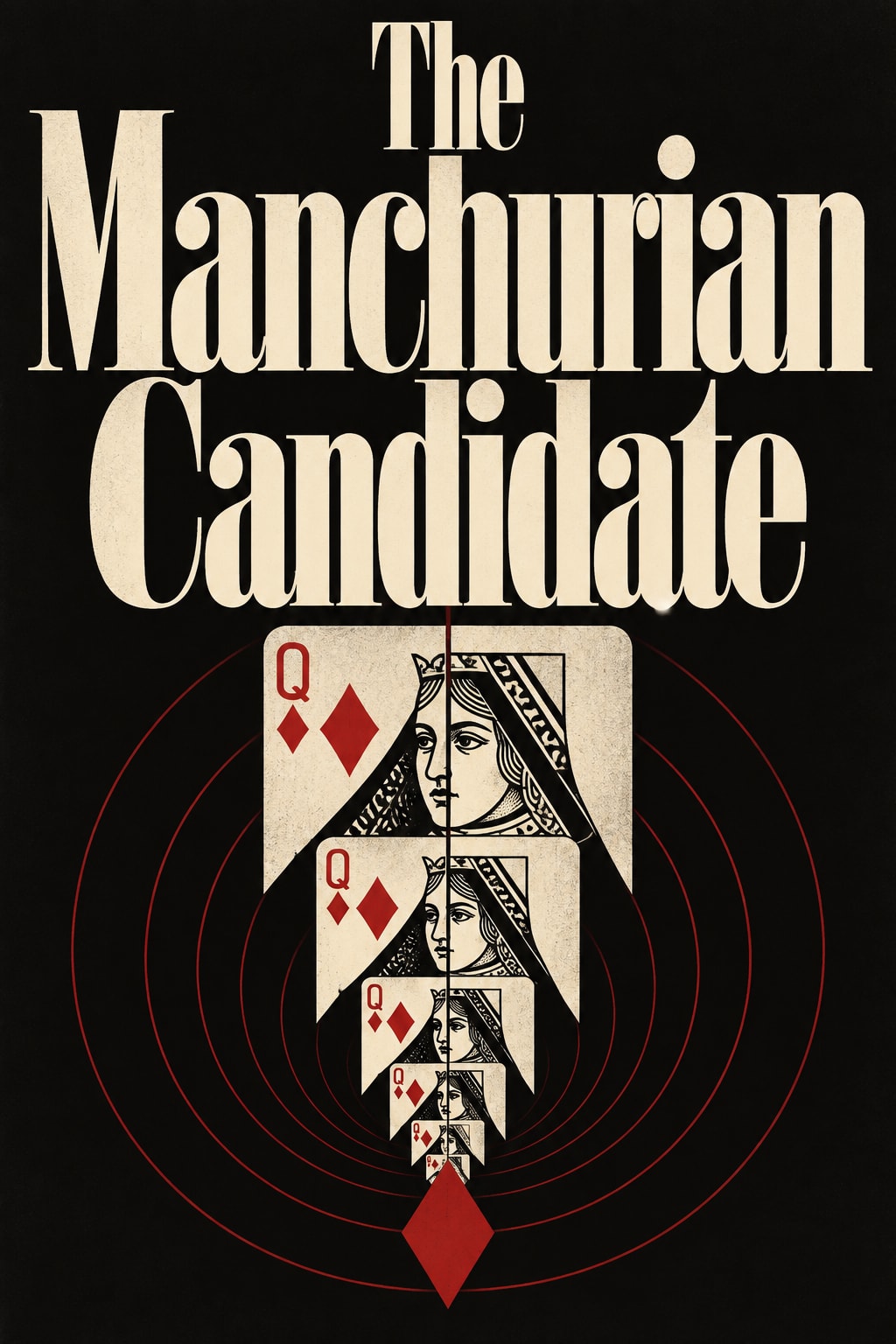
The Manchurian Candidate — Large ivory lettering and repeated queen-of-diamonds cards form a hypnotic pattern.

Image: Monocurator · source · Original Monocurator artwork

The Manchurian Candidate: 1962 or 2004?

Bennett Marco and Raymond Shaw appear in both films, but the actors, wartime setting, and political roles change. Check these details before following an explanation of the plot.

1962 · John Frankenheimer
Frank Sinatra plays Marco; Laurence Harvey plays Raymond Shaw, whose mother is played by Angela Lansbury. The conspiracy begins with soldiers captured during the Korean War. AFI’s 1962 entry.
2004 · Jonathan Demme
Denzel Washington plays Marco; Liev Schreiber plays Shaw; Meryl Streep is his mother, Senator Eleanor Shaw. Their wartime experience is Desert Storm, and Shaw becomes a candidate for vice president. Paramount’s remake guide.

What does the Queen of Diamonds do in the 1962 film?

Within the story’s fictional brainwashing scheme, seeing the Queen of Diamonds triggers Raymond’s obedience to instructions; afterwards he does not remember what he has done. The card gives the viewer something concrete to follow: who shows it, and what command comes next? AFI identifies the card and its function.

Why does Marco dream about a garden club?

The prisoners have been made to perceive their captors as women discussing gardening. As the camera travels between the two settings, we can see what the soldiers have been prevented from recognising. Howard Hampton’s Criterion essay traces this movement from the imagined club to the demonstration of control. The changing room makes the unreliable memory visible.

The 1962 ending explained Ending spoilers

Raymond’s mother orders him to kill the presidential nominee so his stepfather, Senator Iselin, can seize power. Marco tries to undo her control using the cards. At the rally, Raymond instead kills his mother and Iselin, then takes his own life. AFI’s synopsis follows that reversal.

I read the change of target as Raymond’s resistance to the role chosen for him. His handlers lose the outcome they planned, but stopping them gives him no life afterwards. The assassination plot ends; the damage done to Raymond survives in the ending’s grief.

À quoi s’attendre

Frankenheimer turns Cold War paranoia into unstable images, performances, and memories. The conspiracy is outrageous, yet the film’s control of viewpoint makes manipulation feel disturbingly procedural.

Comment aborder le film

The opening confusion is intentional. Hold on to Raymond Shaw, Bennett Marco, and the repeated wartime ceremony; later scenes will revise what those images meant.

À savoir

Une brève note non exhaustive Contains brainwashing, political assassination, suicide, war trauma, racism, and family abuse.
Momo's Note Peut contenir des révélations sur l’intrigue Qui est Momo ? → (S’ouvre en anglais)
Ouvrir la note ↓ Fermer la note ↑

I keep asking whether a person can be separated from the commands placed inside him. Raymond is frightening and vulnerable at once because even his coldness may not belong entirely to him.

— Momo

Momo thinking about this film

Générique et versions

Sources des données

Pour poursuivre la découverte

Envie d’un prochain film plus doux, plus court ou plus étrange ? Demandez à Momo un film dans le même esprit → (S’ouvre en anglais)
Momo est de service. Visiter Momo Cinema → (S’ouvre en anglais)
Poursuivre la découverte du catalogue →