What to watch next
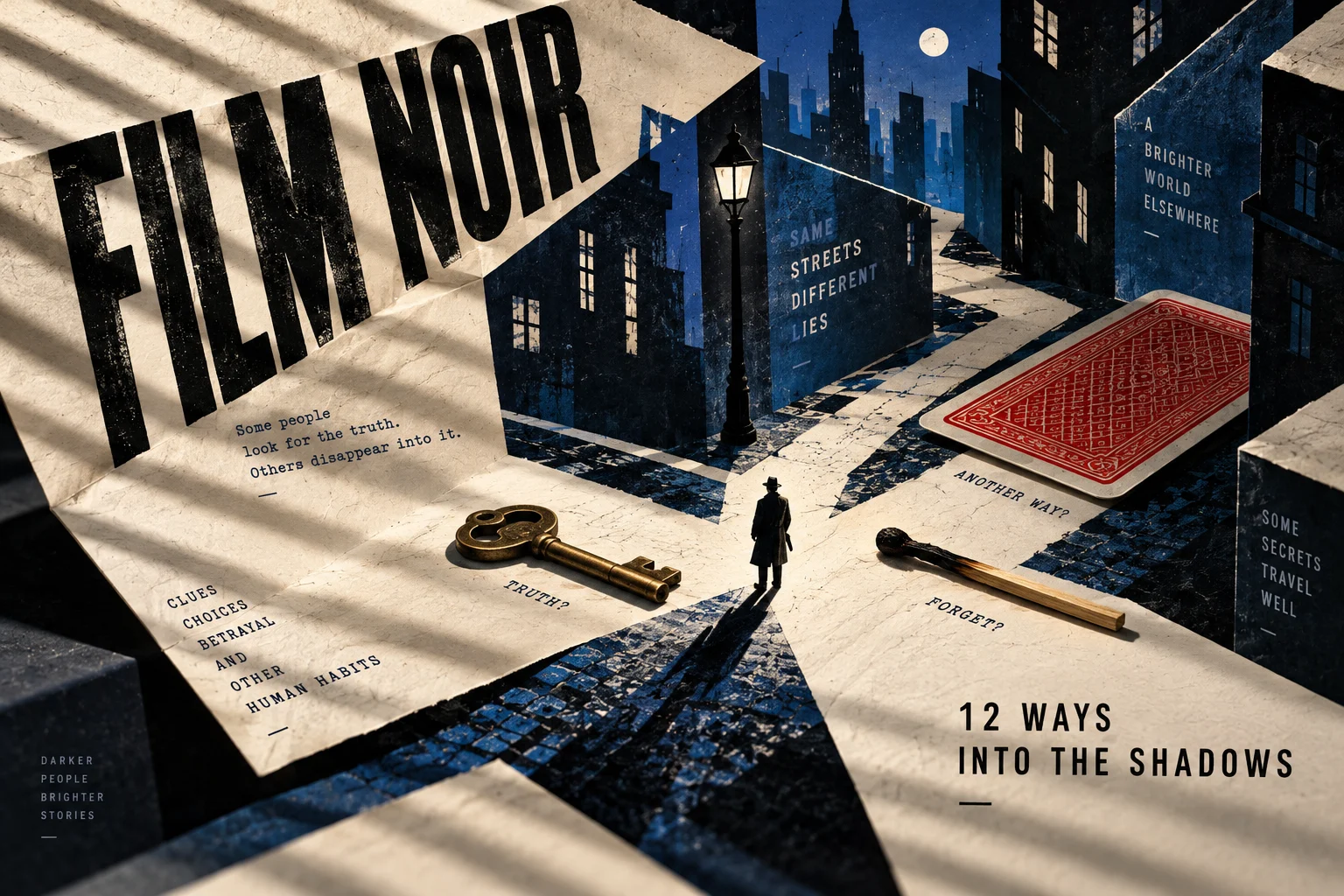
12 Best Film Noir Movies: Choose Your Kind of Trouble
Choose your next film noir: 12 classics compared by mystery, heist, dangerous attraction and trapped characters, with runtimes and US viewing options.
Tonight’s choice
Find your kind of trouble
Start with a mood and the time you have. The notes below help you decide what suits the evening.
Three places to start, from 12 films.
No film in this selection meets all those choices. Change a preference or return to the starting picks.
Double Indemnity
Wit and attraction turn into a murder scheme with little room for error.
Before choosing: Murder, adultery and manipulation.
Read why →The Killing
A racetrack robbery assembled through overlapping hours.
Before choosing: Gun violence, racism, marital cruelty and animal death.
Read why →The Maltese Falcon
A private detective bargains with people who all want him to believe a story.
Before choosing: Murder, intimidation and misogynistic behaviour.
Read why →
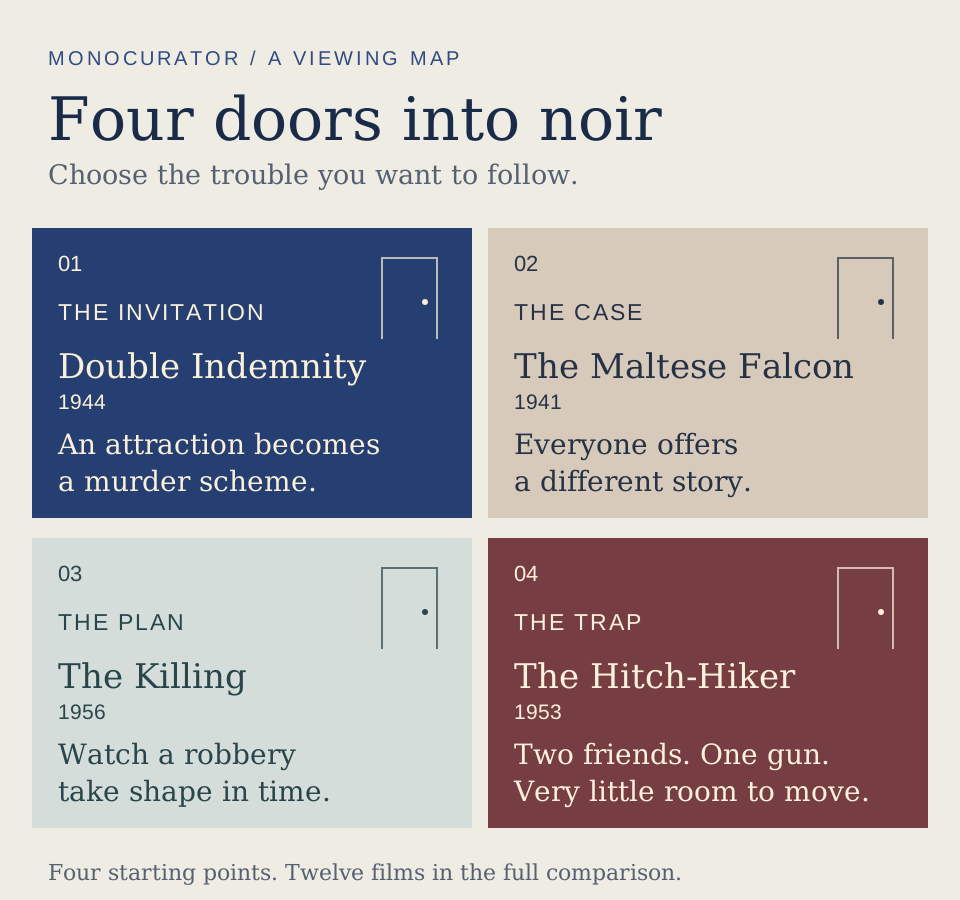
Start with Double Indemnity for a murder scheme whose cleverness becomes part of the danger. Choose The Killing for a shorter, tightly timed robbery, The Maltese Falcon for a private detective surrounded by liars, or The Hitch-Hiker for a frightening situation you can understand immediately.
The best film noir movies offer different evenings. Some invite you to enjoy the plan; others make you dread the next person through the door. These twelve picks span 1941 to 1958, including the British The Third Man. They are grouped by the pleasure of watching them.
Compare the 12 film noir movies
The times below follow the named archive or distributor presentations in our sources. Touch of Evil has substantially different cuts; the 110-minute figure refers to Eureka’s presentation of the 1998 reconstruction.
| Film | Time | Choose it for | What the evening asks of you |
|---|---|---|---|
| Double Indemnity (1944) | 108 min | Attraction turning into a murder plan | Follow a small central group |
| Out of the Past (1947) | 97 min | A romance that makes escape difficult | Keep track of a flashback and betrayals |
| The Maltese Falcon (1941) | 100 min | Bargaining, suspects and Bogart | Listen closely to competing stories |
| Laura (1944) | 88 min | An elegant, intimate murder mystery | Notice who controls the conversation |
| The Big Sleep (1946) | 114 min | Flirtation and private-eye swagger | Enjoy uncertainty as the case expands |
| The Third Man (1949) | 104 min | A city mystery and compromised friendship | Follow an outsider’s questions |
| The Asphalt Jungle (1950) | 112 min | The people behind a jewellery robbery | Settle into preparation and aftermath |
| The Killing (1956) | 84 min | A racetrack heist with overlapping timelines | Follow the same hours more than once |
| Detour (1945) | 69 min | A shabby, feverish account of bad luck | Question the man telling the story |
| The Hitch-Hiker (1953) | 71 min | A direct, sustained hostage thriller | Stay with three men under pressure |
| The Big Heat (1953) | 89 min | A furious investigation into corruption | Expect unusually cruel violence |
| Touch of Evil (1958) | 110 min | Corrupt policing and extravagant camerawork | Navigate a dense, threatening border town |
Desire: when an invitation becomes a trap
Double Indemnity
Our first pick for a full evening of noir. Billy Wilder brings an insurance salesman and a married woman into a scheme that requires them to understand both a policy and each other. One of those things proves easier.
The pleasure is in the changing use of conversation: flirtation becomes negotiation, then the need to keep accounts straight. The insurance office gives the story another kind of intimacy through Walter Neff’s colleague, Barton Keyes. A crime can threaten a friendship as well as expose a guilty person. Choose this for the combination of wit, attraction and pressure, rather than a mystery that saves every answer until the end.
Heads-up: murder, adultery and manipulation. Next: Out of the Past for a less settled trail through the same dangerous attraction. Film guide. [1]
Out of the Past
A man running a petrol station has arranged a quiet life. Then someone from his previous one arrives. Jacques Tourneur’s film lets that peaceful setting exist before Robert Mitchum’s Jeff explains how a job brought him to Kathie, played by Jane Greer.
Mitchum’s low-key manner is the attraction: Jeff can sound as though he has already considered the objection you are about to raise. That makes his continuing involvement more troubling. Choose it for romantic fatalism and changing loyalties. If you want one clear chronological pursuit, begin with The Hitch-Hiker instead; here, the flashback explains the relationships you will need later.
Heads-up: coercive relationships, betrayal and gun violence. Next: Double Indemnity for a more concentrated criminal partnership. Film guide. [2]
Mysteries: someone wants you to believe a story
The Maltese Falcon
The strongest pick here for the classic private detective. Humphrey Bogart’s Sam Spade encounters a succession of people who need his help finding a statuette. They also need him to accept their version of events. Mary Astor, Peter Lorre and Sydney Greenstreet give the bargaining three wonderfully different rhythms.
John Huston makes a roomful of people feel like an unstable arrangement. Who sits comfortably, who performs a grievance, and who is suddenly willing to pay? Follow those changes and the object’s elaborate history becomes easier to hold. It is a particularly good choice if verbal sparring gives you more pleasure than chases.
Heads-up: murder, intimidation and misogynistic behaviour. Next: The Big Sleep for Bogart investigating a more sprawling case. Film guide. [3]
Laura
For a shorter mystery with luxurious rooms and sharp social observation, choose Otto Preminger’s Laura. A detective investigates a woman’s murder through her acquaintances, her possessions and the portrait in her apartment. Before he has established what happened, the people around her have already supplied competing versions of who she was.
Clifton Webb’s columnist Waldo Lydecker makes every gracious phrase sound as though it comes with conditions. Notice when an account of Laura becomes a claim upon her. The mystery rewards attention, but it is also a deliciously uncomfortable film about the pleasure people take in describing someone else. Avoid plot summaries before watching.
Heads-up: obsessive behaviour, murder and possessiveness. Next: The Third Man for another absent person reconstructed through conflicting accounts. Film guide. [4]
The Big Sleep
Choose Howard Hawks’s film when you want to spend time with Bogart and Lauren Bacall, and can tolerate a case that keeps acquiring names. Philip Marlowe’s blackmail investigation opens into the affairs of a wealthy family. His exchanges with Bacall’s Vivian give that maze a more immediately readable question: how much do these two trust, or enjoy, each other?
The conversation supplies much of the momentum. A question can become a flirtation before either person has provided an answer. If an orderly solution is essential to your enjoyment, The Maltese Falcon is the better first choice. Come here for the encounters along the way.
Heads-up: blackmail, sexual coercion, drugs and violence. Next: Laura for a tighter circle of suspects. Film guide. [5]
The Third Man
This is the choice for anyone who wants the city to matter as much as the case. An American writer arrives in occupied Vienna to meet an old friend, only to hear that the friend has died. Carol Reed turns the attempt to understand that death into an increasingly difficult test of loyalty.
The slanted compositions and damaged streets deny the visitor a comfortable footing, while Anton Karas’s zither keeps offering something unexpectedly lively. That musical lightness makes the unease distinctive. You can follow the writer’s simple questions even when the city’s allegiances feel complicated. Let the film make its introductions; famous scene compilations give away too much.
Heads-up: medical harm involving children, postwar deprivation and gun violence. Next: Touch of Evil for another outsider confronting corruption. Film guide. [6]
Heists: enjoy the plan, worry about the people
The Asphalt Jungle
John Huston assembles a jewellery robbery through the particular skills of its participants. The film gives you time to understand the work, but also the private wants attached to the money. Its criminals do not become interchangeable once everyone has been assigned a job.
Choose this if a heist becomes more interesting when you care who needs it to succeed. Preparation and consequences have room to breathe around the robbery itself. The shift from professional competence to personal vulnerability is the point of the evening. For a brisker film that turns the timing into a puzzle, choose The Killing.
Heads-up: armed robbery, exploitation and fatal violence. Next: The Killing to see another plan organised around Sterling Hayden. Film guide. [7]
The Killing
Our pick for a heist under ninety minutes. Stanley Kubrick follows a racetrack robbery through an account that keeps returning to overlapping hours. The repetition lets you see a planned event from another participant’s position; you are gradually assembling the operation yourself.
The film makes schedules feel reassuring, then places that reassurance beside people with loyalties and grievances a timetable cannot measure. Its short running time carries considerable density. Choose it when you want the construction of a thriller to be part of the fun. If repeated events irritate you, The Asphalt Jungle offers a more straightforward progression.
Heads-up: gun violence, racism, marital cruelty and animal death. Next: The Asphalt Jungle for more time with the crew. Film guide. [8]
Trapped: small spaces and shrinking choices
Detour
The shortest film here is also one of the least comfortable. A hitchhiking pianist, Al Roberts, tells how his trip went wrong. Edgar G. Ulmer gives that account very little breathing space: a road, cheap rooms, an unwelcome companion and a voice trying to explain the mess.
Its roughness is part of the experience. Do not choose it for polished detective glamour; choose it for the feeling of being stuck beside someone who needs you to accept his excuses. Ask where a supposed stroke of bad luck follows a decision. That tension between predicament and self-justification gives a tiny film a remarkably long aftertaste.
Heads-up: threats, coercion, violence and death. Next: The Hitch-Hiker for a road thriller with a much clearer external threat. Film guide. [9]

The Hitch-Hiker
Two friends on a fishing trip give a stranger a lift. He pulls a gun. Ida Lupino keeps the basic situation legible, then finds new pressure within it: who drives, who speaks, what can be said during a stop, and how to protect a companion without provoking their captor.
The open desert offers a sharp contrast to the confinement inside the car. There is room everywhere and remarkably little freedom. Choose this for suspense without a crowded suspect list or a complicated romantic scheme. Its brevity makes it an easy film to schedule, though the sustained intimidation makes it a demanding watch.
Heads-up: hostage-taking, murder and prolonged gun threats. Next: Detour to exchange an armed captor for an unreliable account. Film guide. [10]
Corruption: the investigation becomes dangerous
The Big Heat
For directness and anger, choose Fritz Lang’s The Big Heat. Glenn Ford’s detective follows an investigation into a city where criminals enjoy official protection. The violence reaches into domestic life, making it difficult to keep the case at a professional distance.
The film asks you to notice the people exposed as the detective pushes ahead. Gloria Grahame’s Debby is essential to that wider field of damage and resistance. This is a forceful choice when you want a compact crime film with moral friction. If you want noir chiefly for its glamorous surfaces, its cruelty may make the wrong evening.
Heads-up: severe burns, violence against women and revenge. Next: Touch of Evil for a darker view of police authority itself. Film guide. [11]
Touch of Evil
Orson Welles begins with a camera following a car bomb through a crowded border town. The suspense is immediate; the investigation that follows is thick with intimidation, competing jurisdictions and the power to manufacture a convincing case.
Choose this for the most visually extravagant film in the selection. Welles’s detective Quinlan seems to occupy more space than any room should allow. Start with the 1998 reconstruction, which reworks the film using his detailed memo; our cut comparison explains the alternatives. If you would prefer to learn a few characters before entering a dense world, save this for a later night.
Heads-up: drugging, sexual threat, racist stereotypes and violence. Next: The Third Man for corruption seen through a more inviting mystery. Film guide. [12]
Where to watch a first film noir
US listings checked 16 September 2026. These links identify the original films. Check the provider’s current offer; a store rental is separate from a streaming subscription.
| Film | US viewing route |
|---|---|
| Double Indemnity (1944) | Rentals on Apple TV Store, Amazon Video and Fandango At Home. Apple TV Store · US options. |
| The Killing (1956) | Prime Video or MUBI subscription; rentals and ad-supported options also listed. Check US options. |
| The Maltese Falcon (1941) | HBO Max subscription or a digital rental. Check US options. |
Outside the United States, change the country on the availability listing. For the remaining choices, the linked Film guides offer edition notes and routes to viewing where available.
Which one should you watch first?
For a single choice, make it Double Indemnity. For a shorter evening, choose The Killing if you enjoy structure, Laura if you want a mystery, or The Hitch-Hiker if you want a clear, immediate threat. Detour is shorter still, but deliberately abrasive.
For a planned sequence, our four-film beginner route starts with Sunset Blvd. and moves through a city mystery, a nightmare journey and a boxing match. Its Hollywood opening offers another way in, especially if a criminal scheme is not what attracts you.
Momo’s note: An excellent crime plan has one inconvenience: it must eventually be entrusted to people. That is usually where the evening gets interesting.
Sources and presentation notes
Film records checked 16 September 2026. Times refer to the named presentations, not every release of a film. The selections and comparisons are Monocurator’s editorial judgement.
- Double Indemnity — Criterion, 108 minutes; credits and premise.
- Out of the Past — BFI, 97 minutes; credits and premise.
- The Maltese Falcon — BFI, 100 minutes; credits and premise.
- Laura — BFI, 88 minutes; credits and premise.
- The Big Sleep — BFI, 114 minutes; credits and premise.
- The Third Man — BFI British presentation, 104 minutes; credits and premise.
- The Asphalt Jungle — Criterion, 112 minutes; credits and premise.
- The Killing — Criterion, 84 minutes; credits and premise.
- Detour — Criterion restoration, 69 minutes; credits and premise.
- The Hitch-Hiker — AFI release, 71 minutes; credits and premise.
- The Big Heat — Criterion, 89 minutes; credits and premise.
- Touch of Evil — Eureka 1998 reconstruction, 110 minutes; credits and premise.
On screen
Films discussed
- Double Indemnity (1944) · Billy Wilder
- Out of the Past (1947) · Jacques Tourneur
- The Maltese Falcon (1941) · John Huston
- Laura (1944) · Otto Preminger
- The Big Sleep (1946) · Howard Hawks
- The Third Man (1949) · Carol Reed
- The Asphalt Jungle (1950) · John Huston
- The Killing (1956) · Stanley Kubrick
- Detour (1945) · Edgar G. Ulmer
- The Hitch-Hiker (1953) · Ida Lupino
- The Big Heat (1953) · Fritz Lang
- Touch of Evil (1958) · Orson Welles
Continue exploring on Monocurator
Further reading
Read next in the Journal
Want a recommendation shaped around your evening? Ask Momo what to watch next →