See Films Differently Cinematography
What Is Film Noir? Look Beyond the Shadows
Film noir involves more than shadows and hats. Double Indemnity and The Hitch-Hiker show how desire, danger and restricted choices shape the tradition.
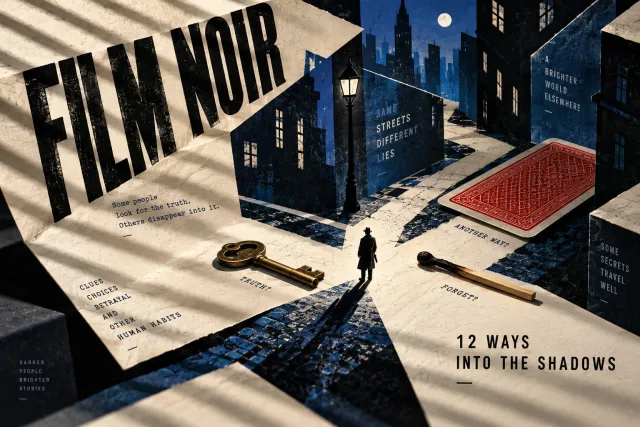
A man in a hat, a dark street, a woman who knows more than she says. Film noir has such recognisable accessories that you can almost assemble it before pressing play. The trouble is that the hat is doing rather too much work.
Film noir is a critical label most strongly associated with a body of American crime films of the 1940s and 1950s. It brings together dark visual styles with stories of desire, distrust and people losing control of their circumstances. Its borders are disputed: critics have approached it as a genre, a style or a historical cycle. You need not settle that argument to enjoy what the films do.[1][2]
The useful question is not whether a film contains enough shadows to qualify. It is what those shadows, its story and its people are doing together.
Darkness that changes what we know
Low-key lighting, familiar in noir, uses little fill light—the light that would brighten shadowed areas—leaving strong contrasts between light and dark. It is not simply a matter of making the whole picture dim.[6] UCLA’s account connects such lighting and deep shadows with effects of isolation, disorientation and entrapment.[1] But noticing a dark room is only the beginning of looking at it.
Try following the distribution of visibility. Is one face easy to read while another is withheld? Does a bright area help us understand the space, or draw our attention away from something else? A room can be perfectly legible as a room while the people inside remain difficult to place.
These are possibilities, not a secret code in which every shadow means guilt. Lighting can withhold information, organise a confrontation or simply give a face extraordinary presence. Its pleasure is partly graphic: a small patch of light can hold a whole composition together. Noir rewards that kind of attention even before the plot has become complicated.
Nor is black-and-white photography a membership requirement for every later noir. Colour films such as Chinatown (1974) carry the tradition into different visual circumstances.[1] Removing their colour would not make them more noir. The question is how their images work.
A confession changes the question
In Billy Wilder’s Double Indemnity (1944), insurance salesman Walter Neff arrives at his office and records a confession for his colleague Barton Keyes. The film then returns to the events that brought him there.[3] This is the opening arrangement, not a revelation saved for the ending.
That arrangement gives the film a particular tension. We are not simply standing outside a crime, waiting to discover who did it. We listen to a participant explain how he became involved. The earlier Walter makes decisions; the later Walter already knows their consequences. Both versions of him occupy our attention.
Voiceover and flashbacks recur in discussions of noir, but they are not compulsory equipment.[2] What matters here is the uncomfortable intimacy they permit. We can understand the attraction of a decision without endorsing it. Following someone’s reasoning need not mean trusting their account of themselves.
For a closer reading after watching, our essay on noir confessions examines Neff’s wit and self-justification. It discusses the ending.
Trouble can find you in daylight
Then consider Ida Lupino’s The Hitch-Hiker (1953). Two men on a fishing trip give a stranger a lift in Baja California. He produces a gun and takes command of their journey.[4] UCLA programmes the film as noir, although its central predicament needs neither a private detective nor a seductive woman.[5]
This is a useful correction to the idea that noir always concerns someone who has knowingly chosen a dubious bargain. Here, a simple act of assistance becomes captivity. The men’s difficulty is not that they find danger attractive. It is that another person has acquired the power to decide what happens next.
The road setting also complicates the familiar image of the enclosed, nocturnal city. A car can travel a considerable distance without its passengers gaining any control over the journey. Movement and freedom are separate things. That distinction supplies a way into this film’s tension without demanding that it resemble Double Indemnity.
A family with arguments
The differences matter. A definition that requires every noir to contain a corrupt protagonist, a femme fatale, flashbacks and city streets would exclude films that make the category interesting. Nick James observes that even the classic examples rarely contain everything associated with noir.[2]
Think of the term as a useful family name with persistent arguments about the guest list. It helps us compare the way a film makes desire persuasive, limits what we know, or allows a decision to become difficult to reverse. It need not flatten those different pleasures into one compulsory atmosphere.
Walter in Double Indemnity gets to tell the story of his own past. The two travellers in The Hitch-Hiker have another man deciding even their immediate actions. Both films belong in the discussion of noir, but their characters hold very different kinds of control. Dark images alone cannot explain that difference.
For a film to start with, see 12 Best Film Noir Movies: Choose Your Kind of Trouble.
References & Further Reading
- UCLA Film & Television Archive. “Film Noir.” Collection introduction, n.d.
- Nick James. “Twenty-first century noir.” Sight and Sound, BFI, updated 27 November 2020. Originally published in the February 2013 issue; expanded online.
- American Film Institute. “Double Indemnity (1944).” AFI Catalog of Feature Films, n.d.
- American Film Institute. “The Hitch-Hiker (1953).” AFI Catalog of Feature Films, n.d.
- UCLA Film & Television Archive. “The Hitch-Hiker / On Dangerous Ground.” Screening programme, 27 April 2018.
- Yale University. “Part 2: Mise-en-scene.” Film Analysis, ‘Low-key lighting’, n.d.
For the next unexpected question, follow the Journal in your RSS reader.
On screen
Films discussed
- Double Indemnity (1944) · Billy Wilder
- The Hitch-Hiker (1953) · Ida Lupino
Further reading
Read next in the Journal
Want a recommendation shaped around your evening? Ask Momo what to watch next →