What to watch next
12 Classic Mystery Films: Choose Your Next Case
Choose a classic mystery by the case you want: witty detectives, Christie whodunnits, Gothic clues or patient police work. Compare 12 films without revealing the answers.

An unexplained disappearance, an impossible alibi, a witness nobody believes: a good mystery gives you something to worry at. The pleasure can be solving the case, but it can also be keeping company with an exceptionally entertaining detective. Nick and Nora Charles make an evening of murder; Inspector Cockrill makes a nuisance of himself; Philip Marlowe discovers that being loyal is poor protection against being used.
These twelve classic mystery films, made between 1934 and 1978, offer different kinds of investigation. Some invite you to weigh suspects. Others follow the gathering of evidence or ask what a detective has misunderstood. Choose the experience first; the most intricate puzzle is not automatically the best film for tonight.
Three places to start
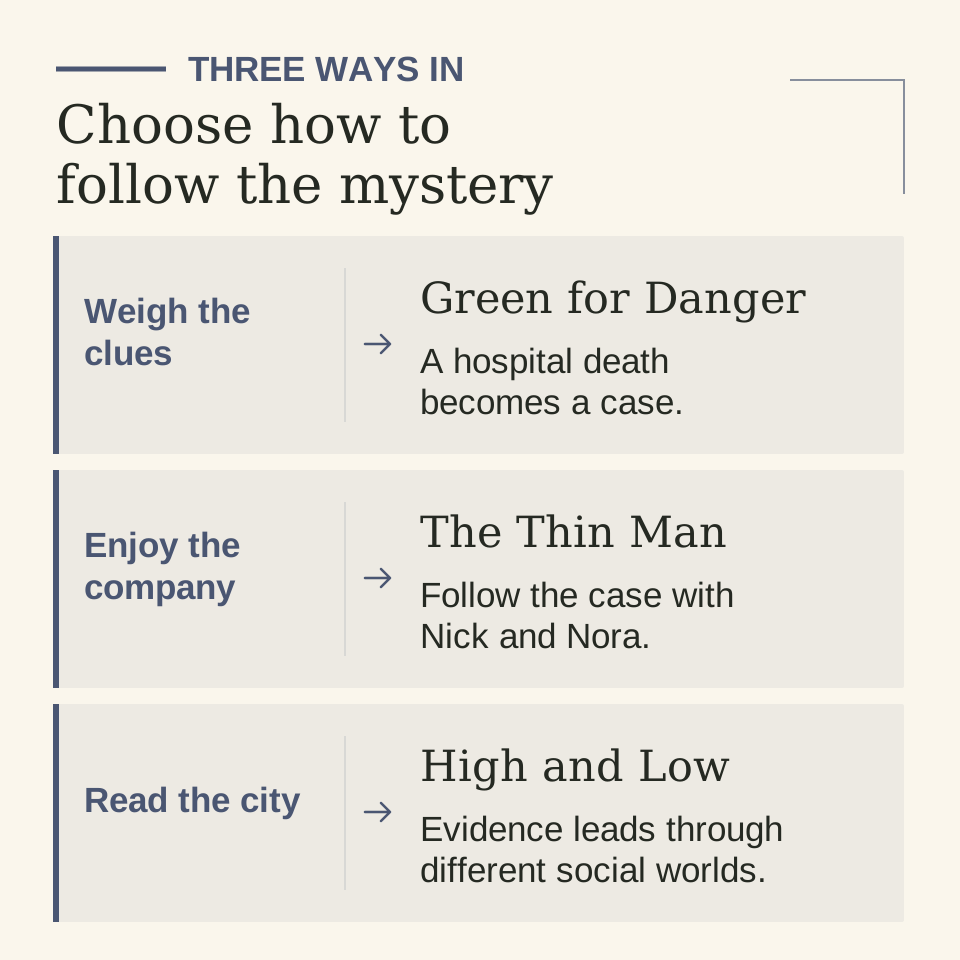
- For a compact whodunnit: Green for Danger. A wartime hospital, a suspicious death and an inspector whose peculiar manner conceals a watchful mind.
- For murder with sparkling company: The Thin Man. William Powell and Myrna Loy make the investigation feel like a party you have been allowed to join.
- For serious police work: High and Low. A kidnapping expands into a search across a city, with money and social position woven into the evidence.
Choose your kind of mystery
Times below follow the named archive or distributor in each entry; releases sometimes differ. In particular, the two Poirot films here are the 1970s versions, and The Hound of the Baskervilles is the 1939 Basil Rathbone film.
| Film | Year | Minutes | The pleasure | Consider before choosing |
|---|---|---|---|---|
| The Thin Man | 1934 | 91 | Witty detective partnership | Frequent drinking; a busy suspect list |
| The Hound of the Baskervilles | 1939 | 78 | Gothic clues and Sherlock Holmes | Threatening hound and a fearful atmosphere |
| The Lady Vanishes | 1938 | 96 | A disappearance in plain sight | Peril mixed with comedy and romance |
| Green for Danger | 1946 | 91 | A contained hospital whodunnit | Surgery, death and wartime bombing |
| The Maltese Falcon | 1941 | 100 | Testing a succession of slippery stories | Dense conversation and double-dealing |
| Murder She Said | 1961 | 86 | An underestimated amateur taking charge | A witnessed strangling starts the case |
| High and Low | 1963 | 143 | Patient, collective investigation | Child kidnapping; later drug-related scenes |
| In the Heat of the Night | 1967 | 110 | Detection under hostile scrutiny | Racist abuse and violence |
| Chinatown | 1974 | 131 | A private case opening onto public corruption | Sexual abuse, violence and a bleak tone |
| Murder on the Orient Express | 1974 | 127–128 | Alibis and an elaborate suspect ensemble | Child kidnapping in the backstory |
| Death on the Nile | 1978 | 137 | Jealousy and deduction on a luxury cruise | Shootings and some blood |
| The Long Goodbye | 1973 | 112 | An old-fashioned private eye out of step | Sudden violence beneath the relaxed surface |
The Thin Man (1934): choose the company as well as the case
Nick Charles is a former detective; Nora, his wealthy wife, is considerably less interested in his retirement than he claims to be. A missing inventor draws them into a case during a New York visit. W. S. Van Dyke directs William Powell and Myrna Loy. AFI
The investigation keeps producing names and complications, but Powell and Loy give the evening its shape. Notice how often their exchanges turn curiosity into flirtation: Nora wants access to Nick’s world, and he enjoys having someone who can answer him back. Their marriage is part of the entertainment, rather than a refuge from it.
Choose this when you want a sociable mystery with a proper case attached. If keeping every suspect straight feels like work tonight, the partnership still supplies plenty of pleasure. For a more concentrated puzzle afterwards, move to Green for Danger.
The Hound of the Baskervilles (1939): a detective enters a ghost story
An apparent family curse hangs over the Baskerville estate. Sherlock Holmes and Dr Watson must investigate a danger that arrives already wrapped in frightening folklore. This is Sidney Lanfield’s black-and-white film with Basil Rathbone and Nigel Bruce. AFI
Its attraction is the friction between the rational detective story and the landscape of a Gothic tale. A lonely house and the moor make fear feel plausible before Holmes has explained anything. Watson’s presence lets the place remain strange: you do not spend every minute safely inside the cleverest man’s thoughts.
Pick it for an atmospheric, relatively short evening. The central pleasure is watching investigation contend with superstition, rather than assembling a contemporary forensic case. Do check the year: the later Peter Cushing adaptation has a different cast, colour photography and a different flavour.
The Lady Vanishes (1938): when everyone disputes what you saw
A young traveller befriends an older woman on a European train. Then the woman disappears, and other passengers deny that she was there. Hitchcock makes the train both a moving adventure and a tightly bounded collection of people with reasons to be unhelpful. Criterion
The useful question is not simply where the missing passenger has gone. It is why a witness might prefer an easy explanation to an awkward truth. Meanwhile, Margaret Lockwood and Michael Redgrave keep the investigation buoyant through irritation, attraction and reluctant cooperation.
This is a good bridge between a cosy mystery and a thriller: there is a missing-person problem, but also physical danger, comedy and momentum. Choose it when a roomful of interviews sounds too static. Explore the film.
Green for Danger (1946): the strongest choice for a contained puzzle
A patient dies during an operation at a rural hospital while wartime air raids continue outside. Inspector Cockrill arrives to investigate whether the death was accidental. Sidney Gilliat’s adaptation of Christianna Brand’s novel gives Alastair Sim a wonderfully inconvenient presence. Criterion
The hospital is useful because actions have procedures attached to them. Who was present, what someone handled and how a routine should have worked all matter. Personal tensions complicate this practical machinery without requiring a whole city’s worth of new characters.
Choose it if you enjoy revising your suspicions as people explain themselves. Sim’s humour keeps the questioning lively, though death, surgery and bombing stop the setting from becoming merely quaint. Of these twelve, it is one of the clearest recommendations for someone specifically asking for a whodunnit.
The Maltese Falcon (1941): listen for the story someone needs you to believe
Sam Spade accepts a case that quickly entangles him with murder and a group pursuing a valuable statuette. John Huston’s film stars Humphrey Bogart, Mary Astor, Peter Lorre and Sydney Greenstreet. AFI
Watch the explanations as closely as the clues. An account can be persuasive, emotionally effective and still designed to recruit Spade into somebody else’s scheme. His job involves deciding what to do with people, not merely putting an answer beside a question.
This is the pick for sharp dialogue and a detective who makes other characters reveal themselves under pressure. It is less comfortable company than The Thin Man. It also belongs in our film noir selection, where the emphasis shifts towards desire, compromised choices and getting trapped. Film guide.
Murder She Said (1961): the pleasure of refusing to be dismissed
Margaret Rutherford’s Miss Marple witnesses a murder, fails to convince the authorities, then takes a job as a maid to investigate. George Pollock directs. The film adapts 4.50 from Paddington, with Marple given a more active role than in the novel. TCM · Agatha Christie
Rutherford supplies a particularly physical kind of determination. Entering a house as a servant gives the investigation a practical comic problem: she must keep appearing useful while looking where she should not.
Choose this for an amateur detective whose confidence is part of the fun. The opening murder is unsettling, but the film’s prevailing pleasure is Marple making progress through other people’s low expectations. If you want a quieter, more book-faithful Marple, do not assume every screen incarnation has Rutherford’s personality.

High and Low (1963): when detection becomes a city's work
A kidnapping confronts a wealthy executive with a costly decision. Kurosawa then broadens the film into a police investigation. Criterion
The change of scale is the recommendation. At first, money and responsibility press upon people sharing one domestic space. Later, a city has to be read through routes, timings, observations and the work of several investigators. The satisfaction comes from pieces being brought together, rather than one eccentric genius dazzling an audience.
Allow time for both movements. Someone wanting a light guessing game may find its kidnapping and social tensions heavy; someone wanting to see how a clue becomes useful should find the detail absorbing. Pair it with In the Heat of the Night for another investigation in which status affects what people see and whom they believe. Film guide.
In the Heat of the Night (1967): evidence has to survive prejudice
Philadelphia detective Virgil Tibbs becomes involved in a murder investigation in Sparta, Mississippi, alongside the hostile local police chief. Norman Jewison directs Sidney Poitier and Rod Steiger. Criterion
Tibbs’s competence does not remove the racism around him. The chief needs his expertise while resisting his authority, so even routine police work becomes a negotiation: who gets to question a suspect, challenge an assumption or decide that the case is solved? Their clashes make the partnership as absorbing as the search for the killer.
Choose it for a detective story with pressure inside the investigation itself. The racist language and violence are central to that pressure, not incidental period decoration. Compared with High and Low, the focus is more tightly held on a fraught partnership, with each man having to reckon with the other’s presence.
Chinatown (1974): a small assignment uncovers a larger arrangement
Private investigator Jake Gittes is hired for what appears to be an adultery case in pre-war Los Angeles. The trail leads into personal and political corruption. Roman Polanski directs Jack Nicholson and Faye Dunaway. Paramount
Gittes is practised at collecting compromising photographs. Water supplies and land ownership demand a different kind of looking: a dry landscape or an unremarkable public record may matter more than a lover caught in the wrong place. The case keeps forcing him to revise what his evidence means. AFI
Choose this for an investigation that grows from one client’s problem into the workings of a city. Compared with High and Low, you are tied more closely to one detective’s partial understanding. The sunlit settings give it a different look from shadowy 1940s noir, but the evening is bleak, with sexual abuse among its subjects.
Murder on the Orient Express (1974): a carriage full of competing accounts
Albert Finney plays Hercule Poirot in Sidney Lumet’s adaptation, with a trainload of suspects played by a striking ensemble. A murder and a snowbound train create the conditions for an extended exercise in interviews, alibis and inference. AFI
Choose this if your ideal mystery gives you several people to suspect and time to reconsider them. The luxury is part of the pleasure, but the compartments also organise the investigation: people can be approached individually, then their statements set against one another.
Finney’s Poirot is an emphatic performance, well suited to an evening built around watching a detective work the room. Knowing the story need not eliminate the enjoyment of the acting, though a first viewing benefits from avoiding plot summaries. The opening backstory involves the kidnapping of a child.
Death on the Nile (1978): a more expansive Poirot holiday
Peter Ustinov’s Poirot is aboard a Nile steamer when an heiress is killed. John Guillermin directs a cast including Maggie Smith, Bette Davis, Mia Farrow and David Niven. BFI · Agatha Christie
This is the roomier Poirot choice: a holiday setting lets you spend time with jealousies, grievances and social performances before concentrating them into a case. Ustinov gives the questioning a different texture from Finney’s; the two films work as companion experiences rather than interchangeable packages.
Pick it when you want scenery, costumes and an ensemble alongside deduction. Choose Green for Danger if you would rather reach a smaller suspect group quickly. The Nile may look inviting, but the murders include shootings and brief bloody moments.
The Long Goodbye (1973): follow a detective whose instincts may be out of date
Robert Altman brings Raymond Chandler’s Philip Marlowe into 1970s Los Angeles, with Elliott Gould as a private eye caught in a case involving a friend. Kino Lorber
Before the case gathers pace, Marlowe has trouble buying the right food for his cat. That wonderfully unheroic errand introduces Gould’s rumpled, muttering detective better than a display of brilliance would. He keeps applying an old-fashioned sense of obligation to people who may not share it. The wandering rhythm leaves room to enjoy his habits and question his judgement. BFI programme notes
Choose it after a more conventional private-eye film, especially The Maltese Falcon. The contrast makes the displacement sharper. It is a poor choice for a brisk, reassuring puzzle: sudden violence punctures its relaxed surface, and the investigation carries emotional consequences.
Choose the question you want to follow
For suspects and deduction, start with Green for Danger or either Poirot film. For a detective you enjoy spending time with, choose The Thin Man, Murder She Said or Holmes. For an investigation that exposes the world around it, choose High and Low, In the Heat of the Night or Chinatown.
These are different pleasures, not levels of difficulty. A mystery can withhold information, misdirect attention or make its detective unreliable without offering the audience an entirely solvable puzzle. The comparison above tells you what sort of evening each film offers, rather than promising that every answer is available in advance.
If what you want most is pursuit, danger and mounting pressure, our classic thriller selection takes that route. Several films can satisfy both appetites.
Want to try a little deduction yourself? Crack two simple ciphers, with optional hints, worked answers and a wartime Holmes mystery to follow.
Momo’s Note
I like the moment when a detective stops asking, “Who looks suspicious?” and starts asking, “What did I actually see?” A very useful distinction. Particularly when everyone has a splendid coat and a terrible explanation.
On screen
Films discussed
- The Thin Man (1934) · W. S. Van Dyke
- The Hound of the Baskervilles (1939) · Sidney Lanfield
- The Lady Vanishes (1938) · Alfred Hitchcock
- Green for Danger (1946) · Sidney Gilliat
- The Maltese Falcon (1941) · John Huston
- Murder She Said (1961) · George Pollock
- High and Low (1963) · Akira Kurosawa
- In the Heat of the Night (1967) · Norman Jewison
- Chinatown (1974) · Roman Polanski
- Murder on the Orient Express (1974) · Sidney Lumet
- Death on the Nile (1978) · John Guillermin
- The Long Goodbye (1973) · Robert Altman
Continue exploring on Monocurator
Further reading
Read next in the Journal
Want a recommendation shaped around your evening? Ask Momo what to watch next →