Version guide
Metropolis: Which Restoration Should You Watch?
Choose the 2010 restoration of Metropolis. Check your copy by its label, runtime and recovered footage—and find out why 153 minutes is not the target.
Identify your copyWhich Metropolis is in your listing?
Compare the actual edition label, its restoration details and the feature runtime. A date or a number alone cannot identify your copy.
Your next step
Compare this viewing option →The edition clues behind this comparison
- Eureka identifies its 150-minute release as the 2010 reconstruction, with the recovered footage and a new recording of Huppertz’s score.Eureka: Metropolis →
- The Murnau Foundation’s 153-minute record describes the 1927 premiere. That historical number does not verify a present-day copy.Murnau Foundation: film record →
- Sony’s Osamu Tezuka’s Metropolis is Rintaro’s animated film, a separate work from Lang’s silent film.Sony Pictures: Osamu Tezuka’s Metropolis →
Edition records checked 13 September 2026.
Choose the 2010 restoration of Fritz Lang’s Metropolis for a first viewing of the 1927 silent film. The clearest archival identifier is the Friedrich-Wilhelm-Murnau-Stiftung DCP at 149 minutes 36 seconds, with Gottfried Huppertz’s score in the recording conducted by Frank Strobel.
Already have a disc or stream in front of you? Identify your copy by comparing its label, running time and the clues you can see or hear.
Looking for the animated Metropolis? Rintaro’s 2001 film, based on Osamu Tezuka’s manga, is separate from Lang’s silent film. The 2001 restoration discussed below is an earlier reconstruction of Lang’s 1927 film.
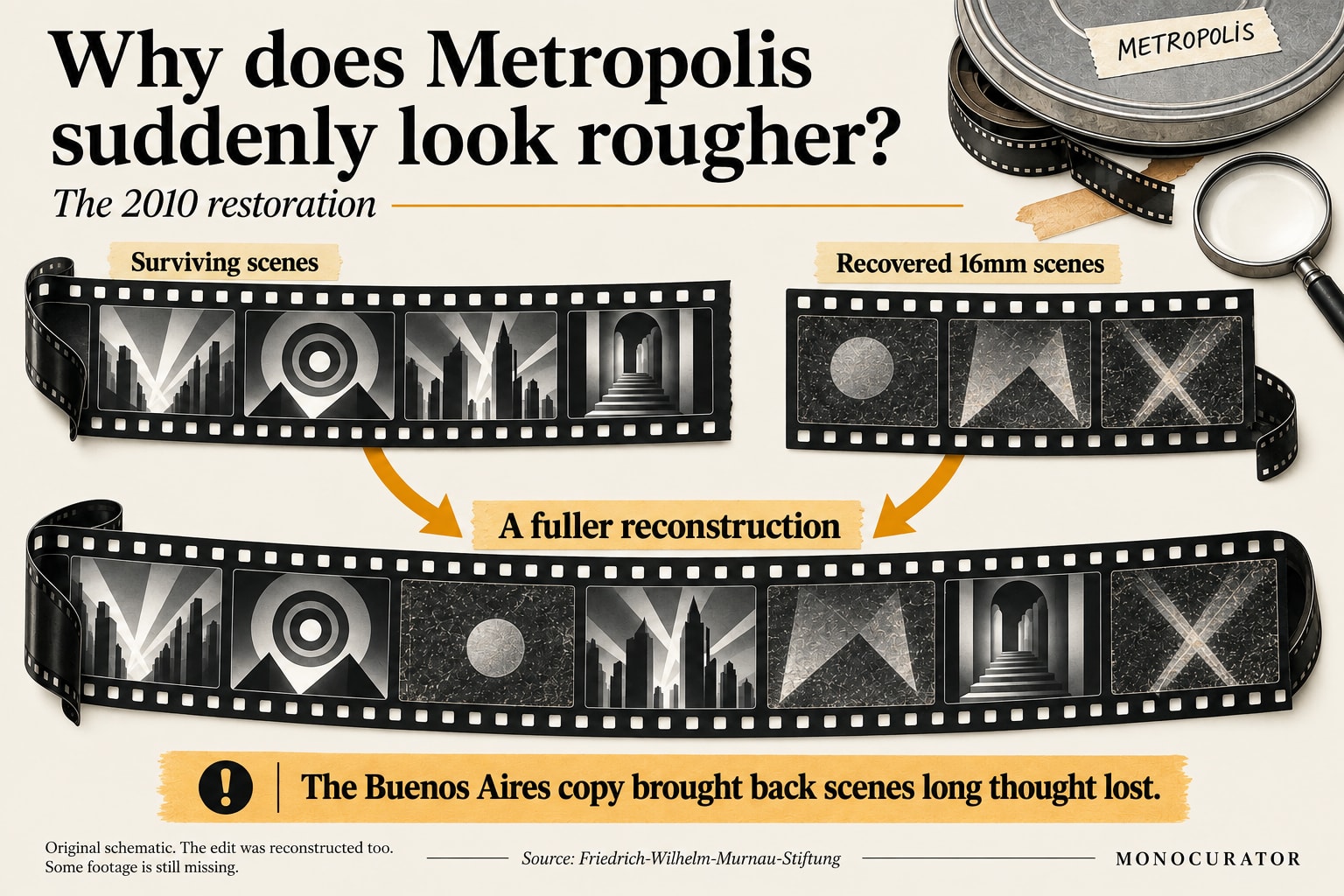
Is the 2010 restoration the complete version? It is the most complete surviving reconstruction, not a wholly complete print. The recovered Buenos Aires material returned most of the previously missing scenes and shots, but a few shots and sequences still do not survive. The rougher recovered passages reflect their damaged 16mm source, not a playback fault.
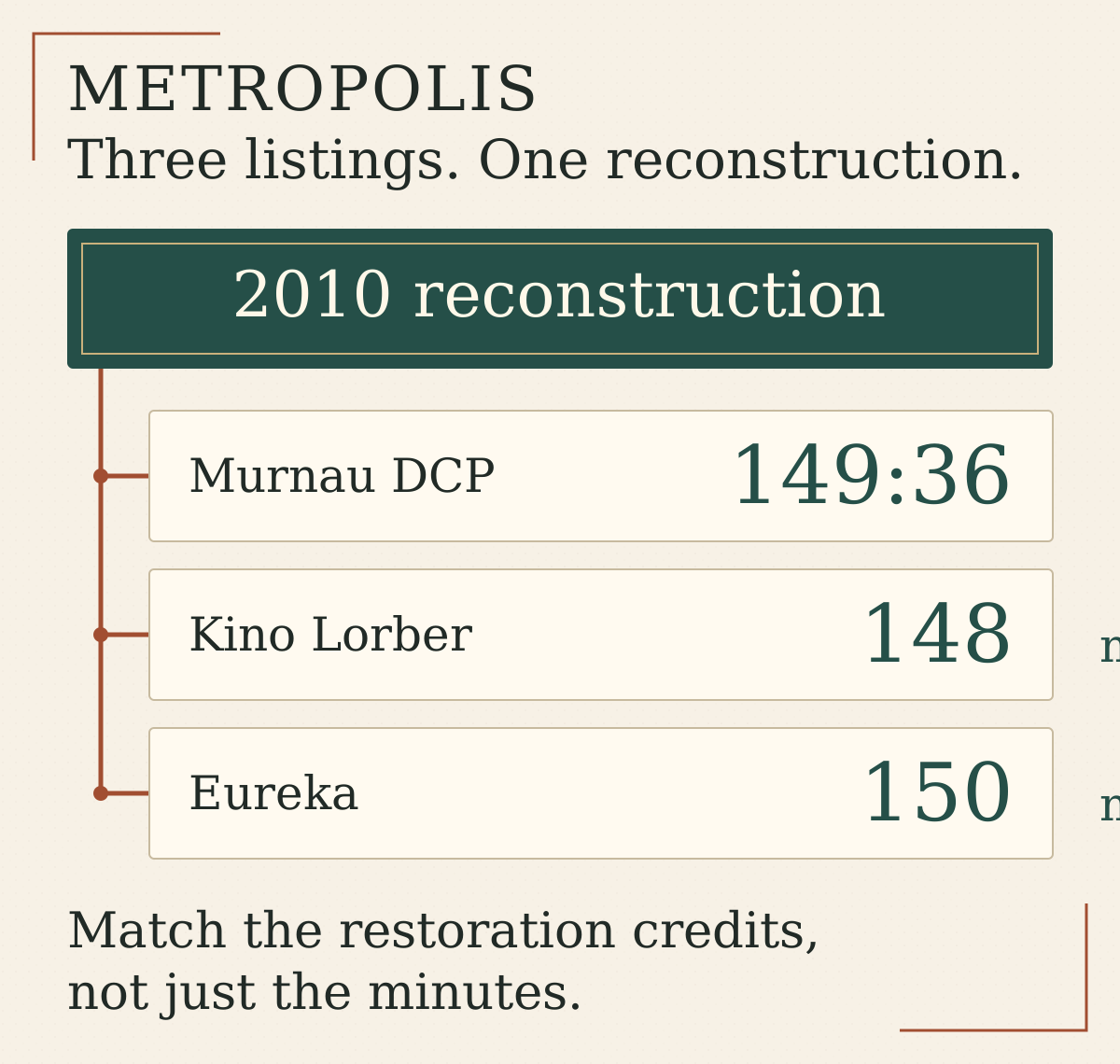
Retail and distribution records may round the same reconstruction differently. Kino Lorber lists The Complete Metropolis at 148 minutes; Eureka lists its restored 2010 edition at 150 minutes. Those three timings do not establish three different cuts. Match the restoration year, institutional credits, recovered Buenos Aires material, and score before treating a small runtime difference as editorial evidence.
Fact boundary and editorial answer
Confirmed facts: the Murnau Foundation identifies a 2010 restoration at 149:36. Its 2010 premiere programme says the reconstruction comes closer to the premiere form than previous versions, but still lacks a few shots and sequences. Kino and Eureka each describe more than, or exactly, 25 minutes of previously lost footage in their releases of the 2010 reconstruction.
Editorial judgment: Monocurator recommends that reconstruction first because it restores the most coherent surviving route through the film while preserving the visible limits of the archive. “Most complete surviving reconstruction” is more accurate than “the original cut in perfect form.”
The restoration map for Lang’s film
| Presentation | What the source establishes | Runtime | Boundary |
|---|---|---|---|
| Murnau Foundation 2010 restoration | Reconstruction using the Buenos Aires material; Huppertz score; restored-version premiere on 12 February 2010 | 149:36 in the Murnau DCP catalogue | A few shots and sequences still do not survive |
| Kino Lorber release of the 2010 restoration | The Complete Metropolis; more than 25 minutes of newly discovered footage | 148 min | A distributor listing, not proof of a separate cut |
| Eureka release of the 2010 restoration | Reconstructed and restored 2010 version; 25 minutes previously thought lost | 150 min | A rounded home-video listing, not proof of a separate cut |
| 1927 Berlin premiere version | Premiere on 10 January 1927; Murnau’s current film record lists 4,174 metres and 153 minutes | about 153 min as a historical estimate | Not a complete surviving print or a currently selectable edition |
The Metropolis Film page’s version map lists the 2010 restoration and historical premiere record separately. Kino’s 148-minute and Eureka’s 150-minute figures describe the same restoration, not competing cuts.
Why 153 minutes is an estimate, not a target
The Murnau Foundation’s current film record gives the Berlin premiere date, a length of 4,174 metres, and a runtime of 153 minutes. That is useful historical context, but it should not be treated as a stopwatch specification for a complete print available today.
The Foundation’s 2010 premiere programme documents the premiere-version film length differently—4,189 metres—and describes the restored presentation at 3,945.5 metres and 145 minutes in that concert context. Its later DCP catalogue gives 149:36. Silent-film timing depends on the relationship between film length, projection speed, musical synchronization, and the particular presentation record.
The safe conclusion is narrow: 153 minutes is a historical estimate associated with the 1927 premiere version; 149:36 is the exact duration of the currently documented Murnau 2010 DCP. The numerical difference does not measure the missing material by itself.
What was missing, and what was recovered
The film was shortened soon after its Berlin premiere. The Murnau premiere programme says roughly a quarter of the film had been considered lost. The 2001 restoration used the best surviving elements then available and marked gaps with still images or descriptive material in a study reconstruction.
In 2008, the Museo del Cine Pablo C. Ducrós Hicken in Buenos Aires was confirmed to hold a 16mm safety copy derived from an Argentine distribution print acquired soon after the Berlin premiere and before the later cuts. The source was worn and damaged, but it preserved most of the previously missing scenes and shots.
Restorers did more than insert fragments into the 2001 version. The programme explains that the Argentine material sometimes preserved a different arrangement, so the premiere-version montage had to be reconsidered with sources including Gottfried Huppertz’s piano reduction.
The recovered scenes also make character motives easier to follow. For a story companion, use the Film guide to distinguish Maria from her double and follow Fredersen and Rotwang’s different plans.
The 2010 result is therefore nearly complete, not wholly complete. The recovered passages remain distinguishable because their 16mm source carries scratches, damage, softer definition, and different framing. Those shifts are evidence of the recovered material, not a playback fault.
How to identify the recommended version
For a first viewing, check for several identifiers together:
- 2010 restoration or The Complete Metropolis in the edition description.
- A runtime near 148–150 minutes.
- Restoration credit to Friedrich-Wilhelm-Murnau-Stiftung, with Deutsche Kinemathek and the Museo del Cine named in the restoration history.
- Gottfried Huppertz’s score, preferably the recording conducted by Frank Strobel.
- A description of footage recovered from Buenos Aires.
Do not rely on runtime alone. A platform can round a listing, omit seconds, or reuse incomplete metadata. Conversely, a newly uploaded edition can contain an older short master. Edition name, restoration credit, score, and recovered-footage note are stronger together than any single number.
A spoiler-light way in
At about two and a half hours, the restoration works best as the destination of an evening rather than a quick sample. Follow the city vertically: privilege above, workers below, and machines joining the two. Rooms, elevators, clocks, stairways, and crowd movement often explain power before an intertitle does.
Browse Fritz Lang films in the catalogue to explore his other work. For a shorter first encounter with silent cinema, compare the comedies, romance and fantasy in our six-film beginner guide. If the city of Metropolis is what draws you, you can start here: the shorter films are alternatives, not prerequisites.
Heads-up: industrial disaster, dehumanizing images of labour, mass panic, threats to children, violence, and flashing or rapidly changing light.
Watch, rent, own, or read
Use the Film page’s Ways to watch and read as a discovery route, not as a live availability guarantee. Before paying, confirm the edition is the 2010 restoration, the listed region and playback format work for you, subtitles are suitable, and the score is identified.
The links are ordinary search and retailer routes. They do not claim that a particular service currently carries the restoration, that stock is available, or that every listing uses the correct master.
Frequently asked questions
Is the 2010 restoration complete?
Nearly, but not entirely. The Murnau Foundation’s premiere programme says only a few shots and sequences remained absent, while describing the reconstruction as closer to the premiere form than any previous version.
Are the 148-, 149:36-, and 150-minute listings different cuts?
The reviewed sources do not establish that. They are current institutional or distributor records for the 2010 reconstruction. Small timing differences alone are insufficient evidence of different editorial assemblies.
Should I search for a 153-minute version?
No. Treat 153 minutes as a historical estimate associated with the 1927 Berlin premiere record, not as proof of a complete modern edition. Identify the 2010 restoration through its credits, recovered material, score, and approximate runtime.
Why do the recovered scenes look rougher?
They derive from damaged 16mm material in the Buenos Aires copy, while much of the rest of the reconstruction can use better surviving elements. The contrast is an honest record of unequal survival.
Was the 2001 restoration unimportant?
No. It was a major reconstruction based on the best evidence then available, and UNESCO’s Memory of the World record concerns the restored and reconstructed 2001 negative. The Buenos Aires discovery later enabled the substantially fuller 2010 restoration.
Where to go next
- Open the Metropolis Film page for its Guide, Version map, Sources, related films, and commerce routes.
- Choose another evening’s film and its edition in the silent-film beginner guide.
- Continue to The Cabinet of Dr. Caligari for a shorter expressionist doorway.
- Continue to Modern Times for another vision of bodies caught inside machines.
- Go back to A Trip to the Moon for an earlier, handmade future.
- Compare a different restoration boundary in Pather Panchali: Which Version Should You Watch?.
Sources and checked dates
-
Friedrich-Wilhelm-Murnau-Stiftung: Metropolis film record — premiere date, 4,174 metres, 153-minute historical record, director, and production details. Checked July 29, 2026.
-
Murnau Foundation silent-film DCP catalogue — 2010 restoration, 149:36, German or English intertitles, Huppertz score, Frank Strobel, and the Rundfunk-Sinfonieorchester Berlin. Checked July 29, 2026.
-
Murnau Foundation 2010 premiere programme — restoration history, the Buenos Aires source, remaining missing shots and sequences, restoration credits, film-length records, and 2010 premiere context. Checked July 29, 2026.
-
Kino Lorber: The Complete Metropolis — 148-minute listing, more than 25 minutes of newly discovered footage, Huppertz score, and institutional restoration credits. Checked July 29, 2026.
-
Eureka Entertainment: Metropolis — 150-minute reconstructed and restored 2010 version, 25 minutes previously thought lost, and Huppertz score. Checked July 29, 2026.
-
UNESCO Memory of the World: Metropolis — registration and 2001 restored-and-reconstructed negative context. Checked July 29, 2026.
-
Sony Pictures: Osamu Tezuka’s Metropolis — the separate 2001 animated film, directed by Rintaro, written by Katsuhiro Otomo and based on Osamu Tezuka’s manga. Checked 6 September 2026.
The distinction between the animated film and the restorations was added on 6 September 2026. The original restoration references retain their individual checked dates above.
The recommendation of the 2010 restoration is Monocurator’s editorial judgment. The runtimes, dates, recovery history, remaining-loss boundary, and institutional credits above are attributed facts. Edition availability changes by country, service, seller, and format; no current availability is claimed.
For the next unexpected question, follow the Journal in your RSS reader.
Continue exploring on Monocurator
Further reading
Read next in the Journal
Want a recommendation shaped around your evening? Ask Momo what to watch next →