See Films Differently Cinematography
What Is German Expressionism? When the Set Joins the Cast
German Expressionism in cinema gives sets, bodies and crowds a visible shape. Caligari, Metropolis and Nosferatu show why one formula cannot explain it.
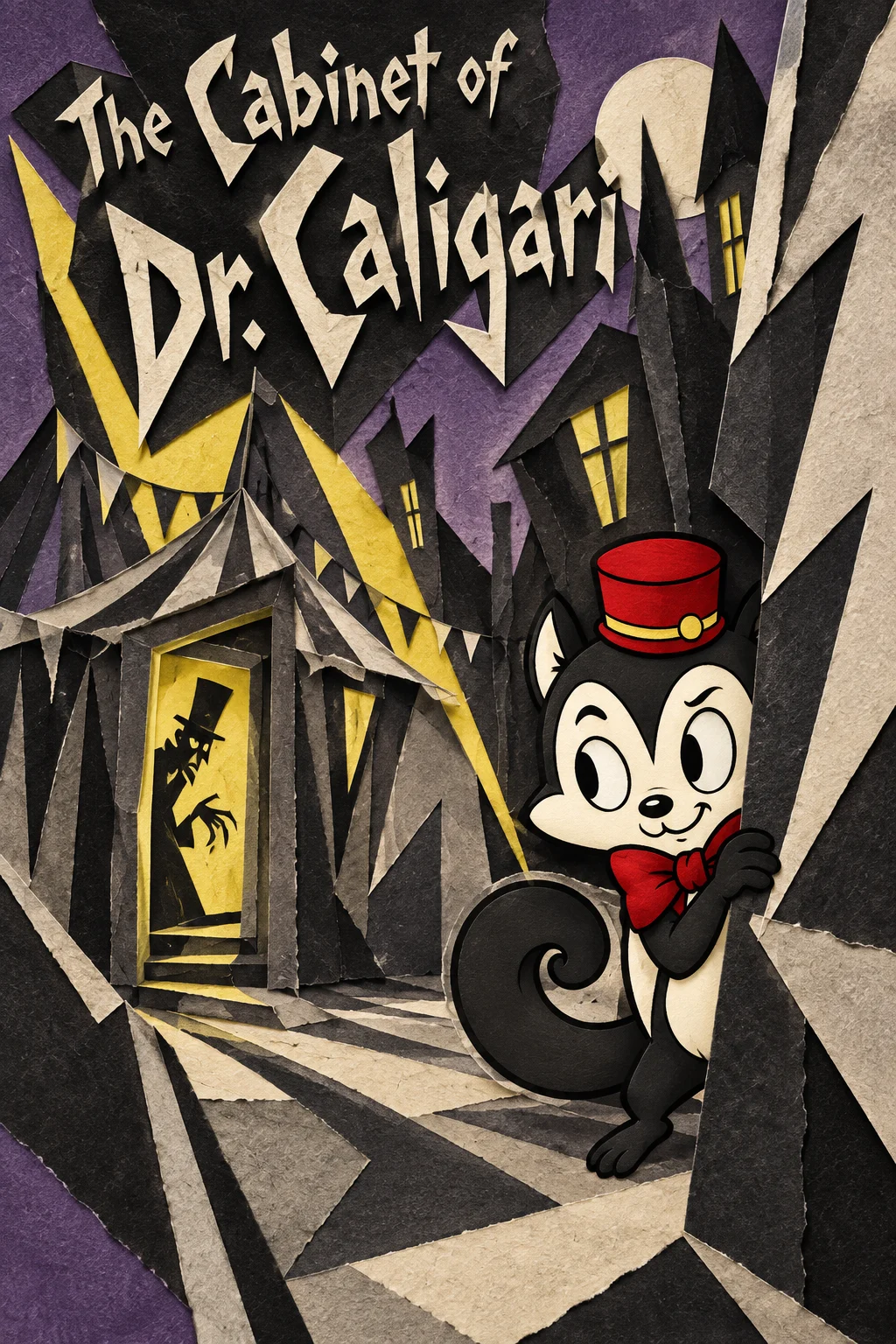
A doorway does not usually tell you how to feel about entering a room. In German Expressionist cinema, it may try.
German Expressionism is an artistic approach associated in film with the stylised German silent cinema of the 1920s. It presents the external world through inner feeling. Distorted buildings, strong shadows and arrangements of people can give unease a visible form. Expressionism had also developed in painting, literature and theatre. In cinema, sets, lighting, performance and composition work together to shape the image.[1][3]
The name is useful, but it is not a label for every German film of the period. Even films commonly discussed together can use very different means. The clearest starting point is a small town whose builders appear to have had objections to right angles.
Caligari: an environment with a performance of its own
Robert Wiene’s The Cabinet of Dr. Caligari (1920) is the conspicuous example. Its painted settings turn streets and rooms into a world of sharp, skewed forms. Hermann Warm, Walter Reimann and Walter Röhrig designed the sets.[2] BFI critic Alex Barrett describes how the performers’ movements join the designs to make geometric patterns.[3]
That relationship matters more than the simple fact that the scenery looks strange. In a naturalistic setting, we may treat a room as a container for the important event: two people speaking, arriving or leaving. Here, the surrounding shapes demand to be read along with the people. A figure and the space around it can belong to the same graphic arrangement.
Watch a body in relation to a diagonal. Does it continue the line, resist it or appear pinned between competing directions? These are ways to look at the design, not clues with fixed translations. One slanted wall does not mean one particular emotion.
The artificial shapes and pronounced gestures work together. A performance that departs from everyday movement can become part of the composition against a sharply distorted background. Measuring the scenery and acting only against a naturalistic town and naturalistic behaviour would miss that relationship.
The crowd can become part of the design
The vocabulary also extends beyond crooked buildings. In Fritz Lang’s Metropolis (1927), the workers’ coordinated, mechanical movement makes groups of people part of the visual design. Pamela Hutchinson identifies this as one of the film’s expressionist elements, alongside a mixture of Gothic and futuristic styles.[1]
The useful word is mixture. Calling Metropolis expressionist does not require every building, scene and gesture to belong to one pure school. Different forms can coexist within the same film.
Here, a group has a shape and a tempo. Watching its arrangement offers something different from selecting a single face and following that person’s story. How much room is there for an individual movement within a pattern? Does the eye register people first, or the organised mass they form? These questions begin in the image itself. They need no inventory of every symbol the film might contain.
A real landscape complicates the label
F. W. Murnau’s Nosferatu (1922) makes an instructive comparison because it uses real landscapes and streets extensively.[1] It does not need to rebuild the whole world in the manner of Caligari.
The difference has prompted critical disagreement about how expressionist Murnau’s work really is. In a 1967 essay, republished by Sight and Sound, Gilberto Perez Guillermo emphasises the film’s natural settings and argues against making conventional Expressionism the master explanation for it.[4]
That disagreement is worth keeping. A category should help us see a film’s choices, rather than demand that we overlook inconvenient ones. An impossible painted street announces that its world has been remade. A recognisable landscape can be unsettling in another way: the world keeps its ordinary appearance, while the story changes our expectations of what may happen there.
The two approaches offer different visual pleasures. One makes construction conspicuous; the other allows familiar places to acquire an unfamiliar charge. We lose something if both become merely “old films with shadows”.
Let the shapes remain shapes
Expressionist devices travelled beyond their original setting, including into film noir.[2] Influence does not make the terms interchangeable. A later crime film can use forceful contrasts without becoming a German Expressionist silent, just as a 1920s film can combine expressionist elements with other styles.
For an introduction, Caligari makes the relationship between scenery and performance unusually easy to notice. Resist the urge to decode every corner immediately. Follow a line from the setting to the person standing beside it. Notice when a still figure completes the picture, or when movement interrupts its arrangement.
One practical note before choosing a copy: the 2014 restoration of Caligari restores its colour toning. [2] These visual choices are worth following in tinted editions too.
For help choosing a copy, see our separate Metropolis restoration guide and Nosferatu version guide.
References & Further Reading
- Pamela Hutchinson and Alex Barrett. “10 great German expressionist films.” BFI, 8 June 2017. Introduction and selected film entries.
- Deutsche Kinemathek – Museum for Film and Television. Be Caligari! – The Virtual Cabinet. Exhibition press folder, 2020, pp. 4–6.
- Alex Barrett. “100 years of The Cabinet of Dr. Caligari: why we’re still living in its shadows.” BFI, 25 February 2020.
- Gilberto Perez Guillermo. “Shadow and substance: F. W. Murnau’s Nosferatu.” Sight and Sound, Summer 1967; republished online by BFI, 4 March 2022.
For the next unexpected question, follow the Journal in your RSS reader.
On screen
Films discussed
- The Cabinet of Dr. Caligari (1920) · Robert Wiene
- Metropolis (1927) · Fritz Lang
- Nosferatu (1922) · F. W. Murnau
Further reading
Read next in the Journal


Want a recommendation shaped around your evening? Ask Momo what to watch next →