One-evening watchlist
15 Best Classic Films Under 90 Minutes
Find classic black-and-white movies under 90 minutes: 15 picks from 45 to 88 minutes, sorted by time, mood, and silent or dialogue-led storytelling.
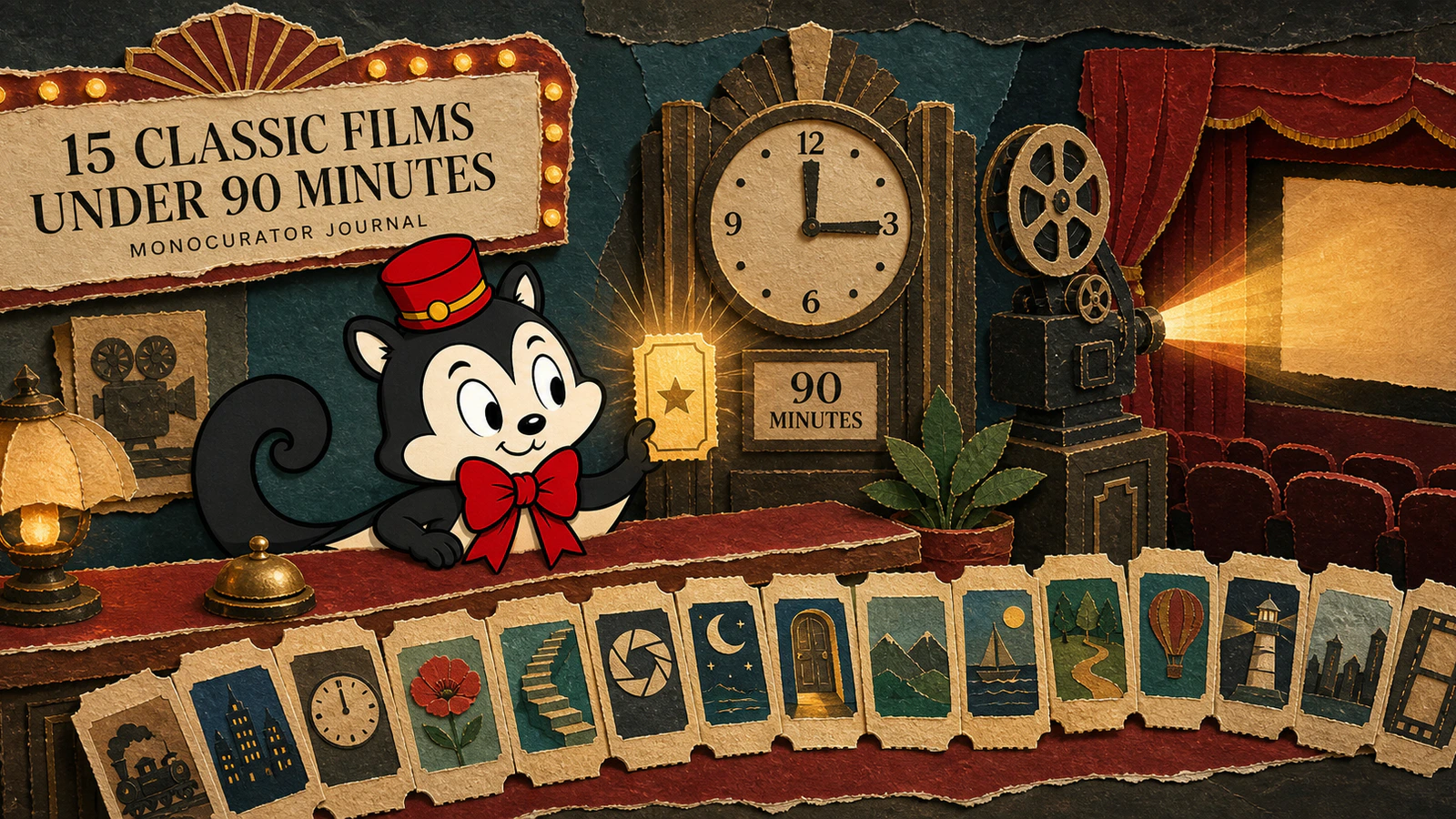
The shortest answer: start with Sherlock Jr. if you have less than an hour, Duck Soup for comedy, Frankenstein for horror, or High Noon for suspense. Every recommendation below is under 90 minutes in the presentation identified here.
Classic black-and-white cinema does not have to consume an afternoon. Some of its best doorways are shorter than a modern streaming episode plus a scroll through the menu.
Every selected presentation here runs under 90 minutes. The list moves from 45 to 88, but runtime is only the first filter. Use the mood notes to choose the evening you actually want: funny, thrilling, strange, romantic, or dark.
If you want a classic movie around 90 minutes, jump to the final five: High Noon, City Lights, Modern Times, Paths of Glory, and Rashomon all run 85–88 minutes in the presentations listed here. For a shorter evening, start with the under-60-minute choices or choose a film in the 60–75 or 76–84 minute groups below.
Prefer to browse the catalogue before choosing? Open every current Monocurator Film guide under 90 minutes, ordered from shortest to longest. This Journal list remains the smaller editorial route: it explains why each choice fits a particular evening.
Compare all 15 films
These figures were checked against institutional catalogues or official restoration and distribution records on 27 August 2026. A runtime belongs to a particular release, restoration or screening presentation—not to a title in the abstract. This matters most for silent films, where projection speed, intertitles, score and surviving material can change the total.
| Film | Year | Minutes | Mood | Ease |
|---|---|---|---|---|
| Sherlock Jr. | 1924 | 45 [1] | Funny / beautiful | Easy |
| Safety Last! | 1923 | 64 [2] | Funny / tense | Easy |
| The Kid | 1921 | 68 [3] | Gentle / funny | Easy |
| Detour | 1945 | 69 [4] | Bleak / strange | Easy |
| Duck Soup | 1933 | 70 [5] | Funny / strange | Easy |
| Frankenstein | 1931 | 70 [6] | Strange / bleak | Easy |
| The Set-Up | 1949 | 72 [7] | Tense / bleak | Moderate |
| The Cabinet of Dr. Caligari | 1920 | 77 [8] | Strange / mystery | Moderate |
| The General | 1926 | 78 [9] | Funny | Easy |
| The Passion of Joan of Arc | 1928 | 81 [10] | Bleak / beautiful | For patient viewers |
| High Noon | 1952 | 85 [11] | Tense / bleak | Easy |
| City Lights | 1931 | 87 [12] | Romantic / gentle | Easy |
| Modern Times | 1936 | 87 [13] | Funny / gentle | Easy |
| Paths of Glory | 1957 | 88 [14] | Bleak / tense | Moderate |
| Rashomon | 1950 | 88 [15] | Mystery / tense | Moderate |
Pick by the time you have
Under 60 minutes
Silent: Sherlock Jr. (45 min). Another option is The Kid in Criterion’s 53-minute 1972 re-release version. That is a different presentation from the 68-minute DCP used in the main list. [3]
60–75 minutes
Silent: Safety Last! (64 min) or The Kid (68 min).
Dialogue-led: Detour (69 min), Duck Soup (70 min), Frankenstein (70 min), or The Set-Up (72 min).
76–84 minutes
Silent: The Cabinet of Dr. Caligari (77 min), The General (78 min), or The Passion of Joan of Arc (81 min).
85–88 minutes
Mostly visual: City Lights or Modern Times (87 min each).
Dialogue-led: High Noon (85 min), Paths of Glory, or Rashomon (88 min each).
Silent films are usually presented with musical accompaniment. City Lights and Modern Times tell their stories chiefly through movement, while also using music, sound effects, and selected vocal sounds.
Five runtimes worth checking before you press play
| Film | Under-90 presentation used here | Another authoritative listing |
|---|---|---|
| The Kid | 68 min — a 2025 Cinémathèque française DCP screening | Criterion’s 1972 re-release version is 53 min [3] |
| Frankenstein | 70 min — AFI’s original-release record | AFI also records a 72-minute restored video version that included three reportedly lost or deleted segments [6] |
| The General | 78 min — the selected National Gallery of Art DCP | BFI records list 79 min and 90 min presentations [9] |
| The Passion of Joan of Arc | 81 min — Criterion’s Gaumont restoration at 24 fps | A Eureka edition sold by the BFI Shop includes 20 fps and 24 fps presentations; the product listing gives 97 min [10] |
| City Lights | 87 min — AFI’s 1931 release record | Criterion lists its restoration at 86 min [12] |
If your disc or stream crosses the 90-minute line, check the edition and presentation before assuming the listing is wrong.
Sherlock Jr. — 45 minutes
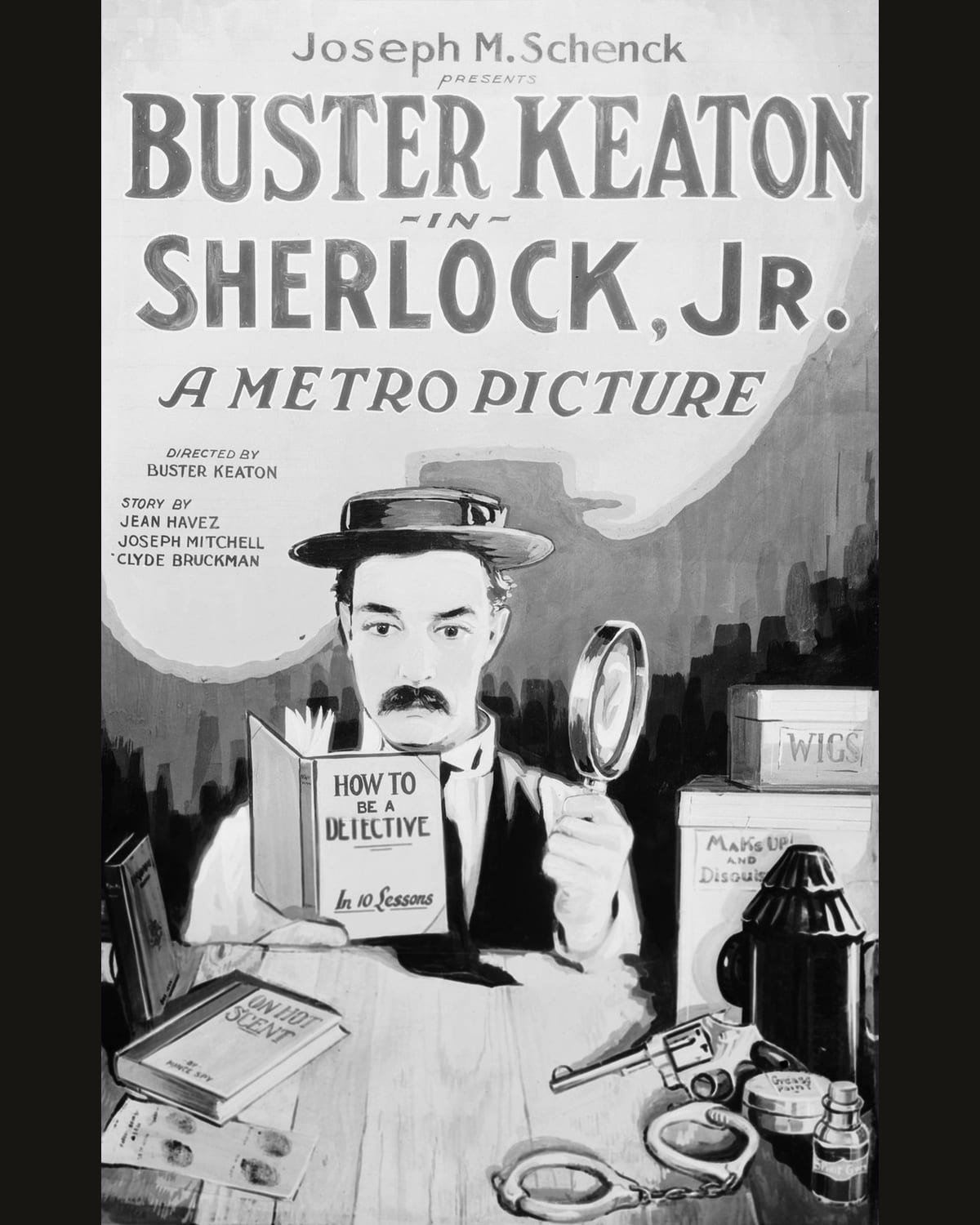
Sherlock Jr. (1924) is the cleanest answer to “I want to try a silent film, but not make a project of it.” Buster Keaton plays a projectionist who enters the world on screen, allowing editing, dreams, detective stories, and physical space to become parts of the same joke.
The film is fast, visually legible, and astonishing without asking you to admire it from a distance. Each gag is easy to read and then pushed one step beyond what should be possible.
Choose it when: you have less than an hour, want to laugh, or need proof that silent cinema can move faster than you expect.
Want to keep going? Follow the six-film silent starter route from Sherlock Jr. through The General and Modern Times to Metropolis.
Safety Last! — 64 minutes
Safety Last! (1923) turns a modern city into a comic machine of jobs, crowds, deadlines, money, and vertical ambition. Harold Lloyd’s climb up a building is famous, but the danger works because the first half builds a precise chain of practical problems leading to it.
The effects use camera position and real physical performance, so the height can feel unusually immediate even now.
Choose it when: you want comedy with action-film suspense.
Heads-up: prolonged peril at extreme heights and dangerous stunts.
The Kid — 68 minutes
The Kid (1921) joins Charlie Chaplin’s physical comedy to a story of an improvised family. The Tramp and an abandoned boy build a life from small routines and schemes; every joke also reveals how well they understand and protect each other.
The feeling is direct without replacing the comedy. Chaplin and Jackie Coogan remain equal partners in the film’s movement, mischief, and eventual fear of separation.
Choose it when: you want warmth, laughter, and the possibility of crying before the 70-minute mark.
Version note: this guide uses a 68-minute DCP presentation screened by La Cinémathèque française in 2025. Criterion’s 1972 re-release version runs 53 minutes. Both numbers identify a presentation; neither should be silently applied to every copy. [3]
Detour — 69 minutes
Detour (1945) strips film noir down to a road, a few rooms, and a narrator whose story never feels entirely trustworthy. Its small budget becomes part of the mood. Anonymous spaces and artificial roads make the journey feel like a memory being repeated badly.
The film wastes no time creating the sensation that fate has closed in. The useful question is whether fate did all the work the narrator claims.
Choose it when: you want something dark, fast, and sour enough to linger.
Heads-up: coercion, violence between partners, accidental death, and a bleak tone.
Duck Soup — 70 minutes
Duck Soup (1933) treats government as entrances, costumes, insults, songs, and escalating retaliation. Groucho, Chico, Harpo, and Zeppo Marx move faster than the plot needs to, which is exactly the point. Diplomacy and war both collapse into performance.
You will miss a line. Another gag will already have arrived, so it does not matter. The film’s speed is more welcoming once you stop trying to catch everything.
Choose it when: you want maximum joke density and minimum solemnity.
Heads-up: war satire, slapstick violence, gunfire, and dated stereotypes.
Frankenstein — 70 minutes
Frankenstein (1931) moves from graveyard to laboratory to tragedy in barely more than an hour. James Whale’s film created images that have been repeated for generations, but Boris Karloff’s Monster is more than an icon. His hands, pauses, fear of light, and response to cruelty keep complicating the boundary between creator and creation.
The theatrical acting and sudden transitions belong to early sound cinema’s texture. The speed makes the film a particularly easy first doorway into Universal horror.
Version note: AFI records the original release at 70 minutes. Its catalogue also notes a 72-minute restored video version that included three reportedly lost or deleted segments. [6]
Choose it when: you want a familiar monster to become strange and sad again.
Heads-up: grave robbing, medical horror, child death, strangulation, mob violence, and fire.
The Set-Up — 72 minutes
The Set-Up (1949) uses one boxing arena and a tight span of time to make a single match feel like an entire moral world. A fighter’s persistence meets the private calculations of managers, gamblers, and spectators, each watching for a different reason.
You do not need to understand boxing strategy. Watch the crowd. Their appetite changes the meaning of each blow while the fighter knows less than almost everyone around him.
Choose it when: you want compact film noir pressure and a sports film without uplift pasted over it.
Heads-up: sustained boxing violence, serious injury, criminal coercion, and a brutal assault.
The Cabinet of Dr. Caligari — 77 minutes
The Cabinet of Dr. Caligari (1920) places murder and control inside a town of crooked streets, painted shadows, and sharp angles. It does not hide the artificial set; it uses design to make reality itself feel untrustworthy.
Approach it as a nightmare staged in a small theatre. The exaggerated acting, scenery, and framing belong to one visual language.
Choose it when: you want the strangest-looking film available in under 80 minutes.
Heads-up: murder, abduction, mind control, confinement, and dated depictions of mental illness.
The General — 78 minutes
The General (1926) builds comedy from physical logic. A train moves, a problem appears, and Buster Keaton solves it with an idea that creates the next, larger problem. His calm expression makes the machinery and chaos around him funnier.
The chase remains easy to follow because every gag grows from space, timing, and the railway line itself. Track the locomotive, the line, and who currently controls each; the action will do the rest.
Version note: the 78-minute figure identifies the National Gallery of Art DCP selected for this guide. BFI records also list presentations at 79 and 90 minutes. [9]
Choose it when: you want a silent action comedy whose practical scale still looks impossible.
Heads-up: wartime violence and a Confederate hero whose cause is presented without examining the slavery behind it.
The Passion of Joan of Arc — 81 minutes
The Passion of Joan of Arc (1928) removes the pageantry that can make a historical epic feel remote. Carl Theodor Dreyer gives us faces instead: Joan holding to her certainty, judges searching for weakness, and onlookers registering fear or fascination.
Extreme close-ups make the space difficult to map and deny the comfort of observing from a safe distance. Renée Falconetti’s smallest changes become enormous on screen.
Choose it when: you want something emotionally intense, austere, and visually unlike almost anything else.
How to ease in: do not try to identify every judge or reconstruct the courtroom. Follow the direction of looks and the rhythm between questions and answers.
Version note: Criterion’s 81-minute presentation uses the Gaumont restoration at 24 frames per second. A Eureka edition sold by the BFI Shop includes both 20 fps and 24 fps presentations; the product listing gives 97 minutes. Presentation details matter before treating either number as universal. [10]
Heads-up: religious persecution, threats of torture, bloodletting, execution by burning, and crowd violence.
Classic films around 90 minutes
High Noon — 85 minutes
High Noon (1952) compresses a western into an approaching deadline. As Marshal Will Kane looks for help before an outlaw arrives by train, gratitude and public principle dissolve into fear, self-interest, and refusal.
Clocks, repeated visits, and emptying streets create more suspense than the brief final gunfight. The central action is not marksmanship. It is watching a community decide what risk it will leave to one person.
Choose it when: you want a clean, nearly real-time countdown.
Heads-up: gun violence, death, abandonment, racial prejudice, and sustained anxiety.
City Lights — 87 minutes
City Lights (1931) arrived after talking pictures had changed Hollywood, but Chaplin kept visual storytelling at its centre. The Tramp’s devotion to a blind flower seller moves through mistaken identity, unstable friendship, street comedy, and a boxing match.
Its final encounter is celebrated because recognition passes through gesture and touch rather than explanation. Few films make comedy and moral attention feel so inseparable.
Version note: AFI records the 1931 release at 87 minutes; Criterion lists its restored presentation at 86 minutes. The one-minute difference is a catalogue distinction, not evidence of a different story. [12]
Choose it when: you want romance, physical comedy, and an ending that may undo you.
Modern Times — 87 minutes
Modern Times (1936) turns assembly lines, workplace surveillance, unemployment, and hunger into comedy without losing sight of the people inside them. Chaplin stands between silent cinema and the sound era, using movement, music, and a few carefully chosen voices as parts of the joke.
The film moves in clear episodes. Each workplace or scrape is a fresh start, connected by the Tramp’s gentleness and his hope for something as small as a meal, a home, and a person to walk beside.
Choose it when: you want comedy with social anger and a warm human scale.
Paths of Glory — 88 minutes
Paths of Glory (1957) moves from the geometric horror of trench warfare to the polished injustice of military command. Stanley Kubrick uses cramped trenches and enormous formal rooms to show who bears risk and who controls the story told about it.
The legal proceeding is not a puzzle waiting for a clever solution. Its foregone conclusion is the point. Watch the rituals used to make institutional self-protection appear orderly.
Choose it when: you want a concise film with no wasted motion and no easy comfort.
Heads-up: battlefield deaths, executions, military abuse, and intense institutional injustice.
Rashomon — 88 minutes
Rashomon (1950) revisits one violent event through accounts that overlap, contradict, and reshape one another. The question is not only what happened. It is how pride, fear, and desire enter every act of remembering.
The structure is intellectually rich, but the film moves with physical energy through rain, forest light, forceful performances, and a mystery established almost immediately.
Choose it when: you want the shortest route here to a film that can occupy the whole conversation afterward.
If it becomes your doorway, follow a five-film Akira Kurosawa route next.
Heads-up: sexual assault, violence, death, victim-blaming, and conflicting accounts of trauma.
A short film is not a lesser commitment to cinema. It is simply a door that fits tonight.
If runtime is not the question you want to answer, start with eight approachable black-and-white films arranged by mood instead.
References
- Sherlock Jr., British Film Institute film record (accessed 27 August 2026).
- Safety Last!, AFI Catalog of Feature Films (accessed 27 August 2026).
- Le Kid, 68-minute DCP screening, La Cinémathèque française; The Kid, 1972 re-release version, The Criterion Collection (both accessed 27 August 2026).
- Detour, The Criterion Collection (accessed 27 August 2026).
- Duck Soup, British Film Institute film record (accessed 27 August 2026).
- Frankenstein, AFI Catalog of Feature Films, including its note on the restored segments and runtime (accessed 27 August 2026).
- The Set-Up, AFI Catalog of Feature Films (accessed 27 August 2026).
- Das Cabinet des Dr. Caligari, 2014 restoration, 77:09 DCP, Friedrich-Wilhelm-Murnau-Stiftung silent-film DCP catalogue, January 2026 (accessed 27 August 2026).
- The General, 78-minute DCP, National Gallery of Art; 79-minute BFI Player record; 90-minute BFI film record (all accessed 27 August 2026).
- The Passion of Joan of Arc, 24 fps presentation, The Criterion Collection; Eureka edition with 20 fps and 24 fps presentations, BFI Shop (both accessed 27 August 2026).
- High Noon, British Film Institute film record (accessed 27 August 2026).
- City Lights, 1931 release record, AFI Catalog of Feature Films; restored presentation, The Criterion Collection (both accessed 27 August 2026).
- Modern Times, AFI Catalog of Feature Films (accessed 27 August 2026).
- Paths of Glory, The Criterion Collection (accessed 27 August 2026).
- Rashomon, The Criterion Collection (accessed 27 August 2026).
If this guide helped you choose tonight’s film, you can support Monocurator. Support Monocurator →
Continue exploring on Monocurator
Want a recommendation shaped around your evening? Ask Momo what to watch next →